6,000 Trustpilot Reviews Milestone

Trust Deed Scotland® have more 5 Star TrustPilot reviews than all other Trust Deed providers combined. As a leading Scottish debt solutions provider, we’ve always been proud of our customer feedback, therefore this has been an important week for us as we’ve reached an important milestone of 6,000 Trustpilot reviews. Trust Deed Scotland® was founded in 2009 with the goal of becoming the best rated debt solutions company in Scotland, with a philosophy of putting our customers’ best interests at heart and helping them to truly realise their potential to achieve life after debt. We’ve helped over [volume] people in Scotland by giving them tailored Scottish debt advice. Not only do we have an excellent Trustpilot rating, but our numbers stack up too. 98.5% of our proposed Trust Deeds gain protection status making us No.1 in 2021¹ 99.9% of our proposed Debt Payment Programmes (DPPs) under the Debt Arrangement Scheme are approved by creditors²
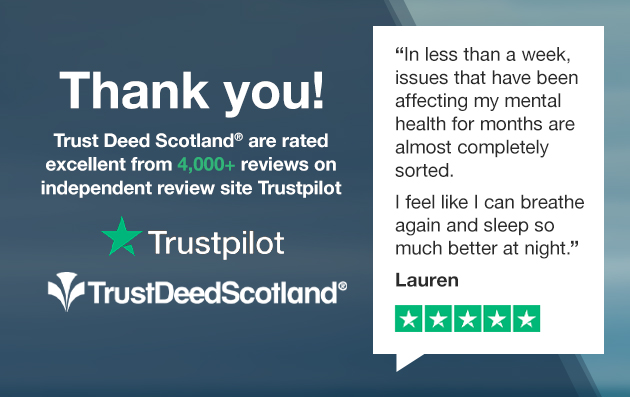
Of our most recent debt advice reviews, Gordon, reviewing the service received from our experienced debt adviser Danielle, said: “The service I have received from Trust Deed Scotland has been second to none. I have been struggling with debt for years and they have helped me make the unaffordable payment affordable. Danielle has been an absolute star throughout the process – due to the hours I work, it was difficult to take phone calls to discuss and so she set everything up through emails correspondence. She was helpful and kind throughout, a real asset to the Trust Deed Scotland Team.”
Writing a review of her Debt Arrangement Scheme experience and Michael in our debt advice team, our customer Clare wrote: “The most incredible, empathetic, patient and understanding man made our experience so much easier to go through. Michael has wonderful customer communication skills. He explained everything several times as there is quite a lot to take in. It can be stressful and emotional going through debt problems and I have never dealt with someone who has so much, empathy and patience as Michael. He could answer every question I had immediately and having someone so professional and knowledgeable making our experience so much easier.”
Reviewing our debt adviser Anisah, our new customer Dan said: “It is incredibly embarrassing having to admit your problem(s) but the team at Trust Deed Scotland were excellent. I was comfortable talking to them, we discussed my situation and then I was walked through my options. They just provided the advice and let me make my own decisions while keeping me informed. Anything I didn’t understand they explained until I understood. I genuinely feel so less stressed knowing I have a plan in place to clear my debts while having an amazing team behind me to support me.”

What did our 6,000th reviewer say of their Trust Deed Scotland® Experience?

Our 6,000th reviewer, PB wrote a short review about his Trust Deed Scotland® experience saying: “Such a helpful experience, Vicky was more than helpful, so friendly and showed compassion and helpfulness through the full experience. Got a fresh start at a debt free life now couldn’t be more grateful!”  

Why does getting good debt advice matter?

At Trust Deed Scotland® we invest much time and effort into our own training and compliance in order to constantly evolve and enhance our customers’ experience. TrustPilot feedback and customer feedback surveys help us to drive improvements too. It’s another reason why our reviews matter to us. Our tailored debt advice is: Non-Judgemental – We’re here to listen and advise. Not to judge you. We can promise you that you’re not alone in developing problem debt. There are many changes in personal circumstances that create the situation. Redundancy, divorce, illness and simply overcommitment. Problem debt can happen to anyone, but if it does happen to you, we can help you move on. Confidential – We’ll always respect your privacy and will not divulge your situation to anyone. Safe & Secure – Our advice team are based exclusively in-house and regardless of whether you choose to proceed with us or not, we’ll never share your details with any other company. We will never attempt to push you into a solution, you’ll always be the one that makes the decision in your own time, on your own terms. Balanced – We’re here to give you the risks and benefits of all formal Scottish debt solutions. This helps you to understand what your options are and how they will impact your day-to-day life. You will be the one that makes the decision. Experienced – Not only are we authorised to give debt advice, but our team are vastly experienced, with knowledge of the inner workings of formal Scottish debt solutions legislation.

Get help with your debt today

You can contact Trust Deed Scotland® today for tailored, confidential debt advice on 0141 221 0999. Alternatively, start the process online and find out what options you might be eligible for by trying our Trust Deed Wizard tool.
In 2021, we achieved a protection rate of 98.5%, this made us the best performing volume provider of Protected Trust Deeds in Scotland. Trust Deeds advertised between 01/01/21 and 31/12/21. ²In this sample of 1,144 Debt Payment Programmes (DPPs) under the Debt Arrangement Scheme (DAS), approved between July 2019 and October 2021, only 1 proposed DPP was rejected and unable to proceed.

Debt Awareness Week 2021

Debt Awareness Week 2021 in the UK takes place between 22-28 March this year. Spearheaded by Stepchange debt charity and championed by other prominent debt charities including the National Debtline, and supported by leading Scottish debt advice companies such as Trust Deed Scotland, the annual Debt Awareness Week event serves as an opportunity for a coordinated push by all debt advisory services to work together and help people struggling with unaffordable debt. StepChange is a registered UK Charity with a head office in Leeds, Yorkshire and is funded mostly by voluntary donations from creditors, and works with over 900 partner organisations. The theme of Debt Awareness Week 2021 is all about destigmatising debt. It’s about empowering people to feel confident about asking for the help they need and easing any worries they may have about being judged or feeling ashamed or embarrassed. For many households across Scotland, unaffordable debt is an everyday unavoidable fact of life but asking for help can feel daunting, something which Trust Deed Scotland understands well. Every week, Trust Deed Scotland receives new reviews from customers who in their own words tell us that they find our experienced debt advice team to be friendly and non-judgemental and that once they’ve spoken to our advisors, that their fears of being judged, ashamed or embarrassed are lifted. A number of people say that once they do ask for help, they can then begin to sleep again at night, or that their mental health improves significantly. Recently 55% of young Scots said that they were losing sleep over debt and there are already many established links between debt and mental health. Many of the people that we speak to on a day-to-day basis say that they contacted us after a referral from a friend, family member or work colleague. This greatly pleases us because not only does it show that our customers are happy with the outcome of their advice they received and the formal debt solution put in place for them, but it shows that people are more willing to open up about their personal finances to those around them. Challenging the stigma around debt. And, as the country continues to recover from the Coronavirus pandemic, many more people are now having to deal with their debt as a consequence. The theme of Debt Awareness Week 2021 continues with the hashtag #TheFirstStep and we’ve included some recent reviews received by our customers who themselves have recently taken their own first steps in their own journey. Trust Deed Scotland recently helped set up a Protected Trust Deed for our customer Shelley, who left a review saying: “Excellent service from the start. It took me a long time to make that call about my debt. I was embarrassed and feared been judged but it was completely the opposite I was treated with respect Sharon was absolutely lovely, welcoming, and most of all understanding she helped me enormously and can not speak highly enough of her service. I would 100% recommend Trust Deed Scotland if your struggling with debt please make that call.” title underlines Gordon, another customer who has entered into a Protected Trust Deed said of his Trust Deed Scotland experience: “Vicky was immensely helpful and easy to talk to about the very delicate situation of my debt. All anxiety was lifted with such fast and helpful guidance. Will definitely refer anybody I know struggling with debt to this program. Thank you very much. It’s greatly appreciated.” title underlines Earlier in the month, Trust Deed Scotland set up a Debt Payment Programme (DPP) under the Debt Arrangement Scheme (DAS) for our customer Erin who said: “After stressing for too long over my debts and feeling really embarrassed to ask for help, Pamela from Trust deed Scotland was extremely helpful and I didn’t feel judged at all, I felt so comfortable talking with her on the phone and she made me feel so at ease with the procedure. I can now say I’m so glad I went to Trust Deed Scotland as a weight has been lifted off my shoulders!” title underlines Robert, a self-employed customer who Trust Deed Scotland helped with a Protected Trust Deed said: “This difficult decision to address my debt problems was made significantly easier by the friendly and non-judgmental advice and help from all the staff especially my main advisor Joe at Trust Deed Scotland. Within the space of a month, I had been helped through what had always appeared as a terrifying financial minefield into which I hadn’t dared step, only for it to be revealed as a solvable problem. I can only urge anyone in my previous position to grasp the nettle and let Trust Deed Scotland help you.” title underlines Angela, a customer who Trust Deed Scotland helped with a Trust Deed proposal said: “I cannot thank Soreena enough for her patience and most importantly her complete understanding of my personal circumstances. The weight and total burden seemed to be lifted almost immediately after our initial conversation which was worth its weight in gold. With ease and comfort, the process was explained fully and my understanding checked at each step of the way. My needs and my individual concerns were paramount and taken into consideration with all decisions. Nothing at all, no question, no text nor no email was ever a problem for Soreena and I was treated with dignity and respect throughout. I now look forward to a sunnier future and leaving my troubles behind me.” Angela applied for a Trust Deed alongside her husband who made an application for a DPP as part of the Debt Arrangement Scheme showing that there really is no one-size-fits-all solution for our customers, with each customer’s individual circumstances, needs and affordability being the utmost priority at all times. title underlines With over [reviews] Trust Deed Scotland reviews you can read more reviews like these, written in our customers’ own words.

Take the first step on your journey to a brighter future today

  If you are struggling with unaffordable debt and you want to find out your options, you can contact Trust Deed Scotland today on 0141 221 0999. We offer tailored debt advice. We do not judge and we’ll treat any information that you share with us confidentially so, you don’t even need to commit to taking the first step today.

Fuel Poverty In Scotland Increasing

Families across Scotland are having to choose between heating and eating, Energy Action Scotland reveals in a new fuel poverty awareness campaign. Energy Action Scotland was established in 1983, EAS seeks to develop and promote effective solutions to the problem of cold, damp and expensive to heat homes. Frazer Scott of the Glasgow-based charity reported to STV News that local food banks were reporting food banks asking for ‘cold packs’. Cold packs are parcels that can be eaten without the need of heat, suggesting that those families can no longer afford to oven cook or microwave meals. Frazer said “Right now, 600,000 households in Scotland live in cold and damp homes and it isn’t fair that more than 25 per cent of all Scottish households have to make choices every single day between heating or eating. More has to be done for households with all-electric homes. They on average pay £600 more than a house in Scotland which has gas and electricity to live a similar life. We need to get a balance of benefits and support in place to help lift them out of fuel poverty. Fuel poverty kills six a day in winter – that’s a disgrace” The group have been actively delivering lower-energy pressure cookers to housing associations, an incentive that can save as much as 70% off typical cooking bills, and recently teamed up with celebrity Masterchef Gary Maclean to promote a campaign to distribute more pressure cookers to those most in need. UK households are deemed to be living in fuel poverty if the home has a fuel poverty energy efficiency rating of band D or below or if, when they spend the required amount to heat their home, they are left with a residual income below the official poverty line. The official poverty line is when households’ income is 60 per cent below the median household income after housing costs for that year.

Fuel Poverty in Scotland Statistics

Fuel poverty is not a recent symptom of the financial impact of the Coronavirus pandemic, although the numbers of people affected by fuel poverty have undoubtedly grown as families struggle to make ends eat while one or both parents are unemployed, or are furloughed. A 2019 Scottish Government commissioned survey found that 613,000 households were living in fuel poverty, 311,000 of those were classified as having extreme fuel poverty. In July 2020, the UK-wide End Fuel Poverty Coalition predicted that as the numbers in fuel poverty soared, a second wave striking during colder weather could be catastrophic for individuals and health services. Earlier in 2021, the Resolution Foundation reported that many homes across the UK had fallen behind on their rent and mortgage payments. As a result of people being made redundant during the pandemic, or furloughed as part of the Job Retention Scheme, many people are falling into a cycle of debt where they are using credit to fund general living expenses, including priority bills such as council tax but with limited funds available, this often means that something needs to give. Increasing the likeliness of fuel poverty, or food poverty. Food poverty rates in the UK are amongst the highest in Europe reported the Big Issue earlier this month. Research into food poverty by the University of West Scotland found that the Coronavirus pandemic has aggregated food insecurity. Their report entitled ‘food insecurity in times of Covid-19‘ found that Food insecurity across the UK had been on the rise before the Coronavirus pandemic and that is was clear that the pandemic itself led to a further rise. Food insecurity is a wider term used to describe food poverty and varies in levels from mild food insecurity; worrying about the ability to obtain food to severe food insecurity; experiencing hunger.

Help With Unaffordable Debts in Scotland

If you’re worried about your finances and would like to take control of your unaffordable debt, you can contact Trust Deed Scotland on 0141 221 0999, or complete our Trust Deed Wizard tool for more information. As a leading provider of formal Scottish debt solutions including Trust Deeds, and the Debt Arrangement Scheme, our experienced debt advice team are able to work with you and offer tailored debt advice that puts you at the heart of the decision-making process.

25% Of Scots Wait 3 Years Before Seeking Debt Help

Christians Against Poverty Scotland have released a new report that shows that 25% of the people that they helped in Scotland waited between one and two years before seeking help with their debts, and a further 25% waited three years or more before seeking help. Worryingly, 45% said that they did not know where to get help. CAP Scotland is a national charity that works with 715 affiliate churches, looking to help the vulnerable people out of poverty, UK-wide.
  • 12% Didn’t wait to seek help.
  • 27% Waited less than one year.
  • 25% Waited 1-2 years.
  • 25% Waited 3 years or more.
  • 11% Unknown
A rise in non-priority debt e.g. credit cards, personal loans and catalogue debts, saw the average debt level in Scotland increase to £17,917, of which £12,065 was identified as being non-priority debt. On average, CAP Scotland clients have 9 non-priority debts and the most common types of non-priority debts their clients reported were personal loan (69%), credit card debts (63%), mobile phone debt (46%), overdraft debt (38%) and catalogue debt (34%). In terms of priority debts, council tax arrears (40%), rent arrears (10%), energy arrears (9%) and mortgage arrears were the common types of debt that their clients sought help for. Low income, mental ill-health, relationship breakdown, long-term illness and unemployment were identified as the most common reasons that caused a debt crisis for their clients. 71% said that debt impacted their relationship, with 19% citing debt stress as the reason for a relationship breakdown. 44% are unable to afford adequate clothing 37% sacrificed meals 37% went without heating 31% are unable to afford basic toiletries 28% said they had considered or attempted suicide as a way out of debt. 20% were unable to afford to light their home. Speaking on the finding of the CAP Scotland report, Gareth McNab, Director of External Affairs said: “The full effects of the global pandemic will not be felt for some time; we know that one in four (25%) CAP clients wait over three years before seeking debt help. The debt advice industry is anticipating rising numbers in need of debt advice. More must be done to reach and help households struggling. Joined-up working is needed more than ever, forming partnerships to combat the financial fallout of the pandemic. Yet we cannot forget that even before COVID-19, households were struggling and, without change, people will still struggle in the future. Unless we do something about it” You can read the CAP Scotland 2021 client report.
As a leading Scottish debt advice company, having helped thousands of people with their unaffordable debt, Trust Deed Scotland® have received over [reviews] reviews on Trustpilot where many people tell us things like “I wish I got help sooner” or “I can sleep again at night, now that my debt is under control again.” The fear of being judged, or feeling ashamed or embarrassed about having debts are often spoken about by our clients in regards to reasons why they put off seeking debt help. In April 2021, Lauren said: “After being hesitant for a while to contact Trust Deed Scotland, I am so glad I did, as Pamela was so friendly, understanding and non-judgemental during the process. I would 100% recommend anyone struggling with financial difficulties to get in touch. I wish I had sooner.” Also speaking in April 2021, Louise said: “Called Trust Deed Scotland eventually after months of worrying about mounting debt and just wish I’d have done it sooner. Soreena dealt with my case and couldn’t have asked for anyone better than her. She listened and totally understood everything I said and never judged me at all. I can now look forward to receiving my wages every month, knowing that everything is going to be paid in one payment and might even have some left now.” Earlier in the year, in January 2021, Jamie said: “I couldn’t have been made to feel more comfortable, I was always quite ashamed to talk about my debt. Vicky made me feel completely at ease and made the whole process seem so simple.”

Help with unaffordable debt in Scotland

If you live in Scotland and you are struggling with your finances, you can find out more about your options by calling Trust Deed Scotland® on 0141 221 0999. Alternatively, you can also download our Scottish debt solutions guide. Our experienced team can give you confidential advice, that with help you understand the pros and cons of all formal debt solutions in Scotland such as Trust Deeds, the Debt Arrangement Scheme and other Scottish Debt Solutions. Once we know more about your situation, we are then able to give you tailored debt advice that fits your individual requirements.

4,000 Trustpilot Reviews Milestone

As a leading Scottish debt solutions provider, we’ve always been proud of our client feedback, therefore this week has been an important week for us as we’ve reached 4,000 Trustpilot reviews. Trust Deed Scotland® was founded in 2009 with a unique vision – to be the best-rated debt advice company in Scotland with a philosophy of putting our clients best interests at heart and helping them to truly realise a brighter future. We’ve helped over [volume] people in Scotland with formal debt solutions and given tailored Scottish debt advice to many more. We’ll never…
  • Cold call, or send unsolicited text messages
  • Charge for debt advice
  • Pass a clients details onto anyone else
Of our most recent debt advice reviews, one we received from a client in May 2021 helped to demonstrate how our message ‘If you do something about your debt today, you can stop worrying about it tomorrow’ really helps to empower people with problem debt to take action. Rory wrote: “My debt was something I was worried and shy about for years, I always tried to forget about it and say to myself I would deal with it in the future. I finally made the decision to contact Trust Deed Scotland and honestly it was the best decision I could have made. The service I received from Danielle was amazing, she made me feel comfortable to speak about my debt which I have never done with anyone. She was kind and very very helpful. Danielle has been an absolute credit to your company and I thank her so much for what she has done for me, as it is a huge weight off my shoulders which was draining me and affecting my lifestyle.”

What did our 4,000th reviewer say of their Trust Deed Scotland® Experience?

Our 4,000th reviewer  wrote about their Trust Deed Scotland® experience saying: “I had just had to use this service. I cannot express enough how stressed I have been. I was advised by Pamela, she has been simply outstanding. I felt no judgement at all, all options were explained fully so I could make an informed and realistic decision for my circumstances. The professionalism Pamela showed along with empathy and a very friendly approach makes her a credit to this company. If you are worried about finances I would urge you to give these a call 100%. There is nothing to lose and peace of mind to be gained.

Trust Deed Scotland® TrustScore of 5/5

Of the 4,000 reviews received, 98% rated us 5/5. Our overall TrustScore is 5/5. TrustScore is an overall measurement of reviewer satisfaction, based on all the Service and Location reviews a business receives on Trustpilot. A star rating is the TrustScore visualised. Learn about how TrustScore is calculated. Not only do we have a TrustScore of 5/5 but we’re the highest rated company in Scotland in the Trustpilot debt relief service category.  

What makes the perfect debt advisor?

At Trust Deed Scotland® we invest in our own training and compliance in order to constantly evolve and improve our internal processes. We make sure that any advisor that we employ has the right mix of experience and personality. Our tailored debt advice is: Non-Judgemental – We’re here to listen and advise. Not judge you. We can promise you that you’re not alone and that no one, including you, found themselves with unaffordable debts through their own deliberate fault. There are many changes in personal circumstance that create the situation. Redundancy, divorce, illness and simply overcommitment. It happens, and we help you to move on. Confidential – We’ll always respect your privacy and will not divulge your situation with anyone else unless given explicit permission to do so by you. Safe & Secure – Our advice team are based in-house and if you choose to proceed with us or not, we’ll never share your details with any other company. We will never attempt to push you into a solution, you’ll always be the one that makes the decision in your own time, on your own terms. Balanced – We’re here to give you the risks and benefits of all formal Scottish debt solutions. This helps you to understand what your options are how they will impact your day-to-day life. You will be the one that makes the decision. Experienced – Not only are we authorised to give debt advice, but our team are vastly experienced, with knowledge of the inner workings of formal Scottish debt solutions legislation.

Get help with your debt today

You can contact Trust Deed Scotland® today for tailored, confidential debt advice on 01412210999. Alternatively, start the process online and find out what options you might be eligible for by trying our Wizard tool.
5,000 Trust Deed Scotland TrustPilot reviews milestone 6,000 Trust Deed Scotland TrustPilot reviews milestone 7,000 Trust Deed Scotland TrustPilot reviews milestone 8,000 Trust Deed Scotland TrustPilot reviews milestone 9,000 Trust Deed Scotland TrustPilot reviews milestone 10,000 Trust Deed Scotland TrustPilot reviews milestone

Household Bills Arrears Increased During 2020

A new report published by a leading debt advice charity has shown an alarming increase in household bills in Scotland during 2020. The ‘Scotland in the Red‘ report published by Stepchange shows that at least 50% of their clients were behind on at least one utility bill. Household bills are generally classed as ‘priority debts’ and those types of debts should typically be paid ahead of ‘non-priority debts’ which tend to be credit card debts, unsecured loans and catalogue debts. However, the term non-priority is not intended to be implied that it is an unimportant debt that does not have to be dealt with. There are consequences for non-payment of any debt that you may owe.

Household Bills arrears broken down by type

Rent Arrears – The average arrears per Stepchange enquiry in 2020 was £1,230, a 43% increase from the previous year. Mortgage Arrears – The average arrears per client enquiry was £3,667, decreased from the previous year but largely impacted by the availability of payment breaks from lenders. Council Tax Arrears – An average of £1,975 per Stepchange enquiry and the most common individual household bill for their clients to be struggling to repay. Electricity Arrears £1,239 (36% increase from the previous year) and Gas Arrears £823 (29% increase from the previous year) Citizens Advice Scotland earlier in 2020 urged people struggling with council tax arrears debt to make use of the Scottish Government’s council tax reduction scheme. The Scotland in the Red report also highlighted other key information about their Scottish clients such as the age and gender breakdown of clients who approached them for help. 58% of their new clients identify as female, and the most typical age group of client they spoke to was between the 25-39 age bracket (43%), an increase of 35% but this is largely attributed to younger age groups being more directly affected by the financial impact of the Coronavirus pandemic. E.g. younger age groups tend to be employed more in the hospitality, leisure and non-essential retail sectors. Industries decimated by Coronavirus.

Average unsecured debt totals in Scotland

The reported average unsecured debt totals in Scotland rose from £11,712 in 2019 to £14,566 in 2020 which represents an increase of 24%. It has been widely reported that many individuals across the UK are using credit cards and loans to pay off debts included rent arrears and council tax debts, therefore these figures are expected to increase once again. Demand for debt advice in 2021 is expected to increase towards the end of the year, and with many payments breaks arrangements now ending, and with some now being replaced by tailored support, more people in Scotland may now be finding themselves with unaffordable ‘problem debt’ as a result. In conclusion to the Scotland in the red report, Stepchange asked for Scottish government support and stated: “Whilst forbearance has allowed some households to prepare for, or weather the financial storms, the income shocks sustained by thousands of households in recent months will leave many financially vulnerable for years to come, even if they are able initially to avoid immediate detriment. Supporting households in difficulty and preventing them from falling into difficulty in the first place, must be a primary focus for the new Scottish Government through the new parliamentary term.”

Help with unaffordable debts

If you are worried about potential enforcement action such as a visit from Sheriff Officers and wage arrestments over the non-payment of your household bills, including council tax arrears debt, call us on 0141 221 0999 and we will be able to find out more about your situation and offer advice on how to deal with your debts. For people struggling with either their household debts and their unaffordable unsecured debt, it is important to deal with problem debt as soon as possible. Trust Deed Scotland recently reported that 25% of Scots wait 3 years before seeking debt help and while there are many reasons why individuals are allowing their problem debt to worsen, it is advisable to seek professional help. Contact Trust Deed Scotland today for non-judgemental and confidential advice. Our experienced debt advice team offer tailored debt advice and will explain the advantages and disadvantages of any formal Scottish debt solution that you may be eligible to apply for.  

What is a Payday Loan Continuous Payment Authority?

What is a Continuous Payment Authority?

A payday loan continuous payment authority sometimes referred to as a CPA, is an agreement that you make with a payday loan company, granting them permission to take a recurring amount from your debit or credit card. Payday loans are not the only companies to use continuous payment authorities as a means of collecting a recurring transaction, as most commonly, these agreements are used by streaming service providers such as Netflix, or mail order subscription services such as Amazon Prime. Gym membership, mobile phone apps and magazine subscriptions also frequently use continuous payment authority requests as their preferred recurring payment collection method.

How does a Continuous Payment Authority work?

When a payday loan company sets up a continuous payment authority, they will use your long debit card number, as opposed to a direct debit or standing order payment which uses your sort code and account number. Hidden within the terms and conditions of your payday loan agreement is a clause that previously allowed unlimited attempts to take money from your account, however, this has since been revised in recent times to allow companies to make only two attempts to obtain funds from you, unless you’ve agreed to rollover the balance, and these can only be for the full amount due.

What are the dangers of having Continuous Payment Authority arrangements?

Firstly, many subscription services are offered on a trial basis, which then gets deducted from an account on a regular basis after the trial period ends. Regardless of whether you used the service or not in the time you’ve been billed for. A number of mobile apps exist that encourage trial period based subscriptions, that are not easy or straightforward to cancel. Indeed, these apps offer little in the way of a reminder that a trial period is due to end and sometimes default to annual subscriptions. Secondly,  a continuous payment authority will be taken without any prior consideration of your affordability. If you have taken out a payday loan as a short term solution to financial difficulties then you are more likely to already be within a problem debt cycle and therefore making payments to an unaffordable loan may increase your chances of then not being able to afford a priority debt such as your mortgage, rent or council tax. Martin Lewis, also known online as the Money Saving Expert regularly writes about the need to audit our debit card transactions to monitor payments that are being deducted and not being used. “Do I need it? Can I afford it?” or “Will I use it? Is it worth it?” is a slogan that Martin uses to encourage savvy shoppers to save money in his online articles and TV appearances.. Many people with problem debt tend to check their bank accounts less frequently and therefore are more prone to paying for goods and subscriptions they no longer own, or are subscribed to. This may include a wider range of products such as breakdown cover for white goods and mobile phones no longer owned by the individual, but still being paid for.

How can I cancel a Continuous Payment Authority request?

You can ask your bank to stop the transaction, usually by writing to your bank directly, phoning or email. There are templates online that you can download to cancel a continuous payment authority. It’s also worthwhile emailing your payday loan lender to let them know that you won’t be making the latest payment and making them aware that you are experiencing financial difficulties. The cancellation deadline is close of business on the working day before the payment is to be taken but it is also advisable that you get confirmation that your request has been received and actioned by your bank. Switching banks may be a solution that also stops a continuous payment authority from occurring. However, while switching banking providers means that many standing orders and direct debits can be automatically transferred, continuous payment authority requests are not. This is something you should consider if you pay for insurance premiums using a CPA as your insurance provider may not pay out a claim if you’re uninsured due to non-payment of insurance premiums. If you believe that you have had a continuous payment authority payment taken without your permission, you can firstly complain to the company directly, or escalate your complaint to the Financial Ombudsman Service.

Whatever happened to Payday Loan adverts?

Many of the payday loan providers that once famously dominated our TV screens, newspapers and radio such as Wonga.com, Sunny and Quick Quid have since gone into administration and stopped trading. Payday loan companies haven’t gone away, there are many payday loan providers still in existence, albeit with greater scrutiny on their affordable lending practices. Payday loans have for many years been a well-known source of problem debt for many people throughout the UK for a number of years and recently, Manchester City Council have thwarted attempts at payday loan providers opening stores in disused high street locations, or local convenience stores with a commitment to preventing firms or individuals from applying for planning permission to convert convenience stores or disused offices into loan shops. As many retail units become available on UK high streets due to a succession of lost high street retail brands, this may become an ongoing concern with Provident loans closing their doorstep lending operation also. Therefore face-to-face over-the-counter lending facilities may not always be welcomed additions to high streets if they lead to an increase in irresponsible lending.

Worried about Payday Loan debt in Scotland and need help?

If you are worried about payday loan debts, or any other debts that you have may; it is always best to seek help as soon as possible. It is feared that more people in Scotland are turning to payday loans, and more alarmingly, loan sharks, in order to fund short term cash flow problem. Trust Deed Scotland® offer tailored debt advice and formal debt solutions to residents of Scotland and our experienced debt advice team are well placed to help you understand what your options are, plus the pros and cons of solutions such as the Debt Arrangement Scheme (DAS) or Protected Trust Deeds, which help thousands of Scots every year to deal with their unaffordable debt and allow them to look forward to a brighter future. For confidential, non-judgemental debt advice today, contact Trust Deed Scotland® or call us on 0141 221 0999.

Scrap 5 Week Universal Credit Wait: Scottish Debt Charity

Citizens Advice Scotland (CAS) has repeated a call for the abolition of the 5 week wait for new Universal Credit claims and the introduction of a non-repayable assessment period grant for everyone claiming Universal Credit to help prevent individuals in Scotland from being dragged into a problem debt cycle. The Scottish debt charity ran a survey of their clients and found that the wait for a first payment was causing stress and anxiety for those respondents to the survey. The survey was based on over 600 people who had sought universal credit advice in Scotland between March 2020 and December 2020.
  • 70% said they found the application for Universal Credit to be stressful.
  • Nearly 50% said they had to borrow or take an advance to get through the 5-week wait.
  • Among those that borrowed to get them through the 5-week waiting period until they got their first payment, 65% said they will find it difficult to repay the loan. Single people, homeless people, and people without a final wage were more likely to require loans during the 5-week wait, saddling them with debt before their UC payments have even begun.
  • Single-parent families were also more likely to borrow during the five-week wait, meaning children in those families may face significant financial hardship before the first payment.
‘Universal Credit should be a safety net, not an obstacle course’  Speaking on their findings, the Scottish debt charity’s spokesperson Nina Ballantyne advised: “CAS has long campaigned to end the five-week wait for the first payment, and today’s research shows the considerable detriment it continued to cause people throughout the pandemic. The five-week wait punishes the most vulnerable; those without savings and without family or friends to borrow from and those who are paid weekly who don’t have a final monthly salary payment to rely on. Many are also reluctant to take on additional debt.”

Pandemic Aftermath

As the country continues to recover, the Scottish debt charity further predicted that another influx of Universal Credit claims are expected when access to the Job Retention Scheme (furlough) is removed after September, and with the UK government also cutting the £20 additional payment in October these are worrying times for those most affected by redundancy and furlough due to the financial impact of the Coronavirus pandemic. From August onwards, the government will reduce their contribution from 80% in June to 60% in August & September with the employer expected to pick up at least the minimal 20% contribution, further causing anxiety for employees and employers alike, particularly in those sectors most affected both pre and post ‘freedom day.’

Getting money and debt advice in Scotland

As well as CAS, you can get impartial help with your money from Money Helper. By using the free services offered by either CAS or Money Helper, you can get guidance on a range of issues from benefits, pension and retirement and housing advice. If you are worried about your finances and in need of help with debt, the best advice is to not ignore the situation and try to deal with the debt issue as soon as you possibly can. If you’re unable to contact the people you owe money to and make your own arrangements, then you should seek advice from an experienced debt advisor in order to understand the severity of your situation, and any possible options available to help you deal with your debt. As Scotland’s leading debt solution company on Trustpilot with over [reviews] reviews, we are in a position to advise you on the advantages and disadvantages of formal debt solutions such as Trust Deeds, the Debt Arrangement Scheme (DAS) and alternatives such as Sequestration and the Minimal Asset Process route into Sequestration. Our experienced debt advisors provide tailored debt advice and every year guide many Scots towards a brighter future. Find out more about Trust Deed Scotland® today and find out more about your options by completing our Trust Deed Wizard tool, or by calling us on 0141 221 0999  

Improving your credit score after a Trust Deed

One of the biggest downsides for many people considering entering into a Protected Trust Deed, or any other formal Scottish debt solution, is the impact on their credit score. You may typically be in a Protected Trust Deed for a period of 48 months but you will find that for a further 24 months at least, your credit rating is substantially worse than when you were at the peak of your borrowing. However, if you continued to do nothing about your debts, missed contractual repayments and defaulted on your payments, then this in itself would have a severe impact on your credit rating too. Your credit score, lifestyle and needs are taken into consideration while working out which solution may be best for you if you do have unaffordable debt. Ultimately, you are responsible for your own decision and should you approach a company looking for debt help, together you will go through the advantages and disadvantages of each solution and how it may impact you. The process for cleaning your credit rating after a Protected Trust Deed is largely the same as if you were Sequestrated (made bankrupt) or completed a Debt Payment Programme (DPP) as part of the Debt Arrangement Scheme (DAS). In theory, you shouldn’t need to do anything to improve your credit score after a Trust Deed, as it should disappear from your credit rating but sometimes work is required to expedite the process. The detail and dates may vary for Sequestration and Debt Arrangement Scheme, depending on how long you are in the solution. e.g. MAP Sequestration, you may be discharged earlier than you would in a Trust Deed, or with DAS. you may still be making payment contributions for longer than the six year period. The following guide relates to Protected Trust Deeds more specifically, but you can also view our guide: Improving your credit score after repaying debt under the Debt Arrangement Scheme.

How Protected Trust Deeds should show on your credit record

What should happen after a few months?
  • The Trust Deed shows in the Public Record section of your credit record. It can take a few weeks for the entry to appear
  • All debts in your Trust Deed should be marked as defaulted The default date for every debt included in your Trust Deed should be the date your Trust Deed started or earlier
  • There will be no change for any Decrees ( CCJs in Scotland) even though they are in your Trust Deed
  • There will be no change for any debts, such as your mortgage, which do not form part of your Trust Deed.
When your Trust Deed term ends and you have received a ‘Letter of Discharge’ the changes to your credit file depend on whether this is less than six years after the date your Trust Deed started or more than 6 years. With a typical Trust Deed case lasting 48 months, in most cases, you will receive the letter well in advance of the 72 month term. If you have the fortune of being able to pay off your debts in full, even before the term of your Trust Deed has concluded, your credit file will still show an active Trust Deed mark. All debts that you included in the Trust Deed should have their balance owed set to zero. The Information Commission Office (ICO) says that the debts should be marked “to show that you no longer owe money on that account (perhaps by marking the entry as ‘partially satisfied’ or ‘partially settled’ or in some other way).” How this is reported depends on what credit report system you are viewing, however in practice, it shouldn’t matter providing the balance owed is zero. Decrees in your Trust Deed will not be changed – they cannot be marked as ‘partially satisfied’ – barring the unlikely event where you have repaid 100p in the £ to all your debts included in the Decree debt(s). If all the above has happened correctly, after six years everything vanishes and your credit rating will improve substantially.

Correcting problems with your credit score after you have finished your Trust Deed term

Depending on the creditors you have, you may need to check that your credit records with all the Credit Reference Agencies because the creditors only tend to report to one of them. While we often refer to our credit score as a single entity, the reality is that in the UK we have three credit scores as we have three main Credit Reference Agencies in the UK: Equifax Experian TransUnion Each Credit Reference Agencies (CRA) has a record of your data that has been sent to them by your lenders. Most lenders typically report to one of the three CRAs, however, some may report to all three. Your credit report with Equifax can look very different to your Experian file. This doesn’t mean however that you have a better credit rating on one over the other, they are reporting on different information from different lenders. Should you encounter one of the problems below, you shall need to contact your creditors directly, as the agency will forward any complaint directly onto them and not take an active involvement in the correction of the information held about you, as frustrating as that sounds. When it comes to complaining to your lender about an error in your credit report, you should always complain in writing. This will help ensure that there is a paper trail of the logged complaint, but also consider that whoever you speak to, in branch or at call centre level, may not always know what a Trust Deed is, or for that matter any other formal Scottish debt solutions including the Debt Arrangement Scheme. Find information on the Data Controller from the ICO website and send the following letter to your creditor, recorded delivery. Make sure you keep a copy of the letters you send and get proof of postage. This may seem a bit troublesome and intimidating in itself, but while most problems can and will be resolved amicably, this will help you ensure your case is sorted to your satisfaction. Generally, you should wait 6 months after the Trust Deed begins to start this process. There is no rush at this stage since you have several months and years to go.
Dear [Creditor] Re: [account/reference xxxxxxxxxxxxxxx] I started an Protected Trust Deed (PTD) on dd/mm/yyyy. You can confirm this by checking the Register of Insolvencies at https://roi.aib.gov.uk/roi/PublicSearches/PublicSearch I am writing to ask you to correct my credit file for [details of your debt with the creditor, including the account number or reference number]. This debt is included in my Protected Trust Deed. At the moment [there is no default date shown / the default date is shown as dd/mm/yyyy]. This is incorrect and a breach of the Information Commissioner’s Office guidelines and the Data Protection Act 1998. There should be a default date not later than the start date of my Protected Trust Deed. Please correct this entry within 28 days or supply me with a written reason why you will not do so. Regards [Your Name]
If the creditor replies saying that they don’t know anything about the Trust Deed, inform your Insolvency Practitioner. Where a creditor has knowledge of your Protected Trust Deed but refuses to add, or correct the default date, complain to the Financial Ombudsman. Attach copies to the creditor, the proof of posting and any reply that you’ve had from the creditor in question.

If your creditor doesn’t mark your balance as zero after Trust Deed is completed

If the default date for the debt is on/before the date your Trust Deed started, as would typically be the case, the debt is going to disappear from your credit record six years after that date. Where there is a lag of a few months, you may decide to correct this immediately or be content that your credit score will naturally correct itself in the same period. However, if you do want this correctly sooner, send the below letter to your creditor. Again, by recorded delivery and getting proof of delivery, and keeping a copy of the letter that you send.
Dear [Creditor] Re: [account/reference xxxxxxxxxxxxxxx] I completed my Protected Trust Deed on dd/mm/yyyy. I attach a copy of my Letter of Discharge. I am writing to ask you to correct my credit file for the above debt which was included in my Protected Trust Deed. The Information Commissioner’s Office guidelines state that my credit file should show that I no longer owe money on that account, perhaps by marking the entry as ‘partially satisfied’ or ‘partially settled’ or in some other way. Please correct this entry within 28 days or supply me with a written reason why you will not do so. Regards [Your Name]
Again, if the entry is not corrected, complain to the Financial Ombudsman. Please note that your creditor is not obliged to mark your debt as fully settled/satisfied so partially settled/satisfied is more realistically the best you will be able to achieve by taking this action. Decrees are not amended The sheriff court only has to mark a Decree as satisfied if you have paid it in full, which you haven’t done so. A decree will remain on your credit record with a balance showing and can’t be changed.

Is all this worth doing?

It is worth correcting the dates of default unless they are only a few weeks late. If default dates are late or missing, they delay the time until your credit file is clean as those debts will remain for six years after the default date. Depending on your lifestyle and aspirations, you may decide to apply for a mortgage or move to a new property after the Trust Deed term has ended. In which case, it is essential that your credit record is corrected and improved upon as quickly as possible. On the otherhand, having endured an extended period of financial difficulties, resulting in the need to seek help, it’s easy to understand why you would be less inclined to be deemed creditworthy again so soon after finally being able to declare yourself free from debt. Getting the balances set to zero after you get your Letter of Discharge is less important. Even if you get this amended, most applications for credit are likely to be refused whilst the Protected Trust Deed remains on your credit file. If you are close to the six-year drop-off, then you could decide to wait and let that clean everything up. However, if the balances are all zero, although this doesn’t improve your credit score at all, it may be enough for you to be approved for a ‘Poor Credit / Bad Credit’ card, see below. A zero balance also prevents the debt from being ‘sold on’ to another Debt Collector, which will result in you having to correspond with another third party and having to send them details of your Trust Deed.

Getting positive markers on your post-Trust Deed credit score

You should aim to start rebuilding your credit score after the Trust Deed ends. You should aim to start acquiring new, positive credit marks after your Trust Deed has finished. If you don’t, when your credit record becomes clean, it is also has nothing showing. By following the steps above, you are dealing with the cleanup process of your old debts.

1. Electoral Roll

Make sure you are on the electoral roll. and that your address and any other details are correct with the Credit Reference Agencies. This is important as lenders use the electoral register as an indicator that you live where you say you do, helping to prevent fraud. This step of being able to verify your identity will in itself have a positive impact on your credit score.

2. Poor (Bad) Credit Card

There are a number of poor (bad) credit card companies known as Vanquis, Aqua and Luma. You may be familiar with these brands already, generally, you should avoid reapplying for a credit card with one of these lenders, if they were included in your Protected Trust Deed as a creditor. You may still be refused credit by one of these companies, however, ensure your credit score is clean with all three Credit Reference Agencies and, wait another few months and then apply for another poor (bad) credit card. Always be mindful of your affordability and avoid getting back into a situation where you have problem debt once again. Consider that in order to be accepted for a poor (bad) credit card, you will be more risk to that company, and the rates they charge will not be as favourable. These cards can be dangerous. Over 4 million people across the UK have a credit card in this category, which can also be marketed as sub-prime credit cards, credit-builder cards or second chance cards. Research from a UK regulatory body, the body responsible for regulating the credit card industry also found that as many as 25% may default on their poor (bad) credit card within one year, or as reported by Stepchange, many people also use these cards with a typical APR% of 34.9%-69.9%. Therefore, only use a credit card well and your credit score goes up because as recent times have shown, we can never predict a sudden change of circumstances beyond our control. indeed this is something that you most likely experienced before you applied for your Protected Trust Deed originally. To get the biggest boost to your score:
  • Use the card once a month for something that is less than a quarter of your credit limit, such as a tank of petrol.
  • Set the card to repay the full balance every month by direct debit.
  • Know when the direct debit is collected and make sure there is the money in your account for it.
  • Most lenders let you change the date, just after you are paid is often best.
This is the best way to maximise your credit score – using the card, but never too much and never running a balance. Your credit rating will not improve if you leave a balance on the card Your credit score is maximised by using the card every month for small transactions, closely monitored by yourself and repaying the card in full every month.

3. Save with LOQBOX

LOQBOX is a tool designed to help rebuild your credit score with the aim of giving you access to more lenders, and ultimately better rates. LOQBOX works by reporting your monthly savings, (which it classes as a loan) to the Credit Reference Agencies. LOQBOX is not a loan, it’s a ‘cash redeemable savings voucher’ where you essentially use finance to purchase a voucher, which in turn is viewed by the CRA’s as a loan. This lets you save money every month for a year and reports this to the Credit Reference Agencies as a loan you are repaying, so your credit score improves and is less of a risk than walking the tightrope of taking on bad credit cards and falling behind again. However, LOQBOX is not risk-free either. If you do miss one of your payments, this will be reported to the CRAs and will have a detrimental impact on your credit score. It is possible to avoid this by immediately quitting, which may still affect your credit score but with a lesser consequence. LOQBOX is not without cost either, you will typically have to open an account with one of their suggested saving accounts, for which they receive a commission from their partner and should you wish to avoid this and have the money paid into your own account; you’ll have to pay a £30 fee. When all your Trust Deed debts go, there is then this simple loan which you have repaid on time so your credit score is good. Find out more about how LOQBOX works.

Rebuilding a credit rating takes time

If you were expecting the end of your Protected Trust Deed to make an immediate improvement to your credit score, it usually doesn’t, unless it is after the six year point and there isn’t a way to speed this up. Firms selling a ‘repair your credit’ service either don’t work at all, or they will be no better than what you can do yourself using the letters here.
New Scottish Loan Shark Victim Support Service Launched

The Scottish Illegal Money Lending Unit (SIMLU) has launched a new support service for Scottish loan shark victims, struggling to deal with loan shark debts reports both the Daily Record and Herald newspapers. The unit’s new website – stopillegallending.co.uk – has been set up to provide dedicated advice and support. Trust Deed Scotland recently reported on a clampdown by Manchester City Council on payday loan providers opening in-store locations in their city, with the English local authority fearing that many more people are turning to high cost, short term lending solutions to deal with their problem debt. On average, loans that are taken out from illegal lenders end up costing three times as much as a regular, unsecured loan the UK regulators have previously said. As the country continues to recover from economic and financial uncertainty following successive lockdowns and restrictions, many people have been forced into taking out loans with payday loan providers, with many more borrowing with credit cards and bank overdrafts to pay for essential living expenses, from food and basic living expenses to even paying off their council tax arrears. More worryingly, a growing number have turned to illegal loan sharks in Scotland as a last resort. Scottish loan sharks have been taking advantage of the pandemic, and have been known to adopt illegal methods of debt collection, including violence, theft and in the most extreme cases, forcing borrowers into prostitution and drug dealing. With recent cuts to Universal Credit also expected to cause extended stress to households already struggling with debt, people across Scotland could find themselves borrowing from loan sharks. Indeed, The Guardian earlier this year reported that as well as traditional tactics at the community level, loan sharks are said to targeting new loan shark victims via social media platforms including WhatsApp and Facebook. As well as supporting victims of Scottish Loan Sharks, the group aim to help more residents in communities throughout Scotland report illegal loan shark activity safely and:
  • Immediate support with any urgent issues
  • Longer term support to assist you in moving away from using loan sharks
  • Help to access local services, including debt advice services, credit unions, addiction counselling and local support groups.

Stop Loan Sharks Scotland Charter Mark

The new recipients of the Stop Loan Sharks Scotland charter mark, a scheme initially launched last Christmas to crack down on scams, are social enterprise Scotcash and charity Grampian Regional Equality Council (GREC) in recognition of their commitment to supporting and promoting the work of the SIMLU and for taking a zero-tolerance stance on illegal money lending within their communities. Speaking on the launch of the new service, Fiona Richardson of Trading Standards Scotland commented: “I am delighted that Scotcash and Grampian Regional Equality Council have signed up to the Stop Loan Sharks Charter Mark. We have been working with Scotcash over a number of years to tackle the problem of illegal money lending and we have been working with GREC over the past year on a prevention project. By signing up to the Charter Mark, both organisations confirm their ongoing commitment to work with us on this problem. We will work together to promote the message that you should not use loan sharks, but also to make sure that, where somebody has ended up using an illegal money lender, they know where to go to receive the appropriate help and assistance. In a period of great financial uncertainty, it is important that we take all the steps we can to stop people from borrowing from loan sharks and getting trapped in a cycle of debt and intimidation.” While payment breaks may have ended for more, lenders are still obliged to offer tailored support to those struggling with their debt. Where an individual is struggling with unaffordable debt, help is available from a number of Scottish debt charities and organisations such as Trust Deed Scotland, who can offer tailored debt advice given by an experienced debt advice team. As a leading debt solutions provider in Scotland, we have already helped [volume] people in Scotland, and have also gained [reviews] Trustpilot reviews in the process. We’re suitably placed to give you tailored debt advice, and by speaking to us, you’ll have a better understanding of the options available to you.

Considering borrowing money to repay debt?

If you are struggling with debt and considering borrowing money from any other source of lending, firstly consider your own affordability and whether you will be able to repay the money you are borrowing. This doesn’t just apply to loans, but other forms of borrowing such as credit cards and buy now pay later agreements. If you feel that you have unaffordable debts and cannot manage to repay the debt, don’t borrow. Borrowing money to repay debt, via an illegal loan shark, or a high-cost lending source such as a payday loan is never a good idea, but especially when you are unable to continue the repayment of these finances. Never pay a non-priority bill (e.g. credit card debt, payday loan) in favour of a priority bill (e.g. mortgage, rent, council tax) Seek help immediately. You can get free and impartial help with money, set up by the government: MoneyHelper, an independent service set up to help people manage their money. Or, you can call Trust Deed Scotland today on 0141 221 0999 for confidential, non-judgemental debt advice.