Category: Payday Loans Debts
New Scottish Loan Shark Victim Support Service Launched
The Scottish Illegal Money Lending Unit (SIMLU) has launched a new support service for Scottish loan shark victims, struggling to deal with loan shark debts reports both the Daily Record and Herald newspapers.
The unit’s new website – stopillegallending.co.uk – has been set up to provide dedicated advice and support.
Trust Deed Scotland recently reported on a clampdown by Manchester City Council on payday loan providers opening in-store locations in their city, with the English local authority fearing that many more people are turning to high cost, short term lending solutions to deal with their problem debt.
On average, loans that are taken out from illegal lenders end up costing three times as much as a regular, unsecured loan the UK regulators have previously said.
As the country continues to recover from economic and financial uncertainty following successive lockdowns and restrictions, many people have been forced into taking out loans with payday loan providers, with many more borrowing with credit cards and bank overdrafts to pay for essential living expenses, from food and basic living expenses to even paying off their council tax arrears.
More worryingly, a growing number have turned to illegal loan sharks in Scotland as a last resort.
Scottish loan sharks have been taking advantage of the pandemic, and have been known to adopt illegal methods of debt collection, including violence, theft and in the most extreme cases, forcing borrowers into prostitution and drug dealing.
With recent cuts to Universal Credit also expected to cause extended stress to households already struggling with debt, people across Scotland could find themselves borrowing from loan sharks. Indeed, The Guardian earlier this year reported that as well as traditional tactics at the community level, loan sharks are said to targeting new loan shark victims via social media platforms including WhatsApp and Facebook.
As well as supporting victims of Scottish Loan Sharks, the group aim to help more residents in communities throughout Scotland report illegal loan shark activity safely and:
- Immediate support with any urgent issues
- Longer term support to assist you in moving away from using loan sharks
- Help to access local services, including debt advice services, credit unions, addiction counselling and local support groups.
Stop Loan Sharks Scotland Charter Mark
The new recipients of the Stop Loan Sharks Scotland charter mark, a scheme initially launched last Christmas to crack down on scams, are social enterprise Scotcash and charity Grampian Regional Equality Council (GREC) in recognition of their commitment to supporting and promoting the work of the SIMLU and for taking a zero-tolerance stance on illegal money lending within their communities. Speaking on the launch of the new service, Fiona Richardson of Trading Standards Scotland commented: “I am delighted that Scotcash and Grampian Regional Equality Council have signed up to the Stop Loan Sharks Charter Mark. We have been working with Scotcash over a number of years to tackle the problem of illegal money lending and we have been working with GREC over the past year on a prevention project. By signing up to the Charter Mark, both organisations confirm their ongoing commitment to work with us on this problem. We will work together to promote the message that you should not use loan sharks, but also to make sure that, where somebody has ended up using an illegal money lender, they know where to go to receive the appropriate help and assistance. In a period of great financial uncertainty, it is important that we take all the steps we can to stop people from borrowing from loan sharks and getting trapped in a cycle of debt and intimidation.” While payment breaks may have ended for more, lenders are still obliged to offer tailored support to those struggling with their debt. Where an individual is struggling with unaffordable debt, help is available from a number of Scottish debt charities and organisations such as Trust Deed Scotland, who can offer tailored debt advice given by an experienced debt advice team. As a leading debt solutions provider in Scotland, we have already helped [volume] people in Scotland, and have also gained [reviews] Trustpilot reviews in the process. We’re suitably placed to give you tailored debt advice, and by speaking to us, you’ll have a better understanding of the options available to you.Considering borrowing money to repay debt?
If you are struggling with debt and considering borrowing money from any other source of lending, firstly consider your own affordability and whether you will be able to repay the money you are borrowing. This doesn’t just apply to loans, but other forms of borrowing such as credit cards and buy now pay later agreements. If you feel that you have unaffordable debts and cannot manage to repay the debt, don’t borrow. Borrowing money to repay debt, via an illegal loan shark, or a high-cost lending source such as a payday loan is never a good idea, but especially when you are unable to continue the repayment of these finances. Never pay a non-priority bill (e.g. credit card debt, payday loan) in favour of a priority bill (e.g. mortgage, rent, council tax) Seek help immediately. You can get free and impartial help with money, set up by the government: MoneyHelper, an independent service set up to help people manage their money. Or, you can call Trust Deed Scotland today on 0141 221 0999 for confidential, non-judgemental debt advice.What is an Employer Salary Advance Scheme?
For an increasing number of cash-strapped Scots, a fairly new solution to short term money problems has emerged in the shape of Employer Salary Advance Schemes (ESAS).
Companies such as Hastee and Wagestream have emerged as the leading providers of Employer Salary Advance Schemes, a new form of Payday Loan, albeit without the infamously high interest rates that their predecessors had, that can allow individuals to access up to 50 percent of their wages before their usual payday.
While it is highly unlikely that an individual may have built up problem debt exclusively with an ESAS, they’re more likely to become an issue for people already experiencing financial difficulties.
The main concern with the ESAS is that, if used regularly, the fees can add up to a significant amount.
Despite these fees often being between 0-5% of the loan provided, over time this can accumulate rapidly.
Therefore, without realising, ESAS borrowers can be paying hundreds of pounds in fees if they use ESAS multiple times.
Another concern area with ESAS is the potential for its borrowers to become reliant on the service. If used continuously throughout the year or even over a few months, ESAS can cause budgeting to become focused on two payments a month instead of one. E.g. having to borrow early in the following month as their ‘final salary’ has been reduced by repaying the previous loans.
As a result, anyone considering borrowing through their employer’s ESAS system should be careful about how often they are using them to get through periods of financial difficulties.
Can Employer Salary Advance Schemes result in an unaffordable debt problem?
In short, yes, Employer Salary Advance Schemes can become part of an eventual unaffordable debt problem for people who have been given access to funds but not correctly assessed for affordability. In a similar way to the likes of payday loans previously, An ESAS can push people with unaffordable debt into a problem debt cycle. It is therefore anticipated that these Employer Salary Advance Scheme services will be regulated, like the payday lenders they aimed to replace, or more recently like Buy Now, Pay Later lenders such as Klarna and ClearPay. Whilst still in their infancy, ESAS lenders predominantly work with hospitality, retail and healthcare employers. The regulatory body said that they are seeing new providers joining the market and expect the sector to expand in the next few years. In July 2020, the regulatory body issued a statement that warned of a lack of transparency around costs, and the likelihood of workers making repeat withdrawals and becoming dependent on the services to make ends meet. The regulator said that while ESAS products do have benefits, it is important that employees and employers are aware that there may be some risks in using ESAS lending services that could result in Employer Salary Advance Scheme debt issues further down the line. Lack of credit regulation. The regulatory and statutory rights and protections, from which borrowers under consumer credit agreements benefit, do not apply, as ESAS usually operate outside of credit regulation. For example, ESAS providers have no obligation to check affordability. Therefore, employees will need to satisfy themselves that they will have enough money on payday to pay other expenses they may incur at that time (for example their mortgage or rent payments) when they receive the balance of their normal salary. The high-cost short-term credit (HCSTC) price cap on charges does not apply either, and the Financial Ombudsman Service will not be able to consider complaints. Lack of transparency about cost. The amount of the transaction fee might be a modest sum. However, there is a risk that employees might not appreciate the true cost and how this compares with credit products such as loans. Employees may find it difficult to compare the fixed transaction fee charged for each drawdown to an interest rate/APR. In some cases (depending on the amount of the advance and when it is used in the pay cycle) this may result in it being equivalent to an interest rate that is higher than the price cap for payday loans and other forms of HCSTC. This can become particularly expensive if an employee uses the product repeatedly Dependency and repeat use. If an employee takes their salary early, it is more likely they will run short towards the end of the next payday, potentially leading to a cycle of repeat advances and escalating fees. Lack of visibility for credit reference agencies. Credit reference agencies will not record use of the product, so creditors who subsequently carry out credit searches won’t necessarily be aware that the customer is using ESAS. This may in some cases be relevant to creditors’ assessment of credit or affordability risk and might result in unaffordable loans being made. In February 2021, the regulatory body followed up on the regulation of ESAS loans and highlighted a couple of examples: Paul, an ESAS user that spoke to the regulatory body said “I would like to keep it personal and my employer not to know. It could affect your progression.” Emily, who also spoke to the regulatory body, but who isn’t a current ESAS borrower said: “I wouldn’t really want my employers to know that I’m struggling with money every month.” The regulatory body further warned that “Where ESAS providers also offer regulated credit products or at least act as a broker, there is a potential conflict of interest. If poor use of an ESAS creates a need for credit, for example, to cover a shortfall in wages at the end of the month, the provider could profit from this if they offer alternative credit products. However, given the size and scale of the market, it would be disproportionate, at this time, to introduce a bespoke regulatory regime. Unlike BNPL (Buy Now, Pay Later), ESAS is not a form of credit relying on a legal exemption, and would therefore require a significant regulatory change to be brought within the perimeter. Although the review has identified a number of risks of harm associated with the use of these products, the Review hasn’t seen evidence of crystallisation or widespread consumer detriment. Nonetheless, the market should continue to be monitored and if the position changes, the question of bringing ESAS within the regulatory body’s remit should be reconsidered.” In their defence, Wagestream claimed that “data clearly shows employees use Wagestream responsibly – with 93% of employees accessing less than 30% of their available wages – as it is their hard-earned money they are spending on emergency expenses, not falling into a cycle of credit and debt.” Hastee told the Guardian newspaper last year that “Safety and governance are baked in with wellbeing algorithms monitoring a user’s shifts, earnings, deduction frequency, deduction amount, and the type of spending, others in the industry may be regulated because they provide some sort of consumer credit, or control payroll, which Hastee does not.” Hastee also advised that any “unusual behaviour” will mean users are directed towards charities like the Money Advice Service. Speaking on improved regulation of the Employer Salary Advance Scheme borrowing, Trust Deed Scotland said: “These schemes can help employees deal with unforeseen expenses and occasional short-term cashflow when used in the right way. However, we’re pleased that the regulatory body has committed to investigating ESAS products in the same way that they’re currently exploring the lack of regulation around Buy Now, Pay Later products. Like guarantor loans before them and BNPL products more recently, there are of course many thousands of people who use these products on a regular basis without falling into a debt trap, however, there are also many thousands who have developed problem debt as a result of those products not being correctly assessed for affordability. And, we must also stress that there is currently no alarming trend with Employer Salary Advance Schemes developing into unaffordable debt. We welcome any opportunity for these services to be regulated fairly by the regulatory body before any such Employer Salary Advance Scheme debt problem can be allowed to happen.”The demise of Payday Loans?
Payday loans have become significantly more regulated than they were since they first started to appear in the mid-noughties. Arguably the most famous rise and collapse of a payday lender was that of Wonga.com, created in 2006 by co-founded by South African tech entrepreneurs Errol Damelin and Jonty Hurwitz. Before going into administration, Wonga, once boasted of being able to get cash into a borrowers account within 15 minutes. However, this was often with little or no affordability checks being put in place. With many thousands of customers forced into taking on unaffordable debts. Wonga.com collapsed in 2018 with administrators for the lender revealing that as of 2020, that 389,621 eligible claims had been made since Wonga’s demise. The average debt owed to a payday loan in their peak of 2013 was £1,657 according to the Debt Charity Stepchange. However, many other payday loans companies do remain open and operate in Scotland, including Lending Stream. Mr Lender and Satsuma Loans among others.Get Tailored Debt Advice today
If you’re worried about your finances and would like to take control of your unaffordable debt, you can contact Trust Deed Scotland on 0141 221 0999, or complete our Trust Deed Wizard tool to begin your debt help journey today. As a leading provider of formal Scottish debt solutions including Trust Deeds, and the Debt Arrangement Scheme, our experienced debt advice team are able to work with you and offer tailored debt advice that puts you at the heart of the decision-making process.What is Zombie Debt?
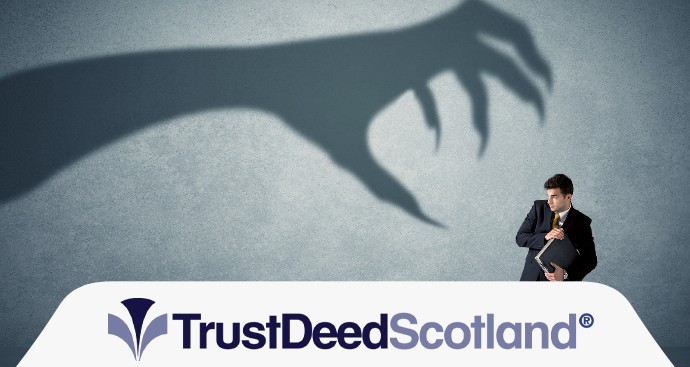
Halloween 2020 is set to look different than any other in Scotland with the Scottish Government asking us to avoid guising and thus help prevent spreading Coronavirus.
Residents of Scotland with old debts beware: a forgetful moment from your past could results in old debts rising from the dead and coming back to haunt you. Zombie debt.
So, as we’re at home this Halloween, we’ve put together a guide to help you understand more about what you’re options are. Helping you to avoid having a night of the living debt.
What are Zombie Debts?
Zombie debts are old accounts that may have been forgotten about and then either written off as ‘uncollectable’ and which have passed the time in which they can legally be collected. These can be anything from an old payday loan to a credit card debt. Even an old library fine. Depending on the type of debt and how old the debt may be, you may be in for a nasty surprise, or it may become unenforceable due to becoming a Prescribed Debt, known more commonly across the UK as Statute Barred.Are my statute barred debts written off?
A regulatory body say that it’s not fair for a creditor to keep asking you to pay a statute-barred or prescribed debt if you’ve told them you don’t intend to pay it. In Scotland, If the creditor waits too long, the debt will become prescribed. Once a debt is prescribed, the law says it no longer exists so there’s nothing more the creditor can do collect it. This is outlined as part of the Prescriptions and Limitation (Scotland) Act 1973. Statute barred debt in England refers to a debt that’s not enforceable because the time a creditor has to chase payment has passed. This is outlined under the Limitation Act 1980. In England, Wales and Northern Ireland where under the Limitation Act 1980, a creditor has six years to chase most unsecured unpaid debts or twelve years for some mortgage shortfalls. This ‘limitation period’ starts from the time of your last payment or acknowledgement of the debt, not the total length of time you’ve been making payments. The Limitation Act 1980 act states that when all of the following conditions are met a debt cannot be enforced:- The creditor has not registered a CCJ against you (Known as a Decree in Scotland)
- You have not made a payment in the last six years (or with joint debts, the other person)
- You have not admitted the debt in writing in the last six years
- Where it’s a mortgage shortfall, the latter two restrictions are doubled to 12 years.
How did I get a Zombie Debt?
Zombie Debt comes in many forms, including legitimate debts that have been forgotten or ignored, Identity theft cases and I.T. errors. The most common way of this happening is a combination of change of address, change of telephone and changed bank details. With no little way of knowing, we assume the debt has been paid and eventually may believe that we paid it off. If you have built up a zombie debt and forgotten about it, don’t feel bad about it – it’s an easy oversight to make. But, if you have forgotten about a debt you are protected from harassment or any other contact from the creditor. You cannot be pursued through the courts, as the debt is deemed to have either been abandoned or repaid. It involves unsecured credit from credit cards, store cards and the likes of council tax arrears. It does not apply to secured debt such as mortgages and money owed to the government for income tax, property tax, fines and student loans.Help with unexpected debt?
If you have unaffordable debt, whether it’s from an old Zombie Debt, or more recent – You should always look for expert debt help in Scotland. You can find out more about Trust Deed Scotland and find out why we’ve become the No.1 rated company in Trustpilot‘s debt relief services category. If you are struggling with debts, we’re here for you. You’re not alone. Find out more about what is a Trust Deed in Scotland or about what trust deeds do, call us today on 01412210999 for friendly, non-judgemental advice.What debts does a Protected Trust Deed include?

The type of debts that can be included in a Protected Trust Deed are generally those that are described as unsecured, with some exceptions.
When you enter into a Protected Trust Deed in Scotland, most of your unsecured debts will be included and this may include:
- Credit Cards
- Personal Loans
- Overdrafts
- Catalogues
- Gas and Electric Arrears
- Council Tax Arrears
- Payday Loans
- Store Cards
- Buy Now Pay Later Agreements
- Any Other Outstanding Personal Bill e.g. Vet Bills
What types of debt are excluded from a Protected Trust Deed?
Typical debts that aren’t included within a Protected Trust Deed include:- Mortgages
- Secured Loans
- PCP and PHP Agreements
- Hire Purchase Agreements
- Court Fines
- TV Licence Arrears
- Student Loans
- Child Support Arrears
Can joint debts be included in my Protected Trust Deed?
A joint debt in Scotland is a debt that has your name and the name of the other person you entered into it with on the agreement. A joint debt can be included in a Protected Trust Deed, however, the other person named on the debt will still be responsible for making payments towards it. This is also true of guarantor loan debts in Scotland. If you have some of the debt written off, the other person will still be asked to pay the remaining money back, therefore that debt isn’t written off in the same way that the other debts that included in the Protected Trust Deed would be written off. If you have joint debts, and are thinking about applying for a Protected Trust Deed, you should contact us for confidential advice first. We can let you know how it would affect you and the other person named on the debts.What happens to my debt during a Protected Trust Deed?
Before Trust Deeds are agreed, proposals are put to the creditors who monies are owed to. If the creditors agree to the Trust Deed, you’ll make monthly payments towards the Trust Deed for 48 months, or 60 months if this was agreed as an extended duration for the Trust Deed. When your Protected Trust Deed has been complete, you’ll be discharged. At this point, any balances outstanding on the debts included in your Trust Deed will be written off.Is a Protected Trust Deed right for me?
To find out if a Protected Trust Deed is right for you, we advise you to try our online Trust Deed Wizard® tool. This will begin the process of finding a debt solution for you, based on your own unique circumstances. When you’re looking at the types of debts that can be included in a Protected Trust Deed, you may have debts that can be included such as those owed to family and friends but you may benefit from speaking to Trust Deed Scotland® in order to find out the advantages and disadvantages of doing so. There are alternative solutions to Trust Deeds in Scotland, one of which is the Debt Arrangement Scheme. When you speak to an expert money advisor, all pros and cons will be explained to you, and sometimes the type of solution that fits your needs best may not be a Protected Trust Deed after all. When considering your decision on whether a Protected Trust Deed is right for you, we have previously written articles in response to questions we’ve previously been asked such as Is A DAS Worth It? or Is A Trust Deed A Good Idea? Trust Deed Scotland® has thousands of reviews on Trustpilot, however, we also offer Debt Arrangement Scheme and Sequestration advice, which means you will be given balanced, fair advice that puts you in control of the decision-making process.What Is A Debt Payment Programme in Scotland?

A Debt Payment Programme in Scotland (DPP) is the term used to describe how much you pay back to your debts each month as part of a Debt Arrangement Scheme (DAS).
DAS is a statutory debt management plan, introduced by the Scottish Government in 2004 to help individuals repay their debts in full. If you need a helping hand to get out of debt, DAS could be a suitable option for you. Also referred to as a Debt Payment Plan, a DPP is essentially a financially means-tested method of managing your debts at an affordable level.
As well as individuals, the Debt Arrangement Scheme offers self-employed debt help to sole traders, partnerships, certain limited partnerships, trusts, unincorporated businesses, certain categories of charities and certain corporate bodies are all eligible for the Debt Arrangement Scheme.
Only a DAS-approved money advisor can arrange this on your behalf, however once arranged – it offers you a chance to restructure your unaffordable debts at a level that you are comfortable repaying each month. If you believe you fall into the category of a business rather than an individual for DAS you have to seek advice from a qualified insolvency practitioner.
Once approved, the DPP offers legal protection against creditor enforcement action and freezes interest and charges. A Debt Payment Programme will protect your home and car.
Only available to residents of Scotland, a Debt Arrangement Scheme – is a popular alternative to a Protected Trust Deed and Sequestration.
Note, in England, Wales and Northern Ireland – there is no equivalent solution that offers the same statutory legal protection, the nearest equivalent is more widely referred to as a Debt Management Plan. A DMP is a voluntary arrangement between the individual and creditor basis only.
When considering the Pros and Cons of a Debt Arrangement Scheme, a qualified debt expert should go over all your income, outgoings, debts and other pertinent information to work out what options are open to you.
What Debts Can Be Included In My Debt Payment Programme?
Very similar to the Protected Trust Deed, you can include most types of unsecured debts in your Debt Payment Programme. ✓ Credit Cards ✓ Store Cards ✓ Personal Loans ✓ Bank Overdrafts ✓ Payday Loans ✓ Council Tax Arrears ✓ Utility Bill Arrears ✓ Shopping Catalogues ✓ Credit Unions ✓ HMRC In a Debt Arrangement Scheme, this can further include some secured debts ✓ Mortgage, Rent + Car Finance arrears. Optional – Missed payments only, terms and conditions apply – contact us for details. Debts than cannot be included are typically Student Loans, Court Fines and CSA/Child Maintenance Arrears.DPP Proposal
If DAS is appropriate for your circumstances, the money adviser will calculate an affordable monthly repayment amount and decide how long the plan should last. The adviser then makes a formal proposal to your creditors, who must either accept or reject within 21 days. If the creditors don’t respond to the DPP Proposal, it’s assumed that they agree with the terms. If a creditor doesn’t approve the DPP proposal, the plan can be put through if the money adviser believes it to be fair and reasonable under the terms of the Debt Arrangement Scheme. Once the DPP Proposal has been accepted, the interest and additional charges on your debts will be frozen as long as you abide by the DPP terms.Advantages of a DPP
- A DPP lets you repay your unaffordable debts at a more reasonable rate, while still leaving you enough money for living costs and household bills
- All interest or charges that are being applied to your debts will be frozen at the point when you apply for your DPP
- Your creditors can’t contact you or take any further legal action against you
- If your situation changes you can apply to vary your payment or apply for a payment break, although the term of the break will be added to the DPP
- When your DPP is complete, your unsecured debts will be paid in full
- Once your DPP becomes approved then by law any earnings arrestments currently in force have to be cancelled. Your continuing money adviser will ensure that this happens for you.
Disadvantages of a DPP
- Unlike a Trust Deed which typically lasts a period of 48 months, the DPP lasts until the full debt is written off. Therefore, there is no unaffordable debt written off, other than frozen interest and charges
- Once you’re on a DPP your details will be put onto the DAS register. This is an online register that your creditors can access
- A DPP will appear on your credit file for six years
- If you don’t keep up your payments the DPP could fail, and creditors can add interest charges, or take further action against you
How Can I Apply For A DPP?
You can apply for a Deb Payment Programme under the Debt Arrangement Scheme today with Trust Deed Scotland®. There are no setup fees for a Debt Payment Programme and the cost of administering the DPP are borne by the creditors. More information available here. There are a variety of debt solutions available in Scotland to help deal with your debts. You can find out more about the solutions above or you can visit our debt advice in Scotland page. Give us a call on 01412210999 to find out more.Payday Loan Debts

Payday Loans Debt have created a problem, not the quick-fix solution that so many seek.
Amidst the country’s growing consumer debt crisis, thousands of people in Scotland are turning to high-cost loans to make essential payments and ends meet. Despite constant bad press and recent regulatory crackdowns, the most common port of call is the Payday Loan because of its perceived convenience.
We want to show you the real cost of Payday Loans – all too often, reliance on high-cost, short-term credit serves as an entry point to a more serious debt problem: one that could last a lifetime, and not just until payday.
How Payday Loans work
As the name suggests, payday loans are short-term loans designed to tide you over, meet essential payments or living costs until your next payday. In 2018, 53% of borrowers withdrew a payday loan for living expenses or utility bills. A Payday Loan is paid into your account in one lump sum, and you repay in full, with interest and charges, typically at the end of the month. However, payday loans now commonly stretch over 3 months, with the option to ‘rollover,’ where for a fee the lender agrees to extend the repayment period even further. One condition lenders commonly attach is that you set up a recurring payment, essentially a direct debit allowing them to take a repayment instalment directly from your account on the agreed date. Despite their high-cost Payday Loans are a popular short-term solution, generally due to their ease of access and the simplicity of the whole process. Payday Loans allow you to get a ‘loan on your lunch hour,’ bypassing the timely process of borrowing from a mainstream lender. In 2017 the Competition and Markets Authority found that 85% of borrowers took out their payday loan at the click of a button and this figure has likely increased since then. Combine this with the fact that most lenders don’t conduct credit checks (and advertise this) and it’s easy to see where the perception of Payday Loans as ‘free money’ comes from.1,500% interest: the real cause of Payday Loan Debts
The number of payday lenders active in the UK has decreased significantly due to new regulatory requirements. Worth over £2 billion in 2013, the industry is now worth an estimated £220 million today. As a result, it has been argued that the industry is now less predatory, and consumer friendly. We wholly disagree. A payday loan is subtly expensive and can create a debt problem or make an existing one a lot worse in just a few short months. Although the average loan size is just £260, this can be deceiving. Servicing debt with debt is a risky business and should be practised with the greatest of care. You can consult our guide on safe debt consolidation for more information. Due to inflated interest payments, payday loans have no place in any effective debt consolidation strategy. Over a year, the average annual percentage interest rate of charge (APR) is typically between 1,200-1,300% and can be up to 1,500%. For comparison, a typical credit card has an APR of 22.8%. To give a practical example, we used lender’s own loan calculators to get a quote for a £500 loan. Quickquid offered a maximum repayment schedule of 3 months with an APR of 1294.1%. Therefore, the total interest on a £500 loan was £360, making the total repayment £860.Payday Loan Debts and the debt spiral effect
Payday Loans are one of the most common debts our clients have and with these interest charges, it’s no small wonder that they have dragged thousands into deeper waters. More and more research is emerging to back up our view that they are a major contributor to the debt spiral. In America, for example, the Centre for Responsible Lending found that 76% of Payday Loans are taken out to pay off older payday loans. They reported further, that although most are scheduled to be paid within two weeks, on average the borrower stays in debt for more than a year, demonstrating how a quick fix often leads to potentially long term debt. Borrowers regularly only notice the true cost of their loan at the time of repayment making the rollover option all too tempting. As the months go by, interest and charges snowball with their debt now standing at three to four times what it was. While it’s true that the situation is better here in Scotland than it is in the United States, there is a misinformed consensus here, that the UK’s financial regulator), have effectively addressed this cycle with recent reforms. In 2015 they introduced a price cap on the interest of payday loans, and limited charges to £24 per £100 borrowed. The result is that no customer would repay more than double the amount they had borrowed. This is a highly concentrated solution that regulates at the level of the individual loan. Consider the whole picture, and the trapping effect of payday lending is still clear. 75% of customers take out more than one payday loan per year – on average they actually take out 6. Consider also that 25% of borrowers take advantage of the rollover option at least once. Compound interest also comes into play if you borrow for more than one month, and it continues to accumulate each time you choose to roll over. In short, the new regulations only ensure you pay back a maximum of double your original loan if you take out a single loan and repay it the same month. It’s still very easy to multiply your debt rapidly with payday loans and create a much more serious debt problem.Alternatives and other considerations
Equipped with a more realistic understanding of payday loans, it’s important for you to consider alternatives. The one attraction payday loans will always have is that they are quick, easy and cover every cash flow emergency possible. The good news is they are not the only show in town anymore. Be it guarantor loans; peer-to-peer loans and other new ‘fintech’ initiatives; or credit unions, there are other options out there. If your last wage isn’t stretching far enough and you have an upcoming bill, essential payment to make or an unforeseen breakdown that needs to be repaired, try the Money Helper Payday Loan portal which is dedicated to payday loan alternatives as a starting point. As a final note, if you have very recently taken out a payday loan and feel you could struggle to repay, make sure to take advantage of the seldom advertised 14 days ‘cooling off period.’ This allows you to withdraw from the agreement if you change your mind within the first two weeks. You will only have to pay the interest on the credit you have used, and any other charges must be refunded to you.Need help now?
Perhaps this blog has reached you too late, and you already find yourself in an unmanageable debt spiral. If so, we can help. If you have multiple high-interest payday loans you are repaying individually you may qualify for a Trust Deed. A legal and binding agreement between you and your creditors, overseen and administered by an Insolvency Practitioner (IP.) A Trust Deed allows you to repay your debts in a single, reduced monthly payment distributed to creditors by your IP and write off the debts that you simply can’t afford. For more information on Trust Deeds read our guide on how they work. In time, the Protected Trust Deed will give you the financial fresh-start you need. We are here for you if you are in an unmanageable financial position and can talk you through your options, our service is no obligation and 100% confidential. Consider alternatives too, like the Debt Arrangement Scheme in Scotland. We have helped thousands of people like you out of debt so far. For a detailed, comprehensive consultation with one of our experienced debt advisers, get in touch today on 0141 221 0999 or find out if you qualify for a formal debt solution. Our team of friendly debt advisers are ready to help you.The Benefits of a Debt Consolidation Loan
A guide to the benefits of a debt consolidation loan. Find out more about the best way to consolidate debt in Scotland.
Government funding cuts have had a negative impact on several households across the United Kingdom with less protection for public services and other businesses that people are heavily reliant on. This has affected people in virtually every industry since the global recession and shocked many when falling into debt.
The lure of payday loans cannot be seen as an effective solution, even after recent regulations capping interest rates for those needing instant cash.
At Trust Deed Scotland® we understand how quickly living costs can pile up and become unaffordable in the blink of an eye. For this reason, we offer all of clients tailored and experienced debt advice with sustainable Scottish debt solutions.
One of these is a debt consolidation loan. This can be the best method of removing debt and reduce stresses about your finances as a result. It is conceivable that many of us have considered a short-term fix to our money problems, but quite often this will not be beneficial in the long run.
Desired sustained answers to debt may feel unrealistic at the time, but we pride ourselves on outstanding reviews from those who have contacted us. Of course, that is not to say that debt consolidation loans easily eradicate your arrears, but they help people manage their repayments.
Dealing with debts is easier said than done, however working out exactly what you owe is more effective than some may think. Although the prospect of doing this can be daunting people should not feel embarrassed when finding out the figure – it is the first step to solving your financial issues. We are fully aware that the cost of living has increased in recent years and our team have the necessary experience to help people get back into the black. Our debt advice services are confidential and we are only interested in making clients happy rather than others who seek monetary gain.
Debt consolidation loans allows people to repay their debts over a longer time and get out of the red without harming their future finances. This is often a direct consequence from using payday lenders, but repayments recommended by us are much more affordable as well as being more flexible and effective. This method of debt reduction means you can repay exactly what you owe into manageable monthly payments which frees up your income on other vital areas of spending. Although the lower payments mean that you are likely to be in debt for longer, this can make budgeting easier.
Your repayments shall be significantly lower than interest rates of payday loan companies and is more affordable for our clients. We are proud to say our TrustPilot rating of 5/5 sets us apart from competitors, enhancing our reliability and proving that it’s possible to reach a brighter future.
We help restore confidence and peace of mind and our services do not cost a penny for such incredible effectiveness. There are no setup fees and our clients pay back what they can afford in four years without the risk of losing their home and prized assets. If you would like to hear from our team then contact us today. Alternatively, you can also view what our happy customers have said about our support and advice.
Debt Consolidation Loan alternatives
Trust Deed Scotland® have helped over [volume] people reach a brighter future. With no further borrowing required, no credit checks and affordable repayments – there are other ways to consolidate your debts without needing to resort to applying for a loan. Learn more about the Scottish Trust Deed and alternative Scottish debt solutions such as DAS.Young People in Debt Rising Throughout Scotland


Austerity measures throughout the UK have caused financial difficulty for a number of groups as the government have cut grants to councils and support streams for individuals. As a result, several people are struggling to afford paying for their food, rent and household bills.
Therefore, it should come as no surprise that young people in Scotland are suffering financially.
With organisations and politicians under increased scrutiny to lower their expenditure, there is a lack of employment options for all Scottish and British residents which has negatively affected the financial security of those aged between 16 and 24. Ten per cent of British people in this age group are finding the current economic climate ‘difficult or very difficult’ according to a recent report published by the Office for National Statistics (ONS).
Research carried out by Citizens Advice Scotland alarmingly revealed that a quarter of young people in Scotland have been in debt before turning 22. Approximately a third of all debts exceeded £5,000 placing a huge amount of pressure on Scotland’s youth.
When finances are stretched one short-term fix a large number opt for is a risky loan from payday loan companies. These lenders may seem like a competent way of combating debt at the time, but their high interest rates often result in customers being worse off than before so their difficulties prolong.
An adequate way of reducing your debt without the threat of spiralling interest rates is by choosing to receive support from us at Trust Deed Scotland, thanks to our 5/5 TrustPilot rating from thousands of reviews. This gives our company unrivalled credibility and vital trust for people in hardship.
Unlike payday lenders, those who sign up for a Trust Deed settlement only repay what they can afford. Our staff’s motives are to help people in need of financial support, not boosting profits as loan companies often do.
More evidence from the ONS demonstrated that unemployment for Scottish youngsters rose by nine per cent in the last 10 years, with 21 per cent of young people jobless.
Late teenagers and people in their early twenties should not be worrying about their economic situation and we are committed to offering affordable repayment plans here at Trust Deed Scotland. In most cases, you will have two years to repay what you owe meaning you shall be able to keep your home and car.
These are also speedy to set up – taking around five or six weeks generally. This eases the burden of debt on our clients who regain a sense of freedom from paying back affordable monthly fees.
Another advantage of managing your debt with a Trust Deed is that creditors are powerless to take legal action as soon as your Trust Deed is protected. With young unemployment rising, the number of 16 to 24-year-olds in debt has also increased.
Our Glasgow office and phone lines are open for anyone who needs urgent Debt Help Scotland for their cash problems.
One of our friendly experts shall be willing to speak with you today. We’ve been giving Debt Advice in Scotland since 2009 and became the No.1 rated on TrustPilot.
How Effective Will the Payday Loan Cap Be for Scotland?

In January 2015, caps on payday lending were introduced across the UK in an effort to stem the tide on the snowballing debt problems faced by many people throughout the country. The new set of rules have been designed to protect those who have used – and in some case become reliant on – the countless numbers of payday lending companies that are now ever-present within our society, but for people in Scotland there are still many question marks still hanging over the people in vulnerable financial positions.
Scotland, however, is hit worse than the rest of the UK and in light of this there are calls for more evasive courses of action in order to overcome these problems. Mike O’Connor, chief executive of StepChange, has said “Scotland has suffered more from the rise in payday loans than other parts of the UK. New rules for payday loans are a welcome start to 2015.
“They will help address problems within the payday loan industry which have made bad situations worse for thousands of people. We want to see a mandatory real-time database for payday lenders to share information, limiting the risks of unaffordable multiple borrowing.”
But what does the cap actually mean for borrowers? Fees and daily charges are limited to 0.8 per cent of the loan amount, and default charges have been left capped at £15.
Fees and interest will never account for more than the initial loan value, with the 100 per cent total cost cap also coming into full effect. While extremely useful for those borrowing small amounts, for those that have debts that run into the thousands it may act as only small consolation.
Although in theory, putting a cap on these short-term loan companies can only be a good thing. People can only find themselves accumulating a certain amount of debt, and the worst practices within the cut-throat market of payday loans left consigned to the past. But without widespread action on personal debt, with the root problem – the debt itself – still prevalent within society in Scotland, this cap may well prove to be a drop in the ocean of financial issues.
The regulations have all been taken over by a UK regulatory body, which may offer some hope for people wanting further reform within the sector, but ultimately these changes take a while to be passed legally. It is the smaller changes that ultimately may have a bigger effect in the long run – for example, free debt advice is now a mandatory requirement for those in difficulty, something that can only be beneficial for all parties involved.
While increased spotlight from the media has led to increased scrutiny from authorities, it would be naïve for us to believe debt problems and injustice begin and end with the underhand tactics employed by payday lending companies. With numerous other deregulated avenues for people to pursue when in need of a quick financial fix – not all of them legal – payday loans may soon be seen as the ‘safe option’ when it comes to borrowing.
Letting the cap lull us into a false sense of security regarding short term loans, in reality, is equally as damaging as doing nothing about it at all.
Here at Trust Deed Scotland, we are firm believers in tackling your debt problems head-on as soon as possible. Some recent questions we’re being asked by people suffering at the hands of payday loan lenders include:
Is an IVA the same thing as a Trust Deed?
By fixing yourself into a Protected Trust Deed plan, you provide yourself with a much greater opportunity to get out of the red and into the black in the most amicable way possible. We take care of communications with your creditors and provide you with the structure and guidance that is absolutely integral to financial recovery.
Trust Deeds are an extremely real pathway out of debt. For more information on the services we offer, or how to apply for a personalised Trust Deed illustration, contact one of our team immediately. We’ve been giving Debt Advice in Scotland for over a decade and have helped thousands of people look forward to a brighter future.