Author: Craig Stocks

It’s a New Year and time for a Fresh Start

The start of a new year often brings a natural pause for reflection. For many people across Scotland, January represents more than resolutions about health or habits. It is a moment to take stock of finances, stress levels, and the future they want to build.
At Trust Deed Scotland, we believe a fresh start should be exactly that. It should be practical, informed, and free from judgement. To better understand the real experiences people have before and after seeking debt help in Scotland, we carried out a detailed December 2025 survey of 2,829 people who entered a formal debt solution. The results are powerful, honest, and in many cases deeply human.
What follows is not just a collection of statistics. It is a snapshot of how debt affects everyday life in Scotland and how seeking the right help can genuinely change things.
What you will learn in this article
- Why nearly half of people in Scotland wait a year or more before seeking debt help
- The emotional impact debt has on sleep, mental health, and family life
- The most common causes of problem debt in Scotland today
- Which types of debt cause the most stress
- How confidence and wellbeing improve after entering a formal debt solution
Why People in Scotland Research Debt Advice Before Asking for Help
Before reaching out for advice, most people want reassurance that they are making the right decision.- 72% said they read Trustpilot reviews before seeking advice
- Almost 1 in 4 heard about Trust Deed Scotland from friends, family, or work colleagues
Missed Mortgage or Rent Payments Before Seeking Debt Help in Scotland
One of the biggest fears around debt is losing your home. Our survey shows that while many people were struggling, most managed to protect their housing before entering a solution.- 13%missed a mortgage or rent payment in the 12 months prior to entering their solution
How Long People in Scotland Wait Before Seeking Debt Advice
One of the most revealing parts of the survey looks at how long people delay before seeking advice.- 19.1%asked for help straight away
- 35.2% waited up to one year
- 21.8% waited between one and two years
- 23.8% waited over two years
Shame and Self Reliance
When asked what put them off seeking help sooner, the responses were open and emotional.- 61% felt ashamed or embarrassed about their debt
- 45% believed they could deal with the debt by themselves
- 97% said they wish they had sought debt advice sooner
Talking About Money Before and After Help
Money remains one of the most difficult topics for people to discuss. Before seeking help:- 72% did not feel comfortable talking about money
- 81% now feel more comfortable talking about money
The Impact of Problem Debt on Mental Health and Sleep
Debt does not stay on paper. It follows people into their daily lives.- 91% lost sleep worrying about debt
- 90% said their mental health was negatively affected by debt
- 90% said their mental health improved
Keeping Debt Hidden
Many people feel unable to speak openly about their financial situation.- 88% hid their unaffordable debt from family or friends
Causes of Financial Difficulty
Financial difficulty is rarely caused by one single factor.- 28.2% said a lack of control over their finances was the main issue
- 26.3% cited the cost of living
- Other causes included issues such as separation or unexpected life events
The Debts That Cause the Most Worry
Some types of debt create more anxiety than others.- Credit cards worried 76.1%
- Personal loans worried 58.5%
- Overdrafts worried 22.9%
- Council tax arrears worried 15.3%
- Buy Now Pay Later worried 13.9%
- Payday loans worried 12.9%
How People Tried to Cope With Rising Costs
Before seeking help, many people made significant sacrifices.- 66.4% cut back on socialising or hobbies
- 50.8% cut back on other spending
- 33.1% cut back on buying food
- 27.1% cut back on heating
- 20.4% borrowed money from family or friends
- 13.1% took on additional debt
- 23.8% worked extra hours or took a second job
Work, Family, and Responsibility
Debt has a significant impact on working life and family responsibilities.- 55% worked longer hours or more than one job to manage their debts
- 82% worried about providing for dependents while dealing with problem debt
Are Trust Deeds and Alternative Debt Solutions Effective in Scotland?
The most reassuring results come from those who have already taken action.- 98% are satisfied with their chosen debt solution
- 94.1% feel more confident managing their household budget
A Fresh Start Is Achievable
The message from this survey is clear. People do not regret getting help. They regret waiting. A new year does not automatically solve financial problems, but it does provide an opportunity to take a different step. Whether someone feels overwhelmed, embarrassed, or unsure where to begin, confidential debt advice can make a real difference. A fresh start is not about failure. It is about taking control and moving forward with confidence.World Cancer Day

Cancer, Ill Health and Debt: The Financial Impact of Serious Illness.
Debt does not always start with poor money management. For many people, financial difficulty begins with a life event that could not be planned for or avoided. Serious illness, including cancer, can place sudden and overwhelming pressure on household finances.
At Trust Deed Scotland®, we regularly speak to customers whose money problems began with a health crisis rather than a financial decision.
 Paul
Paul and his wife faced sudden financial difficulty after their child was diagnosed with cancer. Caring responsibilities meant both parents had to take time off work, causing an immediate drop in household income during an already distressing time.
“The service provided was second to none. Matthew McNally was our adviser from the very start, and he guided us through one of the toughest periods of our lives. He put our minds at ease straight away.
Our financial situation arose because one of our children was diagnosed with cancer. My wife and I had to stay off work to care for her, and our income fell suddenly.
Matthew was extremely understanding and reassured us that he would find a solution, which he did. He removed one of our biggest worries and stresses and put us in a much better financial position.
This allowed us to focus entirely on caring for our daughter. We really cannot thank him enough or speak highly enough of the support we received. He is a credit to Trust Deed Scotland.”
Angela
Angela’s financial difficulties developed over several years while she was caring for her father during his terminal cancer diagnosis. Despite working tirelessly and doing everything she could to stay afloat, her situation eventually became unmanageable.
“Entering a Trust Deed was the best decision I ever made. Even after I had fully paid my Trust Deed, the support continued. The advice I received was genuinely helpful and actually worked.
My financial problems started while my dad was dying of cancer. I gave up work to care for him and tried everything possible to keep paying my bills. I worked night shifts and zero hour contracts, but it was still not enough.
I had worked for the same company since I was 18. When I returned, I was placed under an agency contract for years. By the time I finally regained stability, I was already too far gone financially.
Setting up a Trust Deed gave me breathing space. The help and advice stopped the sleepless nights and constant anxiety. Sometimes people fall into debt even when they are trying their hardest to get out of it.
I would highly recommend Trust Deed Scotland.”
James
James explained that his financial problems escalated rapidly after his wife was diagnosed with cancer and had to stop working. Balancing work, finances and caring responsibilities quickly became impossible.
“The service I received was outstanding. Amy in customer services was friendly, clear and explained exactly what moving forward would look like.
My money problems were manageable at first, but everything changed when my wife was diagnosed with cancer and had to stop working. I tried to keep us afloat, but my wife needed me at home, and I simply could not afford to take time off.
Eventually, it hit me that my financial problems were not going away. Vicky set everything up for me, and the stress was lifted almost immediately.
Now I can focus on helping my wife through her treatment without constant financial pressure. I cannot thank the team enough for the help and support they provided.”
Paul
Paul and his wife faced sudden financial difficulty after their child was diagnosed with cancer. Caring responsibilities meant both parents had to take time off work, causing an immediate drop in household income during an already distressing time.
“The service provided was second to none. Matthew McNally was our adviser from the very start, and he guided us through one of the toughest periods of our lives. He put our minds at ease straight away.
Our financial situation arose because one of our children was diagnosed with cancer. My wife and I had to stay off work to care for her, and our income fell suddenly.
Matthew was extremely understanding and reassured us that he would find a solution, which he did. He removed one of our biggest worries and stresses and put us in a much better financial position.
This allowed us to focus entirely on caring for our daughter. We really cannot thank him enough or speak highly enough of the support we received. He is a credit to Trust Deed Scotland.”
Angela
Angela’s financial difficulties developed over several years while she was caring for her father during his terminal cancer diagnosis. Despite working tirelessly and doing everything she could to stay afloat, her situation eventually became unmanageable.
“Entering a Trust Deed was the best decision I ever made. Even after I had fully paid my Trust Deed, the support continued. The advice I received was genuinely helpful and actually worked.
My financial problems started while my dad was dying of cancer. I gave up work to care for him and tried everything possible to keep paying my bills. I worked night shifts and zero hour contracts, but it was still not enough.
I had worked for the same company since I was 18. When I returned, I was placed under an agency contract for years. By the time I finally regained stability, I was already too far gone financially.
Setting up a Trust Deed gave me breathing space. The help and advice stopped the sleepless nights and constant anxiety. Sometimes people fall into debt even when they are trying their hardest to get out of it.
I would highly recommend Trust Deed Scotland.”
James
James explained that his financial problems escalated rapidly after his wife was diagnosed with cancer and had to stop working. Balancing work, finances and caring responsibilities quickly became impossible.
“The service I received was outstanding. Amy in customer services was friendly, clear and explained exactly what moving forward would look like.
My money problems were manageable at first, but everything changed when my wife was diagnosed with cancer and had to stop working. I tried to keep us afloat, but my wife needed me at home, and I simply could not afford to take time off.
Eventually, it hit me that my financial problems were not going away. Vicky set everything up for me, and the stress was lifted almost immediately.
Now I can focus on helping my wife through her treatment without constant financial pressure. I cannot thank the team enough for the help and support they provided.”
World Cancer Day and the Human Impact of Cancer
World Cancer Day is an international awareness day held annually on the 4th February, which focuses on improving understanding of cancer and the challenges faced by those affected. Organisations such as Macmillan Cancer Support highlight not only the medical impact of cancer but also the emotional and financial strain it places on individuals and families. In October 2025, Trust Deed Scotland® raised over £500 in support of Macmillan Cancer Support. This fundraising was part of our ongoing commitment to supporting people affected by cancer and recognising the wider impact the illness can have on individuals, families and finances. Macmillan’s work plays a vital role in providing practical, emotional and financial support to those living with cancer, and we are proud to contribute to that effort in a meaningful way.World Cancer Day Theme 2025 to 2027
The World Cancer Day theme for 2025 to 2027 is United by Unique. This theme places people at the centre of care and their individual stories at the heart of conversations about cancer. Every cancer experience is different. The financial impact, the emotional strain and the support needed will vary from person to person. This is especially true when illness affects income, employment and the ability to manage everyday costs.What Our Survey Shows
In a recent Trust Deed Scotland customer survey, we asked: What was the biggest cause of your financial difficulties? 5% said ill health or injury Almost 3% said a bereavement These figures show that for many people, debt begins with circumstances completely outside their control. Illness and loss often trigger a chain reaction that leads to financial difficulty.How Cancer Can Lead to Debt
Loss or Reduction of Income
Cancer treatment can make it impossible to work for extended periods. Even where Statutory Sick Pay or employer support is available, income is often much lower than normal earnings. Self-employed people are particularly affected, as time away from work can result in little or no income.Increased Everyday Costs
Cancer can bring additional costs at the same time income is reduced. These may include travel to hospital appointments, prescription charges, higher energy bills, childcare or domestic support, and special dietary needs.Using Credit to Get By
To manage essential expenses, many customers rely on credit cards, overdrafts or loans. What starts as short term support can quickly become difficult to manage once interest and charges build.Real Customer Experiences Affected by Cancer
The theme United by Unique is reflected in the real experiences of Trust Deed Scotland customers who faced problem debt following cancer diagnoses or caring responsibilities. Graham Graham contacted Trust Deed Scotland® during an extremely difficult period in his life. Alongside major personal changes, he was also dealing with a cancer diagnosis, which placed significant pressure on both his health and finances. “From day one, speaking with Ashley on the call to start the process, my mind was put at ease. I knew that being honest, open and communicating regularly was the only way to make a Trust Deed work. I think people sometimes bury their head in the sand when changes happen and feel they cannot stick to the original agreement. I could have ignored the problems, but I knew from the outset that the review team and regular check-ins really help reduce stress and support a successful Trust Deed outcome. The last two to three years were extremely tough. I was diagnosed with a low form of cancer, split up with the mother of my children, moved into temporary housing and eventually found a new home, all while trying to be a parent and work two to three jobs. There was never any pressure or force from Trust Deed Scotland, and I will never forget that. I would recommend this to anyone facing overwhelming debt and stress. Do not bury your head in the sand. Take a brave step and pick up the phone.”
Paul
Paul and his wife faced sudden financial difficulty after their child was diagnosed with cancer. Caring responsibilities meant both parents had to take time off work, causing an immediate drop in household income during an already distressing time.
“The service provided was second to none. Matthew McNally was our adviser from the very start, and he guided us through one of the toughest periods of our lives. He put our minds at ease straight away.
Our financial situation arose because one of our children was diagnosed with cancer. My wife and I had to stay off work to care for her, and our income fell suddenly.
Matthew was extremely understanding and reassured us that he would find a solution, which he did. He removed one of our biggest worries and stresses and put us in a much better financial position.
This allowed us to focus entirely on caring for our daughter. We really cannot thank him enough or speak highly enough of the support we received. He is a credit to Trust Deed Scotland.”
Angela
Angela’s financial difficulties developed over several years while she was caring for her father during his terminal cancer diagnosis. Despite working tirelessly and doing everything she could to stay afloat, her situation eventually became unmanageable.
“Entering a Trust Deed was the best decision I ever made. Even after I had fully paid my Trust Deed, the support continued. The advice I received was genuinely helpful and actually worked.
My financial problems started while my dad was dying of cancer. I gave up work to care for him and tried everything possible to keep paying my bills. I worked night shifts and zero hour contracts, but it was still not enough.
I had worked for the same company since I was 18. When I returned, I was placed under an agency contract for years. By the time I finally regained stability, I was already too far gone financially.
Setting up a Trust Deed gave me breathing space. The help and advice stopped the sleepless nights and constant anxiety. Sometimes people fall into debt even when they are trying their hardest to get out of it.
I would highly recommend Trust Deed Scotland.”
James
James explained that his financial problems escalated rapidly after his wife was diagnosed with cancer and had to stop working. Balancing work, finances and caring responsibilities quickly became impossible.
“The service I received was outstanding. Amy in customer services was friendly, clear and explained exactly what moving forward would look like.
My money problems were manageable at first, but everything changed when my wife was diagnosed with cancer and had to stop working. I tried to keep us afloat, but my wife needed me at home, and I simply could not afford to take time off.
Eventually, it hit me that my financial problems were not going away. Vicky set everything up for me, and the stress was lifted almost immediately.
Now I can focus on helping my wife through her treatment without constant financial pressure. I cannot thank the team enough for the help and support they provided.”
Support and Resources Available
If cancer, ill health or bereavement has contributed to debt, support is available. Alongside debt advice, there are organisations that can help with benefits, emotional support and practical guidance. We have gathered a range of trusted charities and services on our support and signposting page: Trust Deed Scotland® Support Services These resources are designed to support individuals alongside their financial journey.How to Contact Our Debt Advice Team Today
To get in touch with our debt advice team, please call us on 0141 221 0999. Our team of experienced debt advisers will discuss your circumstances and talk you through the available Scottish debt solutions for you. Alternatively, if you are unable to make a call, you can contact us via our WhatsApp Debt Advice Service, or quickly check your options using our Trust Deed Wizard® tool before reaching out to us.You Are Not Alone
Illness and bereavement are life events, not financial failures. Cancer can change lives in ways that go far beyond health, and financial difficulty should never be a source of shame. Trust Deed Scotland® is here to provide clear, compassionate guidance and help customers take control of their finances during some of life’s most difficult moments.Financial Help Scotland: Scottish Household Finances Remain Dismal

New research shows household confidence remains low as debt concerns rise, with more people looking for financial help in Scotland. Many families are increasingly worried about rising debt, falling savings and future financial security.
If you are searching for financial help in Scotland, you are not alone.
The latest Consumer Sentiment Index from S&P Global recorded a reading of 44.8 in February. Any score above 50 signals improving confidence. Anything below 50 suggests deterioration.
S&P Global is an international financial information and analytics company that produces economic research and economic data used by governments, banks and policymakers worldwide.
Although February’s figure was slightly higher than January’s, it remains among the weakest readings of the past two years.
In short, many Scottish households are feeling financial pressure.
Debt Levels Rising Across Scotland
The survey found households are accumulating debt at the fastest pace since July. Key concerns include:- Growing reliance on credit
- Reduced access to affordable borrowing
- Falling savings
- Increased worry about the next 12 months
Savings Falling And Spending Slowing
Households reported lower savings and less available cash. There has also been a clear drop in appetite for large purchases. When confidence falls, people delay spending and focus on essentials. This reflects a wider uncertainty about jobs, income and debt levels across Scotland.What Financial Help In Scotland Looks Like
If you are worried about debt, there are formal Scottish solutions available depending on your circumstances. These may include:- Protected Trust Deeds – A formal agreement to write off some debt, and repay the rest at an affordable amount over time, typically lasting 48-60 months.
- Debt Arrangement Scheme (DAS) – A popular debt repayment programme in Scotland that legally freezes interest and charges, and allows you to pay back debts at an affordable monthly amount.
- Sequestration – An equivalent bankruptcy for severe debt situations
- Informal repayment arrangements
Signs You May Need Financial Help in Scotland
You may benefit from speaking to an adviser if you are:- Struggling to make minimum payments
- Using credit cards for everyday living costs
- Falling behind on priority bills
- Facing wage arrestment or bank arrestment
- Watching savings disappear
Confidential Debt Advice In Scotland
If debt is causing stress, support is available. At Trust Deed Scotland®, we provide:- Confidential advice without obligation
- Clear explanations of all available options
- Regulated guidance tailored to your circumstances
- Support throughout the entire process, regardless of whether you enter into a debt solution or not.
Survey Finds: Getting Debt Help Sooner Changes Lives
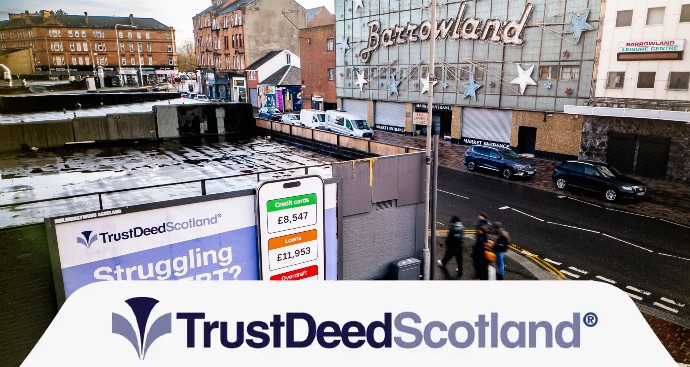
New research from Trust Deed Scotland reveals that stigma, silence, and sleepless nights continue to define Scotland’s debt crisis and that almost everyone who has struggled with unaffordable debt and sought help with us now wishes they had reached out for help sooner.
In 2024 & 2025, we were Scotland’s largest provider of statutory Scottish debt solutions. Recently, we launched our biggest-ever national awareness campaign to encourage people across the country who are struggling with problem debt to seek support earlier, before the pressure becomes overwhelming and the situation harder to face.
Our campaign is being heard nationwide on radio and seen across outdoor advertising in bus shelters and on billboards. At its centre is a striking 3D phone displaying the average debt of people who come to us for help. A stark, impossible-to-ignore symbol of a problem that too many people still feel forced to hide behind closed doors.
The campaign is backed by insightful new findings from our latest customer survey of 2,829 people, offering one of the clearest pictures yet of how problem debt impacts lives across Scotland. not only financially, but emotionally and mentally too. The findings underline just how long many people endure the strain in silence before seeking support, and how different life can look once they finally do.
As shared with several publications, including Evening Times and The National, the research highlights a powerful and consistent message: delaying debt advice often prolongs the stress, while taking that first step earlier can dramatically improve confidence, wellbeing and financial stability.
Stigma over Problem Debt is delaying action
Nearly half of the respondents told us they waited a year or more before asking for help. The biggest barriers were stigma and self-blame.- 61% said they felt ashamed or embarrassed
- 45% believed they should be able to deal with the problem alone
- 97% now say they wish they had sought debt advice sooner
The hidden toll of debt in Scotland
Debt affects far more than finances. It impacts sleep, relationships, confidence and mental health.- 91% lost sleep worrying about their debt
- 90% said it negatively affected their mental health
- 88% hid their debt from family or friends
- 82% worried about providing for their dependents
- 66% reduced spending on socialising and hobbies
- One third cut back on food
- 55% worked longer hours or took on multiple jobs to try to stay afloat
Seeking help can change everything
Crucially, our research also shows just how transformative the right debt solution can be. After entering a statutory debt solution such as a Protected Trust Deed, or the Debt Arrangement Scheme (DAS):- 90% say their mental health improved
- 81% now feel comfortable talking about money
- 94% feel more confident managing their household budget
- Overall satisfaction with our services stands at 98%
Our message to people struggling with debt in Scotland
Through this campaign, we want to challenge the stigma that still surrounds debt and send a clear, simple message: You are not alone. And asking for help sooner can change everything. If you’re struggling with problem debt, support is available. Trust Deed Scotland can help you find out more about your options and take the first step toward a more affordable financial future.Trust Deed Scotland Reaches 13,000 Trustpilot Reviews Milestone
Trust Deed Scotland® has reached an important milestone, surpassing 13,000 customer reviews on Trustpilot.
While the number itself is significant, what matters most is what those reviews represent. Behind every review is someone who reached out for help with their debts, often during one of the most stressful periods of their life.
For many people, taking that first step and asking for advice is the hardest part.
Why Reviews Matter When You’re Worried About Debt
Research consistently shows that many people delay seeking debt advice because of embarrassment, fear of judgement, or uncertainty about where to turn. For someone struggling financially, hearing about the experiences of others who have already taken that step can provide reassurance and confidence. In fact, surveys show that 72% of people read Trustpilot reviews before contacting a debt advice provider, highlighting how important real customer experiences can be when someone is deciding who to trust for support. Reading honest feedback from others who have been in similar situations can help people realise that they are not alone and that there are accessible debt solutions available.
The Hidden Problem of Waiting Too Long
One of the most common themes we hear from customers is that they wish they had asked for help sooner. Many people spend months or even years trying to manage their debts on their own before seeking advice. During that time, they often cut back on essentials, borrow from friends or family, or struggle to keep up with multiple payments. Unfortunately, delaying support can make the situation more stressful and difficult to manage. Getting professional advice earlier can often open up solutions that reduce pressure and make debts more manageable.
Real Experiences From People Who Asked for Help
Across thousands of Trustpilot reviews, customers frequently mention the same things about their experience. Many say they felt nervous before making the first call, but quickly realised they were speaking to someone who genuinely wanted to help. One recent reviewer shared how their fears disappeared almost immediately: “I was really nervous to contact them to seek help because I was afraid of being judged. Five minutes into my first phone call, my fears were eased. Barry, who handled my case, was top class from start to finish, and it is the best decision I have made in years. I am now on my way to a happier, debt free future.” Others highlight how having an experienced debt adviser made a stressful situation far easier to deal with: “Allan was fantastic at guiding me through this process. He was very kind, personable and completely judgement free. He managed to get my debt payments massively reduced, which has lowered my stress levels by a significant amount.” Many customers also mention how clearly the process is explained and how approachable advisors are throughout: “From start to finish, Jacqui was professional, patient and never made me feel judged. She explained everything clearly, answered all my questions and made sure I understood my options before moving forward.” For people who may have been worrying about their debts for a long time, simply having a supportive and understanding conversation can make a huge difference.
Breaking the Stigma Around Debt
Debt can affect anyone. Unexpected life events, rising living costs, illness, relationship breakdowns, or job changes can quickly turn manageable finances into a difficult situation. Despite this, many people still feel embarrassed about asking for help. The thousands of reviews shared by Trust Deed Scotland customers show a very different reality. They highlight how important empathy, understanding, and tailored debt advice can be when someone is facing financial difficulties. By sharing their experiences publicly, these customers help others realise that seeking help is nothing to be ashamed of.
More Than Just a Number
Reaching 13,000 reviews is a significant milestone, but it also represents thousands of individuals in Scotland who have taken positive steps to address their unaffordable debt problem. The latest milestone builds on earlier achievements, including when Trust Deed Scotland® first surpassed 10,000 Trustpilot reviews and later 12,000 reviews, as more customers chose to share their experiences of getting support with their debts. For many people, the biggest barrier is simply making that first call. If reading the experiences of others helps even one person feel more confident about asking for advice and taking control of their finances, then every review shared becomes far more meaningful than just a number.Debt Awareness Week 2026: Debt Doesn’t Define You
Debt Awareness Week 2026: Debt Doesn’t Define You
Debt Awareness Week 2026 (16–22 March) is about breaking the stigma around debt and encouraging people to talk openly about money worries. Across Scotland, hundreds of thousands of people struggle with debt at some point in their lives. Rising living costs, unexpected life events, and financial pressure can quickly lead to problems that feel overwhelming. Yet many people suffer in silence because they feel embarrassed or ashamed to ask for help. Debt Awareness Week is a reminder that debt can happen to anyone, and it doesn’t define who you are. Most importantly, it highlights that support is available and solutions exist.Why Debt Awareness Week Matters
Debt problems are far more common than many people realise. Job loss, illness, relationship breakdown, or simply the increasing cost of living can make it difficult to stay on top of bills. Unfortunately, stigma often stops people from seeking help early. Many individuals worry about being judged or believe they should deal with debt alone. Debt Awareness Week aims to change that by encouraging honest conversations about money and promoting the support that is available. The campaign focuses on helping people:- Understand that debt problems are common
- Realise they are not alone in their situation
- Feel confident seeking professional advice
- Learn about the solutions that can help them regain control of their finances
The Impact Debt Can Have on Mental Health
Financial stress can affect much more than your bank balance. Many people experiencing debt also struggle with anxiety, sleep problems, and constant worry about the future. Common feelings people report when dealing with debt include:- Stress about opening letters or answering calls
- Feeling overwhelmed by multiple creditors
- Difficulty sleeping due to money worries
- Avoiding conversations about finances
Signs You May Need Debt Help
Many people wait months or even years before asking for support with their finances. Recognising the warning signs early can help you take action before things become more serious. You may benefit from debt advice if you are:- Struggling to keep up with monthly payments
- Using credit cards or overdrafts to cover everyday expenses
- Falling behind on household bills
- Receiving letters or calls from creditors
- Feeling anxious or overwhelmed about your finances
Debt Solutions Available in Scotland
There are several formal debt solutions available in Scotland designed to help people regain control of their finances. The most suitable option will depend on your personal circumstances, income, and the amount of debt you owe. One potential solution is a Trust Deed. A Trust Deed is a legally binding debt solution available in Scotland that allows you to repay what you can afford over a fixed period of time. At the end of the arrangement, any remaining unsecured debt included in the Trust Deed may be written off. Trust Deeds are designed to help people:- Consolidate multiple debts into one manageable payment
- Stop creditor pressure and collection activity
- Work towards achieving a more affordable future within a structured plan
Breaking the Stigma Around Debt
One of the main messages of Debt Awareness Week is that debt should never be something people feel ashamed of. Financial problems can arise from circumstances that are often outside of our control, including rising living costs, unexpected expenses, or changes in employment. The stigma surrounding debt can make people feel isolated, but the reality is that thousands of people across Scotland seek help with debt every year. Talking openly about money problems helps remove the shame associated with debt and allows people to access the support they need sooner.Taking the First Step Towards Debt Help
If you’re worried about debt, the most important step is simply starting the conversation. Speaking to a professional adviser can help you: Understand your financial situation clearly Explore all available debt solutions Create a realistic plan to regain control of your finances Many people find that once they talk about their debt problems and understand their options, the situation immediately feels more manageable. Debt Awareness Week is an important reminder that you don’t have to face financial difficulties alone. Support is available, and with the right tailored debt advice, it’s possible to take positive steps towards a more stable financial future.How to clear debts in Scotland

Looking for ways to clear debts that you can’t afford to repay in Scotland?
If your borrowing has become difficult to manage, it is natural to look for ways to clear debts in Scotland and regain control of your finances.
Many people ask whether debts can simply be written off. In reality, debts are not usually cleared on demand. However, there are formal solutions available in Scotland that allow you to clear your debts over time, often with a portion written off at the end.
The right approach depends on your circumstances, your income, and what you can realistically afford.
Understanding how to clear debts in Scotland
Clearing your debts is not about finding a quick fix. It is about choosing a structured solution that allows you to deal with everything you owe in a manageable way. In Scotland, this usually means entering into a formal arrangement that:- Reduces financial pressure
- Brings all your debts into one place
- Reduces contact from the people you owe to
- Gives you a clear path to managing unaffordable debt
Options available to clear debts in Scotland
If you are able to maintain your current repayments, continuing as normal may be an option. However, if interest, charges, or multiple debts are making this impossible, formal solutions are designed to help you clear your debts in a realistic timeframe. The three main debt solutions in Scotland are outlined below.Trust Deed
A Trust Deed is one of the most widely used ways to clear debts in Scotland. It is a legally binding agreement where you repay what you can afford over a fixed period, usually four years.- One affordable monthly payment
- Interest and charges are typically frozen
- Creditors cannot take further action
- Remaining debt included in the plan is written off at the end
Debt Arrangement Scheme (DAS)
The Debt Arrangement Scheme allows you to repay your debts in full, but over a longer and more manageable period.- Single monthly payment based on affordability
- Protection from creditor action
- Interest and charges are frozen
- Flexibility if your circumstances change
Sequestration (Bankruptcy)
Sequestration is a formal insolvency process used when debts cannot realistically be repaid.- Debts can be written off
- Assets may be used to repay creditors
- Your credit rating will be affected
- Financial restrictions may apply
Can I get breathing space before choosing a solution?
Yes, using a Statutory Moratorium. If you are not ready to commit to a formal solution but need time to consider your options, a Statutory Moratorium can provide short-term protection. A Statutory Moratorium is not a debt solution. Instead, it is a pause that gives you time to plan your next steps.- Lasts for up to 6 months
- Helps prevent most creditor enforcement actions
- Can stop actions such as wage arrestment or bank arrestment
- Can delay bankruptcy proceedings if applied in time
- Interest and charges may still be added
- It does not reduce or write off debt
- It can only be used once in a 12-month period
What is the process to clear debts in Scotland?
To formally clear your debts, you will need advice from a qualified professional such as a licensed insolvency practitioner. This ensures:- You understand all available options
- The solution is suitable for your circumstances
- Your creditors are dealt with correctly
- The process is handled from start to finish
Start your journey to clearing your debts
If you are looking to clear debts in Scotland, the most important step is getting the right debt advice early. At Trust Deed Scotland®, we provide debt advice tailored to your situation. We will help you understand your options, deal with your creditors, and put a plan in place to help you move forward again. Speak to Trust Deed Scotland® today and take the first step towards clearing your debts.Rising bills today could leave over 1 million people in Scotland short in retirement

Rising living costs are not just affecting today’s bills
More than 1m people in Scotland could be undersaving for retirement, based on a Scotland-equivalent estimate of the latest Pensions Commission warning.
The Pensions Commission’s interim report, published on 19 May 2026, warned that 15 million people across Britain are currently undersaving for retirement, with that figure potentially rising to 19 million without action. Scaled to Scotland’s share of the official population, that is equivalent to around 1.2 million people in Scotland today, potentially rising to around 1.5 million.
For many households, this is not simply a case of choosing not to save. It is increasingly about whether there is anything left to save at all.
At Trust Deed Scotland, our own customer survey data found that 55% of customers are working extra hours to deal with debts they can’t afford to repay in full.
That paints a clear picture: many people are already stretching themselves just to cover everyday costs, before they can even think about building savings, emergency funds or pension pots.
Scotland’s retirement savings gap is becoming harder to ignore
Auto-enrolment has helped millions of workers start saving into a pension. But the Pensions Commission warned that the job is only ‘half done’, with many people saving only the minimum amount and others not saving into a pension at all. The Commission reported that 45% of working-age adults, around 18 million people, are not saving into a pension at all, despite nearly half of them being in work. Scaled by population, that is equivalent to around 1.4 million people in Scotland. MoneyWeek also reported that around 43% of the working-age population, equivalent to 15 million people, are undersaving based on retirement income replacement measures used by the Commission. That matters because the longer someone goes without saving enough, the harder it can be to catch up later.Cost of living pressure is changing financial priorities
The challenge is that pension saving competes with immediate financial pressure. When rent, mortgage payments, council tax, food, energy bills and debt repayments are rising, long-term saving can feel out of reach. For someone already working extra hours to stay afloat, increasing pension contributions may simply not feel realistic. This is where the pensions debate connects directly with the cost-of-living crisis in Scotland. Rising costs are not only making it harder for people to save for retirement; they may also push some people to consider using existing savings pots earlier than planned. The Pensions Commission warned that, on current trends, around three in 10 private pension pots are accessed at the earliest possible opportunity, while half of all pots are taken out in full. Nearly half of these are spent on large expenses such as a car, holiday or home renovations. For people under serious financial pressure, the temptation to use long-term savings to deal with short-term problems can be strong. But it can come with consequences.Should you use a pension pot to deal with debt?
Using pension savings to pay off debt may seem like a way to get breathing space, especially for those old enough to access some pension funds. But it is not a decision to rush. Taking money from a pension could leave you with less income in retirement. It may also affect tax, benefits, future financial security and the suitability of some debt solutions. This is especially important if you are already struggling with repayments. A pension withdrawal might reduce one pressure today but create new problems later.What to do if debt is stopping you from saving
If debt repayments are making it impossible to save, the first step is to understand the full picture. That means looking at:- Your income, including wages, benefits and pension income
- Essential living costs
- Priority bills such as rent, mortgage, council tax and energy
- Unsecured debts, including loans, credit cards, overdrafts and catalogues
- Whether your current repayments are affordable
Saving for tomorrow should not mean ignoring today
The Pensions Commission’s findings show that Britain faces a serious long-term savings challenge. But in Scotland, the day-to-day reality for many people is more immediate: wages are being stretched, bills are rising, and extra hours are becoming necessary just to keep up. That is why conversations about retirement saving cannot be separated from conversations about debt and affordability. If you are struggling to save because debt repayments are taking up too much of your income, it may be time to get advice. Understanding your options could help you regain control of today’s finances and give you a better chance of planning for the future. If you live in Scotland and are worried about debt, Trust Deed Scotland can help you understand your options. You can check whether a Protected Trust Deed or another Scottish debt solution may be suitable for your circumstances. Use our Wizard tool to get started or give us a call on 0141 221 0999. You can also chat to an experienced debt adviser using our WhatsApp service.Scotland’s Most Trusted Debt Solutions Provider – Trust Deed Scotland®
Trust Deed Scotland® has been helping people across Scotland deal with unaffordable debt since 2009.
Over that time, thousands of people have come to us at one of the most stressful points in their lives. For many, making the first call is not easy. Debt can feel overwhelming, isolating and difficult to talk about. It can affect your sleep, your confidence, your relationships and your day-to-day wellbeing.
That is why, from the beginning, our focus has always been simple: to provide clear, tailored debt advice with understanding, professionalism and without judgement.
This week, as Harper McDermott celebrates its 10th birthday, we are reflecting on an important milestone in the Trust Deed Scotland® journey and why bringing our debt solutions in-house in 2016 helped shape the service we provide today.