Survey Finds: Getting Debt Help Sooner Changes Lives

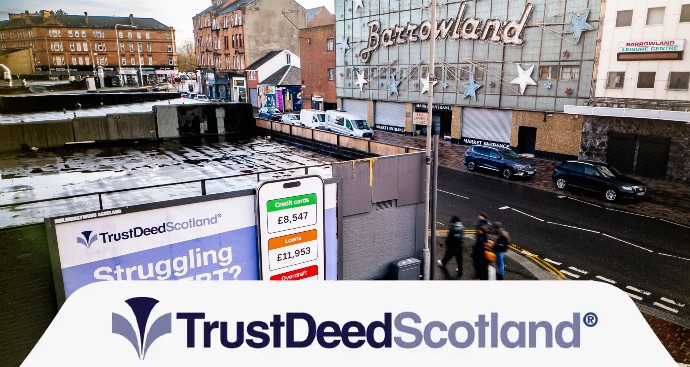
New research from Trust Deed Scotland reveals that stigma, silence, and sleepless nights continue to define Scotland’s debt crisis and that almost everyone who has struggled with unaffordable debt and sought help with us now wishes they had reached out for help sooner. In 2024 & 2025, we were Scotland’s largest provider of statutory Scottish debt solutions. Recently, we launched our biggest-ever national awareness campaign to encourage people across the country who are struggling with problem debt to seek support earlier, before the pressure becomes overwhelming and the situation harder to face. Our campaign is being heard nationwide on radio and seen across outdoor advertising in bus shelters and on billboards. At its centre is a striking 3D phone displaying the average debt of people who come to us for help. A stark, impossible-to-ignore symbol of a problem that too many people still feel forced to hide behind closed doors. The campaign is backed by insightful new findings from our latest customer survey of 2,829 people, offering one of the clearest pictures yet of how problem debt impacts lives across Scotland. not only financially, but emotionally and mentally too. The findings underline just how long many people endure the strain in silence before seeking support, and how different life can look once they finally do. As shared with several publications, including Evening Times and The National, the research highlights a powerful and consistent message: delaying debt advice often prolongs the stress, while taking that first step earlier can dramatically improve confidence, wellbeing and financial stability.

Stigma over Problem Debt is delaying action

Nearly half of the respondents told us they waited a year or more before asking for help. The biggest barriers were stigma and self-blame.
  • 61% said they felt ashamed or embarrassed
  • 45% believed they should be able to deal with the problem alone
  • 97% now say they wish they had sought debt advice sooner
Too many people suffer in silence, believing that struggling with debt is a personal failure. Our findings show the opposite: debt problems are common, often driven by circumstances beyond someone’s control, and solvable with the right support.

The hidden toll of debt in Scotland

Debt affects far more than finances. It impacts sleep, relationships, confidence and mental health.
  • 91% lost sleep worrying about their debt
  • 90% said it negatively affected their mental health
  • 88% hid their debt from family or friends
  • 82% worried about providing for their dependents
The cost-of-living crisis remains a significant driver. Many people told us they had cut back on essentials in an effort to cope:
  • 66% reduced spending on socialising and hobbies
  • One third cut back on food
  • 55% worked longer hours or took on multiple jobs to try to stay afloat
Behind every percentage is a person carrying an enormous emotional burden.

Seeking help can change everything

Crucially, our research also shows just how transformative the right debt solution can be. After entering a statutory debt solution such as a Protected Trust Deed, or the Debt Arrangement Scheme (DAS):
  • 90% say their mental health improved
  • 81% now feel comfortable talking about money
  • 94% feel more confident managing their household budget
  • Overall satisfaction with our services stands at 98%
These findings reinforce what we see every day: when people take that first step and ask for help, the weight lifts. The sleepless nights ease. Conversations become easier. Confidence returns.

Our message to people struggling with debt in Scotland

Through this campaign, we want to challenge the stigma that still surrounds debt and send a clear, simple message: You are not alone. And asking for help sooner can change everything. If you’re struggling with problem debt, support is available. Trust Deed Scotland can help you find out more about your options and take the first step toward a more affordable financial future.

Rising bills today could leave over 1 million people in Scotland short in retirement

Rising living costs are not just affecting today’s bills More than 1m people in Scotland could be undersaving for retirement, based on a Scotland-equivalent estimate of the latest Pensions Commission warning. The Pensions Commission’s interim report, published on 19 May 2026, warned that 15 million people across Britain are currently undersaving for retirement, with that figure potentially rising to 19 million without action. Scaled to Scotland’s share of the official population, that is equivalent to around 1.2 million people in Scotland today, potentially rising to around 1.5 million. For many households, this is not simply a case of choosing not to save. It is increasingly about whether there is anything left to save at all. At Trust Deed Scotland, our own customer survey data found that 55% of customers are working extra hours to deal with debts they can’t afford to repay in full. That paints a clear picture: many people are already stretching themselves just to cover everyday costs, before they can even think about building savings, emergency funds or pension pots.

Scotland’s retirement savings gap is becoming harder to ignore

Auto-enrolment has helped millions of workers start saving into a pension. But the Pensions Commission warned that the job is only ‘half done’, with many people saving only the minimum amount and others not saving into a pension at all. The Commission reported that 45% of working-age adults, around 18 million people, are not saving into a pension at all, despite nearly half of them being in work. Scaled by population, that is equivalent to around 1.4 million people in Scotland. MoneyWeek also reported that around 43% of the working-age population, equivalent to 15 million people, are undersaving based on retirement income replacement measures used by the Commission. That matters because the longer someone goes without saving enough, the harder it can be to catch up later.

Cost of living pressure is changing financial priorities

The challenge is that pension saving competes with immediate financial pressure. When rent, mortgage payments, council tax, food, energy bills and debt repayments are rising, long-term saving can feel out of reach. For someone already working extra hours to stay afloat, increasing pension contributions may simply not feel realistic. This is where the pensions debate connects directly with the cost-of-living crisis in Scotland. Rising costs are not only making it harder for people to save for retirement; they may also push some people to consider using existing savings pots earlier than planned. The Pensions Commission warned that, on current trends, around three in 10 private pension pots are accessed at the earliest possible opportunity, while half of all pots are taken out in full. Nearly half of these are spent on large expenses such as a car, holiday or home renovations. For people under serious financial pressure, the temptation to use long-term savings to deal with short-term problems can be strong. But it can come with consequences.

Should you use a pension pot to deal with debt?

Using pension savings to pay off debt may seem like a way to get breathing space, especially for those old enough to access some pension funds. But it is not a decision to rush. Taking money from a pension could leave you with less income in retirement. It may also affect tax, benefits, future financial security and the suitability of some debt solutions. This is especially important if you are already struggling with repayments. A pension withdrawal might reduce one pressure today but create new problems later.

What to do if debt is stopping you from saving

If debt repayments are making it impossible to save, the first step is to understand the full picture. That means looking at:
  • Your income, including wages, benefits and pension income
  • Essential living costs
  • Priority bills such as rent, mortgage, council tax and energy
  • Unsecured debts, including loans, credit cards, overdrafts and catalogues
  • Whether your current repayments are affordable
For people in Scotland, there may be formal debt solutions available depending on their circumstances. These can include the Debt Arrangement Scheme (DAS), Protected Trust Deeds, Sequestration, or other options. A Protected Trust Deed is not suitable for everyone, but for some people in Scotland it can help make unsecured debt repayments more manageable and may write off unaffordable unsecured debt after successful completion.

Saving for tomorrow should not mean ignoring today

The Pensions Commission’s findings show that Britain faces a serious long-term savings challenge. But in Scotland, the day-to-day reality for many people is more immediate: wages are being stretched, bills are rising, and extra hours are becoming necessary just to keep up. That is why conversations about retirement saving cannot be separated from conversations about debt and affordability. If you are struggling to save because debt repayments are taking up too much of your income, it may be time to get advice. Understanding your options could help you regain control of today’s finances and give you a better chance of planning for the future. If you live in Scotland and are worried about debt, Trust Deed Scotland can help you understand your options. You can check whether a Protected Trust Deed or another Scottish debt solution may be suitable for your circumstances. Use our Wizard tool to get started or give us a call on 0141 221 0999. You can also chat to an experienced debt adviser using our WhatsApp service.

Finance Tips for Scottish Students

As of 2023, outstanding loan debt owed by students in Scotland reached a record £7.6 billion. This number has only been climbing over the years, with the number haven almost doubled since 2018. With September 2024 approaching, many students across Scotland are looking forward to starting their new year. For many, this can come with a lot of financial concern.  

Financial Support for Students

Whilst we all struggle to keep up with rising costs, students are no different. Student loans and bursaries are hoped to reflect this. Higher education students who would have applied for the Care Experienced Accommodation Grant, will now be eligible to apply for a 12-month support package for the first time this year. This is in response to concerns over students struggling to pay for essentials and priority payments such as rent during the summer. This year, the annual support package will also be increased by £2,400 to £11,400 for undergraduates. We urge any students in need of financial support to make their applications as early as possible. Delayed applications can result in delayed pay and harm your financial situation further. Check your deadline dates for The Student Awards Agency Scotland (SAAS) here.  

Students Working Longer Hours to Cope with Rising Costs

Students, alike all of us across Scotland, are looking for financial support to cover the cost of living crisis. With a record 56% of UK students working whilst studying. The cost of living is likely a direct cause of this new record number. Before 2021, two-thirds of students had no paid employment during term time. With this number not only rising in 2024, but students were also found to work longer hours than students from previous years. On top of this, the report by the Higher Education Policy Institute (Hepi) found that 33% of students who didn’t work during term time said it was because they couldn’t find a suitable job. Only 23% of students said that they didn’t need to work during term time. Unfortunately, this creates a strong imbalance between students who must split their time between study and long working hours and students who are able to put their full attention to their studies. On average, students with part time jobs would spend 48 hours per week on study and work, with some reaching 56 hour weeks. When comparing this to the average work week for adults, at 37 hours per week, this is an extreme jump. The long hours can lead to students over-working themselves and become more inclined to drop out and experience a reduced chance of gaining a higher grade.  

Student Foodbank Use Increased

This year, a new report by National Union of Students found that student foodbank use has doubled in the last 2 years. With 7% of students reporting foodbank use in the 2021/ 2022 academic year to 14% in 2023/ 2024. The same study found that 45% of students were left with £50 or less per month after housing costs in 2024. Whereas, 42% of students in a 2022 report were left with £100 or less per month. It was also reported that for the 2023/ 2024 academic year:
  • 75% of students said their loan or bursary did not comfortably cover the cost of living.
  • 74% said they cut back on socialising because of rising costs.
  • 55% said they cut back on food.
  • 13% said they have experienced homelessness.
The impact of financial difficulties on mental health is a problem for all of us, students included. 40% of students reported a decrease in their mental health since last year.  

Young People in Debt

44% of people in the UK get their first credit card between 18 and 24 years old. Nearly half of people between 18 and 24 years of age also held 3 or more credit cards. However, despite this, their understanding of how credit cards work was lacking. 75% of young people surveyed did not know what APR stood for and 41% we unable to say when they would start paying interest. 53% of 18-24 year olds have missed a payment in the previous 2 years as well as 11% increasing their credit limit due to the cost of living crisis.  

Money Management for Students

Debt building from credit cards, overdrafts, everyday loans and guarantor loans are real possibilities for young people and students. Once you agree to any type of credit or financial agreement such as these, you must follow through on the payments otherwise it will be legally considered as debt. We know that circumstances can change and students especially can struggle as financial support varies through the year. Make sure to bear this in mind when agreeing to any type of credit agreement. The key to managing finances, including an overdraft successfully, is to fully understand their potential pitfalls as well as how and when you will pay it all back. It’s important to create a realistic budget for this that includes emergency funds. Our main piece of advice is to fully research the financial agreements you enter into beforehand and have a financial plan to stay on top of your repayments. Opportunities such as a 0% interest rate overdraft are an appealing choice for students, however repayments and eventual fees can accumulate quickly. Find out more information on overdrafts as a student.  

Overdraft Fees

Many banks offer student accounts with a large overdraft at 0% interest (for a certain period of time). For a lot of students, this can be the difference between purchasing essential items and going without. It can be a great tool for when funds are running low. In the National Student Money Survey by Save The Student, 35% of students said that they use their student overdraft as a source of income. It’s tempting to view your student overdraft as free money however, it’s important to understand that this is a loan to your bank. It should be used as an emergency fund or as an option to dip into when necessary, with the awareness that it will need to be paid back, ideally as soon as possible. During Freshers week as a student, many banks will approach you with offers for student accounts that come with large, and often interest-free (for a time!) overdrafts. Make sure to do your research into all available options before committing to one – if any. Read up on the advantages and disadvantages of student overdrafts before making any decisions.  

Buy Now Pay Later

Buy Now Pay Later providers such as Klarna, PayPal, Clearpay and Amazon can be a great option for you spread costs. So many stores offer Buy Now Pay Later payments to help with clothing, food, and student essentials such as stationery, textbooks, kitchen equipment, and even online subscriptions providing access to articles. This can look like a great option; however, this is only if you are able to manage these ongoing payments.

The Dangers of Buy Now Pay Later

It’s important to understand that Buy Now Pay later is a form of credit. By taking out this credit, you are agreeing that Buy Now Pay Later providers can take action against you if you do not pay this back on time. You will be in debt to the company. This can lead to potential fees, making it harder to pay back as well as the potential for debt collection action. On top of this, Buy Now Pay Later is not a regulated agreement, meaning it is easy to take out more than you can afford.  

Help with Debt as a Student

When you’re studying, you’re often on a very low income and have to rely on bursaries and student loans in order to cover your living costs. Sometimes it’s possible to find part-time employment that works around your studies, but even with this you may still find that your money only stretches so far. If you’re struggling to make the payments on credit cards, store cards or loans as well as paying your rent and buying food, you may need debt help. The longer you wait, the worse your situation will get. Get in touch with a team of experienced debt advisers at Trust Deed Scotland ® for tailored, confidential and non-judgmental advice. We understand that people from all walks of life can find themselves dealing with unaffordable debt for various reasons. We will never judge. Get in touch today by calling 0141 221 0999. Alternatively, find out if you’re eligible to apply for a formal Scottish debt solution through the Trust Deed Scotland Wizard ® tool. You can also reach us on WhatsApp if you are unable to take a call.
Talk Money Week 2024

The 4th November 2024 marks the start of UK Talk Money Week. The annual event is run by Money and Pensions Service, usually falling on the second week of November. Talk Money Week is a time for debt charities and companies including Trust Deed Scotland® to speak out and encourage people across the country to open up about their money and debt worries. We want to highlight that although this week has a strong focus on talking about money, Talk Money Week also brings awareness to the importance of having these conversations all year round. For all ages, talking about money is extremely valuable – from pocket money to pensions. By opening up and sharing our experiences and knowledge, we can create a brighter financial future for us all.  

Do One Thing

The focus of Talk Money Week’s is to encourage people to Do One Thing that could help improve their financial wellbeing – whether a small or big act – and encourage others to do the same. They suggest talking to a child about pocket money, using one of the free tools or calculators, or getting financially educated.  

Talk Money Week Podcast Episode

For Talk Money Week 2024, Trust Deed Scotland® alongside Blethered with Sean McDonald spoke to one of our previous customers, Becky about her experience with unaffordable debt. This inspiring episode is an important one for Trust Deed Scotland®, we often speak about the importance of our TrustPilot reviews in showing people across Scotland that debt happens, and there is help available. However, this informal chat with Becky dives deeper and illustrates how easy it can be to have debt. Becky completed a debt solution and has recently shared the exciting news that she is a homeowner. Her story can help to inspire many more people across Scotland, listen here.  

The Importance of Talking About Money Debt

A key focus of Talk Money Week every year is to encourage conversations about unaffordable debt. By having this conversation, you can improve your physical, mental and financial wellbeing. Money and Pensions research shows that talking about money can help you to:
  • Make better and less risky financial decisions
  • Have stronger personal relationships
  • Help your children form good lifetime money habits
  • Feel less stressed or anxious and feel more in control
With money conversations involved in everyday lives, you can build financial confidence and resilience to face whatever the future throws at us. For Talk Money Week, start this conversation in any walk of life, including:
  • In your workplace
  • At home with friends and family
  • In educational establishments, or with debt charities
  • With the people to who you owe money to
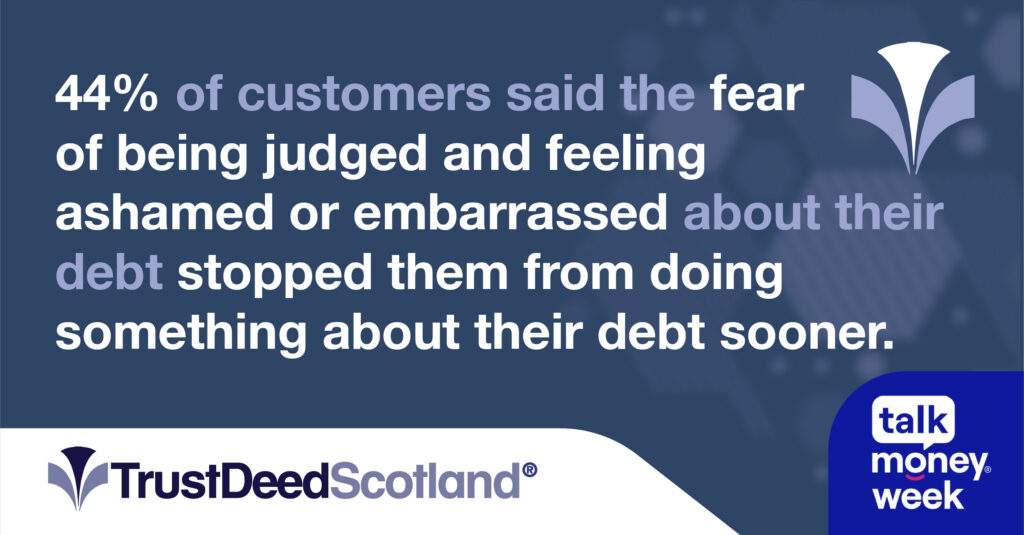
However, we understand that isn’t easy talking about money and debt. In our most recent survey, 44% of our customers said that the fear being judged, or feel embarrassed or ashamed of their debt when the truth is problem debt can happen to anyone.

How long do people wait before getting help with their debt?

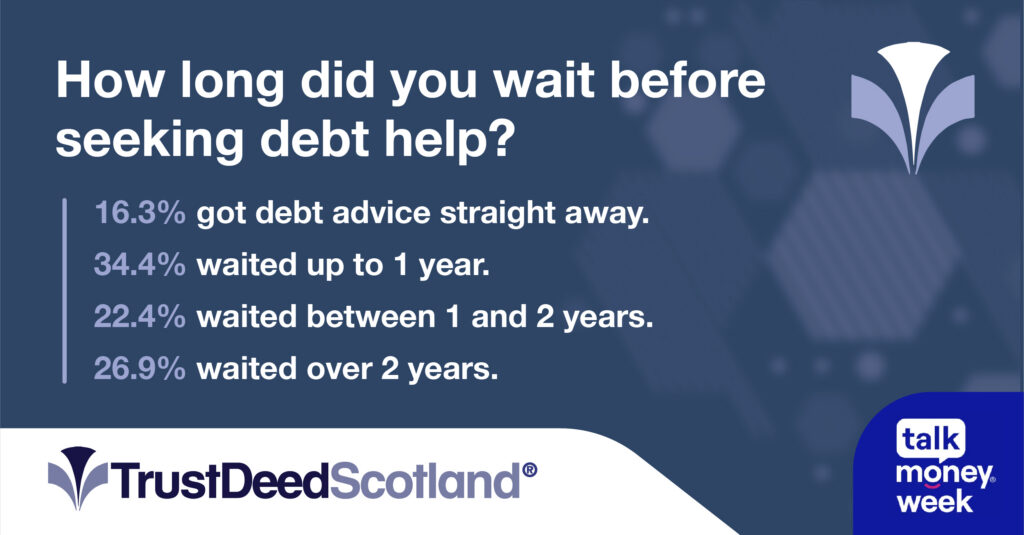
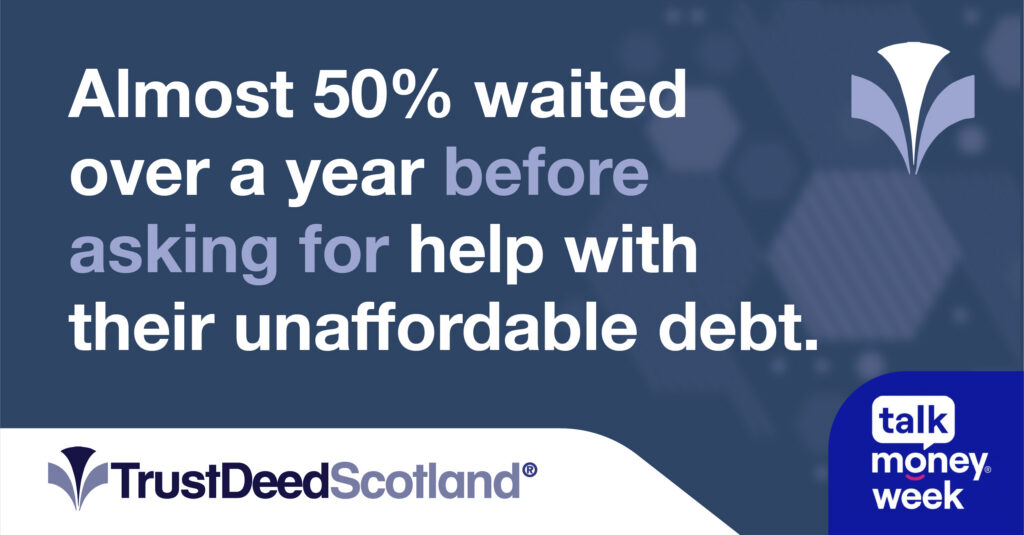
In a 2024 customer survey of existing Trust Deed Scotland® & Harper McDermott customers…
  • 16.3% got debt advice straight away.
  • 34.4% waited up to 1 year before getting debt advice.
  • 22.4% waited between 1 and 2 years before getting debt advice.
  • 26.9% waited over 2 years before getting debt advice.
Almost 50% waited over a year before finally asking for help with their unaffordable debt.
What type of debts worried our customers most?

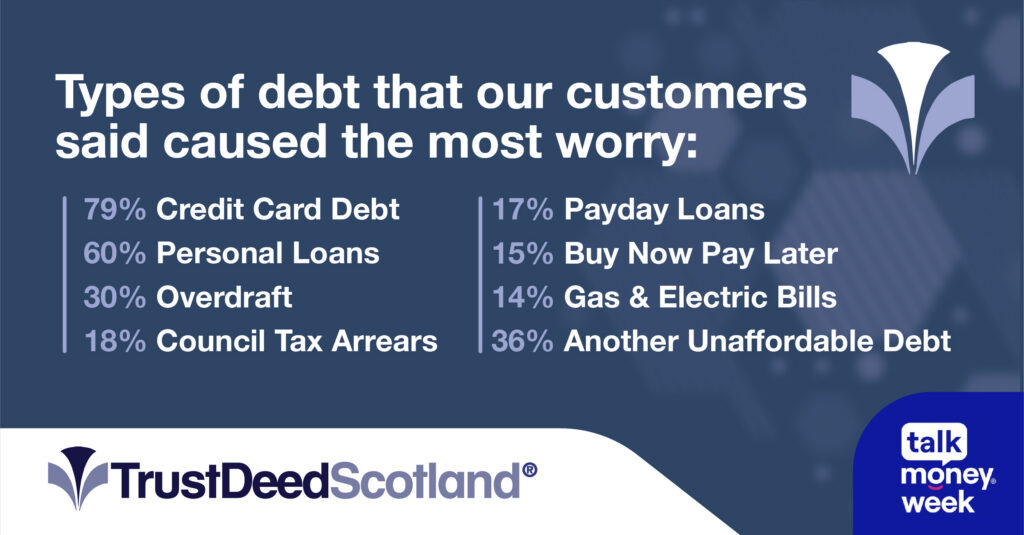
Credit card debts are the most troublesome type of debt that our customers encounter.
  • 79% were worried about credit card debt
  • 60% were worried about personal loans
  • 30% were worried about their overdraft
  • 18% were worried about council tax arrears
  • 17% were worried about payday loans
  • 15% were worried about buy now pay later
  • 14% were worried about gas and electric bills
  • Lastly, 36% were worried about another type of unaffordable debt (including HMRC, DWP, Mortgage arrears, rent arrears and car finance)

What impact did debt have on our customers’ mental health?

We asked our customers if their mental health or physical health was impacted by their debt problem.
  • 93.1% of customers lost sleep worrying about their debt.
  • 90.9% of customers said that their mental health was impacted before entering into a debt solution.
  • 89% of customers said that their mental health improved after entering their chosen debt solution.
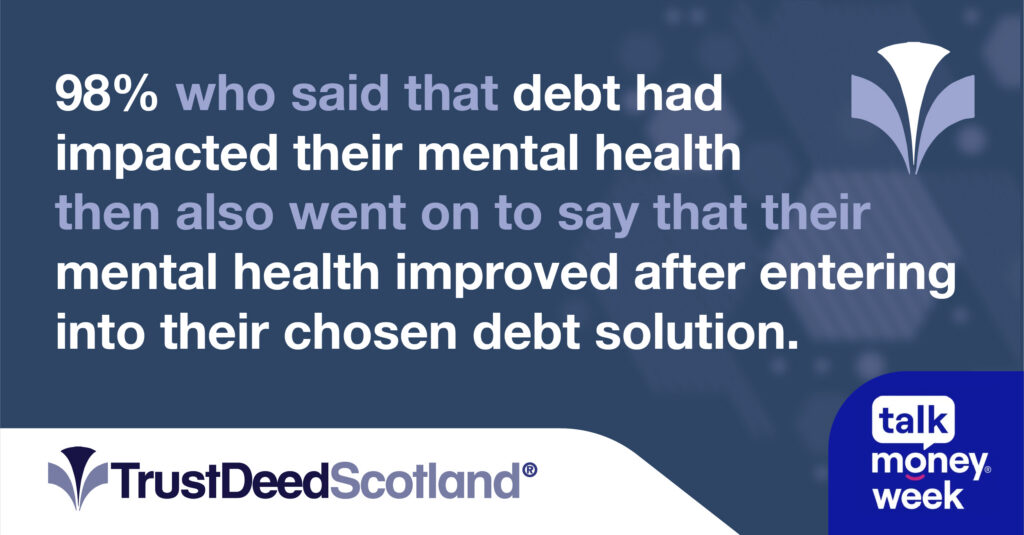
Of those who said that debt had impacted their mental health, 98% also said that entering into a debt solution improved their mental health.

What do people who have previously started a conversation with Trust Deed Scotland® say about their experience?

At Trust Deed Scotland® we currently have over [reviews] reviews from our customers, with a rating of 5/5 rating on TrustPilot. Our Trust Deed Scotland reviews are just as important to us, not only as a signal that our customers are happy with the service that they have received from us but also because they allow people with problem debt in Scotland to find other individuals who were once in the same position that they too find themselves in. We’re always keen to take action on any feedback that we receive to make improvements to our processes wherever we can and continuously improve our own learning and development as a leading Scottish debt solutions provider. Our experienced debt advisers received reviews in the run-up to Talk Money Week 2024 which perfectly described many of the feelings that individuals have when they’re looking for help with their unaffordable debt… Matthew McNally was our adviser from the very start and he guided us through one of the toughest periods of our lives and put our minds at ease from the beginning. Our financial situation arose due to one of our children being diagnosed with cancer and my wife and I having to stay off work to care for her. Matthew was extremely understanding and promised to find a solution for us, which he did. As a result he was able to relieve one of our worries and stresses and put us in a much better financial position where we could focus entirely on the care for our daughter going forward.” – Paul Jacqui was really incredible. It’s really nerve wrecking to make that call, there’s lots of questions to answer and it can feel really embarrassing and overwhelming. Jacqui was super patient, really helpful and helped put my mind at ease. I didn’t feel judged, I felt really supported and comfortable through the whole process. Now a huge weight is off my shoulders and things feel a bit more normal again.” – Heather “Debt adviser Jason made my entire time better than I could of imagined. He’s not only professional and good at his job, he went and above beyond for me with nice thoughtful words and positivity towards my unfortunate life situations.” – Dale “I was a bit scared and embarrassed to call but once I made the call Michael reassured me straight away, I felt that Michael went above and beyond and helped me through everything, 100% tremendously made me feel better in myself as well.” – Derek “The help and advice I received from Anisah was absolutely outstanding. I cannot thank her enough for helping me manage my debts that I didn’t think I would or could ever get out off. As you can imagine, it feels like a massive weight has been lifted off my shoulders and I can breathe again.” – Lee-Anne  

Start a conversation about your unaffordable debt

Our experienced, friendly debt advisers offer tailored debt advice and explain the advantages and disadvantages of any formal debt solutions that you may be eligible for. You can contact Trust Deed Scotland® on 0141 221 0999 or use the Trust Deed Scotland Wizard® Tool to find out more about your options.

Talk Money Week 2025

The 3rd November 2025 marks the start of UK Talk Money Week. The annual event is run by Money and Pensions Service, usually falling on the second week of November. Talk Money Week is a time for debt charities and companies, including Trust Deed Scotland® to speak out and encourage people across the country to open up about their money and debt worries. We all think about money way more than we talk about it. Talk Money Week is here to get the conversation started, whether it’s about saving, debt, or just getting by.

Ready to start the conversation?

  Chatting about money isn’t always easy. It can feel a bit uncomfortable, maybe even a little nerve-wracking. But honestly? There are many tougher things to talk about. Money shouldn’t be one of them. The more we talk about it, the more normal it becomes and before long, it’s just another everyday conversation.

The Importance of Talking About Money Debt

A key focus of Talk Money Week every year is to encourage conversations about unaffordable debt. By having this conversation, you can improve your physical, mental and financial wellbeing. Money and Pensions research shows that talking about money can help you to:
  • Make better and less risky financial decisions
  • Have stronger personal relationships
  • Help your children form good lifetime money habits
  • Feel less stressed or anxious and feel more in control
With money conversations involved in everyday lives, you can build financial confidence and resilience to face whatever the future throws at us. For Talk Money Week, start this conversation in any walk of life, including:
  • In your workplace
  • At home with friends and family
  • In educational establishments, or with debt charities
  • With the people to who you owe money to
However, we understand that isn’t easy talking about money and debt. In our most recent survey, 44% of our customers said that the fear being judged, or feel embarrassed or ashamed of their debt when the truth is problem debt can happen to anyone.

How long do people wait before getting help with their debt?

In a 2024 customer survey of existing Trust Deed Scotland® & Harper McDermott customers…
  • 16.3% got debt advice straight away.
  • 34.4% waited up to 1 year before getting debt advice.
  • 22.4% waited between 1 and 2 years before getting debt advice.
  • 26.9% waited over 2 years before getting debt advice.
Almost 50% waited over a year before finally asking for help with their unaffordable debt.
What type of debts worried our customers most?

Credit card debts are the most troublesome type of debt that our customers encounter.
  • 79% were worried about credit card debt
  • 60% were worried about personal loans
  • 30% were worried about their overdraft
  • 18% were worried about council tax arrears
  • 17% were worried about payday loans
  • 15% were worried about buy now pay later
  • 14% were worried about gas and electric bills
  • Lastly, 36% were worried about another type of unaffordable debt (including HMRC, DWP, Mortgage arrears, rent arrears and car finance)

What impact did debt have on our customers’ mental health?

We asked our customers if their mental health or physical health was impacted by their debt problem.
  • 93.1% of customers lost sleep worrying about their debt.
  • 90.9% of customers said that their mental health was impacted before entering into a debt solution.
  • 89% of customers said that their mental health improved after entering their chosen debt solution.
Of those who said that debt had impacted their mental health, 98% also said that entering into a debt solution improved their mental health.

What do people who have previously started a conversation with Trust Deed Scotland® say about their experience?

At Trust Deed Scotland® we currently have over [reviews] reviews from our customers, with a rating of 5/5 rating on TrustPilot. Our Trust Deed Scotland reviews are just as important to us, not only as a signal that our customers are happy with the service that they have received from us but also because they allow people with problem debt in Scotland to find other individuals who were once in the same position that they too find themselves in. We’re always keen to take action on any feedback that we receive to make improvements to our processes wherever we can and continuously improve our own learning and development as a leading Scottish debt solutions provider. Our experienced debt advisers received reviews in the run-up to Talk Money Week 2024 which perfectly described many of the feelings that individuals have when they’re looking for help with their unaffordable debt… Matthew McNally was our adviser from the very start and he guided us through one of the toughest periods of our lives and put our minds at ease from the beginning. Our financial situation arose due to one of our children being diagnosed with cancer and my wife and I having to stay off work to care for her. Matthew was extremely understanding and promised to find a solution for us, which he did. As a result he was able to relieve one of our worries and stresses and put us in a much better financial position where we could focus entirely on the care for our daughter going forward.” – Paul Jacqui was really incredible. It’s really nerve wrecking to make that call, there’s lots of questions to answer and it can feel really embarrassing and overwhelming. Jacqui was super patient, really helpful and helped put my mind at ease. I didn’t feel judged, I felt really supported and comfortable through the whole process. Now a huge weight is off my shoulders and things feel a bit more normal again.” – Heather “Debt adviser Jason made my entire time better than I could of imagined. He’s not only professional and good at his job, he went and above beyond for me with nice thoughtful words and positivity towards my unfortunate life situations.” – Dale “I was a bit scared and embarrassed to call but once I made the call Michael reassured me straight away, I felt that Michael went above and beyond and helped me through everything, 100% tremendously made me feel better in myself as well.” – Derek “The help and advice I received from Anisah was absolutely outstanding. I cannot thank her enough for helping me manage my debts that I didn’t think I would or could ever get out off. As you can imagine, it feels like a massive weight has been lifted off my shoulders and I can breathe again.” – Lee-Anne  

Start a conversation about your unaffordable debt

Our experienced, friendly debt advisers offer tailored debt advice and explain the advantages and disadvantages of any formal debt solutions that you may be eligible for. You can contact Trust Deed Scotland® on 0141 221 0999 or use the Trust Deed Scotland Wizard® Tool to find out more about your options.

Cost of Living Crisis: More Scots Forced to Cut Back in 2025

More Scots Feeling the Squeeze as Cost of Living Pressures Bite – Which? Report. Households across Scotland are continuing to feel the strain of rising prices. According to new research from Which?, more than half of UK households have had to make at least one financial adjustment in recent weeks just to keep up with everyday essentials. This is the highest level seen so far this year. The Which? survey found that 52% of people said they’d had to take action to cover daily costs such as food shopping, energy bills, rent or mortgage payments, school items or prescriptions. If those numbers were applied across the UK, it would mean around 14.8 million households have made changes to cope with rising costs, the highest level since December 2024. The survey of more than 2,100 people across the UK was carried out between 17 and 19 October. People said they had been cutting back on essentials, dipping into savings, selling belongings, or borrowing money to get by. Those on lower incomes were particularly likely to say they’d had to go without.

Cost of Living in Scotland

Here in Scotland, our own 2024 Trust Deed Scotland® Customer Survey found similar patterns. When asked what actions they had taken to combat the cost of living crisis:
  • 66% said they had cut back on socialising or hobbies
  • 31% said they had cut back on heating
  • 34% said they had cut back on buying food
  • 20% said they had borrowed money from family or friends
We also asked those struggling with problem debt about the impact of interest and charges being added to what they owed. Over 93% told us it made their situation worse. And 62% said they had taken on longer hours or even extra jobs just to make payments. The Scottish government released a report in February 2025, amongst its findings, it reported rising levels of food insecurity. Food insecurity is the lack of reliable access to enough affordable, nutritious, and safe food. It can range from reducing the variety of diets to members sometimes disrupting eating patterns or going without food due to a lack of resources. The Which? report found that the number of households missing at least one essential payment, such as rent, mortgage, utilities or loan repayments, was 5.5% in October. Applying the same percentage to Scotland’s population suggests that around 140,000 Scottish households may have missed at least one essential payment during that period. This is only an estimate, as both the Which? survey and the National Records of Scotland household data are based on sample and census estimates rather than exact numbers. Which? warned that more households are still making financial sacrifices just to stay afloat as we head into the colder months and the expensive festive period. Looking ahead, one in five (20%) people believe their financial situation will improve over the next year, while about a third (34%) expect things to get worse. Those who expect things to deteriorate cited the rising cost of food, energy bills and inflation as key concerns. Some also mentioned worries about possible tax rises and government policies.

If You’re Struggling With Debt, You’re Not Alone

At Trust Deed Scotland®, we speak to hundreds of people every month who are in the exact same position. The rising cost of living has made it harder for many to stay on top of bills and debts, even when they’re working full-time or more than one job. If you’re feeling overwhelmed, it’s important to know that there’s help available. We’ve helped thousands of people across Scotland reduce their monthly payments, write off unaffordable debt, and find a way forward. You don’t have to face it alone. Our team is friendly, understanding and here to help you make sense of your options. Take the first step today and see if you qualify for help. Use our Trust Deed Wizard or speak with one of our experienced advisers on 0141 221 0999.  

Pet Costs in 2024

With nearly 60% of us in the UK owning a pet, we are clearly a nation of animal lovers. Bringing us comfort, companionship, and – of course – the joy from the adorability of our furry friends; it goes without saying that we have never-ending love for our pets. However, owning a pet doesn’t come cheap.  

Why You Should Consider the Cost of a Pet Beforehand

With the number of UK households owning a pet rising from 40% in 2019, to 62% in 2022, we stress the importance of understanding the costs of owning a pet before committing. More than 1 in 10 dog owners in the UK are now in debt due to the cost of pet care. As well as 33% borrowing money to pay for unexpected pet bills. If not properly considered, the costs of owning a pet can lead to an inability to look after your pet, or an inability to provide them with a good quality of life. Sadly, many Dogs Trust’s centres have been finding themselves at full capacity, with an increasing number of pets brought in with untreated health conditions. Pet owners are simply finding the costs too steep. For anyone considering owning a new pet, it’s important to check that they can fit their pet’s daily expenses into their budget but any unexpected costs that may arise.  

What are the Costs of Owning a Pet?

The costs of owning a pet are dependent on the animal, breed and level of care you want to provide. Read below to get a rough idea of how much a pet costs. On average;
  • Owning a dog in the UK has a lifetime cost of £30,800.
  • Owning a cat in the UK has a lifetime cost of £12,000 – £24,000.
  • Owning a rabbit in the UK has a lifetime cost of £6,500 – £9,000.
  • Owning a fish in the UK will be more low-income friendly than the above pets, averaging at a few thousand pounds through their life.
Check the RSPCA Pet Calculator for a more accurate cost estimate.  

What Pet Costs Should You Factor into your Budget?

In a 2023 Trust Deed Scotland® customer survey, 25% of our customers told us that a lack of control over their finances was the biggest cause of their financial difficulties.* Creating and sticking to a well-planned budget will help you to stay on top of your finances and leave enough money to spend on what’s important to you – or who! A well-planned budget will help you to make room for a happy and well taken care of pet. Costs of pets that you should consider:
  • Upfront payments
  • Pet insurance
  • Medical bills/ vet fees
  • Pet grooming
  • Pet food
  • Vaccinations
  • Lodging (kennels and catteries)
  • Accessories (from toys to pet beds)
 

Rising Costs of Living

The rising costs of living affect our finances across the board. With vets also impacted by rising costs, you can expect higher fees for you and your pet. With many people across the country already cutting costs, many pet owners are also forced into cost-cutting decisions for their pet care which is likely to negatively impact their pet’s health. For example, skipping vaccines, worming treatments and emergency treatments that are now unaffordable people across the UK. A report by Pets4Homes found that 25% of pet owners were skipping trips to the vet as a direct impact of the high costs. Some pet owners may be eligible for help with their Pet’s healthcare from the PDSA. The UK animal charity that helps pets in need and in order to qualify for their help, you would typically be in receipt of benefits and live within certain areas throughout Scotland, or the wider UK. Use their pet health care eligibility calculator to find out more.  

What to Do if You Are Struggling with Your Finances

If you are struggling to keep up with payments and everyday costs, it’s important to reach out for advice as soon as possible. Money problems can quickly snowball into unaffordable debt; and, once in debt, it can be extremely difficult to get yourself out again. We know that taking care of your debt can feel like an intimidating experience. The fear of being judged or feeling ashamed or embarrassed about debt stopped 44% of our customers from reaching out sooner.* The truth is that problem debt can happen to anyone. Our non-judgemental and friendly debt advice team are here for you, you’re not alone! So, if the rising costs for your household have seriously impacted on your finances, reach out to us on our WhatsApp Debt Advice Service, or on 0141 221 0999. *Trust Deed Scotland® Customer survey from November – December 2023, with 2,246 customer responses.

UK Clothing Poverty Awareness Week

This week is Sharewear Clothing Scheme’s national awareness campaign to highlight the problem of clothing poverty throughout the UK. With the rising cost of living impacting people across the country, it is extremely important to discuss all struggles caused by this, including the impact on the Right to Clothing. With an 11% rise in clothing prices, access to this right is becoming more and more difficult. For people dealing with unaffordable debt, clothing can be one of the first expenses to cut, regardless of how necessary it may be. UK Clothing Poverty Awareness Week hopes to share the belief that the Right to Clothing should have more importance in UK law.  

Clothing Poverty: The Hidden Problem

The UK’s problem with clothing poverty is a stark comparison alongside our growing problem with textile waste. In the UK, the equivalent of £12.5 billion worth of clothing is sent to landfill every year. If you are able to enjoy a new outfit for every event, or you are leaving 73% of your wardrobe untouched, then it’s hard to see the other side; where children are going to school with re-worn uniforms and adults are struggling to afford appropriate wear for an interview. There are an estimated 5.5 million adults experiencing clothing deprivation in the UK; and this number has likely grown in the wake of the cost of living crisis. Many of us are unaware of the depths to which this problem is affecting people across the country. So, clothing poverty is often described as a “hidden problem”. However, people affected by this can include anyone from homeless people, to families who are struggling to make ends meet and so cutting costs on essential clothing, to people who are unable to purchase new clothes once their old ones are worn through or outgrown.  

Cutting Costs by Cutting Back

The cost of living crisis has many of us cutting back on both essential and non-essential expenses. Almost 2/3rds of people across the UK are struggling to pay for grocery shopping, essential travel and household bills. Most of Scottish Government’s People’s Panel members reported that they changed their behaviour as a direct result of rising costs, including clothing, also reporting that they are buying clothes less frequently. A recent survey found that 51% of people across the UK said they will cut spending in 2024. And for those who had cut back on spending, 62% said they had cut back on clothing (as the 2nd most voted for behind eating out). The survey also found that the most important factor when purchasing is price. Shockingly, a recent study reported that 1.4 million people across Scotland regularly sit in the dark to save money on household bills. And close to a quarter of a million have cut spending on their children’s clothes. In a 2023 Trust Deed Scotland® customer survey, we asked our customers what actions they had taken to combat the cost of living crisis¹:
  • 78% cut back on socialising.
  • 46% cut back on heating.
  • 44% cut back on buying food.
  • 28% borrowed money from family or friends.
  • 11% took on additional credit.
 

How to Get Help

We know that one unaffordable expense can quickly lead to an inability to pay for other essential payments. As this builds up, people can find themselves in unaffordable debt. With rising costs for all our expenses including clothing, many of us are struggling to make ends meet. If it’s become too much to handle, there is help available. If you find yourself dealing with unaffordable debt, there are many debt solutions available to you. We are leading Scottish debt help providers, specialising in debt solutions such as Protected Trust Deeds and the Debt Arrangement Scheme. To find out how we can help you, please get in touch.   ¹ Survey results taken from November – December 2023 with 2,246 responses.

Scots Worried About Household Bills

A new report has revealed that six in ten Scots are worried about being able to afford their household bills as a result of the cost-of-living crisis. Two thirds of people in Scotland have cut back on non-essential spending, with two million having to cut back on everyday essentials such as food and heating. Citizens Advice Scotland has said that more people required food banks referrals in January 2023 than ever before. Millions of food parcels were handed out last year, with almost half going to children. The cost-of-living crisis has plunged 70% of Scottish households into fuel poverty and debt, but help is available for the millions who are struggling.  

Energy Crisis

The Office for National Statistics has revealed that, in the last 12 months, gas prices have increased by an average of 129%, taking the average household energy and gas bills to over £200 a month. A further 20% rise in energy bills is expected in April this year. Demand for support with energy bills has overtaken the number of people seeking help with universal credit for the first time ever and is three times higher than it was before the COVID-19 pandemic. A household is described as being in fuel poverty when 10% or more of their income is spent on heating and other energy bills. Many people are falling behind on payments to their energy suppliers due to the high costs, causing them to fall into debt.  

Debt

A third of people in Scotland started 2023 in debt. Advice Direct Scotland, have revealed that 17% have fallen behind with repayments in the last few months, with the most common forms of debt being energy bill arrears, council tax arrears, and credit cards. A quarter of those owing money are in over £10,000 worth of debt. However, the cost-of-living crisis has caused a third of households to turn to credit cards and loans to keep up with everyday costs. A rise in debts means a rise in required repayment amounts and this cycle is pushing struggling households further into their debt. 2.3 million households in Scotland missed at least one of their January payments and over half have not yet sought any form of help. The stigma surrounding debt is affecting those who need help. People who have never found themselves in debt before are now struggling to keep up with the amounts that they owe.  

Mortgages

Mortgage interest rates are a heavily discussed topic at the moment. Average interest rates are expected to rise to between four and five percent, and those with fixed term contracts set to expire in the next 12 months will be expected to keep up with the rising costs. 47% of people with mortgages are worried about affording their monthly payments. This figure rises to 55% amongst those who rent. Higher taxes and inflation are the root cause for higher interest rates, which means that the costs are set to continue rising. Reports have found that many people who are afraid of falling behind on mortgage payments are falling into debt to avoid losing their homes.  

Self-employment

The national minimum wage has been increased in an attempt to aid low-income households during the crisis. However, those who are self-employed do not benefit from this and not everyone has the same ability to increase their charge rates. The cut back on non-essential spending has also seen many self-employed individuals lose business and fall into financial difficulties. The lack of job security for both zero-hours workers and those who are self-employed is adding to the debt problem millions in Scotland are facing. The drop in income has also affected individuals’ ability to pay their income tax.  

Vulnerable Groups

More than 60,000 disabled adults have fallen into debt, which has forced many to live without essential care and support. Social care is free to adults in Scotland over the age of 65, but for those under that age, the costs are adding up. Costs are at the discretion of local councils, and some offer free care for all ages if other criteria are met. The average cost in Scotland is £832 a week for nursing care and £719 a week for residential care. Councils have taken an increased amount of action on those who have fallen behind with the rising costs of their social care.  

Worried about household bills and struggling with debt – What to do?

If you are worried about your household bills and you are struggling with debt – Help is available. Our doors are always open at Trust Deed Scotland® where we offer tailored debt advice and support. By using our Trust Deed Wizard tool, you can get in contact with us and we can help formulate a decisive plan to reduce your debts. Our advisers can change people’s lives for the better. We can advise on several effective solutions such as a Trust Deed, the Debt Arrangement Scheme and Minimal Asset Process sequestration which can reduce and eventually stop harassment from the people you owe money to and help put you back in control of your financial situation. We believe that with the right advice, people in debt can regain command of their finances, and feel empowered about their options, rather than fearing about enforcement agents and other debt collection practices. If you require support, then please do not hesitate in contacting a member of our experienced debt advice team today.

International Workers Day 2023

The cost-of-living crisis is set to plunge 460,000 people in Scotland into debt. A further 644,000 people are predicted to be pushed further into their existing debts. For International Worker’s Day, we want to recognise the millions of people who are overworking to stay afloat financially. Across the UK, over four million people are considering taking on a second job to combat the cost-of-living crisis. Despite this, 88% of working people in the UK have experienced a burnout in the last two years and 27% said that working longer hours makes them feel depressed. No employer in the UK can legally ask you to work more than 48 hours a week. However, those on low incomes may be struggling to afford basic living costs. Therefore, may be looking for additional employment to plug the gap in their finances. Here at Trust Deed Scotland®, we are seeing more people than ever who have been forced to turn to credit to fund everyday essentials. We calculated that those on minimum wage are likely to be in a deficit each month after basic household funds were deducted.  

Debt Help in Scotland

If you are struggling with unaffordable debt, debt help is available in Scotland. Here at Trust Deed Scotland®, we specialise in formal Scottish debt solutions designed to reduce your overall monthly payments and get you back in control. Our experienced advisers give debt advice tailored to you that can allow you to make an informed decision on whether a formal debt solution is right for you.  

A Trust Deed

A Trust Deed is a voluntary but legally binding agreement between you and the people you owe money to, where you agree to make an affordable payment each month. This allows you to make payments towards your debts, typically over four years, and once your Trust Deed is completed the remainder of the debt is legally written off. Once your Trust Deed has been approved, your creditor contact will reduce, and they can no longer take any court action against you to collect the debt. All interest and charges to your debts will also be frozen. In January 2023, borrowers in the UK paid £156 million pounds in interest a day. To qualify for a Trust Deed, you must be living in Scotland and have debts above £5,000.  

The Debt Arrangement Scheme

The Debt Arrangement Scheme (DAS) allows you to repay your debt at a manageable level for you, also freezing all interest and fees. To qualify you can have any amount of debt but must not be in any other formal debt solution. Like a Trust Deed, the DAS is also legally binding and the people you owe money to are not able to contact you or take any court action against you. Payment breaks of up to six months due to unemployment or illness are also available while you are in a Debt Payment Programme (DPP). The DAS will last until the debt is cleared but it will protect assets such as your home and cars.  

Facing Redundancy

There were 90,000 redundancies in the last three months in the UK. It can be difficult to secure another position quickly and many people may be left unemployed for extended periods of time and relying on benefits. For those struggling to adjust to their reduced income or struggling with unaffordable debt, either the Minimal Asset Process (MAP), or a Statutory Moratorium may be the best solution. Minimal Asset Process is a route into Sequestration, which is the Scottish form of bankruptcy. The Minimal Asset Process allows you to write off your unsecured debts in a short period of time if you are on a low income with no disposable income left after covering your essential living costs or your income is only from income dependent benefits. A Statutory Moratorium effectively stops creditor action against you for 6 months, offering you valuable time to seek advice and think about your longer-term options. It is not a debt solution, it doesn’t write off debt and does not stop interest and charges from building up, but it does give you time to think and will stop imminent creditor action, such as a wage arrestment or a bankruptcy petition. Regardless of your previous situation, you are not alone. In Scotland, there were 21 people a day who registered as insolvent or bankrupt between October and December 2022. Here at Trust Deed Scotland®, we will never judge you. All advice is completely confidential and seeking advice does not oblige you to follow through with a debt solution.