Coping with the Cost of Living Crisis on a budget

The cost of living crisis is set to plunge over 460,000 people in Scotland into debt for the first time. To add to this, a third of UK adults have said that they are struggling to afford their rent or mortgage payments. 46% of Scots have cut back on their non-essential spending in an attempt to combat the crisis. The cost of living crisis does not seem to have an end date in sight and millions are left with an adapted life. By reducing the amount of money that they would previously spend on activities that bring them joy, many may begin to see a negative impact on their mental wellbeing. We’ve compiled a list of free or inexpensive activities designed to keep your mind healthy without breaking the bank.    

Exercise for mental wellbeing

Something that is proven to improve a persons’ mental wellbeing is exercise. There are ways to avoid a heavy gym membership fee.
  1. Yoga
Yoga can improve flexibility, strength, energy, and overall health. The slower movements and breathing exercises increase blood flow and can be a great low-impact form of exercise.  
  1. Youtube & Tiktok
The internet is filled with millions of exercise videos to follow. We recommend picking an instructor and sticking with them and their recommended program. Often, they will update a daily playlist with a compilation of videos so that you have a fresh workout routine every day. TikTok is a great place to find exercise ideas as well as other help and advice. For example, Trust Deed Scotland® are now on TikTok and we provide debt advice and further information on the solutions that we offer.  
  1. Classpass
If you live in either Edinburgh or Glasgow, Classpass is a subscription service which gives you access to hundreds of individual studios for single classes. They offer a one month free trial which can be used at any of their studios. This would allow you one month of instructor-led classes in a variety of different areas. It’s worth noting that, while in your free trial, you can only redeem a class at each studio once, but there are plenty to choose from. There is a subscription fee if you decide to continue on with your membership.  
  1. Outdoors
There are the obvious free activities that we have to mention. You could go for a walk, a run, a hill climb, dancing in your living room, or cycling. If you’re looking for more information about free outdoor activities to get involved in, we recommend visiting Visit Scotland and Nature.scot.  

Activities

For anyone not looking for some exercise motivation, there are many free or cheap activities to keep your mind busy or get the family out for a day without pushing you further into financial struggle.
  1. Visit a free attraction
There may be some added costs here such as transport. But there are many free attractions to visit in Scotland. These Include:
  • The Kelpies, located in Helix Park
  • Glasgow’s Riverside Museum
  • Highland Folk Museum
  • St Magnus Cathedral
  • Calanais Standing Stones
 
  1. Create your own board game
It’s super easy to create. All you’ll need is some paper and some coloured pens or pencils. This is a great way to entertain both kind and adults. After you’ve created your game, you can spend some time trying out each persons creation.  
  1. Virtual zoo and aquarium visits
Since the COVID-19 pandemic closed attractions across the country, many aquariums and zoos have introduced cameras that stream footage from inside the enclosures or tanks. You can sit down with your family and enjoy watching the animals.  
  1. Fondant sculptures
Fondant is most commonly used in the decoration process of cakes. It’s relatively cheap to buy and can be a great crafty activity to take part in. You can purchase a few different colours and see if you can create an animal or perhaps even a car.  
  1. Reading aloud with your loved ones
For a more low-key activity, you can take turns reading a book aloud to your loved ones. This can be a great way to enjoy time together, as well as engaging you all in a new story.    

Mental Health resource links

For some people living in Scotland, the impact of the cost of living crisis may trigger compulsive thoughts and unhelpful behaviours, particularly if you have pre-existing conditions such as an anxiety disorder or Obsessive Compulsive Disorder. If you are receiving support for your condition, you might find it helpful to talk to your clinician, therapist, or other medical professionals. There are also an increasing number of online resources available for you. Anxiety UK: Help for mental health and other forms of anxiety. Beat Eating Disorders: Help and support for those suffering with Eating Disorders GamStop: Free online self-exclusion from gambling apps and websites in the UK. OCD-UK: Tips and support for people living with OCD. Rehab Recovery – Addictions helpline. SAMH – Providing support and additional help for people in Scotland with poor mental health. It’s important for our mental wellbeing that we continue to keep our minds active as there is a well-established link between debt and mental health.
  • Half of Scots are worried about the impact the cost of living crisis will have on their mental health.
  • Research shows that 50% of adults struggling with debt, also struggle with their mental health.
  Debt is not only an issue for people already living with a mental health problem. Research studies indicate that debt can actually be both a consequence and catalyst of mental health problems, including:
  • Anxiety and Stress
  • Depression
  • Self-Harm & Suicidal Thoughts
  • Strain on Personal Relationships, Social Inclusion and Self-Esteem.
   

Accessing debt help in Scotland

For those struggling with debt, there are a number of solutions and ways to access financial help in Scotland. Many people are worried about the people they owe money to contacting them to chase payments and can have a detrimental effect on an individual’s mental health. Trust Deed: A Trust Deed is a legally binding agreement between you and your creditors where you agree to pay back an affordable portion of what you owe, whilst protecting assets such as your house and car. There is usually a fixed time rate of four years and on completion of this term, all remaining debt will be written off. While in a Trust Deed, creditors can no longer contact you and cannot pursue you for the remaining balance that will be written off. To qualify, you must have an income and the amount of debt must be more than £5,000.   The Debt Arrangement Scheme: The Debt Arrangement Scheme (DAS) allows you to repay your debt at a manageable level for you, freezing all interest and fees. To qualify you can have any amount of debt but must not be in any other form of debt repayment. A DAS is also legally binding and the people you owe money to are not able to contact you or take action against you. Payment breaks of up to six months due to unemployment or illness are also available while in the scheme. The DAS will last until the debt is cleared but it will protect assets such as your home and cars. The debt advice team at Trust Deed Scotland® can also give you the advantages and disadvantages of both solutions plus alternative formal Scottish debt solutions available for Scottish residents. Call us on 0141 221 0999 for more information.

The Impact of Rising Food Prices

The price of food has increased at its fastest rate in 45 years and is one of the main contributors to the cost of living crisis in Scotland. The annual inflation rate for this category alone was 19.2%. Despite this, inflation has actually reduced in the last few months. As a result, more than over one million adults in Scotland have taken action to reduce their outgoings, admitting to spending less on essentials such as food.  

Food Poverty

Food poverty refers to not having access to sufficient food, or food of an adequate quality to meet a person’s basic needs. The UK’s rate of food poverty is among the worst in Europe. The Trussell Trust saw record numbers of people seeking help between April 2022 and March 2023, with more than 760,000 people forced to turn to the charity’s food banks for the first time in their lives. Key workers are far more likely to experience food poverty. Around one in five teachers, and one in four NHS workers are currently experiencing food poverty.  

Poverty’s Impact on Health

The cost of living crisis and the rising costs that have accompanied it can have a negative impact on a person’s health, both mentally and physically.   There are several ways in which rising costs can affect health, such as: – being unable to afford food or have a nutritious diet – living in a cold or damp home – an increase in unaffordable debt – financial worries may lead to a decline in mental health   What can be done to minimise health impact: – checking eligibility to benefits that may boost income – debt relief through a variety of debt solutions – flexible work to reduce childcare or transportation costs – reduce spending in non-essential areas that are unlikely to impact a person’s mental or physical health    

School Meal Debt

A health and wellbeing census published by the Scottish government in March found that nearly 60% of pupils at least sometimes went to bed or school hungry. For children living in food poverty, a free school meal may be the only guaranteed hot food that they have that day. A growing and forgotten debt is school meal debt. This is where parents or guardians have fallen behind with paying for their children’s school meals. Aberlour, a Scottish children’s charity, has revealed that over one million pounds of school meal debt is owed in Scotland, and one in four children continue to live in poverty. As a result, Glasgow City Council has decided to scrap school meal debt above a certain amount, with further councils expected to follow. Their aim is for this to help families who are struggling with the cost of living. To add to this, school lunches are currently free for children P1-P5, but the Scottish Government are planning to extend this to all primary children.    

Scottish Debt Solutions

There are a number of formal Scottish debt solutions designed to lift the burden of debt. A Trust Deed: A Trust Deed is a voluntary but legally binding agreement between you and your creditors where you agree to pay back an affordable portion of what you owe. After your Trust Deed has ended, which is typically after four years, the remainder of the debt is legally written off. The Debt Arrangement Scheme (DAS): The DAS is designed to help you pay back your debt at a regular, manageable rate – without the threat of legal action hanging over you. The Debt Arrangement Scheme freezes interest, fees, and charges from the date of approval. As long as you fully complete the plan, then these interest and charges cannot be added back by your creditors. Sequestration: Sequestration is the Scottish version of bankruptcy. Sequestration is a way for individuals in Scotland to get rid of their debts, however, if you have any assets, they could be sold to raise money for your creditors. Minimal Asset Process (MAP): Minimal Asset Process (MAP), is a route into Sequestration. The Minimal Asset Process allows you to write off your unsecured debts in a short period of time if you are on a low income with no disposable income left after covering your essential living costs or your income is only from income-dependent benefits. Statutory Moratorium: Whilst not a long-term ‘solution’ as such this effectively stops creditor action against you for 6 months, offering you valuable time to seek advice and think about your longer-term options. As the Statutory Moratorium is not a debt solution in the sense that it does not write off debt, or stop interest and charges from building up, it does give you time to think and will stop imminent creditor action, such as an earnings arrestment or a bankruptcy petition. Any debt recovery actions already in existence, e.g. an earnings arrestment, will remain in place. To get in contact for tailored debt advice, follow our Trust Deed Scotland® wizard tool or call us on 0141 221 0999.

Young Scottish People in Debt

Debt amongst young people in Scotland is at an all-time high. There is a new generation who have access to credit and are finding themselves with debt they can’t afford. There are an estimated 60 million credit cards in circulation in the UK, with an estimated two thirds of UK adults having at least one. Almost half get their first credit card between the ages of 18 and 24. More than half of 18- to 24-year-olds in the UK have fallen into debt in the past 12 months or expect to do so in the next 12 months, and 81% of young people in the UK feel anxious about money. When looking for the root cause of this, there could be a few options.  

Low Income and a Poor Economy

In Scotland, the National Living wage for someone over the age of 23 is £10.42 an hour. However, basic minimum wage for 18–20-year-olds is £7.49 and for 21–22-year-olds it’s £10.18. This means that for someone between the ages of 18 and 20, a full-time wage would be £1,175 a month after tax compared with someone over the age of 23 who would earn £1,503 a month after tax. 45% of jobs in the UK that pay minimum wage or below are within retail, hospitality, cleaning, or maintenance occupations. 16-24-year-olds make up just 10% of the total workforce, but they make up around half of workers in hospitality roles. This means that there’s no surprise that almost half of young people are unable or just about managing to make ends meet each month. It’s worth noting that Generation Z have about 86% less buying power than Baby Boomers did at the same age. To add to this, the average house in the UK currently costs around nine-times the average earnings however, in the 1990s the average house was only four times the average salary. This means that young people do not have the same access to financial security that previous generations had. In fact, just 41% of young people believe others like them will ever be able to buy their own home, and only 51% think they will ever earn enough to support a family.  

Poor Financial Education

Poor financial decisions may be able to be put down to a lack of financial education. How to have healthy finances is something that is rarely taught at school, meaning that there are thousands of graduates each year that are plunged into a world of easy credit without the knowledge to understand the consequences of using it. There is also a worrying trend of young people’s reliance on Buy Now Pay Later services. Nearly a third of 18-34-year-olds don’t realise that they can get into debt using Buy Now Pay Later services. To add to this, 53% of 18-24 year old’s have either accidentally or intentionally missed a credit card payment in the last two years.  

Poor Money Management

Lowell, a company who purchases debts from other lender, have found that 68% of young people in the UK reported that a lack of money management skills was a key factor in driving them into debt. Interestingly, 46% of 16-34-year-olds are in debt due to purchasing luxury items. With 62% of 16–32-year-olds having spent money on them in the last six months, luxury items are a large factor when discussing poor money management. Luxurious purchases can be dangerous if a person does not have the means to foot the bill. They are difficult to resell and a large majority of them immediately lose value, making them poor investments. A continuous change in trends means that many are turning to credit to keep up with their shopping habits. More than one in five young people are taking out credit or using Buy Now Pay Later schemes on a monthly basis to buy designer gear, with over 10% in more than £1,000 worth of debt on the platforms. It’s worth noting that there are two sides to this point. Yes, there is an element of poor money management or poor financial education. However, Generation Z already have the odds of financial health against them. This, for some, results in further poor financial decisions as they believe it will make no difference. To add to this, the chances of a young person being able to get on the property ladder without significant financial support is very slim, therefore they do not have a pressing reason to save their money.  

Debt Help Available

For those who have found themselves with unaffordable debt, there are solutions that can help. Here at Trust Deed Scotland® we provide advice on all formal debt solutions that are available in Scotland. Our experienced debt advisers will be able to discuss your situation and provide you with information on all of the solutions that would suit your individual circumstances so that you can make an informed decision on what is right for you. A Trust Deed is an example of one of the solutions that we offer. A Trust Deed provides legal protection from the people that you owe money to, while freezing interest and charges. It allows you to consolidate all of your debt repayments into just one affordable payment for a period of four years. At the end of the 48-month term, the remainder of the debt is legally written off. Another example of a debt solution that we offer is the Debt Arrangement Scheme (DAS). The DAS, like a Trust Deed, allows you to consolidate your debt into one affordable monthly payment while freezing interest and charges. The difference is that you would pay that affordable payment until the full debt amount is paid. If you think that a debt solution may be the right option for you, you can try either our WhatsApp debt advice service, or quickly check your options using our Trust Deed Wizard tool. Call us on 0141 221 0999.

Elderly and in Debt

The vast majority of the population spend most of their adult lives saving for retirement and paying into a pension. However, the cost of living crisis has seriously affected everyone, with the elderly being no exception. Countless are experiencing the struggle for their pensions to keep up with the steep hike in everyday prices. Unfortunately, one in seven people aged 65 and over has been turning to loans and credit cards to make ends meet during the cost-of-living crisis.  

Low Income and High Costs

The average pension income in the UK is £1,564 which is equivalent to the minimum wage for someone who works full time. It’s true that the older generations are much more likely to own their own home and have potentially paid off their mortgage. However, it’s expected that the number of retired couples who privately rent will double within the next 10 years.  Even though the older generations are less likely to be paying rent or a mortgage, their everyday costs will have risen along with the rest of the population, yet they do not have the means to increase their statistically low income. 45% of those aged 50-plus currently find it difficult to afford their energy bills. Devastatingly, last year 8,500 elderly people died as a result of living in cold homes. Almost two thirds of elderly tenants have cut back on their everyday spending in the recent climate. To add to this, 71% have said that they would not be able to afford a £50 rise in expenses. For someone who has worked their whole lives and paid into a pension that they believed would support them in later life, this will feel frustrating. This has even led many to an increase in the elderly using credit to keep up with their expenses. When desperate for credit, it can be easy to lose control of what is owed. For example, over five million adults in the UK aren’t sure how much they owe in outstanding debts. To add to this, two thirds of Brits have admitted to having debt that weighs them down. The elderly may not have the means, the knowledge or the time to face the debts that they build up, leaving them in a difficult position financially.  

Struggling in the Digital Age

According to Age UK, older people are traditionally seen as living within their means and reluctant to use credit. However, stagnant income and low returns from savings along with rising basic costs are adding to financial pressures on many retired people. In the future there may be an increase in elderly people in debt as the younger generations move up. This is because the younger generations are far more familiar with debts and having access to credit digitally. For now, the older generation is still relatively new to the digital age. Older people are more likely to struggle when dealing with finances digitally. This could lead to them missing credit payments or taking out credit and not understanding the terms of the agreement. According to Compare the Market, 31% of those over 65 aren’t using the internet at all and are still digitally excluded. Furthermore, 43% of over 65’s are narrow internet users who only go online for a small number of activities.  

Debt Help Available

For those who have found themselves with unaffordable debt, there are solutions that can help. Here at Trust Deed Scotland® we provide advice on all formal debt solutions that are available in Scotland. Our experienced debt advisers will be able to discuss your situation and provide you with information on all the solutions that would suit your individual circumstances so that you can make an informed decision on what is right for you. A Trust Deed is an example of one of the solutions that we offer. A Trust Deed provides legal protection from the people that you owe money to, while freezing interest and charges. It allows you to consolidate all of your debt repayments into just one affordable payment for a period of four years. At the end of the 48-month term, the remainder of the debt is legally written off. Another example of a debt solution that we offer is the Debt Arrangement Scheme (DAS). The DAS, like a Trust Deed, allows you to consolidate your debt into one affordable monthly payment while freezing interest and charges. The difference is that you would pay that affordable payment until the full debt amount is paid. If you think that a debt solution may be the right option for you, you can try either our WhatsApp debt advice service, or quickly check your options using our Trust Deed Wizard tool. Call us on 0141 221 0999.

Women with Unaffordable Debt in Scotland

StepChange debt charity recently revealed that over 60% of their new clients are female. In comparison, just under 50% of Trust Deed Scotland’s customers identify as female. When discussing women with unaffordable debt in Scotland, there are many factors at play. It does not necessarily mean that women struggle with unaffordable debt more than men. Indeed, the cost of living crisis is affecting many people across Scotland at the moment, with more people searching for Scottish Debt Help than ever before; all of us are effected regardless of gender. It could mean that women are more open to accepting help and support, or more likely to recognise when they are in a situation that is unaffordable. Studies suggest that men are more likely to have a higher amount of debt, but that there is a higher number of women that are in debt. There is no sole reason why people find themselves in debt, but it’s clear that debt is something that many women are battling with.  

Gender Pay Gap

The Gender Pay Gap (GPG) is often one of the first things that people think of when discussing the finance differences between men and women. The GPG is not the case of women being hired at a lower salary to men, or women and men being paid differently in the same roles. Rather, it is the difference in the average earnings of male and female employees. It is a complex issue that can be attributed to a few reasons:
  • Fewer women choose high paying careers
  • A higher number of women work part-time
  • Fewer women compete for promotions and raises
  • Taking career breaks to raise a family
The current GPG in the UK is estimated to be around 15%. Lower earners may have no alternative option other than taking out further credit or unfavourable loans to deal with unexpected payments or a rise in everyday costs.  

The Motherhood Penalty

Women are more likely to have gaps in their employment or work part-time due to bearing and raising children. It’s estimated that the Motherhood Penalty makes up 80% of the GPG, which could explain why it is still very much a real issue in the UK. Time away from careers can impact promotions, pay rises, or the ability to improve learning and skills.  

Single Parents

Of the almost 3 million single parents in the UK, it’s estimated that 90% of them are women. It’s worth noting that the national average salary for single mothers in £28,794. This equates to £1,966 a month after tax, yet the average cost of full-time childcare is £1,079 a month in Scotland. This is a clear reason as to why many women give up work, work part-time, or take on lower-paying roles that offer more flexibility.  

Economic Abuse

Economic abuse is a common form of abuse in intimate and family relationships. Both men and women can be victims of domestic abuse. Unfortunately, 1 in 4 women in the UK will experience an abusive relationship at some point in their lives. In recent years, there has been increased focus on economic abuse. Economic abuse involves the control of a partner or ex-partner’s money, finances, and things that money can buy. Some examples of economic abuse are:-
  • Controlling your access to money
  • Taking out credit in your name, without your permission
  • Taking your paycheck
  • Preventing your work or education opportunities
  • Forcing you to justify every purchase made
  • Insisting all bills are in your name, leaving you eligible for any arrears
  • Stealing from you
  • Refusal to contribute to household costs
Economic abuse can plunge the victim into debt or prevent them from being able to get out of pre-existing debt. If you, or someone you know is dealing with economic abuse, below are some places to seek help and support.   If you are in immediate danger, please call the police on 999. Women’s Aid Online Chat Domestic Abuse and Forced Marriage Helpline (Scotland) 0800 027 1234 Men’s Advice Line – 0808 801 0327  

Debt Help Available

For those who have found themselves with unaffordable debt, there are solutions that can help. Here at Trust Deed Scotland® we provide advice on all formal debt solutions that are available in Scotland. Our experienced debt advisers will be able to discuss your situation and provide you with information on all the solutions that would suit your individual circumstances so that you can make an informed decision on what is right for you. A Trust Deed is an example of one of the solutions that we offer. A Trust Deed provides legal protection from the people that you owe money to, while freezing interest and charges. It allows you to consolidate all of your debt repayments into just one affordable payment for a typical period of four years. At the end of the minimum 48-month repayment term, the remainder of the debt is legally written off. Another example of a debt solution that we offer is the Debt Arrangement Scheme (DAS). The DAS, like a Trust Deed, allows you to consolidate your debt into one affordable monthly payment while freezing interest and charges. The difference is that you would pay that affordable payment until the full debt amount is paid. If you think that a debt solution may be the right option for you, you can try either our WhatsApp debt advice service, or quickly check your options using our Trust Deed Wizard tool. Call us on 0141 221 0999.

2.3m Scots Households Missed January Payments

A new survey commissioner by the consumer watchdog Which? has found a record number of people missed a payment or defaulted on an unaffordable debt in Scotland in January 2023. Worryingly, the report showed that the number of households defaulting on debt repayment rose by 21% across the UK from £1.9m to £2.3m within one month. As the cost of living crisis continues to push households across Scotland to the limit and with interest rates, more people are struggling to repay debts. Speaking about the findings of their report, Rocio Cocha of the consumer group said “As the cost of living crisis continues to bite into household finances, we are calling on businesses in essential sectors – like food, energy and broadband providers – to do more to help customers get a good deal and avoid unnecessary or unfair costs and charges.” Which? research shows an alarming number of people are struggling with the financial and emotional impact of rising prices. For many people that means missing their mortgage payments, not paying rent or leaving their unsecured debt unpaid entirely. Trust Deed Scotland have already been busy in 2023 and have given confidential, tailored debt advice to hundreds of people who have since entered into a formal debt solution such as a Protected Trust Deed or the Debt Arrangement Scheme in order to take back control of their debt.

Would a formal debt solution help me to repay my unaffordable debt?

People with unaffordable debt in Scotland can get help from Trust Deed Scotland. Our experienced debt advisers have helped over [volume] people to regain control of their finances in Scotland and in a 2022 survey, 84% of our customers told us that their mental health improved as a result of entering into a formal debt solution with us,

Cost Of Living Scotland: Energy Bills

In the latest of our cost of living in Scotland series of articles, Trust Deed Scotland® focuses on energy bill increases, which are expected to worsen finances for many households across the UK. With day-to-day costs like energy, food and rent are rising steeply. If you’re worried about being able to afford to live, you’re not alone. Many people are struggling to cope with the rising cost of living, so if you feel like you have reached a level where your debts have become unaffordable, it’s important that you seek tailored Scottish debt advice as quickly as you can. Arguably, the costs in energy bill increases in Scottish households have been more widely publicised than our increased cost of weekly food shop for example. A recent Citizens Advice Scotland study found that as many as 84% of Scots are worried about the cost of their gas and electricity increasing. The poll of 1001 adults in Scotland found just 12% of those who answered the survey said they were not concerned about the rate rises. Even more recently than the published CAS survey data, the Ukrainian/Russian crisis is expected to create further increases in our energy bills with claims being made that UK energy bills could be as much as £3,000 per year by the start of 2023. There are many reported cases of people cutting back on how much they spend on food or are eating less, so they can pay for heating. Many people are falling into arrears, or using credit cards to pay for essentials, making the problem worse. If this sounds like you, you certainly are not alone. We can help.

Comparing energy quotes to save money

In normal circumstances comparing energy would be the best way to save on electricity and gas. The process is usually really simple – using a service such as Money Saving Expert, you provide them with a few details, such as your postcode, current supplier, and payment and contact details and they show you comparative quotes. However, conditions in the energy market right now mean that you are currently unlikely to be able to switch your energy and save you money. As many providers have recently ceased to exist, themselves victims of the rising costs in energy, naturally the options to switch are decreasing also.

Quick tips to save money on energy bills in Scotland

The Energy Saving Trust published a list of 10 tips that can help you save money on your electric and gas bills. While we’re all responsible for the energy in our homes; whether we own our own homes or rent. Whether we live in student accommodation or live at home with our parents.
  1. Switch off standby You can save around £55 a year just by remembering to turn your appliances off standby mode. Almost all electrical appliances can be turned off at the plug without upsetting their programming. You may want to think about getting a standby saver or smart plug which allows you to turn all your appliances off standby in one go. Check the instructions for any appliances you aren’t sure about. Some satellite and digital TV recorders may need to be left plugged in so they can keep track of any programmes you want to record. 2. Draught-proof windows and doors Unless your home is very new, you will lose some heat through draughts around doors and windows, gaps around the floor, or through the chimney. Professional draught-proofing of windows, doors and blocking cracks in floors and skirting boards can cost around £200, but can save around £40 a year on energy bills. DIY draught proofing can be much cheaper. 3. Turn off lights Turn your lights off when you’re not using them or when you leave a room. This will save you around £20 a year on your annual energy bills. Replacing all the lights in your home with LED bulbs could help you save even more. 4. Careful with your washing You can save around £28 a year from your energy bill just by using your washing machine more carefully:
  • Use your washing machine on a 30-degree cycle instead of higher temperatures.
  • Reduce your washing machine use by one run per week for a year.
5. Avoid the tumble dryer Avoid using a tumble dryer for your clothes: dry clothes on racks inside where possible or outside in warmer weather to save £55 a year. 6. Spend less time in the shower Keeping your shower time to just 4 minutes could save a typical household £65 a year on their energy bills. 7. Swap your bath for a shower Some of us might enjoy a long soak in the bath, but swapping just one bath a week with a 4-minute shower could save you £11 a year on your energy bills. 8. Be savvy in the kitchen Kettles are one of the most used appliances in the kitchen. But many of us will admit that we at least occasionally boil the kettle with more water than we’re going to use. Avoid overfilling the kettle and save yourself £11 a year on your electricity bill. You could also consider fitting an aerator onto your existing kitchen tap to reduce the amount of water coming out without affecting how it washes or rinses. An aerator is a small gadget with tiny holes. they attach to the spout of taps and are cheap and easy to install – and could save you £22 a year. 9. Fill your dishwasher Only run your dishwasher when it is full to reduce the amount of water you use. Reducing your dishwasher use by one run per week for a year could save you £14. 10. Top up the insulation Effective insulation of your hot water cylinder is important: even if you have thin spray foam or a loose 25mm jacket, you can benefit from increasing the insulation to a British Standard Jacket 80mm thick, saving £35 a year in the process. Insulating your water tank, pipes and radiators is a quick and easy way to save money on your bills.

Help with funding

Home Energy Scotland can help you access funding to improve your home’s energy efficiency. You may also find it useful to check any benefits that you are entitled to using the Scottish government’s benefits calculator tool.

Help to repay unaffordable debt in Scotland

It is important to understand that some bills are more important than others. Known as priority bills, you should pay these bills first and a current utility bill is indeed a priority bill and should be paid before your other debts such as credit cards and payday loan debts for example. If you feel like you’re really struggling with unaffordable debts – Don’t worry. You’re not alone. Trust Deed Scotland® have helped thousands of people in Scotland since 2009. We have dealt with cases that included council tax arrears, credit card debts and payday loans. We’ve successfully prevented and lifted creditor enforcement actions such as Wage Arrestments. Whatever the cause of your money problems, Trust Deed Scotland®  can help you to understand your options, find a solution and let you focus on a brighter future. Contact us on 0141 221 0999, or start by simply using our debt calculator tool online to quickly check what your options may look like.

Cost Of Living Scotland: Weekly Food Shop

As Scotland continues to recover from the financial impact of the Covid pandemic, the country is braced for further challenges in the shape of increases to the cost of living for all. With much-publicised increases in our cost of energy, and national insurance grabbing headlines; the most basic and perhaps overlooked expenditures are also increasing including our weekly food shop. Stepchange a debt charity based in Leeds, West Yorkshire recently said: ‘The elderly are going to be choosing between heating the home up and hot water, and eating a meal.’ While this is the stark reality for many low-income households as well as the elderly, when even the cost of eating a meal also increases; the situation grows even more desperate. Figures released by the British Retail Consortium show that shop price inflation was the highest it’s been in January 2022 and at 1.5%, inflation is at its highest rate since October 2013. Shop price inflation is lower than the usual inflation known as Consumer Price Inflation, which was 5.5% in January 2022.

Does the weekly food shopping cost really matter?

The weekly food shop only forms part of a larger story, with average prices rising at their fastest rate in 30 years. Bank of England data shows that households across the UK are putting less into their savings and instead, resorting to borrowing. The Bank of England said that £800m extra was borrowed in December 2021, an increase of 0.8% from November 2021. The slightest of changes to the cost of living affect those on lower incomes the most, primarily because it’s far easier to cut back on spending without affecting your living standards when you are from a higher income bracket. The basic cost of energy, for example, impacts those of a lower income bracket more because the energy rates are the same for all, but those costs account for a larger percentage of their monthly expenditure. However, the difference between solvency and insolvency, or more plainly, our ability to repay our debts isn’t exclusively the difference in income alone. Higher earners may have a disproportionate amount of personal debt to pay off, with credit cards and other forms of borrowing accruing interest. For those individuals, subtle increases in their cost of living can push them beyond their ability to repay their debts also.

What can I do to get more value for my money when I food shop?

The cost of the weekly food shop in Scotland may be alleviated by changing supermarkets. Which? found that a saving of £20 per week could be gained by switching shops.  Aldi and Lidl may result in a better value for money weekly food shops compared to Waitrose, Sainsbury’s or even Tesco, or Asda. Following individuals and groups on social media can help save money also. Feeding a family on £1 a day is a typical example where a working mum prepares meals for struggling parents where a shared meal plan can feed a family of four for 87p per person per day. Using meal planners and batch cooking can also help you save money by reducing waste and reusing meals. Batch cooking can result in cheaper weekly food shops for Scottish residents but also save time and carry additional benefits such as encouraging healthier eating, and actually batch cooking is kinder for the environment with less plastic packaging and waste. Food banks are community organisations that can help families most in need. Typically requiring a referral from an organisation such as Citizens Advice Bureau, food parcels can help make the difference. Nationwide food banks such as Trussel Trust cater for people across the whole of the UK but smaller, more regional organisations exist. Find foodbanks in Scotland.

Where can I get help with problem debt in Scotland?

Separate research from Which? also estimated that as many as 9% of UK households may have missed at least one debt repayment or a bill that should have been paid during the early weeks of 2022. Trust Deed Scotland help people with unaffordable debt in Scotland by providing tailored debt advice and administering formal Scottish debt solutions on behalf of our customers including Protected Trust Deeds and the Debt Arrangement Scheme (DAS) but we also advise on alternatives such as Sequestration; Scotland’s equivalency of bankruptcy. Whilst a weekly food shop itself, or the rising cost of living, in general, may not be the sole reason someone may seek to enter into a formal debt solution, the reality is that many households are already overwhelmed with problem debt. A call with our experienced debt advice team may allow an individual to understand their options and to find a solution that improves their situation. Having advised over [volume] people in Scotland and having gained over [reviews] Scottish debt advice reviews on Trustpilot, you can trust us. For more information, call today on 0141 221 0999 or try our calculator tool to quickly check if you may be eligible to apply for a formal debt solution.

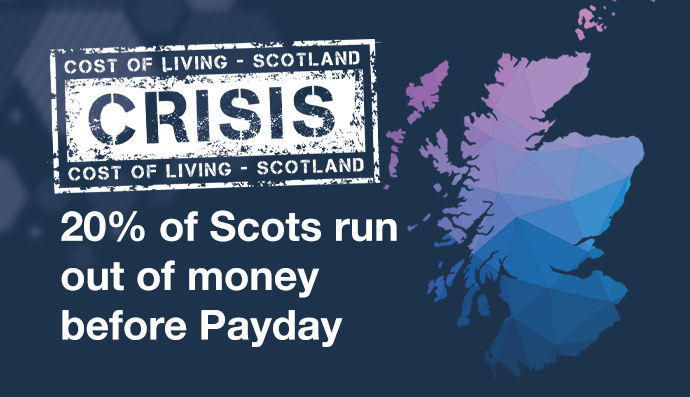
Cost of Living Crisis Scotland: 20% of Scots Running Out Of Money Monthly

20% of people in Scotland are running out of money before payday, a poll from Citizens Advice Scotland (CAS) has found. Broken down further the survey found that 11% run out of money most of the time. 9% of people said that they always run out of money before they are paid wages, pension payments or benefits. As previously reported by Trust Deed Scotland® the cost of living energy bill increases and weekly food shopping price increases have caused many people across the country to use short term credit facilities including their credit cards and bank overdrafts to pay their essential household bills, borrowing their way out of short term crises. With inflation and tax hikes, thousands of people across Scotland are struggling to cover the cost of day to day life. With over [reviews] reviews, Trust Deed Scotland® have helped over [volume] in Scotland and will continue to do so while the cost of living crisis continues to cause havoc to the everyday lives of many Scottish families. Quite simply, people are facing an impossible choice in their spending with some people having to choose between heating and eating. Myles Fitt a representative of CAS, a Scottish debt charity said “One in five people running out of money before payday is extremely concerning, given that these figures have seen an increase since 2021. A real issue here is that incomes simply aren’t keeping up with costs. Social security payments like Universal Credit effectively fell in real terms this year, and that was after the decision last autumn to remove the £20 per week uplift to the benefit.”

Cost of Living Crisis Scotland: Get help with unaffordable debt

When you have unaffordable debt, it’s important to seek help as soon as you can. In a recent survey of Trust Deed Scotland® customers, 57.40% of our customers waited more than one year before asking for help with their debt. 13.82% said that they waited 4 years or more before asking for help. There are many reasons why individuals may put off seeking help with their debts including the fear of being judged, or shame and embarrassment about having a problem with debt. If you do feel like this then it’s important to understand that even before the recent Coronavirus pandemic many people have found themselves with unaffordable debt through no fault of their own and thankfully, there are solutions that can help almost everyone. You do not need to deal with your debts alone. Speak to Trust Deed Scotland® today in confidence and see if we can help put you on the path to a brighter future.
  • Debt solutions that help individuals cope with rising living costs
  • Peace of mind that unaffordable debt is under control
  • Continued support until your journey is complete
Use our Wizard tool to quickly check your options, or call us on 0141 221 0999 for advice.

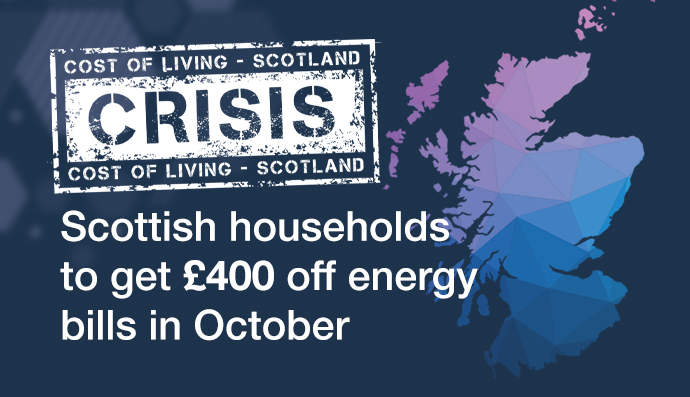
Scottish Households Will Get a £400 Energy Bill Discount

All households in Scotland will get an energy bill discount in the shape of a grant that will reduce the impact of increased energy bills in Scotland by £400 from October the chancellor, Rishi Sunak has announced. Further measures announced contain a mix of broad help and specific payments to those on lower incomes, in Scotland and throughout the rest of the UK. Direct debit and credit customers will have the money credited to their account, while customers with pre-payment meters will have the money applied to their meter or paid via a voucher. Whilst this does come as a source of relief for some households in Scotland; there is a long way to go yet as previously reported in the Trust Deed Scotland® cost of living crisis info hub. If you’ve been following this story closely in the news, you may have heard about the original idea to ‘loan’ £200 to households. Thankfully, the scheme has been scrapped and now replaced by the £400 energy bill discount for all.

The elderly and people on benefits in Scotland get additional help

Households that receive the Winter Fuel Payment, which is nearly all homes with at least one person of pension age in Scotland; will receive an extra £300 in November or December. Those on lower incomes, who claim pension credit, will also receive the £650 mentioned earlier. A small group of pensioners with disabilities will receive a total of £1,500 when all the new payments and discounts they are eligible for are added up. A £650 payment will be made to more than 8,000,000 low income households across the UK who receive Universal Credit, tax credits, pension credit and other means-tested benefits. This will be an automatic payment into bank accounts. It comes in two instalments – the first in July and the second sometime this autumn. Payments for those on tax credits only will follow shortly afterwards. Those on disability benefits will receive £150 in September, which may be on top of the £650 payment.

The cost of living crisis in Scotland will not go away

A typical domestic energy bill is estimated to rise to £2,800 in October, Jonathan Brearley CEO of Ofgem recently told MPs. That is an £800 a year increase, on top of a £700 a year rise which took effect in April 2022. Official forecasters are saying that the rate is set to accelerate. Prices will not fall next year and beyond, but the rate of increase is expected to slow. The biggest factor is what will happen to energy bills in the next few years. This will depend to a large extent on the war in Ukraine, and its wider impact on energy supplies from Russia and how that changes the wholesale prices paid by energy suppliers. The Russian and Ukrainian conflict may affect the cost of our weekly food shop as wheat prices soared on world commodity markets, and the cost of everything from bread and cakes to noodles and pasta has gone up.  

Help to repay unaffordable debt in Scotland

It is important to understand that some bills are more important than others. Known as priority bills, a typical energy bill in Scotland from a current supplier is most definitely a priority bill and you should pay these types of bills first whilst other debts such as credit cards and payday loan debts for example are not as urgent. However, even though these types of debts may not be as important, simply ignoring them is not an option either. If you feel like you’re really struggling with unaffordable debts you should seek advice from an experienced debt adviser or debt charity as soon as you can. You’re not alone in asking for help but the sooner you do something about your debt, the sooner you can move on with your life. Unfortunately, as many as 25% of Scots wait 3 years before seeking help with their unaffordable debt so we would urge you to ask for help sooner so that you don’t fall into the same trap. Trust Deed Scotland® have helped thousands of people in Scotland since 2009. We have dealt with cases that included council tax arrears, credit card debts and payday loans. We’ve successfully prevented and lifted creditor enforcement actions such as Wage Arrestments. Whatever the cause of your money problems, Trust Deed Scotland® can help you to understand your options, find a Scottish debt solution and let you focus on enjoying a brighter future. Contact us on 0141 221 0999, or start by simply using our debt calculator tool online to quickly check what your options may look like.