25% Of Scots Wait 3 Years Before Seeking Debt Help

Christians Against Poverty Scotland have released a new report that shows that 25% of the people that they helped in Scotland waited between one and two years before seeking help with their debts, and a further 25% waited three years or more before seeking help. Worryingly, 45% said that they did not know where to get help. CAP Scotland is a national charity that works with 715 affiliate churches, looking to help the vulnerable people out of poverty, UK-wide.
  • 12% Didn’t wait to seek help.
  • 27% Waited less than one year.
  • 25% Waited 1-2 years.
  • 25% Waited 3 years or more.
  • 11% Unknown
A rise in non-priority debt e.g. credit cards, personal loans and catalogue debts, saw the average debt level in Scotland increase to £17,917, of which £12,065 was identified as being non-priority debt. On average, CAP Scotland clients have 9 non-priority debts and the most common types of non-priority debts their clients reported were personal loan (69%), credit card debts (63%), mobile phone debt (46%), overdraft debt (38%) and catalogue debt (34%). In terms of priority debts, council tax arrears (40%), rent arrears (10%), energy arrears (9%) and mortgage arrears were the common types of debt that their clients sought help for. Low income, mental ill-health, relationship breakdown, long-term illness and unemployment were identified as the most common reasons that caused a debt crisis for their clients. 71% said that debt impacted their relationship, with 19% citing debt stress as the reason for a relationship breakdown. 44% are unable to afford adequate clothing 37% sacrificed meals 37% went without heating 31% are unable to afford basic toiletries 28% said they had considered or attempted suicide as a way out of debt. 20% were unable to afford to light their home. Speaking on the finding of the CAP Scotland report, Gareth McNab, Director of External Affairs said: “The full effects of the global pandemic will not be felt for some time; we know that one in four (25%) CAP clients wait over three years before seeking debt help. The debt advice industry is anticipating rising numbers in need of debt advice. More must be done to reach and help households struggling. Joined-up working is needed more than ever, forming partnerships to combat the financial fallout of the pandemic. Yet we cannot forget that even before COVID-19, households were struggling and, without change, people will still struggle in the future. Unless we do something about it” You can read the CAP Scotland 2021 client report.
As a leading Scottish debt advice company, having helped thousands of people with their unaffordable debt, Trust Deed Scotland® have received over [reviews] reviews on Trustpilot where many people tell us things like “I wish I got help sooner” or “I can sleep again at night, now that my debt is under control again.” The fear of being judged, or feeling ashamed or embarrassed about having debts are often spoken about by our clients in regards to reasons why they put off seeking debt help. In April 2021, Lauren said: “After being hesitant for a while to contact Trust Deed Scotland, I am so glad I did, as Pamela was so friendly, understanding and non-judgemental during the process. I would 100% recommend anyone struggling with financial difficulties to get in touch. I wish I had sooner.” Also speaking in April 2021, Louise said: “Called Trust Deed Scotland eventually after months of worrying about mounting debt and just wish I’d have done it sooner. Soreena dealt with my case and couldn’t have asked for anyone better than her. She listened and totally understood everything I said and never judged me at all. I can now look forward to receiving my wages every month, knowing that everything is going to be paid in one payment and might even have some left now.” Earlier in the year, in January 2021, Jamie said: “I couldn’t have been made to feel more comfortable, I was always quite ashamed to talk about my debt. Vicky made me feel completely at ease and made the whole process seem so simple.”

Help with unaffordable debt in Scotland

If you live in Scotland and you are struggling with your finances, you can find out more about your options by calling Trust Deed Scotland® on 0141 221 0999. Alternatively, you can also download our Scottish debt solutions guide. Our experienced team can give you confidential advice, that with help you understand the pros and cons of all formal debt solutions in Scotland such as Trust Deeds, the Debt Arrangement Scheme and other Scottish Debt Solutions. Once we know more about your situation, we are then able to give you tailored debt advice that fits your individual requirements.

Household Bills Arrears Increased During 2020

A new report published by a leading debt advice charity has shown an alarming increase in household bills in Scotland during 2020. The ‘Scotland in the Red‘ report published by Stepchange shows that at least 50% of their clients were behind on at least one utility bill. Household bills are generally classed as ‘priority debts’ and those types of debts should typically be paid ahead of ‘non-priority debts’ which tend to be credit card debts, unsecured loans and catalogue debts. However, the term non-priority is not intended to be implied that it is an unimportant debt that does not have to be dealt with. There are consequences for non-payment of any debt that you may owe.

Household Bills arrears broken down by type

Rent Arrears – The average arrears per Stepchange enquiry in 2020 was £1,230, a 43% increase from the previous year. Mortgage Arrears – The average arrears per client enquiry was £3,667, decreased from the previous year but largely impacted by the availability of payment breaks from lenders. Council Tax Arrears – An average of £1,975 per Stepchange enquiry and the most common individual household bill for their clients to be struggling to repay. Electricity Arrears £1,239 (36% increase from the previous year) and Gas Arrears £823 (29% increase from the previous year) Citizens Advice Scotland earlier in 2020 urged people struggling with council tax arrears debt to make use of the Scottish Government’s council tax reduction scheme. The Scotland in the Red report also highlighted other key information about their Scottish clients such as the age and gender breakdown of clients who approached them for help. 58% of their new clients identify as female, and the most typical age group of client they spoke to was between the 25-39 age bracket (43%), an increase of 35% but this is largely attributed to younger age groups being more directly affected by the financial impact of the Coronavirus pandemic. E.g. younger age groups tend to be employed more in the hospitality, leisure and non-essential retail sectors. Industries decimated by Coronavirus.

Average unsecured debt totals in Scotland

The reported average unsecured debt totals in Scotland rose from £11,712 in 2019 to £14,566 in 2020 which represents an increase of 24%. It has been widely reported that many individuals across the UK are using credit cards and loans to pay off debts included rent arrears and council tax debts, therefore these figures are expected to increase once again. Demand for debt advice in 2021 is expected to increase towards the end of the year, and with many payments breaks arrangements now ending, and with some now being replaced by tailored support, more people in Scotland may now be finding themselves with unaffordable ‘problem debt’ as a result. In conclusion to the Scotland in the red report, Stepchange asked for Scottish government support and stated: “Whilst forbearance has allowed some households to prepare for, or weather the financial storms, the income shocks sustained by thousands of households in recent months will leave many financially vulnerable for years to come, even if they are able initially to avoid immediate detriment. Supporting households in difficulty and preventing them from falling into difficulty in the first place, must be a primary focus for the new Scottish Government through the new parliamentary term.”

Help with unaffordable debts

If you are worried about potential enforcement action such as a visit from Sheriff Officers and wage arrestments over the non-payment of your household bills, including council tax arrears debt, call us on 0141 221 0999 and we will be able to find out more about your situation and offer advice on how to deal with your debts. For people struggling with either their household debts and their unaffordable unsecured debt, it is important to deal with problem debt as soon as possible. Trust Deed Scotland recently reported that 25% of Scots wait 3 years before seeking debt help and while there are many reasons why individuals are allowing their problem debt to worsen, it is advisable to seek professional help. Contact Trust Deed Scotland today for non-judgemental and confidential advice. Our experienced debt advice team offer tailored debt advice and will explain the advantages and disadvantages of any formal Scottish debt solution that you may be eligible to apply for.  

Council Tax Arrears Statistics Released by Citizens Advice

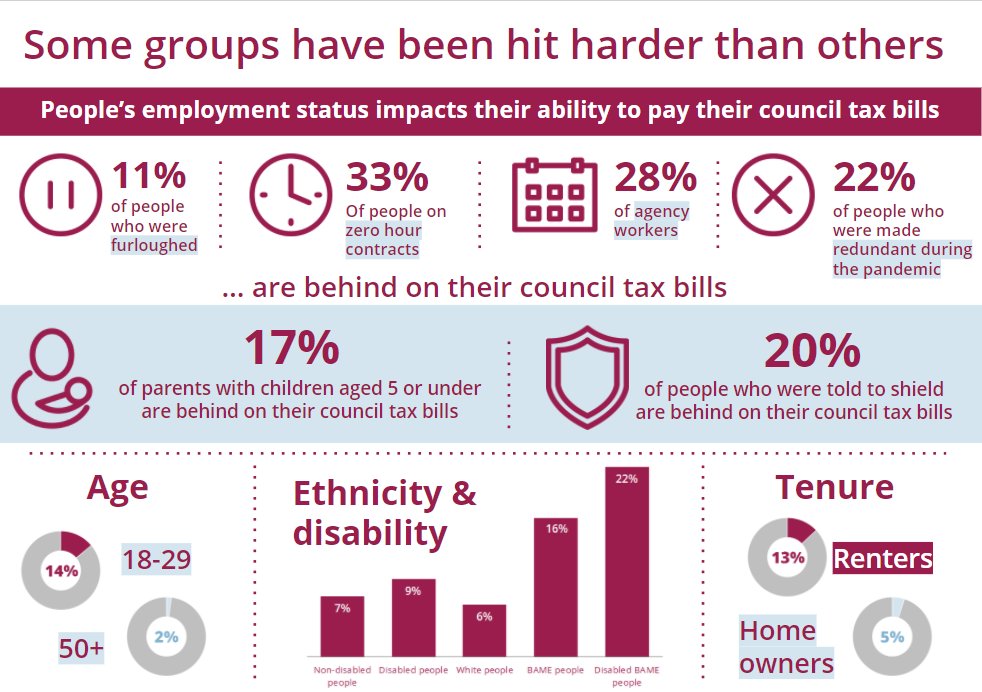
Over 3,500,000 people in the UK now have council tax arrears debt, with an average of £800 council tax arrears, reports Citizens Advice* Founded in 1939, Citizens Advice is a network of 316 independent charities throughout the UK guided by four principles: A free service, Confidentiality, Impartiality and Independence. The unavoidable debt report published by Benedict Guindi and Tilly Cook of Citizens Advice said that the pandemic and the restrictions put in place to control it, have had a dramatic impact on household finances with many people have been made redundant, furloughed, become too ill to work or have taken time off to care for a loved one. Some groups identified as being most affected by council tax arrears included:
  • 11% of people who were furloughed
  • 33% of people on zero-hour contracts
  • 28% of agency workers
  • 22% of people who were made redundant during the pandemic
  • 16% of people of BAME
  • 22% of people of BAME and with a disability.
  • 17% of parents with children aged 5 or under are behind with council tax arrears debt
  • 20% of people who were told to shield are behind with council tax arrears debt.
  • 14% of people aged 18-29 are behind on their council tax
  • 13% of renters and 5% of homeowners indicated that they had accumulated council tax arrears debt.
As a result of the findings of their data, Citizens Advice said: “On average, the people we help with council tax debt have just £20 left after covering essential living costs to pay off debts. 40% have a negative budget, meaning their income doesn’t cover their living costs. People are often forced to make trade offs between repaying their debts and covering essential living costs. During the pandemic, 17% of people with council tax arrears were unable to afford food in comparison to 3% of the total population.” “Councils should prioritise writing off the debts of those who are struggling the most financially, such as those in receipt of Local Council Tax Support and people receiving benefits. There were existing problems with the way council tax is collected before the pandemic hit. The way the regulations are designed makes it harder for people with council tax arrears to arrange and make repayments. The Ministry for Housing, Communities and Local Government should use secondary legislation to amend the Council Tax (Administration and Enforcement) regulations to:
  • Stop people being liable for their entire annual bill if they miss 1 monthly payment.
  • Make it easier for councils to improve collection by giving them more powers to collect debt in a fair way without getting a liability order first.
  • Set out more steps councils must take before using the court process.
This would ensure that all people in debt are given the option of affordable repayments to get back on track.”
Citizens Advice - Council Tax Arrears Stats
The infographic image above was taken from Citizens Advice unavoidable debt report and remains © of Citizens Advice.

Council Tax Arrears Debt in Scotland

As reported in the Glasgow Herald in early January, Citizens Advice Scotland warned of a potential Council Tax explosion, with CAS financial health spokesman Myles Fitt saying: “Scotland is potentially facing an explosion of council tax debt in 2021. The figures before the pandemic are bad enough, but the real fear is that Covid-19 is going to make matters much worse. Councils across Scotland showed a real empathetic approach to those who found themselves in council tax payment difficulties, and the payment breaks in the first six months of the pandemic were extremely welcome. However, this has led to arrears building up, arrears that will be difficult to meet for the many people who have during that period experienced an income drop due to unemployment or reduced working hours. “For others, this problem is yet to come in 2021 when the economic squeeze on personal finances is felt as the furlough scheme and payment support measures close at the end of April, ironically in the same month the first payments of council tax in the new financial year are due.” CAS is calling on people to make use of the Scottish Government’s council tax reduction scheme which can help reduce future payments. For some people, it can also offer a backdate of up to six months. Contact your local authority for more information. All local authorities should have information on their website including: Glasgow council Edinburgh council Aberdeen city council North Lanarkshire council South Lanarkshire council Highland council East Ayrshire council North Ayrshire council South Ayrshire council Trust Deed Scotland® said “Falling behind on priority debts such as council tax can have the severest of consequences. Council tax arrears enforcement action can escalate quickly when there is non-payment of council tax with Sheriff Officers being used to collect outstanding council tax arrears debt with enforcement action such as wage arrestments being used as a last resort to collect outstanding monies. We’re thankful that Citizens Advice have highlighted these groups that they have identified as being most at risk of developing problems with their council tax and we offer tailored debt advice to anyone who is struggling with unaffordable debts, whether they have council tax arrears debt or other types of unsecured debts such as credit cards and loans. As well as being able to provide formal, statutory solutions such as Protected Trust Deeds and the Debt Arrangement Scheme, we can also provide some breathing space for our clients who need more time to think about the best solution for their problem debt by using a Statutory Moratorium.”

Help with unaffordable debt in Scotland

To find out more about managing your money and getting free advice, visit Money Helper, an independent service set up to help people manage their money. Citizens Advice Scotland (0800 028 1456) can give you free, impartial debt advice alongside other money charities including National Debtline (0808 808 4000). As well as formal debt solutions, The Trust Deed Scotland® team offer debt advice that is… Non-Judgemental – Our friendly, helpful team want to help find a solution that suits your needs. Confidential – We do not share your details with any other companies. Your data is safe and secure. Experienced – [volume] people helped and over [reviews] five-star reviews on Trustpilot. Tailored – Advantages and disadvantages of all formal solutions explained. You can find out more about how we can help you by using our Trust Deed Wizard, or by calling us on 0141 221 0999. Our experienced debt advisers provide tailored debt advice outlining the pros and cons of the Debt Arrangement Scheme and other formal Scottish debt solutions including Protected Trust Deeds and Sequestration. *Citizens Advice commissioned ICM unlimited to conduct a survey of a representative sample of 6,004 adults living in the UK. The survey took place between 12th and 25th November. The sample has been weighted by age, gender, region, social grade, work status and ethnicity to be representative of the UK adult population. The 3.5 million in arrears figure is based of 7% of the population being behind on their council tax bills. Then extrapolating this out to the UK adult population of 52.5 million

Rent Arrears Debt Warning by Resolution Foundation

Almost half a million people across the UK have fallen behind on rent or mortgage payments as a result of the coronavirus pandemic, reports the Resolution Foundation. The Resolution Foundation is a UK think-tank that is focused on improving the living standards of those on low-to-middle incomes. Founded in 2005, the Foundation’s established work programme includes incomes and inequality; jobs, skills and pay; housing, wealth and debt; tax and welfare; public finances and the economy. The study into rent arrears found that as many as 450,000 out of an estimated 750,000 people in arrears on housing payments and reporting on the findings, Lindsay Judge a Senior Research and Policy Analyst who leads on housing, advised that many families had suffered ‘huge hits’ to their household earnings and that few have savings to fall back on. 300,000 people are thought to have dependent children. “To make matters worse, measures that could ease the pressure, such as discretionary housing payments from local authorities and negotiated rent reductions from landlords, are not getting through to those that need them.” The Resolution Foundation added: “Both benefit cuts and the end of furlough are pencilled in for the spring, either of which will strain family incomes further. Likewise, unemployment looks set to rise, rather than fall, through 2021, potentially driving up arrears further still.” Trust Deed Scotland said “We speak to hundreds of people every month and most have voiced concerns about their unaffordable debts which typically include the likes of credit cards, catalogues and unsecured loan debt. However, with a number of people having been made redundant in the last year, or who are currently furloughed as part of the Job Retention Scheme – we’ve seen many instances of social and private tenants not being able to afford the repayment of their rent. While there is currently a ban on evictions in Scotland, we’re concerned about the longer-term impact to those individuals’ finances caused by building up rent arrears, as well as other debts, with no clear end in sight. As a result of this, many are falling into a cycle of debt where they are using credit to pay credit and incurring further debt to pay for general living expenses, including priority bills. If you are struggling with unaffordable debt and have dependent children – we also urge you to apply for the School Age Payment award of £250 before the deadline ends on 28th February. The one-off £250 Payment is currently open to families with a child born between 1 March 2015 and 29 February 2016. It can be used for anything from a warm coat to books and toys.”

Support for Scottish tenants with Rent Arrears Debt?

In Scotland, increased support for Scottish tenants in danger of developing rent arrears debt was introduced in December 2020 in the shape of a government-funded Tenant Hardship Loan Fund. The government have set aside £10m for the Tenant Hardship Loan Fund, which is an interest-free loan and is designed to help people who have had their finances or employment impacted by the coronavirus pandemic and do not have other means of housing support. Loans are available for private and social tenants up to a maximum of nine months’ rent costs covering rent arrears and future rent, where those arrears have arisen since 1 January 2020. However, the tenant hardship loan fund will not be available where a tenant had rent arrears before this date. The Tenant Hardship Loan can include up to a maximum of three months of future rent payments as part of the nine-month total. The lending arrangement provides an additional short-term offer that supports tenants to manage rent arrears and helps them to come back into paying their rent. Loan repayments under the tenant hardship loan scheme will be deferred for six months as standard and repaid over a five-year period. The Scottish Government hopes that this helps solve any issues with the continuing uncertainty around the impact of the Coronavirus pandemic. However, as part of the Scottish Government’s commitment to responsible lending, the Tenant Hardship Loan Fund offers will be subject to an affordability assessment. The affordability assessment looks at the applicant’s incomings and outgoings to check whether the applicant has enough surplus income, after other costs, to make the loan payments. Please note: Applications for the Tenant Hardship Loan Fund were discontinued for new applications in December 2021.

Can I include Rent Arrears Debt in a Trust Deed?

The legal position is that all rent arrears should be included in your Trust Deed. However, to avoid any issues with your landlord, especially if you are a private tenant, then you should take advice before considering entering into a Trust Deed whilst you have rent arrears.

Rent Arrears Debt and the Debt Arrangement Scheme

If you have build up rent arrears debt, you may be able to apply for a Debt Payment Programme (DPP) under the Debt Arrangement Scheme (DAS). A DPP, which is a formal debt solution, will give you time to pay off your rent arrears debt at a rate you can afford, and include all other unaffordable, unsecured debts that you are struggling to afford such as credit cards, unsecured loans and council tax arrears. In addition to being able to include your rent arrears debt and credit card debts or other debts that you owe – any interest and charges on those debts are legally frozen, and if you’re receiving distressing telephone calls, text messages and letters threatening you with visits from Sheriff Officers  – you can reduce and eventually stop this type of contact with an approved Debt Payment Programme. The Debt Arrangement Scheme has risks and benefits just like Protected Trust Deeds which have advantages and disadvantages. The Minimal Asset Process route to Sequestration may also be a suitable formal solution for people struggling with unaffordable debt. In order to find out what your options may be suitable for you, Trust Deed Scotland recommends talking to an experienced debt advisor and seeking tailored debt advice, based on your situation.

How to get Scottish Debt Advice today

If you’re worried about your finances and would like to take control of your unaffordable debt, you can contact Trust Deed Scotland on 0141 221 0999, or complete our Trust Deed Wizard tool for more information. As a leading provider of formal Scottish debt solutions including Trust Deeds, and the Debt Arrangement Scheme, our experienced debt advice team are able to work with you and offer tailored debt advice that puts you at the heart of the decision-making process.  

What debts does a Protected Trust Deed include?

The type of debts that can be included in a Protected Trust Deed are generally those that are described as unsecured, with some exceptions. When you enter into a Protected Trust Deed in Scotland, most of your unsecured debts will be included and this may include:
  • Credit Cards
  • Personal Loans
  • Overdrafts
  • Catalogues
  • Gas and Electric Arrears
  • Council Tax Arrears
  • Payday Loans
  • Store Cards
  • Buy Now Pay Later Agreements
  • Any Other Outstanding Personal Bill e.g. Vet Bills
There are other debts that can be included in Trust Deeds, but we recommend contacting us today confidential advice as it’s important to understand not only the debts that you have and whether or not debts those can be included in a Protected Trust Deed, but also other aspects include your affordability, total debt owed and your income vs. expenditure. On some occasions, an alternative Scottish debt solution may be more beneficial for you.

What types of debt are excluded from a Protected Trust Deed?

Typical debts that aren’t included within a Protected Trust Deed include:
  • Mortgages
  • Secured Loans
  • PCP and PHP Agreements
  • Hire Purchase Agreements
  • Court Fines
  • TV Licence Arrears
  • Student Loans
  • Child Support Arrears
You can also find out more about the differences between secured and unsecured loans, if you’re unsure what this means.

Can joint debts be included in my Protected Trust Deed?

A joint debt in Scotland is a debt that has your name and the name of the other person you entered into it with on the agreement. A joint debt can be included in a Protected Trust Deed, however, the other person named on the debt will still be responsible for making payments towards it. This is also true of guarantor loan debts in Scotland. If you have some of the debt written off, the other person will still be asked to pay the remaining money back, therefore that debt isn’t written off in the same way that the other debts that included in the Protected Trust Deed would be written off. If you have joint debts, and are thinking about applying for a Protected Trust Deed, you should contact us for confidential advice first. We can let you know how it would affect you and the other person named on the debts.

What happens to my debt during a Protected Trust Deed?

Before Trust Deeds are agreed, proposals are put to the creditors who monies are owed to. If the creditors agree to the Trust Deed, you’ll make monthly payments towards the Trust Deed for 48 months, or 60 months if this was agreed as an extended duration for the Trust Deed. When your Protected Trust Deed has been complete, you’ll be discharged. At this point, any balances outstanding on the debts included in your Trust Deed will be written off.

Is a Protected Trust Deed right for me?

To find out if a Protected Trust Deed is right for you, we advise you to try our online Trust Deed Wizard® tool. This will begin the process of finding a debt solution for you, based on your own unique circumstances. When you’re looking at the types of debts that can be included in a Protected Trust Deed, you may have debts that can be included such as those owed to family and friends but you may benefit from speaking to Trust Deed Scotland® in order to find out the advantages and disadvantages of doing so. There are alternative solutions to Trust Deeds in Scotland, one of which is the Debt Arrangement Scheme. When you speak to an expert money advisor, all pros and cons will be explained to you, and sometimes the type of solution that fits your needs best may not be a Protected Trust Deed after all. When considering your decision on whether a Protected Trust Deed is right for you, we have previously written articles in response to questions we’ve previously been asked such as Is A DAS Worth It? or Is A Trust Deed A Good Idea? Trust Deed Scotland® has thousands of reviews on Trustpilot, however, we also offer Debt Arrangement Scheme and Sequestration advice, which means you will be given balanced, fair advice that puts you in control of the decision-making process.

What Is Wage Arrestment In Scotland?

What Is Earnings Wage Arrestment In Scotland?

Wage Arrestment in Scotland is increasingly being used as a tactic to recover debts in Scotland, with unpaid council tax arrears debt being the most common cause of a debt being enforced by way of an attachment of earnings. With the Earnings Arrestment enforcement action type, your employer is instructed by law to deduct money directly from your wages. As part of the ‘diligence’ process – A legal process that allows creditors to collect monies where a court order has been unsuccessful in forcing you to pay. Before a Wage Arrestment can be put in place, you will either have had a decree awarded against you or will have received a summary warrant for the debt you owe. Once an Attachment of Earnings is secured, your employer must deduct an amount from your net earnings over time you get paid. If it’s a council tax debt, his Wage Arrestment deduction will then be passed on to your local authority council to pay off your council tax debt. Although most commonly used for council tax debt, wage arrestment can be used for other debts as well. It is not necessary for the creditor to raise a court action before they serve a Charge for Payment. This is a more typical route for debts that are not regulated by the Consumer Credit Act (such as credit cards and personal loans) using the procedure known as summary diligence. A Wage Arrestment is used to collect a single debt owed to one creditor. Current maintenance arrestment is used to enforce the payment of maintenance, such as that awarded by a court during a divorce settlement.

Multiple Wage Arrestments

A Conjoined Arrestment Order is granted by the court to enforce payment of two or more of the same type of debts. The important thing to remember is that a conjoined arrestment can be used for two or more wage arrestments that are in place at the same time but not for an earnings arrestment and current maintenance arrestment. Technically, it’s possible for the local authority to issue you with an Earnings Arrestment for every year of outstanding debt as they are counted as separate debts. However, the amount taken each month would not increase, but would instead be divided on a pro-rata basis between all debts they are chasing you for. Most Scottish councils tend to do it for one year, and when that debt is paid do it again for the next year. They would normally collect the earlier years first. It may be worthwhile double-checking that the arrestment is legal and that the money is owed. If the creditor has not issued a Debt Advice and Information Pack (DAIP) then the procedures have not been followed correctly and you can argue that the Wage Arrestment is not legal. If you decide to pursue this, seek advice first.

Typical Wage Arrestment Example

The usual process prior to getting a wage arrestment for Council Tax debt typically follows this path:

Reminder

The normal method for paying council tax is in 10 monthly instalments. If you miss a payment, the council should send you a reminder giving you seven days to pay the outstanding amount.

Final Notice

If you fail to pay the missing instalment after a reminder, however, you will lose your right to pay by instalments. At this stage, you will receive a final notice giving you 14 days to pay the whole amount outstanding for the remainder of the financial year. It is still possible with some local authorities in Scotland at this stage to negotiate to pay in instalments if you contact them directly. If you are at this stage, it’s important to act as soon as possible. Your council tax should be treated as a priority debt, alongside other utilities and your mortgage/rent so make sure you do not pay unsecured debts such as credit cards and personal loans ahead of any priority debts. No matter what the credit card lender says, they are always a lesser priority debt to pay but that doesn’t mean you should ignore these debts either. Firstly, try to make reasonable arrangements to pay, Second, if that fails, or you feel your debts are more severe, contact a qualified debt advisor ASAP.

Summary Warrant

If this lump sum is not paid then the council can apply to the sheriff court for a summary warrant. This is a certificate from the sheriff court stating the amount of council tax you owe. You will not have the opportunity to negotiate with the court before one is granted. You will only know about it the summary warrant when you receive notification of it in the post. You do not have to be told that the council is applying for a summary warrant. The summary warrant is issued by Sheriff Officers in Scotland. It will state the amount due and who to contact to arrange to pay this amount. Your payments are no longer made to the local authority but then instead, to the Sheriff Officers. The amount due will have increased as there is an automatic penalty fine of 10% when a summary warrant is issued.

Arranging Repayments

At this stage, you can arrange to repay the money at a rate that is comfortable for you. If you decide to do so make sure you come to an arrangement that you will be able to stick to. Remember, priority bills are more important than non-priority bills e.g. credit card debts. It is better to pay less regularly over a longer period of time than to try to stretch yourself and risk missing payments.

Charge For Payment

A Charge for Payment is a legal document that is served in Scotland by Sheriff Officers and Messenger at Arms. They are served to formally demand payment of money and give only 14 days to make payment. If the Charge for Payment is not complied with there are severe consequences. An earning arrestment as discussed, or bank account arrestment. Or an attachment of property held on your home or other assets such as a vehicle. The most common property to be attached by Sheriff Officers are cars, however, they can attach most items that are kept outside the home or business property. Even if it is kept in business premises, garden shed. A Charge for Payment doesn’t need to be served to execute an inhibition. An Inhibition in Scotland is another form of diligence, which makes it a formal, legal debt recovery tool. It allows a creditor to stop you from selling your home, or re-mortgaging without paying them. It doesn’t give them the right to force the sale of your home. This is the typical process that local authorities will pursue to enforce their outstanding Council Tax debt, but remember this can be used for other types of debts. Parking fines are another example of a creditor that uses this enforcement type. A Charge for Payment can quickly escalate e.g. an unpaid bus lane contravention fine debt can go from a manageable £90 to almost double with a fee of £81.16 added; the same debt then becomes £171.16. This fee cannot be removed thereafter.

How Much Of My Wages Can Be Arrested?

There are rules about how much money can be taken from your wages in Scotland, and also procedures in place to govern what happens if more than one creditor tries to arrest your wages. The earning arrestment amount taken from your wages depends on how much you earn. In April 2019, the protected minimum balance increased from £494.01 to £529.90. The exact amount that will be reduced from your debt can be found here. Any payments for commission, bonuses or statutory sick pay will be considered as part of your wages.

How Will My Employer React To My Wage Arrestment?

It is your employer’s legal duty to deduct whatever the courts insist on from your wages. If an employer fails to arrest your wages once lawfully instructed by a Sheriff Officer, they can be held liable to the creditor for the amount that they should have taken off your wages. Furthermore, they too can then be taken to court themselves and ordered to pay the amount they should have or become subject to the Sheriff Officers themselves. For this reason, employers must arrest your wages when told to do so. Your employer can also deduct a £1.00 administration fee every time the money is taken from your salary. Wage arrestment can be uncomfortable for you at work but it is not likely to be more than that, other than an increased administrative burden for your payroll team. However, you may, as a condition of your employment, have a clause in your contract that states that wages arrestment is a matter for which you should be disciplined. This may more likely be the case if, for example, you work in the financial sector. An Earnings Arrestment Order may be considered a disciplinary matter by some employers. In some situations, you can apply to the court for a Suspended Attachment of Earnings Order. If you can supply valid reasons why the wage arrestment should be suspended, you may be able to prevent it. One such reason to apply to the court for a Suspended Attachment of Earnings Order may be dismissal or disciplinary proceedings at work. Any responsibly structured organisation would typically only declare a Wage Arrestment on a need-to-know basis; therefore it’s reasonable to assume that such knowledge within a workplace will not become part of the workplace gossip.

What Happens If I Change Jobs?

If you change your job during the Earning Arrestment, then your Wage Arrestment will stop, due to having no earnings for that employer to deduct your wages from. It is your duty to ensure that you inform the Sheriff Officers of your change in employment. However, your previous employer can be instructed to supply details of your new employment to the sheriff officers where it is known. Most-likely because you had to give them as an employment reference. The Earning Arrestment, therefore, will most likely follow you.

Can My Benefits Become Arrested?

No, if you are in receipt of Universal Credit or any other benefits, a Wage Arrestment cannot be collected from your benefits payment.

How To Prevent A Wage Arrestment Charge For Payment?

A Statutory Moratorium can be registered with the Accountant in Bankruptcy office. Typically this is accepted, provided that one has not already been registered within the last 12 months; This prevents creditors from taking any further enforcement action for a period of six weeks. This is a free application process and can be done relatively quickly. Statutory moratoriums’, however, only allow some breathing space and it is important that the applicant looks to find more long-term debt solutions, including formal debt solutions such as Trust Deeds, Debt Arrangement Scheme or payment in full of the original debt. Assuming of course, that you haven’t found some other means to repay the debt naturally. Remember too that debt collection agencies can use suggestive words in their telephone conversations, or send letters that imply that a Wage Arrestment and/or other enforcement action is imminent against you but it may be a threat at that stage. It is advisable that you seek advice first from an experienced debt adviser, as to be most effective the procedure should only be used when it is absolutely necessary.

How To Stop A Wage Arrestment Charge For Payment?

A Statutory Moratorium should be used, even after a Charge for Payment has been served and has expired. Again, this allows six months breathing space to allow you to pursue a more permanent solution. Whether that be looking at long-term debt management tools such as Trust Deeds, Debt Arrangement Scheme or where possible, payment in full of the original debt upon securing extra funds. Alternatively, even after a court order has been awarded, or a summary warrant granted, you can apply for a Time to Pay Order. A Time to Pay Order allows you to enter an instalment plan with the lender, or local authority where it’s outstanding Council Tax Arrears and providing it is maintained, will prevent a Charge for Payment being relied upon for any further action. If you want to prevent or stop a Wage Arrestment Charge for Payment, get in touch with a qualified money advisor today.

Wage Arrestment Debt Advice

If you’re worried about debts, worried about the threat of having a wage arrestment, have received a decision or decree, or had court action taken against you we’d recommend getting tailored debt advice from us, as this can help you make an informed decision on the best way of dealing with the wage arrestment either before it happens, or after it has been put in place. Our experienced Scottish debt help team at Trust Deed Scotland® specialise in giving debt advice to people living in Scotland. We can talk about your situation and help you find a solution to resolve your debt problem. We’ve helped over [volume] people get out of debt in Scotland, and we’ve got more five-star reviews than any all other Trust Deed providers combined. Call us on 0141 221 0999, or try our Trust Deed Wizard® to get started now.

Priority Debts vs Non-Priority Debts In Scotland

When you owe money to several companies and don’t have enough income to pay them all – the calls, letters and text messages may start to cause you stress. With the cost of living continuing to rise, it can be difficult to know which debt should be paid first. Indeed, this is a dilemma that is affecting many people across the country right now. Some bills that you receive are regarded as priority debts because the consequences of not paying those priority debts are greater than the consequences of not paying the other non-priority debts For example, if you don’t pay your mortgage, your home could be repossessed. If you don’t pay your rent, you could be evicted. Whereas the consequences of missing a credit card payment do not have such a severe consequence. However, this doesn’t mean that you should ignore your non-priority debts as not paying back loans, credit cards and things like a bank overdraft can create problems for you too. You must always pay these priority bills before your other debts. Even with Coronavirus measures in place, where possible, these debts should be paid as priorities, because the consequences of non-payment can be serious. If you have unaffordable, unsecured debt that’s making it more difficult to pay your priority bills, then it’s really important that you get tailored and confidential debt advice as soon as possible. Remember to always get any payment breaks confirmed with your lenders – never assume that it’s an automated process. If you’ve been made redundant and forced to claim Universal Credit, or you have been furloughed – these may be enough to reorganise your priority and non-priority debts – however, make sure you get proof of this as the lender will usually ask for proof of your change of circumstance. Your unsecured debt is classed as ‘non-priority’ because the consequences of not paying these each month are much less severe than not paying your priorities each month. Trust Deed Scotland® can take a look at these debts with you and give expert debt advice and if they are unaffordable, we can provide solutions on how best to pay these debts while you ensure that you’re on top of your most important priority debts. Trust Deeds, Debt Arrangement Scheme, and other tools exist which allow you to reduce unsecured debts down to a more affordable level.

What Is A Priority Debt In Scotland?

Typical examples include the following debt types: Mortgage – not paying your mortgage could result in your property being repossessed. Rent arrears – not paying your rent could result in you being evicted from your home. Child maintenance – not paying your child maintenance service can result in your wages being arrested, goods being removed from your property and a liability order being made against you. Council tax arrears – not paying your council tax could result in your wages being arrested, or goods being removed from your property. Utility bills – not paying your gas and electric may result in you getting disconnected, or a prepayment meter fitted. Broadband & TV – not paying for your broadband & satellite tv services could result in you being connected.

What Is A Non-Priority Debt In Scotland?

  Failing to pay non-priority debts is usually less serious than not paying a priority debt. The most important debts that you have are not necessarily the biggest ones. You can’t be sent to prison for not paying non-priority debts. However, your creditors may take enforcement action against you if you do not pay them. All non-priority creditors should be treated fairly. You should not make full payments to one creditor while reducing payments to another. If you cannot afford the minimum payment to any of your non-priority debts, you should make reduced payments to all of them using a pro-rata calculation. Failure to do so could result in your debt being passed on to a debt collection agency and a Decree (CCJ in Scotland) being made against you. More likely, the non-payment of unsecured debts will firstly result in a default notice being served against you. When a default notice is issued against you for missed payments, you will find your credit rating is affected. Contact Trust Deed Scotland® for advice on 0141 221 0999.

Non-Priority Debts in Scotland include:

Credit card debts, store cards, and personal loans. Bank overdrafts, payday loans, catalogue debts. Money that you borrow from your friends and family is also regarded as a Non-Priority debt. If you have unaffordable debts and you’re struggling to repay them all, don’t worry you’re not alone. an experienced debt adviser can help you separate your priority and non-priority debts before explaining what options may be available to you for dealing with them.

Struggling With Non-Priority Debt In Scotland?

  If you’re struggling with non-priority debt in Scotland – Work out your budget to check how much you have left each month after all your household bills have been paid. You can then use any surplus income to clear your priority arrears as quickly as possible. You can discuss your circumstances with your creditors and offer reduced payments to non-priority debts – this will help free up as much surplus as possible for the priority arrears. Then, when you contact your non-priority creditors, explain why you’re in debt. If you can’t make an offer of repayment straight away, ask for more time, for example, 14 or 28 days. This will give you more time to get expert advice and work out your budget longterm. It’s important to try to pay at least the regular instalment in the meantime. If you can’t do this which is understandable, pay as much as you can afford – even a payment of £1 to the non-priority debt shows a commitment to repay your debs and again allows you time to get help as soon as possible. If you feel like you’re really struggling with unaffordable debts – Don’t worry. You’re not alone. Trust Deed Scotland® have helped thousands of people in Scotland since 2009. We have dealt with cases that included council tax arrears, credit card debts and payday loans. We’ve successfully prevented and lifted creditor enforcement actions such as Wage Arrestments. Whatever the cause of your money problems, we can help you find the way out and make a fresh start. If you have over £3,000 of unaffordable, non-priority debt, and live in Scotland, Trust Deed Scotland® will help find the right solution for you. Contact us on 0141 221 0999, or find out which solutions you may qualify for by using our free debt calculator tool online.

Council Tax Reduction Tool Launched

A new council tax reduction tool has been launched in Scotland that can save people thousands, Trust Deed Scotland has learned. In 2019, Citizens Advice Scotland helped 2,250 people struggling with their Scottish council tax debts averaging over £3,000 and have launched a new campaign designed to help people check their council tax exemptions, reductions, discounts and claim back monies already paid to council tax authorities in Scotland.

Check to Save Campaign?

Myles Fitt, representing Citizens Advice Scotland advised: “Over recent years, council tax debt has grown to be the number one debt issue that people bring to Citizens Advice Bureaux. People coming to us for help last year owed a total of £6.9m to their local authorities. That works out to around £3000 per person on average, three times the average council tax bill in Scotland. The campaign we are launching today is all about helping people who find themselves in council tax debt or who are struggling to pay their council tax bill. Across the country, most councils are set to increase council tax rates. We think local authorities should be do everything they can to ensure more people access these savings to help those least able to pay higher council tax bills. We know that over 80,000 fewer people in Scotland are claiming council tax reduction than when the system was introduced seven years ago, and we fear that lots of families are missing out on savings they are entitled to.”

Council Tax Reduction Calculator?

Trust Deed Scotland, who have helped over 20,000 people in Scotland experiencing financial difficulties by providing expert debt advice, welcome the introduction of the council tax reduction calculator tool available here and support the CAS Check to Save campaign. Council Tax Reduction Tool Last year, Citizen Advice Scotland saved people an average of £380 on their council tax bill, so whether you’re struggling to pay your council tax bill or not, it’s worthwhile as you can easily find out if you’re eligible to claim a council tax discount in Scotland. CAS reported that the number of people claiming council tax reduction has fallen by 80,000 since the new council tax scheme was introduced in 2013. The new council tax reduction campaign from Citizen Advice Scotland has come at just the right time, with local council authorities in Glasgow voting to increase council tax by 4.64% and their counterparts in Edinburgh voting to increase council tax by 4.79%.

Council Tax Arrears Debt?

As the No.1 debt advice company in Scotland, Trust Deed Scotland has helped many individuals to reduce their overall monthly debt repayments using Protected Trust Deeds and the Debt Arrangement Scheme which can cover council tax arrears debt. If you are struggling to repay multiple debts to a variety of creditors, Trust Deed Scotland recommends that you treat council tax debt as a priority debt with equal importance to your Mortgage or Rent and utility bills. If you are feeling that your council tax has become unaffordable due to an overcommitment on credit card debts and other unsecured debts, it is advisable to seek help from a debt charity such as Citizen Advice Scotland. Alternatively, you can find out about managing your money and getting free advice by visiting Money Advice Service, an independent service set up to help people manage their money.

Appeal Your Council Tax Band?

You can appeal your council tax band by visiting the Scottish Assessors Association website and making a proposal online to appeal your council tax. Money Saving Expert also launched a guide showing that challenging your council tax band can be advantageous, and result in you being refunded backdated money, therefore it’s a worthwhile exercise.

Get Council Tax Debt Help Today?

You can also get qualified debt advice today from Trust Deed Scotland. Use our Debt Calculator Tool to find out what your options are, or give us a call on 0141 221 0999. Our specialist debt advisors can help provide a personalised illustration of which debt management options you may qualify for and provide unbiased information on the Pros, Cons and alternatives to your potential debt solutions. As the leading debt relief company in the UK, we’ve gathered thousands of independent debt advice reviews on TrustPilot, where over 98.6% of reviewers have given us a good, or excellent rating. In their own words, our clients speak about their situation before, during and after seeking help. One of the most consistent answers we hear from our clients is “I wish I had done something sooner” which resonates with our own Trust Deed awareness radio campaign where we say “If you do something about your debts today, you can stop worrying about them tomorrow.

Coronavirus Protection From Sheriff Officers

The Coronavirus (Scotland) Act has now officially been enacted, which comes with greater protection against Sheriff Officers in Scotland, our equivalent of a Bailiff. The Civil Enforcement Association had previously reported that in England and Wales, bailiffs had until recently been harassing people over typical debts such as council tax debts, even while social distancing rules had come into existence. As well as better protection against Sheriff Officers in Scotland, there is also now more relief from creditor enforcement action such as Wage Arrestment. The new legislated changes are part of a temporary amendment to the Statutory Moratorium in Scotland and allows you to apply for 6 months protection against creditor debt collection enforcement tactics, including the use of doorstep Sheriff Officers to collect debt.  

What is a Scottish Statutory Moratorium?

  The word Moratorium itself is derived from 19th-century Latin word ‘morat’ meaning ‘delayed’ and sounds quite intimidating on its own, but it is a benefit of people in Scotland worried about how the Coronavirus crisis may impact their finances, especially where enforcement action has been threatened against the individual. So, what is a Statutory Moratorium? Quite simply, it is a temporary prohibition of creditor enforcement activity, that it is free for an individual in Scotland to apply for and does not require an application to be made to the courts in Scotland, even though it protects individuals from court-approved debt recovery practices, known as diligence in Scotland. Once applied for, the Statutory Moratorium protects people from any further action being taken by Sheriff Officers and from applications being made to the courts to make people Sequestrated. The Statutory Moratorium protects people  in Scotland from:
  • Charge for Payments
  • Wage Arrestment
  • Bank Account Arrestment
  • Attachments of Property
If you are being threatened with any of these actions, or the process has already begun, contact Trust Deed Scotland immediately on 0141 221 0999 and we can advise on applying for Statutory Moratorium on your behalf.

Does a Scottish Statutory Moratorium Freeze Interest and Charges?

If we go back to the original Latin meaning of the phrase Moratorium; it means that enforcement action will be ‘delayed’. Your debt total may still increase during this time as your creditors may continue to apply interest to the outstanding amount. The purpose of extending the Scottish Statutory Moratorium terms during the Coronavirus outbreak via the new legislative powers of the Coronavirus (Scotland) Act is to give you valuable breathing space during these uncertain times. As such, treat it as a stay of execution while you evaluate your options to pay back the debt to the best of your reasonable ability.  

Help With Sheriff Officers & Enforcement Action In Scotland

  If you’re struggling with unaffordable debts, due to a change in circumstances brought about directly as a result of the Coronavirus, or because you were already in financial difficulties before the crisis began, there is help available for you to repay those debts and look forward to a life after debt. As Scotland’s No.1 Debt Advice Company, having helped [volume] people since 2009; we have the experience required to help people in Scotland resolve their finances and get their monthly debt repayments down to an affordable level. Thousands of people have left Trust Deed Scotland a five-star debt advice review on TrustPilot and throughout the Coronavirus crisis, our advisors have been continuing to offer the same level of support, by working from home. Always 100% safe and confidential – our debt advisors have been working hard to explain the Pros and Cons of all solutions available to individuals in Scotland burdened with unaffordable debt concerns. We have spoken to while the Covid-19 crisis continues to unfold. Debt Arrangement Scheme The Debt Arrangement Scheme allows people in Scotland to repay all their debts, with one affordable payment each month. Once approved, the Debt Arrangement Scheme ensures that all interest and charges are legally frozen and ensures that you are protected against all creditor activity – from debt collection agencies to Sheriff Officers. In conjunction with a Statutory Moratorium, the Debt Arrangement Scheme will protect you from enforcement action. There are advantages, disadvantages and alternatives to the Debt Arrangement Scheme and you should give careful consideration to what is best for you, based on your own circumstances. Protected Trust Deeds Protected Trust Deeds use formal legislation that helps people reduce their overall debt payments to one fixed affordable monthly repayment. In order to qualify for a Trust Deed, you would typically have over £5,000 of unsecured debts. This may be credit cards, personal loans, payday loans and bank overdraft debts but can also include the likes of catalogue debts and Like the Debt Arrangement Scheme, in conjunction with a Statutory Moratorium, a Protected Trust Deed will protect you from enforcement action and Sheriff Officers. A Trust Deed term lasts a typical period of 48 months. After the Trust Deed term has complete, any remaining debt is then written off as unaffordable, giving you the freedom to get on with building your life. You should be aware that there are Trust Deed Pros and Cons, and there may be better solutions for you that allow you to deal with your debt and move forward with your life. Trust Deed Scotland® always recommends speaking to a qualified debt expert who shall be able to gather all information, and use that to give you a personalised illustration of the solutions available to you, and how it may affect you in the long-term.  

Where can you get reliable debt advice in Scotland?

  Talking about our debts to people that we do not know isn’t easy. Trust Deed Scotland® understands this more than most having helped over [volume] people in Scotland since 2009. We will always offer a friendly, non-judgemental advice service that doesn’t involve you being pressurised into a debt management product that you don’t understand. We’re very proud of our reviews we received where many people comment on the service that they have received and we will always have our clients best interests at heart. Give us a call on 0141 221 0999 or get started online.  

Sheriff Officers, their powers and what to do when faced with one

Dealing with bailiffs at your doorstep is one of the most anxiety-provoking, overwhelming aspects of a debt problem. In Scotland, bailiffs are called sheriff officers. Typically, you will encounter a sheriff officer if you have unsecured debts like council tax arrears, tax payments or utility bill arrears which you are struggling to repay. What’s worse is, you may find yourself too busy trying to get by, to learn about their powers or what to do should you ever find yourself receiving that knock on the door. Sheriff officers enforce court orders relating to debt recovery on behalf of government agencies, private companies or individual creditors. With the right documentation, a Sheriff Officer can enter your home, using reasonable force if blocked from doing so and remove items that belong to you, both inside or outside of your home. These items are taken and resold with the proceeds going towards repaying your outstanding debt balance. While they are officers of the court they are not the police, and therefore their powers are limited in that they can only enforce an existing court order. Creditors are entitled to instruct sheriff officers to take action only when they have made formal attempts to collect your debt. If you have received a ‘charge for payment’ (a formal demand for payment which is commonly sent after at least two or three previous letters warning of court action) this is your guide on sheriff officers: what they can and can’t do; your rights, and how to handle the situation without creating new problems.  

Powers of a Sheriff Officer in Scotland

  Forced Entry The ultimate concern of anyone with unsecured debts they can’t afford is that a sheriff officer will force their way into their home and seize their possessions indiscriminately. Though forced entry is allowed in certain cases, it is quite rare and depends on express authority from the courts.< So when can Sheriff Officers enter your home in Scotland? The Sheriff Officer requires an ‘Exceptional Attachment Order’ before they can force entry. Prior to gaining an Exceptional Attachment Order, a creditor must show that they have made reasonable attempts to repay the debt such as serving you with a Charge for Payment, allowing you 14 days to repay your debt. Additionally, for the order to be valid, you must have received a Debt Advice and Information Package from your creditor along with the charge for payment. As such, whoever your creditor may be, you should always be sure to note whether or not you have received an information pack with any documentation they have sent. A Sheriff Officer should also first try a less intrusive way of recovering your debt such as arresting your bank account, executing an Earning Arrestment or enforcing an Attachment Order. However, if a creditor can prove that they didn’t employ these methods because it wouldn’t have resulted in the debt being repaid they can be excused from not using them and apply for an Exceptional Assessment Order. Before granting an Exceptional Assessment Order a Sheriff Officer will consider the nature of your debt, your living, working and financial circumstances and whether you have applied for and been rejected from debt help in the past along with a number of other factors. When an Exceptional Assessment Order is granted however, they can force entry to, and remove items from your home. What if I refuse entry to the Sheriff Officers?  If you or someone over the age of 16 with a full understanding of the situation does refuse entry to an authorised sheriff officer, they can force a door open or break a lock/window to gain entry. It’s quite ambiguous who would pay for these damages but the general rule is that the cost is covered as part of the officer’s fee. However, it is not uncommon for the cost to be forwarded onto you. Sheriff Officers cannot enter or seize possessions if, when they arrive:
  • You or someone over the age of 16 is not present.
  • If you’re not present, but someone aged 16 or older is they can’t force entry if that person doesn’t speak or understand English; or is unable to understand the situation because of physical or mental disability.
What can Sheriff Officers take? If the Sheriff Officer has an Exceptional Attachment Order, they are entitled to seize any ‘non-essential’ possessions from inside your home. They can also take any goods from outside your home unless they are exempt – as an example, they can force entry into a locked garage to recover a car you have missed hire purchase payments on. It will hopefully be reassuring to know, however, that most of the goods inside your home are likely to be exempt, as it is recognised by the courts that they are essential and you will, therefore, need them. When can Sheriff Officers visit? Sheriff officers are allowed to enforce the order between working the hours of 8am and 8pm. They cannot come to your home at all on a Sunday or a Bank Holiday. Unfortunately, you will not normally be notified as to when they will be coming unless they are in possession of an Exceptional Attachment Order.  

What to Do When Facing a Sheriff Officer

  Again, a sheriff officer can only come into your home with the correct authority from the court to do so – the Exceptional Attachment Order. Without exception, you should always immediately ask the sheriff officer to show you their identification and the document that states that they have the authority to come inside. They are obliged to show you both. Every Sheriff Officer has a red booklet with an identification photograph and the crest of the Scottish court service. It is countersigned by the sheriff clerk for the relevant area. In some cases, it may not be clear from the court document that permission to enter your home is included. As to the Attachment Order, the document usually has a phrase like “grants warrant for all lawful execution.” This is the group of words you are looking for, as they do provide appropriate authority. If you are in any doubt you should ask for the officer’s employer and call them. Though an upsetting ordeal, if the identification and documentation check out, you would be well-advised not to obstruct enforcement. You may face a ‘breach of the peace’ charge if you try to obstruct an officer of the court from carrying out a legitimate court order. It goes without saying that you should not resort to violence. Crucially, at any stage, you can arrange to pay the officer part or all of the debt. If this is affordable, it is probably preferable to having essential goods repossessed, and you should definitely offer to pay whatever you can.  

Has a Sheriff Officer Exceeded Authority?

  If you think that a sheriff officer has behaved in an unreasonable way or taken action beyond their entitled powers, you should immediately call or contact their employer asking for an explanation. You should then make a formal complaint with the Sheriff Principal if you feel that their behaviour has been unreasonable. The Sheriff Principal can arrange for an investigation to be carried out.  

How to avoid this situation

  Dealing with bailiffs and sheriff officers is one of the most distressing aspects of a debt problem, and we may be able to help you avoid to avoid this situation altogether. One of the key advantages of our specialist service, the Protected Trust Deed is that once it is signed and has become protected, as long as you stick to the agreed terms, your creditors can no longer legally contact you or further pursue your debt. Of course, there are other Scottish debt solutions that may help you, such as DAS. All correspondence must be directed to your Insolvency Practitioner instead – no Sheriff Officers, no contact, no stress. You can apply for a statutory moratorium also. Read up on our guide on how to stop sheriff officers in Scotland. For a clean break from your debt problem, get in touch today on 0141 221 0999 or find out if you qualify using our Wizard tool. Our team of friendly and experienced debt advisers, are waiting for your call.