How to Write Off Debt

Many Trust Deed Scotland® customers who come to us looking for debt advice; often asking for more information on whether they can write off their debts.

Can You Write Off Debt without entering into a debt solution?

In some rare cases, you may find that creditors (the people you owe money to) may be willing to write off some or all of your debt if you can prove that is unaffordable for you and if you also have a terminal illness and your life expectancy is limited for example. Alternatively, it’s a genuine possibility to write off debt after completing select debt solutions. In this article, we will explain the available debt solutions that can allow you to write off debt when you have unaffordable payments.  

Debt Solutions That Write Off Debt in Scotland

The following are debt solutions available to Scottish residents. See below for how to write off debt in the UK.

Protected Trust Deed (PTD)

A Trust Deed is a legally binding agreement where, once completed, any remaining, qualifying and unsecured debts will be written off. A Trust Deed is completed after a typical repayment period of 4 years, with affordable monthly payments being paid towards your debt during this period. Trust Deeds can only be arranged and administered by a licensed Insolvency Practitioner (IP), such as Trust Deed Scotland®, who will take on the role of ‘Trustee’.  

Sequestration / Scottish Bankruptcy

Sequestration is the Scottish legal term for bankruptcy. Sequestration can be an appropriate solution for you if you are struggling with unaffordable debts. Sequestration is also used by creditors who take legal action against individuals for repayment of debts. If creditors have already commenced legal action against you, or you would like to get ahead of your debts now, please don’t hesitate to get debt advice. If you have a low income and have little or no assets, the type of Sequestration you would qualify for is known as the Minimal Asset Process route to Sequestration…

Minimal Assets Process (MAP) Bankruptcy

Minimal Assets Process – or MAP – is a route into Sequestration, for Scottish residents with a low income and few assets. With MAPs, you can write off your unsecured debts after 6 months; provided you have no disposable income, or your income is solely derived from social security benefits.  

Debt Solutions That Write Off Debt in the UK

The following are debt solutions available to residents in England, Wales and Northern Ireland. Once chosen or completed these debt solutions, you will be able to write off remaining debt.

Bankruptcy

Write off unsecured debts if you can show it is unaffordable for you. You may have to sell assets such as a house or car.

Debt Relief Order (DRO)

UK residents must have a few assets to choose this debt solution, and usually opt for a Debt Relief Order when debt levels are relatively low.

Individual Voluntary Arrangement (IVA)

This is a formal agreement for those in England, Wales and Ireland to make affordable monthly payments to your debts. Often, lasting over 5 or 6 years.  

Asking Your Creditors to Write Off Debt

Our customers come to us with unaffordable debt; finding themselves in financial difficulties for a range of reasons. Some reasons can be; If you’re struggling to pay off debts due to challenging circumstances, creditors may agree to write off your debts if:
  • You provide proof of inability to pay
  • You have no assets to sell
  • It clearly isn’t worthwhile for them to keep chasing the debt
However, this is rare, as creditors will only do this for the most serious cases. Before writing off debts, creditors may agree to stop contact for a period of time or agree to help if you have a mental health issue. For help with debts from creditors regarding your mental health, provide proof with a Debt and Mental Health Evidence Form (DMHEF). This must be stamped by a professional such as your GP to be considered complete.  

How Writing Off Debt Affects Your Credit Rating

Entering into any formal debt solution mentioned above will harm your credit score. However, if you are continually missing payments already, your credit score is currently affected. There are many misconceptions about credit scores, so make sure you have all the facts before making a decision. Most importantly, once you have written off debt, you can work on rebuilding your credit score. A bad credit score won’t remain if you take the steps to repair it and follow our tips on improving your credit score. With your debts written off, you will no longer miss payments that are harming your credit currently.  

Tailored Debt Advice

“Can I write off my debt?” – our team of experienced debt advisers are happy to answer. After a discussion about your circumstances, Trust Deed Scotland® debt advisers can provide information of all the solutions available to you. We are one of Scotland’s largest debt solutions providers, specialising in debt solutions such as Protected Trust Deeds, which allow you to write off debt once completed. If you have debts mounting up and are unsure what to do, please reach out. We are here to help. Our team of experienced debt advisers ensure you have all the information to make the right decision for your circumstances and needs. Contact us through WhatsApp Service, or by calling 0141 221 0999. Alternatively, try the Trust Deed Wizard® tool to quickly check your eligibility online.

Rent and Eviction Freeze Update Scotland

Even though the rent and eviction freeze came to an end on the 1st April 2023, there are still measures in place to protect tenants from astronomical increases to their monthly bills.  

Private Rent Cap

For those privately renting, there is a cap on increases made between now and the end of September. Landlords can only increase rent by 3%. They can request a rise of up to 6%, but must be able to prove that their expenses on the property have risen. This will only happen in limited circumstances. If Rent Service Scotland have approved a higher increase in rent, tenants can appeal the decision by applying to the First-tier Tribunal for Scotland. Landlords must give at least three month’s notice on any rent increases. However, prices can rise past the 3% threshold only if tenants agree to it. There have been cases of tenants agreeing to a large pay rise under the agreement that they will not face eviction or a much larger rent increase once the law is relaxed. The rent cap attempts to protect low-income households during the cost-of-living crisis and ensures that they are paying fair and appropriate prices for their homes. For those in student accommodation, landlords can increase rent above the rent cap, but they must follow the process as set out in the contract.  

Rent Market in Scotland

In the renter’s market, competition is unmistakably fierce at the moment. The average time between advertisement and signing of the tenancy agreement has fallen from 35 days to 16 days in the last two years. For one and two-bedroom flats, 40% of tenancy agreements are signed within the week.  

Rent Arrears in Scotland

For those that fall into rent arrears, some may be eligible to apply for the Tenant Grant Fund if they are facing eviction. The Tenant Grant Fund is paid directly to the landlord to help the tenant cover any rent arrears, and does not need to be paid back by the tenant. To apply for the Tenant Grant Fund, speak to your to your local council.  

Eviction Freeze

The Eviction Freeze has been extended until the 30th September and protects private tenants from eviction amid the cost-of-living crisis. The landlord can still serve tenants with an eviction notice or get an eviction order from a court or tribunal. However, they cannot enforce the eviction until the end of September unless the ban does not apply to you. If the ban does not apply to you, you may still be evicted. The ban does not apply to you if you: –
  • Are being evicted due to anti-social or criminal activity.
  • Have six months of rent arrears for private tenants.
  • Have £2,250 worth of rent arrears and renting from the council or housing association.
  • Are living in a property that needs to be demolished or renovated.
  If being evicted for falling behind in rent, the landlord must attempt to help you before they are able to evict you. They must be able to prove this at either a tribunal or in court. For unlawful eviction, tenants may potentially be awarded damages up to the value of 36 month’s rent. A large spike in evictions is expected once the ban is lifted towards the end of the year.  

Debts

For those struggling with debt during this time, help is available. It may be worth opening an account with another bank which would allow you to safely pay your rent from your new account and avoid money from being withdrawn to cover non-priority debts such as credit cards. Some bills that you receive are regarded as priority debts because the consequences of not paying those priority debts are greater than the consequences of not paying your other non-priority debts such as credit cards. For example, if you don’t pay your mortgage, your home could be repossessed. If you don’t pay your rent, you could be evicted. Therefore, it is always advisable to regard your rent as a priority bill.

Formal Debt Solutions

A formal debt solution may be the best option for those with unsecured debts, such as credit cards, alongside rent arrears. We offer tailored debt advice on solutions that are designed to consolidate all your unsecured debts into one, affordable monthly payment. Solutions such as a Trust Deed or the Debt Arrangement Scheme can free you from the burden of debt and allow you to regain control of your finances. Follow our Trust Deed Scotland® Wizard Tool to see if you are eligible.

What should you do after being the victim of loan fraud?

What is loan fraud?

Loan fraud comes in a couple of different forms. Perhaps the most common is loan fee fraud, in which individuals will pose as loan companies offering fast loans, sometimes without a credit check. The catch comes when they ask for an amount of money upfront to cover insurance or other costs for the loan, usually meaning it’s a scam. The second form is loan repayment fraud, where scammers will target individuals who have already taken out loans. They’ll use this information to impersonate your loan provider, sending requests for payments that are supposedly overdue. However, once you pay the money, you’ll likely still owe the same amount to the real loan company. If you’ve fallen victim to either of these scams, knowing what to do next can be overwhelming. Loan fraud takes advantage of people who are already struggling, which can be particularly stressful during times of the cost of living crisis where many households are barely able to pay their bills. In this article, we look at the help available to victims of loan fraud and the next steps that you can take to protect yourself from further harm.  

Report the fraud

After you’ve realised that you’ve become a victim of loan fraud, it’s crucial to take action right away. The first step is to report the fraud to the police, which can be done through a service called Action Fraud in the UK. They’ll be able to collect all of the relevant information from you and generate a police report, providing you with a crime reference number which will be invaluable as you move into the next steps of contacting your bank and lender.  

Contact your bank or lender

As soon as you’ve obtained your crime reference number, it’s time to contact your bank or lender to inform them of what’s happened. Your financial institution can then guide you through the process of securing your accounts, blocking any fraudulent activity and taking steps to protect your account going forward.  

Freeze your credit

While you may think that the worst is behind you, fraudsters often attempt to use their newly gained information to further take advantage of the victim. They might try to access your bank accounts or even open new lines of credit in your name, so it’s vital that you go through the process of freezing your credit. This can be done through most of the major credit reference agencies, who will then prevent anyone from accessing your credit report or opening new accounts without your prior consent.  

Regularly review your credit report

It’s a good idea to get into the habit of regularly checking your credit report to look for unauthorised usage, particularly if you’ve fallen victim to something like loan fraud. It’s important to remember that loan fraud can happen to anyone, and there’s no need to feel ashamed. Just make sure to stay informed about your credit status and look out for signs of fraud. This way, you can rest assured that your money will be protected going forward.  

Debt Help Available

For those who have found themselves with unaffordable debt, there are solutions that can help. Here at Trust Deed Scotland® we provide advice on all formal debt solutions that are available in Scotland. Our experienced debt advisers will be able to discuss your situation and provide you with information on all the solutions that would suit your individual circumstances so that you can make an informed decision on what is right for you. A Trust Deed is an example of one of the solutions that we offer. A Trust Deed provides legal protection from the people that you owe money to, while freezing interest and charges. It allows you to consolidate all of your debt repayments into just one affordable payment for a typical period of four years. At the end of the minimum 48-month repayment term, the remainder of the debt is legally written off. (Can be extended to 60 months in some cases) Another example of a debt solution that we offer is the Debt Arrangement Scheme (DAS). The DAS, like a Trust Deed, allows you to consolidate your debt into one affordable monthly payment while freezing interest and charges. The difference is that you would pay that affordable payment until the full debt amount is paid. If you think that a debt solution may be the right option for you, you can try either our WhatsApp debt advice service, or quickly check your options using our Trust Deed Wizard tool. Call us on 0141 221 0999.

Fuel Poverty In Scotland Increasing

Families across Scotland are having to choose between heating and eating, Energy Action Scotland reveals in a new fuel poverty awareness campaign. Energy Action Scotland was established in 1983, EAS seeks to develop and promote effective solutions to the problem of cold, damp and expensive to heat homes. Frazer Scott of the Glasgow-based charity reported to STV News that local food banks were reporting food banks asking for ‘cold packs’. Cold packs are parcels that can be eaten without the need of heat, suggesting that those families can no longer afford to oven cook or microwave meals. Frazer said “Right now, 600,000 households in Scotland live in cold and damp homes and it isn’t fair that more than 25 per cent of all Scottish households have to make choices every single day between heating or eating. More has to be done for households with all-electric homes. They on average pay £600 more than a house in Scotland which has gas and electricity to live a similar life. We need to get a balance of benefits and support in place to help lift them out of fuel poverty. Fuel poverty kills six a day in winter – that’s a disgrace” The group have been actively delivering lower-energy pressure cookers to housing associations, an incentive that can save as much as 70% off typical cooking bills, and recently teamed up with celebrity Masterchef Gary Maclean to promote a campaign to distribute more pressure cookers to those most in need. UK households are deemed to be living in fuel poverty if the home has a fuel poverty energy efficiency rating of band D or below or if, when they spend the required amount to heat their home, they are left with a residual income below the official poverty line. The official poverty line is when households’ income is 60 per cent below the median household income after housing costs for that year.

Fuel Poverty in Scotland Statistics

Fuel poverty is not a recent symptom of the financial impact of the Coronavirus pandemic, although the numbers of people affected by fuel poverty have undoubtedly grown as families struggle to make ends eat while one or both parents are unemployed, or are furloughed. A 2019 Scottish Government commissioned survey found that 613,000 households were living in fuel poverty, 311,000 of those were classified as having extreme fuel poverty. In July 2020, the UK-wide End Fuel Poverty Coalition predicted that as the numbers in fuel poverty soared, a second wave striking during colder weather could be catastrophic for individuals and health services. Earlier in 2021, the Resolution Foundation reported that many homes across the UK had fallen behind on their rent and mortgage payments. As a result of people being made redundant during the pandemic, or furloughed as part of the Job Retention Scheme, many people are falling into a cycle of debt where they are using credit to fund general living expenses, including priority bills such as council tax but with limited funds available, this often means that something needs to give. Increasing the likeliness of fuel poverty, or food poverty. Food poverty rates in the UK are amongst the highest in Europe reported the Big Issue earlier this month. Research into food poverty by the University of West Scotland found that the Coronavirus pandemic has aggregated food insecurity. Their report entitled ‘food insecurity in times of Covid-19‘ found that Food insecurity across the UK had been on the rise before the Coronavirus pandemic and that is was clear that the pandemic itself led to a further rise. Food insecurity is a wider term used to describe food poverty and varies in levels from mild food insecurity; worrying about the ability to obtain food to severe food insecurity; experiencing hunger.

Help With Unaffordable Debts in Scotland

If you’re worried about your finances and would like to take control of your unaffordable debt, you can contact Trust Deed Scotland on 0141 221 0999, or complete our Trust Deed Wizard tool for more information. As a leading provider of formal Scottish debt solutions including Trust Deeds, and the Debt Arrangement Scheme, our experienced debt advice team are able to work with you and offer tailored debt advice that puts you at the heart of the decision-making process.

25% Of Scots Wait 3 Years Before Seeking Debt Help

Christians Against Poverty Scotland have released a new report that shows that 25% of the people that they helped in Scotland waited between one and two years before seeking help with their debts, and a further 25% waited three years or more before seeking help. Worryingly, 45% said that they did not know where to get help. CAP Scotland is a national charity that works with 715 affiliate churches, looking to help the vulnerable people out of poverty, UK-wide.
  • 12% Didn’t wait to seek help.
  • 27% Waited less than one year.
  • 25% Waited 1-2 years.
  • 25% Waited 3 years or more.
  • 11% Unknown
A rise in non-priority debt e.g. credit cards, personal loans and catalogue debts, saw the average debt level in Scotland increase to £17,917, of which £12,065 was identified as being non-priority debt. On average, CAP Scotland clients have 9 non-priority debts and the most common types of non-priority debts their clients reported were personal loan (69%), credit card debts (63%), mobile phone debt (46%), overdraft debt (38%) and catalogue debt (34%). In terms of priority debts, council tax arrears (40%), rent arrears (10%), energy arrears (9%) and mortgage arrears were the common types of debt that their clients sought help for. Low income, mental ill-health, relationship breakdown, long-term illness and unemployment were identified as the most common reasons that caused a debt crisis for their clients. 71% said that debt impacted their relationship, with 19% citing debt stress as the reason for a relationship breakdown. 44% are unable to afford adequate clothing 37% sacrificed meals 37% went without heating 31% are unable to afford basic toiletries 28% said they had considered or attempted suicide as a way out of debt. 20% were unable to afford to light their home. Speaking on the finding of the CAP Scotland report, Gareth McNab, Director of External Affairs said: “The full effects of the global pandemic will not be felt for some time; we know that one in four (25%) CAP clients wait over three years before seeking debt help. The debt advice industry is anticipating rising numbers in need of debt advice. More must be done to reach and help households struggling. Joined-up working is needed more than ever, forming partnerships to combat the financial fallout of the pandemic. Yet we cannot forget that even before COVID-19, households were struggling and, without change, people will still struggle in the future. Unless we do something about it” You can read the CAP Scotland 2021 client report.
As a leading Scottish debt advice company, having helped thousands of people with their unaffordable debt, Trust Deed Scotland® have received over [reviews] reviews on Trustpilot where many people tell us things like “I wish I got help sooner” or “I can sleep again at night, now that my debt is under control again.” The fear of being judged, or feeling ashamed or embarrassed about having debts are often spoken about by our clients in regards to reasons why they put off seeking debt help. In April 2021, Lauren said: “After being hesitant for a while to contact Trust Deed Scotland, I am so glad I did, as Pamela was so friendly, understanding and non-judgemental during the process. I would 100% recommend anyone struggling with financial difficulties to get in touch. I wish I had sooner.” Also speaking in April 2021, Louise said: “Called Trust Deed Scotland eventually after months of worrying about mounting debt and just wish I’d have done it sooner. Soreena dealt with my case and couldn’t have asked for anyone better than her. She listened and totally understood everything I said and never judged me at all. I can now look forward to receiving my wages every month, knowing that everything is going to be paid in one payment and might even have some left now.” Earlier in the year, in January 2021, Jamie said: “I couldn’t have been made to feel more comfortable, I was always quite ashamed to talk about my debt. Vicky made me feel completely at ease and made the whole process seem so simple.”

Help with unaffordable debt in Scotland

If you live in Scotland and you are struggling with your finances, you can find out more about your options by calling Trust Deed Scotland® on 0141 221 0999. Alternatively, you can also download our Scottish debt solutions guide. Our experienced team can give you confidential advice, that with help you understand the pros and cons of all formal debt solutions in Scotland such as Trust Deeds, the Debt Arrangement Scheme and other Scottish Debt Solutions. Once we know more about your situation, we are then able to give you tailored debt advice that fits your individual requirements.

Household Bills Arrears Increased During 2020

A new report published by a leading debt advice charity has shown an alarming increase in household bills in Scotland during 2020. The ‘Scotland in the Red‘ report published by Stepchange shows that at least 50% of their clients were behind on at least one utility bill. Household bills are generally classed as ‘priority debts’ and those types of debts should typically be paid ahead of ‘non-priority debts’ which tend to be credit card debts, unsecured loans and catalogue debts. However, the term non-priority is not intended to be implied that it is an unimportant debt that does not have to be dealt with. There are consequences for non-payment of any debt that you may owe.

Household Bills arrears broken down by type

Rent Arrears – The average arrears per Stepchange enquiry in 2020 was £1,230, a 43% increase from the previous year. Mortgage Arrears – The average arrears per client enquiry was £3,667, decreased from the previous year but largely impacted by the availability of payment breaks from lenders. Council Tax Arrears – An average of £1,975 per Stepchange enquiry and the most common individual household bill for their clients to be struggling to repay. Electricity Arrears £1,239 (36% increase from the previous year) and Gas Arrears £823 (29% increase from the previous year) Citizens Advice Scotland earlier in 2020 urged people struggling with council tax arrears debt to make use of the Scottish Government’s council tax reduction scheme. The Scotland in the Red report also highlighted other key information about their Scottish clients such as the age and gender breakdown of clients who approached them for help. 58% of their new clients identify as female, and the most typical age group of client they spoke to was between the 25-39 age bracket (43%), an increase of 35% but this is largely attributed to younger age groups being more directly affected by the financial impact of the Coronavirus pandemic. E.g. younger age groups tend to be employed more in the hospitality, leisure and non-essential retail sectors. Industries decimated by Coronavirus.

Average unsecured debt totals in Scotland

The reported average unsecured debt totals in Scotland rose from £11,712 in 2019 to £14,566 in 2020 which represents an increase of 24%. It has been widely reported that many individuals across the UK are using credit cards and loans to pay off debts included rent arrears and council tax debts, therefore these figures are expected to increase once again. Demand for debt advice in 2021 is expected to increase towards the end of the year, and with many payments breaks arrangements now ending, and with some now being replaced by tailored support, more people in Scotland may now be finding themselves with unaffordable ‘problem debt’ as a result. In conclusion to the Scotland in the red report, Stepchange asked for Scottish government support and stated: “Whilst forbearance has allowed some households to prepare for, or weather the financial storms, the income shocks sustained by thousands of households in recent months will leave many financially vulnerable for years to come, even if they are able initially to avoid immediate detriment. Supporting households in difficulty and preventing them from falling into difficulty in the first place, must be a primary focus for the new Scottish Government through the new parliamentary term.”

Help with unaffordable debts

If you are worried about potential enforcement action such as a visit from Sheriff Officers and wage arrestments over the non-payment of your household bills, including council tax arrears debt, call us on 0141 221 0999 and we will be able to find out more about your situation and offer advice on how to deal with your debts. For people struggling with either their household debts and their unaffordable unsecured debt, it is important to deal with problem debt as soon as possible. Trust Deed Scotland recently reported that 25% of Scots wait 3 years before seeking debt help and while there are many reasons why individuals are allowing their problem debt to worsen, it is advisable to seek professional help. Contact Trust Deed Scotland today for non-judgemental and confidential advice. Our experienced debt advice team offer tailored debt advice and will explain the advantages and disadvantages of any formal Scottish debt solution that you may be eligible to apply for.  

What is a Payday Loan Continuous Payment Authority?

What is a Continuous Payment Authority?

A payday loan continuous payment authority sometimes referred to as a CPA, is an agreement that you make with a payday loan company, granting them permission to take a recurring amount from your debit or credit card. Payday loans are not the only companies to use continuous payment authorities as a means of collecting a recurring transaction, as most commonly, these agreements are used by streaming service providers such as Netflix, or mail order subscription services such as Amazon Prime. Gym membership, mobile phone apps and magazine subscriptions also frequently use continuous payment authority requests as their preferred recurring payment collection method.

How does a Continuous Payment Authority work?

When a payday loan company sets up a continuous payment authority, they will use your long debit card number, as opposed to a direct debit or standing order payment which uses your sort code and account number. Hidden within the terms and conditions of your payday loan agreement is a clause that previously allowed unlimited attempts to take money from your account, however, this has since been revised in recent times to allow companies to make only two attempts to obtain funds from you, unless you’ve agreed to rollover the balance, and these can only be for the full amount due.

What are the dangers of having Continuous Payment Authority arrangements?

Firstly, many subscription services are offered on a trial basis, which then gets deducted from an account on a regular basis after the trial period ends. Regardless of whether you used the service or not in the time you’ve been billed for. A number of mobile apps exist that encourage trial period based subscriptions, that are not easy or straightforward to cancel. Indeed, these apps offer little in the way of a reminder that a trial period is due to end and sometimes default to annual subscriptions. Secondly,  a continuous payment authority will be taken without any prior consideration of your affordability. If you have taken out a payday loan as a short term solution to financial difficulties then you are more likely to already be within a problem debt cycle and therefore making payments to an unaffordable loan may increase your chances of then not being able to afford a priority debt such as your mortgage, rent or council tax. Martin Lewis, also known online as the Money Saving Expert regularly writes about the need to audit our debit card transactions to monitor payments that are being deducted and not being used. “Do I need it? Can I afford it?” or “Will I use it? Is it worth it?” is a slogan that Martin uses to encourage savvy shoppers to save money in his online articles and TV appearances.. Many people with problem debt tend to check their bank accounts less frequently and therefore are more prone to paying for goods and subscriptions they no longer own, or are subscribed to. This may include a wider range of products such as breakdown cover for white goods and mobile phones no longer owned by the individual, but still being paid for.

How can I cancel a Continuous Payment Authority request?

You can ask your bank to stop the transaction, usually by writing to your bank directly, phoning or email. There are templates online that you can download to cancel a continuous payment authority. It’s also worthwhile emailing your payday loan lender to let them know that you won’t be making the latest payment and making them aware that you are experiencing financial difficulties. The cancellation deadline is close of business on the working day before the payment is to be taken but it is also advisable that you get confirmation that your request has been received and actioned by your bank. Switching banks may be a solution that also stops a continuous payment authority from occurring. However, while switching banking providers means that many standing orders and direct debits can be automatically transferred, continuous payment authority requests are not. This is something you should consider if you pay for insurance premiums using a CPA as your insurance provider may not pay out a claim if you’re uninsured due to non-payment of insurance premiums. If you believe that you have had a continuous payment authority payment taken without your permission, you can firstly complain to the company directly, or escalate your complaint to the Financial Ombudsman Service.

Whatever happened to Payday Loan adverts?

Many of the payday loan providers that once famously dominated our TV screens, newspapers and radio such as Wonga.com, Sunny and Quick Quid have since gone into administration and stopped trading. Payday loan companies haven’t gone away, there are many payday loan providers still in existence, albeit with greater scrutiny on their affordable lending practices. Payday loans have for many years been a well-known source of problem debt for many people throughout the UK for a number of years and recently, Manchester City Council have thwarted attempts at payday loan providers opening stores in disused high street locations, or local convenience stores with a commitment to preventing firms or individuals from applying for planning permission to convert convenience stores or disused offices into loan shops. As many retail units become available on UK high streets due to a succession of lost high street retail brands, this may become an ongoing concern with Provident loans closing their doorstep lending operation also. Therefore face-to-face over-the-counter lending facilities may not always be welcomed additions to high streets if they lead to an increase in irresponsible lending.

Worried about Payday Loan debt in Scotland and need help?

If you are worried about payday loan debts, or any other debts that you have may; it is always best to seek help as soon as possible. It is feared that more people in Scotland are turning to payday loans, and more alarmingly, loan sharks, in order to fund short term cash flow problem. Trust Deed Scotland® offer tailored debt advice and formal debt solutions to residents of Scotland and our experienced debt advice team are well placed to help you understand what your options are, plus the pros and cons of solutions such as the Debt Arrangement Scheme (DAS) or Protected Trust Deeds, which help thousands of Scots every year to deal with their unaffordable debt and allow them to look forward to a brighter future. For confidential, non-judgemental debt advice today, contact Trust Deed Scotland® or call us on 0141 221 0999.

New Scottish Loan Shark Victim Support Service Launched

The Scottish Illegal Money Lending Unit (SIMLU) has launched a new support service for Scottish loan shark victims, struggling to deal with loan shark debts reports both the Daily Record and Herald newspapers. The unit’s new website – stopillegallending.co.uk – has been set up to provide dedicated advice and support. Trust Deed Scotland recently reported on a clampdown by Manchester City Council on payday loan providers opening in-store locations in their city, with the English local authority fearing that many more people are turning to high cost, short term lending solutions to deal with their problem debt. On average, loans that are taken out from illegal lenders end up costing three times as much as a regular, unsecured loan the UK regulators have previously said. As the country continues to recover from economic and financial uncertainty following successive lockdowns and restrictions, many people have been forced into taking out loans with payday loan providers, with many more borrowing with credit cards and bank overdrafts to pay for essential living expenses, from food and basic living expenses to even paying off their council tax arrears. More worryingly, a growing number have turned to illegal loan sharks in Scotland as a last resort. Scottish loan sharks have been taking advantage of the pandemic, and have been known to adopt illegal methods of debt collection, including violence, theft and in the most extreme cases, forcing borrowers into prostitution and drug dealing. With recent cuts to Universal Credit also expected to cause extended stress to households already struggling with debt, people across Scotland could find themselves borrowing from loan sharks. Indeed, The Guardian earlier this year reported that as well as traditional tactics at the community level, loan sharks are said to targeting new loan shark victims via social media platforms including WhatsApp and Facebook. As well as supporting victims of Scottish Loan Sharks, the group aim to help more residents in communities throughout Scotland report illegal loan shark activity safely and:
  • Immediate support with any urgent issues
  • Longer term support to assist you in moving away from using loan sharks
  • Help to access local services, including debt advice services, credit unions, addiction counselling and local support groups.

Stop Loan Sharks Scotland Charter Mark

The new recipients of the Stop Loan Sharks Scotland charter mark, a scheme initially launched last Christmas to crack down on scams, are social enterprise Scotcash and charity Grampian Regional Equality Council (GREC) in recognition of their commitment to supporting and promoting the work of the SIMLU and for taking a zero-tolerance stance on illegal money lending within their communities. Speaking on the launch of the new service, Fiona Richardson of Trading Standards Scotland commented: “I am delighted that Scotcash and Grampian Regional Equality Council have signed up to the Stop Loan Sharks Charter Mark. We have been working with Scotcash over a number of years to tackle the problem of illegal money lending and we have been working with GREC over the past year on a prevention project. By signing up to the Charter Mark, both organisations confirm their ongoing commitment to work with us on this problem. We will work together to promote the message that you should not use loan sharks, but also to make sure that, where somebody has ended up using an illegal money lender, they know where to go to receive the appropriate help and assistance. In a period of great financial uncertainty, it is important that we take all the steps we can to stop people from borrowing from loan sharks and getting trapped in a cycle of debt and intimidation.” While payment breaks may have ended for more, lenders are still obliged to offer tailored support to those struggling with their debt. Where an individual is struggling with unaffordable debt, help is available from a number of Scottish debt charities and organisations such as Trust Deed Scotland, who can offer tailored debt advice given by an experienced debt advice team. As a leading debt solutions provider in Scotland, we have already helped [volume] people in Scotland, and have also gained [reviews] Trustpilot reviews in the process. We’re suitably placed to give you tailored debt advice, and by speaking to us, you’ll have a better understanding of the options available to you.

Considering borrowing money to repay debt?

If you are struggling with debt and considering borrowing money from any other source of lending, firstly consider your own affordability and whether you will be able to repay the money you are borrowing. This doesn’t just apply to loans, but other forms of borrowing such as credit cards and buy now pay later agreements. If you feel that you have unaffordable debts and cannot manage to repay the debt, don’t borrow. Borrowing money to repay debt, via an illegal loan shark, or a high-cost lending source such as a payday loan is never a good idea, but especially when you are unable to continue the repayment of these finances. Never pay a non-priority bill (e.g. credit card debt, payday loan) in favour of a priority bill (e.g. mortgage, rent, council tax) Seek help immediately. You can get free and impartial help with money, set up by the government: MoneyHelper, an independent service set up to help people manage their money. Or, you can call Trust Deed Scotland today on 0141 221 0999 for confidential, non-judgemental debt advice.

Credit Card Debt and Scottish Debt Solutions – What You Need To Know

Overcoming credit card debt in Scotland

Credit card debt in Scotland can be difficult to repay, especially when you are only able to repay the minimum repayment amounts on a monthly basis. Problem debt can often occur when multiple credit card debts and other debts develop into unmanageable debt. Every year, thousands of Scots develop unmanageable, unaffordable debt due to their financial circumstances changing, or simply overcommitting. As problem debt can happen to anyone, it is important to seek help with your credit card debt as soon as you think you can no longer cope. Many people put off seeking help for fear of being judged, or because they may feel ashamed or embarrassed about their debt. Trust Deed Scotland® have helped over [volume] people in Scotland and our friendly, experienced advisers have collected over [reviews] five star reviews as a result. Many of those reviews say that they found our confidential service to be non-judgemental and that they wish they had done something about their debt sooner than they did. If you are struggling with debt; thankfully there are solutions open to you that can allow you to manage your debt and go on to enjoy a brighter future. If you do something about your debt today, you can stop worrying about it tomorrow.

What solutions help you repay credit card debt in Scotland?

A Protected Trust Deed is a formal debt solution that is available to Scottish residents that allows you to write off unaffordable debt and have a clear plan to get your finances back on track. The Debt Arrangement Scheme (DAS) allows you to legally freeze interest and charges and reduce creditor contact. There are other formal alternative solutions available in Scotland such as the Minimal Asset Process route into Sequestration. By restructuring your credit card debts and other forms of unsecured lending, you will typically reduce your debts to a more affordable level that will give you the opportunity to sort out your finances and get your life back on track.

What are the advantages of using a formal debt solution for credit card debt?

 
  • Additional interest and other fees such as late payment charges are stopped when you enter into a formal debt solution
  • Depending on the solution you choose, some of your unaffordable debt can be written off when you finish your term
  • Assets are protected when you enter a Trust Deed, or DAS
  • Your employment won’t typically be affected
  • Monthly debt payments become more affordable

What are the disadvantages of using a formal debt solution for credit card debt?

 
  • Your credit rating will be adversely affected for at least 6 years
  • Obtaining credit in the future may then afterwards become more difficult
  • If you don’t keep up your payments, your solution could fail
 

Is a formal Scottish debt solution right for me?

If you would like more information on whether you are eligible to apply for a Trust Deed, DAS or alternative, you can get in touch with the team at Trust Deed Scotland® today. We have a team of experienced debt advisers who every year help Scottish residents to manage their credit card debts and other unaffordable debts by offering tailored debt advice. Not everyone with a debt problem requires a formal Scottish debt solution. It is important to make sure that you seek professional advice from an experienced debt adviser and not be drawn into forming your own conclusion based on something that you read on a forum or advert that you clicked on social media for example. During a call with us, we’ll help you to understand your options. By making sure that our clients get personalised debt advice based on their affordability, lifestyle and needs you can then become better informed on whether you feel that a formal debt solution is right for you.

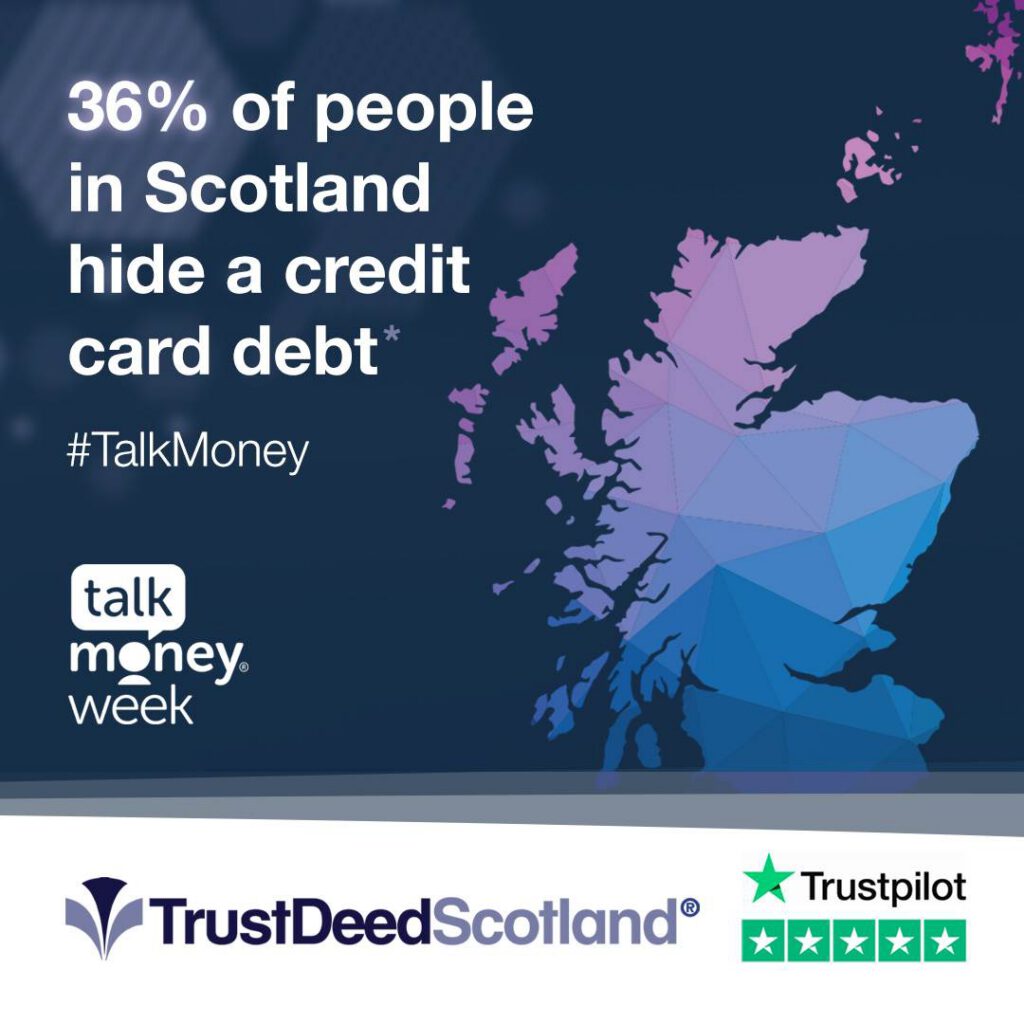
36% Of Scots With Hidden Credit Card Debts

A survey has shown that over 36% of the adult population has a hidden credit card debt. OVER 2 MILLION1 MONEY S£CR£TS KEPT FROM LOVED ONES IN SCOTLAND Research released by the Money and Pensions Service as part of Talk Money Week 2020 shows that 37% of people in Scotland have kept secrets from loved ones about credit cards, loans and savings • 37% of people in Scotland admit to keeping financial products secretPeople most likely to keep money secrets from their partner In the UK, millennials (25-34 year-olds) are the most secretive generation with three in five (59%) hiding money products Adults in Scotland have kept over 2 million2 financial products secret from their loved ones, according to a new study of people’s financial behaviours from the Money and Pensions Service (MaPS) to mark Talk Money Week. Of those who have kept financial products a secret in Scotland, the most common were hidden credit cards (36%). Despite Covid-19 having a widespread impact on people’s finances, the stigma surrounding talking about money in our culture remains – 36% of people in Scotland stay silent about money worries, with some of the reasons they give including embarrassment or fear of being judged. The research, which surveyed over 5,200 people across the UK, has been launched to mark the start of Talk Money Week (9-13 November), a public awareness campaign run by MaPS to improve financial wellbeing by encouraging people to open up about their finances, from pocket money through to pensions.

Hidden Credit Card Debts

Across the UK, 40% of people said they had secret financial products, with the most common products being:
  • Hidden credit cards (36%)
  • Undisclosed personal loans (23%)
  • Secret savings accounts (21%)
hidden credit card debts scotland UK millennials proved to be the most secretive generation, with 59% disclosing they have secret financial products, compared to just 25% of retirees. Of 25-34-year-olds who’d kept a product secret across the UK, credit cards, personal loans and overdrafts were most commonly hidden (by 40%, 31% and 23% respectively). The Talk Money Week study also revealed that across the UK people in relationships tend to underestimate the extent of money secrets their partner keeps from them. While 23% of people in relationships suspect their spouse has kept a money secret, hidden products were found to be even more common, with nearly half of those in relationships (45%) admitting to having an undisclosed money product. Some respondents told the researchers about secrets that became easier to manage once they opened up to their partners: one respondent claimed, “I was once close to bankruptcy due to credit cards and loans which I did not reveal to my partner until it couldn’t be hidden any longer. I admitted the issues eventually and we sorted it.” Another respondent said: “I didn’t tell my husband when I lost control of our credit card debt and ended up juggling cards and minimum payments. Eventually, I admitted it to him and actually acknowledged the amount of debt I now had – he supported me to get onto a Debt Payment Plan which I have been paying for just over a year now, and we are far more financially stable. We made a choice as a couple to no longer use credit. We also now have a joint account as our main account and only our agreed personal budget for minor expenses which is transferred out to our personal accounts.” Allison Barnes, Scotland Manager for the Money and Pensions Service said: “With over 2 million people in Scotland admitting they keep money secrets from loved ones, we are encouraging everyone across Scotland to open up and talk about any money worries you may have during Talk Money Week this week. “However, we understand there could be a number of reasons why people keep money secrets from those closest to them; a secret savings account could act as a buffer for those who want to escape a difficult relationship or an unpaid bill could be kept under wraps in order to protect anxious family members. For many who keep money secrets, it can be a feeling of shame or embarrassment that debts have spiralled out of control. 36% of people in Scotland claim to have money worries and initiating a conversation with someone – a friend, family member or expert – can be a first step to start to mitigate and address the problem. Opening up is a valuable start to making problems more manageable, for the benefit of our health, relationships and overall wellbeing. There’s no better time to start talking than today and the Talk Money Week website offers guidance to help start conversations and prepare yourself ahead of these. You are not alone and as our research shows in Scotland there are many others hiding secrets about money; there are resources available to help tackle some of these secrets including debt advice, as well as money and pensions guidance. Jasmine Birtles, TV money expert and Talk Money Week supporter, said: “Talking about money is still off-limits for a lot of people in the UK. Although we’re happy to talk about all sorts of subjects that used to be off-limits, if you ask someone about their income or investments they clam up. Talking about money really does seem to be the last taboo, despite it being something which is on everyone’s mind. In fact, it’s especially helpful to talk about it now, given the impact the pandemic has had on many people’s finances. It’s particularly important when times are uncertain to talk about money with those closest to us, so we can work together towards a common goal and support each other’s progress. If that’s not an option, you can turn to organisations like the Money and Pensions Service, who have trained specialists who give free, non-judgemental and impartial guidance.” MaPS has a wide range of resources to help people improve their financial wellbeing, starting with a conversation, during Talk Money Week and beyond. Guides to talking about money For guidance on kick-starting conversations about money, see the Money Advice Service’s guides: • Read their guide on Talking to your partner about money • Download their guide on how to talk about money. Take action to work through your money worries Money Navigator is a simple tool which helps people navigate their finances in the wake of Covid-19 to find a way forward, get money support now and help avoid future debt problems. Getting expert support To speak to an impartial expert for free guidance about your money and pensions, visit the following websites and helplines. Money Advice Service  0800 138 7777 Pensions Advisory Service   0800 011 3797 Pension Wise  0800 138 3944 Contact Trust Deed Scotland on 0141 221 0999 for tailored Scottish debt help. If your partner is controlling your money or running up debts in your name, you can find further resources and support on the Money Advice Service website. The research was conducted by Opinium for the Money and Pensions Service. A nationally representative survey of 5,225 UK adults aged 18+ was conducted from 9th – 19th October 2020, of which 440 were from Scotland. The data has been weighted to a nationally representative profile. 1. There are over 5,463,300 million people over 18 (the age you can apply for credit) in Scotland (ONS). The research found that 37% admit to keeping a financial product a secret from family and friends, equating to 2,021,421 people. 2. There are over 5,463,300 million people over 18 (the age you can apply for credit) in Scotland (ONS). The research found that 37% admit to keeping a financial product a secret from family and friends, equating to 2,021,421 products.

About Talk Money Week

Talk Money Week is an annual public awareness campaign, run by the Money and Pensions Service, to get the nation having conversations about money. Talking about finances has been shown to help people make better informed and less risky financial decisions, feel less stressed or anxious and more in control, have stronger personal relationships and help their children form good lifetime money habits. Talk Money Week will take place from 9-13 November 2020.

About Trust Deed Scotland®

Trust Deed Scotland® have helped over [volume] people in Scotland since 2009. Specialising in Trust Deeds and the Debt Arrangement Scheme as two formal debt solutions and advising on alternatives. Find out more about Trust Deed Scotland and get confidential, non-judgemental advice today by calling 0141 221 0999.