Council Tax Arrears Statistics Released by Citizens Advice

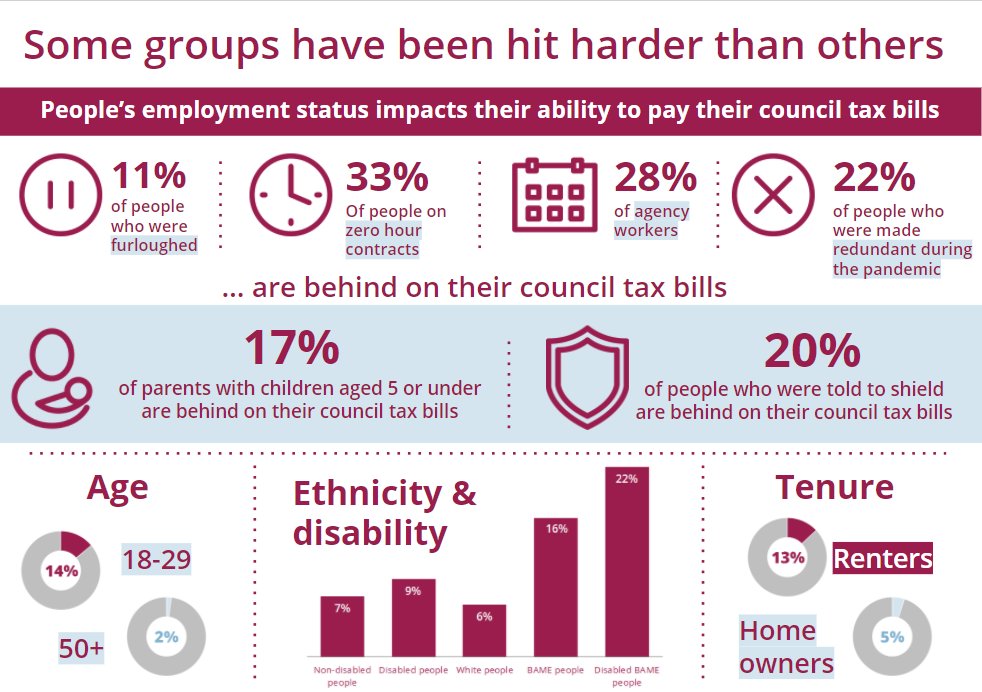
Over 3,500,000 people in the UK now have council tax arrears debt, with an average of £800 council tax arrears, reports Citizens Advice* Founded in 1939, Citizens Advice is a network of 316 independent charities throughout the UK guided by four principles: A free service, Confidentiality, Impartiality and Independence. The unavoidable debt report published by Benedict Guindi and Tilly Cook of Citizens Advice said that the pandemic and the restrictions put in place to control it, have had a dramatic impact on household finances with many people have been made redundant, furloughed, become too ill to work or have taken time off to care for a loved one. Some groups identified as being most affected by council tax arrears included:
  • 11% of people who were furloughed
  • 33% of people on zero-hour contracts
  • 28% of agency workers
  • 22% of people who were made redundant during the pandemic
  • 16% of people of BAME
  • 22% of people of BAME and with a disability.
  • 17% of parents with children aged 5 or under are behind with council tax arrears debt
  • 20% of people who were told to shield are behind with council tax arrears debt.
  • 14% of people aged 18-29 are behind on their council tax
  • 13% of renters and 5% of homeowners indicated that they had accumulated council tax arrears debt.
As a result of the findings of their data, Citizens Advice said: “On average, the people we help with council tax debt have just £20 left after covering essential living costs to pay off debts. 40% have a negative budget, meaning their income doesn’t cover their living costs. People are often forced to make trade offs between repaying their debts and covering essential living costs. During the pandemic, 17% of people with council tax arrears were unable to afford food in comparison to 3% of the total population.” “Councils should prioritise writing off the debts of those who are struggling the most financially, such as those in receipt of Local Council Tax Support and people receiving benefits. There were existing problems with the way council tax is collected before the pandemic hit. The way the regulations are designed makes it harder for people with council tax arrears to arrange and make repayments. The Ministry for Housing, Communities and Local Government should use secondary legislation to amend the Council Tax (Administration and Enforcement) regulations to:
  • Stop people being liable for their entire annual bill if they miss 1 monthly payment.
  • Make it easier for councils to improve collection by giving them more powers to collect debt in a fair way without getting a liability order first.
  • Set out more steps councils must take before using the court process.
This would ensure that all people in debt are given the option of affordable repayments to get back on track.”
Citizens Advice - Council Tax Arrears Stats
The infographic image above was taken from Citizens Advice unavoidable debt report and remains © of Citizens Advice.

Council Tax Arrears Debt in Scotland

As reported in the Glasgow Herald in early January, Citizens Advice Scotland warned of a potential Council Tax explosion, with CAS financial health spokesman Myles Fitt saying: “Scotland is potentially facing an explosion of council tax debt in 2021. The figures before the pandemic are bad enough, but the real fear is that Covid-19 is going to make matters much worse. Councils across Scotland showed a real empathetic approach to those who found themselves in council tax payment difficulties, and the payment breaks in the first six months of the pandemic were extremely welcome. However, this has led to arrears building up, arrears that will be difficult to meet for the many people who have during that period experienced an income drop due to unemployment or reduced working hours. “For others, this problem is yet to come in 2021 when the economic squeeze on personal finances is felt as the furlough scheme and payment support measures close at the end of April, ironically in the same month the first payments of council tax in the new financial year are due.” CAS is calling on people to make use of the Scottish Government’s council tax reduction scheme which can help reduce future payments. For some people, it can also offer a backdate of up to six months. Contact your local authority for more information. All local authorities should have information on their website including: Glasgow council Edinburgh council Aberdeen city council North Lanarkshire council South Lanarkshire council Highland council East Ayrshire council North Ayrshire council South Ayrshire council Trust Deed Scotland® said “Falling behind on priority debts such as council tax can have the severest of consequences. Council tax arrears enforcement action can escalate quickly when there is non-payment of council tax with Sheriff Officers being used to collect outstanding council tax arrears debt with enforcement action such as wage arrestments being used as a last resort to collect outstanding monies. We’re thankful that Citizens Advice have highlighted these groups that they have identified as being most at risk of developing problems with their council tax and we offer tailored debt advice to anyone who is struggling with unaffordable debts, whether they have council tax arrears debt or other types of unsecured debts such as credit cards and loans. As well as being able to provide formal, statutory solutions such as Protected Trust Deeds and the Debt Arrangement Scheme, we can also provide some breathing space for our clients who need more time to think about the best solution for their problem debt by using a Statutory Moratorium.”

Help with unaffordable debt in Scotland

To find out more about managing your money and getting free advice, visit Money Helper, an independent service set up to help people manage their money. Citizens Advice Scotland (0800 028 1456) can give you free, impartial debt advice alongside other money charities including National Debtline (0808 808 4000). As well as formal debt solutions, The Trust Deed Scotland® team offer debt advice that is… Non-Judgemental – Our friendly, helpful team want to help find a solution that suits your needs. Confidential – We do not share your details with any other companies. Your data is safe and secure. Experienced – [volume] people helped and over [reviews] five-star reviews on Trustpilot. Tailored – Advantages and disadvantages of all formal solutions explained. You can find out more about how we can help you by using our Trust Deed Wizard, or by calling us on 0141 221 0999. Our experienced debt advisers provide tailored debt advice outlining the pros and cons of the Debt Arrangement Scheme and other formal Scottish debt solutions including Protected Trust Deeds and Sequestration. *Citizens Advice commissioned ICM unlimited to conduct a survey of a representative sample of 6,004 adults living in the UK. The survey took place between 12th and 25th November. The sample has been weighted by age, gender, region, social grade, work status and ethnicity to be representative of the UK adult population. The 3.5 million in arrears figure is based of 7% of the population being behind on their council tax bills. Then extrapolating this out to the UK adult population of 52.5 million

What is an Employer Salary Advance Scheme?

For an increasing number of cash-strapped Scots, a fairly new solution to short term money problems has emerged in the shape of Employer Salary Advance Schemes (ESAS). Companies such as Hastee and Wagestream have emerged as the leading providers of Employer Salary Advance Schemes, a new form of Payday Loan, albeit without the infamously high interest rates that their predecessors had, that can allow individuals to access up to 50 percent of their wages before their usual payday. While it is highly unlikely that an individual may have built up problem debt exclusively with an ESAS, they’re more likely to become an issue for people already experiencing financial difficulties. The main concern with the ESAS is that, if used regularly, the fees can add up to a significant amount. Despite these fees often being between 0-5% of the loan provided, over time this can accumulate rapidly. Therefore, without realising, ESAS borrowers can be paying hundreds of pounds in fees if they use ESAS multiple times. Another concern area with ESAS is the potential for its borrowers to become reliant on the service. If used continuously throughout the year or even over a few months, ESAS can cause budgeting to become focused on two payments a month instead of one. E.g. having to borrow early in the following month as their ‘final salary’ has been reduced by repaying the previous loans. As a result, anyone considering borrowing through their employer’s ESAS system should be careful about how often they are using them to get through periods of financial difficulties.

Can Employer Salary Advance Schemes result in an unaffordable debt problem?

In short, yes, Employer Salary Advance Schemes can become part of an eventual unaffordable debt problem for people who have been given access to funds but not correctly assessed for affordability. In a similar way to the likes of payday loans previously, An ESAS can push people with unaffordable debt into a problem debt cycle. It is therefore anticipated that these Employer Salary Advance Scheme services will be regulated, like the payday lenders they aimed to replace, or more recently like Buy Now, Pay Later lenders such as Klarna and ClearPay. Whilst still in their infancy, ESAS lenders predominantly work with hospitality, retail and healthcare employers. The regulatory body said that they are seeing new providers joining the market and expect the sector to expand in the next few years. In July 2020, the regulatory body issued a statement that warned of a lack of transparency around costs, and the likelihood of workers making repeat withdrawals and becoming dependent on the services to make ends meet. The regulator said that while ESAS products do have benefits, it is important that employees and employers are aware that there may be some risks in using ESAS lending services that could result in Employer Salary Advance Scheme debt issues further down the line. Lack of credit regulation. The regulatory and statutory rights and protections, from which borrowers under consumer credit agreements benefit, do not apply, as ESAS usually operate outside of credit regulation. For example, ESAS providers have no obligation to check affordability. Therefore, employees will need to satisfy themselves that they will have enough money on payday to pay other expenses they may incur at that time (for example their mortgage or rent payments) when they receive the balance of their normal salary. The high-cost short-term credit (HCSTC) price cap on charges does not apply either, and the Financial Ombudsman Service will not be able to consider complaints. Lack of transparency about cost. The amount of the transaction fee might be a modest sum. However, there is a risk that employees might not appreciate the true cost and how this compares with credit products such as loans. Employees may find it difficult to compare the fixed transaction fee charged for each drawdown to an interest rate/APR. In some cases (depending on the amount of the advance and when it is used in the pay cycle) this may result in it being equivalent to an interest rate that is higher than the price cap for payday loans and other forms of HCSTC. This can become particularly expensive if an employee uses the product repeatedly Dependency and repeat use. If an employee takes their salary early, it is more likely they will run short towards the end of the next payday, potentially leading to a cycle of repeat advances and escalating fees. Lack of visibility for credit reference agencies. Credit reference agencies will not record use of the product, so creditors who subsequently carry out credit searches won’t necessarily be aware that the customer is using ESAS. This may in some cases be relevant to creditors’ assessment of credit or affordability risk and might result in unaffordable loans being made. In February 2021, the regulatory body followed up on the regulation of ESAS loans and highlighted a couple of examples: Paul, an ESAS user that spoke to the regulatory body said “I would like to keep it personal and my employer not to know. It could affect your progression.” Emily, who also spoke to the regulatory body, but who isn’t a current ESAS borrower said: “I wouldn’t really want my employers to know that I’m struggling with money every month.” The regulatory body further warned that “Where ESAS providers also offer regulated credit products or at least act as a broker, there is a potential conflict of interest. If poor use of an ESAS creates a need for credit, for example, to cover a shortfall in wages at the end of the month, the provider could profit from this if they offer alternative credit products. However, given the size and scale of the market, it would be disproportionate, at this time, to introduce a bespoke regulatory regime. Unlike BNPL (Buy Now, Pay Later), ESAS is not a form of credit relying on a legal exemption, and would therefore require a significant regulatory change to be brought within the perimeter. Although the review has identified a number of risks of harm associated with the use of these products, the Review hasn’t seen evidence of crystallisation or widespread consumer detriment. Nonetheless, the market should continue to be monitored and if the position changes, the question of bringing ESAS within the regulatory body’s remit should be reconsidered.” In their defence, Wagestream claimed that “data clearly shows employees use Wagestream responsibly – with 93% of employees accessing less than 30% of their available wages – as it is their hard-earned money they are spending on emergency expenses, not falling into a cycle of credit and debt.” Hastee told the Guardian newspaper last year that “Safety and governance are baked in with wellbeing algorithms monitoring a user’s shifts, earnings, deduction frequency, deduction amount, and the type of spending, others in the industry may be regulated because they provide some sort of consumer credit, or control payroll, which Hastee does not.” Hastee also advised that any “unusual behaviour” will mean users are directed towards charities like the Money Advice Service. Speaking on improved regulation of the Employer Salary Advance Scheme borrowing, Trust Deed Scotland said: “These schemes can help employees deal with unforeseen expenses and occasional short-term cashflow when used in the right way. However, we’re pleased that the regulatory body has committed to investigating ESAS products in the same way that they’re currently exploring the lack of regulation around Buy Now, Pay Later products. Like guarantor loans before them and BNPL products more recently, there are of course many thousands of people who use these products on a regular basis without falling into a debt trap, however, there are also many thousands who have developed problem debt as a result of those products not being correctly assessed for affordability. And, we must also stress that there is currently no alarming trend with Employer Salary Advance Schemes developing into unaffordable debt. We welcome any opportunity for these services to be regulated fairly by the regulatory body before any such Employer Salary Advance Scheme debt problem can be allowed to happen.”

The demise of Payday Loans?

Payday loans have become significantly more regulated than they were since they first started to appear in the mid-noughties. Arguably the most famous rise and collapse of a payday lender was that of Wonga.com, created in 2006 by co-founded by South African tech entrepreneurs Errol Damelin and Jonty Hurwitz. Before going into administration, Wonga, once boasted of being able to get cash into a borrowers account within 15 minutes. However, this was often with little or no affordability checks being put in place. With many thousands of customers forced into taking on unaffordable debts. Wonga.com collapsed in 2018 with administrators for the lender revealing that as of 2020, that 389,621 eligible claims had been made since Wonga’s demise. The average debt owed to a payday loan in their peak of 2013 was £1,657 according to the Debt Charity Stepchange. However, many other payday loans companies do remain open and operate in Scotland, including Lending Stream. Mr Lender and Satsuma Loans among others.

Get Tailored Debt Advice today

If you’re worried about your finances and would like to take control of your unaffordable debt, you can contact Trust Deed Scotland on 0141 221 0999, or complete our Trust Deed Wizard tool to begin your debt help journey today. As a leading provider of formal Scottish debt solutions including Trust Deeds, and the Debt Arrangement Scheme, our experienced debt advice team are able to work with you and offer tailored debt advice that puts you at the heart of the decision-making process.

Rent Arrears Debt Warning by Resolution Foundation

Almost half a million people across the UK have fallen behind on rent or mortgage payments as a result of the coronavirus pandemic, reports the Resolution Foundation. The Resolution Foundation is a UK think-tank that is focused on improving the living standards of those on low-to-middle incomes. Founded in 2005, the Foundation’s established work programme includes incomes and inequality; jobs, skills and pay; housing, wealth and debt; tax and welfare; public finances and the economy. The study into rent arrears found that as many as 450,000 out of an estimated 750,000 people in arrears on housing payments and reporting on the findings, Lindsay Judge a Senior Research and Policy Analyst who leads on housing, advised that many families had suffered ‘huge hits’ to their household earnings and that few have savings to fall back on. 300,000 people are thought to have dependent children. “To make matters worse, measures that could ease the pressure, such as discretionary housing payments from local authorities and negotiated rent reductions from landlords, are not getting through to those that need them.” The Resolution Foundation added: “Both benefit cuts and the end of furlough are pencilled in for the spring, either of which will strain family incomes further. Likewise, unemployment looks set to rise, rather than fall, through 2021, potentially driving up arrears further still.” Trust Deed Scotland said “We speak to hundreds of people every month and most have voiced concerns about their unaffordable debts which typically include the likes of credit cards, catalogues and unsecured loan debt. However, with a number of people having been made redundant in the last year, or who are currently furloughed as part of the Job Retention Scheme – we’ve seen many instances of social and private tenants not being able to afford the repayment of their rent. While there is currently a ban on evictions in Scotland, we’re concerned about the longer-term impact to those individuals’ finances caused by building up rent arrears, as well as other debts, with no clear end in sight. As a result of this, many are falling into a cycle of debt where they are using credit to pay credit and incurring further debt to pay for general living expenses, including priority bills. If you are struggling with unaffordable debt and have dependent children – we also urge you to apply for the School Age Payment award of £250 before the deadline ends on 28th February. The one-off £250 Payment is currently open to families with a child born between 1 March 2015 and 29 February 2016. It can be used for anything from a warm coat to books and toys.”

Support for Scottish tenants with Rent Arrears Debt?

In Scotland, increased support for Scottish tenants in danger of developing rent arrears debt was introduced in December 2020 in the shape of a government-funded Tenant Hardship Loan Fund. The government have set aside £10m for the Tenant Hardship Loan Fund, which is an interest-free loan and is designed to help people who have had their finances or employment impacted by the coronavirus pandemic and do not have other means of housing support. Loans are available for private and social tenants up to a maximum of nine months’ rent costs covering rent arrears and future rent, where those arrears have arisen since 1 January 2020. However, the tenant hardship loan fund will not be available where a tenant had rent arrears before this date. The Tenant Hardship Loan can include up to a maximum of three months of future rent payments as part of the nine-month total. The lending arrangement provides an additional short-term offer that supports tenants to manage rent arrears and helps them to come back into paying their rent. Loan repayments under the tenant hardship loan scheme will be deferred for six months as standard and repaid over a five-year period. The Scottish Government hopes that this helps solve any issues with the continuing uncertainty around the impact of the Coronavirus pandemic. However, as part of the Scottish Government’s commitment to responsible lending, the Tenant Hardship Loan Fund offers will be subject to an affordability assessment. The affordability assessment looks at the applicant’s incomings and outgoings to check whether the applicant has enough surplus income, after other costs, to make the loan payments. Please note: Applications for the Tenant Hardship Loan Fund were discontinued for new applications in December 2021.

Can I include Rent Arrears Debt in a Trust Deed?

The legal position is that all rent arrears should be included in your Trust Deed. However, to avoid any issues with your landlord, especially if you are a private tenant, then you should take advice before considering entering into a Trust Deed whilst you have rent arrears.

Rent Arrears Debt and the Debt Arrangement Scheme

If you have build up rent arrears debt, you may be able to apply for a Debt Payment Programme (DPP) under the Debt Arrangement Scheme (DAS). A DPP, which is a formal debt solution, will give you time to pay off your rent arrears debt at a rate you can afford, and include all other unaffordable, unsecured debts that you are struggling to afford such as credit cards, unsecured loans and council tax arrears. In addition to being able to include your rent arrears debt and credit card debts or other debts that you owe – any interest and charges on those debts are legally frozen, and if you’re receiving distressing telephone calls, text messages and letters threatening you with visits from Sheriff Officers  – you can reduce and eventually stop this type of contact with an approved Debt Payment Programme. The Debt Arrangement Scheme has risks and benefits just like Protected Trust Deeds which have advantages and disadvantages. The Minimal Asset Process route to Sequestration may also be a suitable formal solution for people struggling with unaffordable debt. In order to find out what your options may be suitable for you, Trust Deed Scotland recommends talking to an experienced debt advisor and seeking tailored debt advice, based on your situation.

How to get Scottish Debt Advice today

If you’re worried about your finances and would like to take control of your unaffordable debt, you can contact Trust Deed Scotland on 0141 221 0999, or complete our Trust Deed Wizard tool for more information. As a leading provider of formal Scottish debt solutions including Trust Deeds, and the Debt Arrangement Scheme, our experienced debt advice team are able to work with you and offer tailored debt advice that puts you at the heart of the decision-making process.  

Debt Snowball vs. Debt Avalanche

The debt snowball and debt avalanche techniques are two ways of paying off your debt without utilising a formal debt solution. This is an alternative self-administered solution for residents of Scotland who are experiencing financial difficulties.

Alternative Debt Consolidation methods in Scotland

It’s always possible that a person can negotiate with creditors themselves and secure a short-term debt management plan, or voluntarily agree to pay off a debt over a longer-term. Sometimes without much of an impact against the individual, or in the case of more long-term arrangements, more commonly in the form of default notices being served as an indirect consequence. A default notice itself can have a negative impact on a persons credit history. Trust Deed Scotland® offer debt solutions including Trust Deeds and the Debt Arrangement Scheme and experienced advice on alternative Scottish debt solutions which may include the Minimal Asset Process route. The benefits of undertaking one of these solutions may include:
  • Reducing payments to an affordable level
  • Freezing interest and charges
  • Stopping creditor harassment over non-payment
  • Writing off unaffordable debt
The key to understanding what options are open to an individual and how they can clear their debts is to seek help from a qualified money advisor – this will then ensure that the individual receives transparent, balanced advice and that the pros and cons of each solution are fully explained. If you have unsecured debt and you’re finding these debts unmanageable – you can find out more about government-created debt management solutions available to you. A Trust Deed is only possible when you have over £5,000 of unsecured debts but you could still consider the Debt Arrangement Scheme if you have debts under that level, or indeed Minimal Asset Process if your situation is severe enough to warrant this as a solution. Depending on the individual’s credit rating, income and existing assets – There is the option of a debt consolidation loan which is often secured against a property, or it may be possible to secure a new credit card or lending source at a lower APR%. Using a secured loan against property may allow you to get a loan at a more competitive rate, particularly if you already have a bad/poor credit rating but your home is at risk should you not be able to afford repayment. Ultimately, whatever way works best for you will help you to realise your dream of enjoying a life after debt.

Debt Snowball vs. Debt Avalanche – What’s the difference?

If you’re determined on tackling your debts yourself, don’t need help with debts and have a large enough, disposable income that allows you to do so then you can investigate the two methods known as the debt snowball and debt avalanche systems. Both debt repayment plans are useful and help you regain control of your finances again, however, they both require a serious commitment from you and an element of frugal living. The truth is that the two methods are almost exactly alike in that they both ask you to pay minimum payments on all your debts except for one focus debt. The only difference between the snowball and avalanche is the order that you will pay off your debts. Some personal finance writers argue that one is better than another – but it’s really a matter of personal preference. With either method, you’ll send the creditor every extra penny you can find until the focus debt is paid off. As long as your total debt is going down then either is good.

What is the Debt Snowball technique?

The debt snowball technique involves making minimum payments on all debt, then paying off the smallest debts first to get them out of the way before moving on to bigger ones. The architect of this technique and coined phrase is the American personal finance guru Dave Ramsey. It is a debt reduction strategy that results in you paying off debts in order of smallest to largest. when the smallest debt is paid in full, the money you were paying to that debt rolls on to the next smallest debt you have. When you use the debt snowball technique, you will gain the instant feel-good factor of clearing a debt and moving onto the next.

What is the Debt Avalanche technique?

The debt avalanche technique involves making minimum payments on all debt, then using any remaining money to pay off the debt with the highest interest rate. The debt avalanche technique can often result in lower payments over time. The debt avalanche technique involves making minimum payments on all debt, then using any remaining money to pay off the debt with the highest interest rate. Using the debt avalanche to pay off debt will save you the most money in interest payments. For example, if you have £2,000 extra to devote to debt repayment each month, then the debt avalanche technique will make your money go the furthest. Say for example that you have the following debts: • £10,000 Royal Bank of Scotland credit card debt at 18.99% • £9,000 Capital One credit card debt at 3.00% • £15,000 Halifax loan debt at 4.50% In this example, the debt avalanche technique would have you pay off your RBS credit card debt first, then allow you to pay off your remaining debt in 11 months, paying a total of £1,011.60 in interest. The debt snowball technique would have you tackle the Halifax loan first, managing your debt in 11 months, but you would have paid £1,514.97 in interest. By switching the order of your debts, you can save hundreds of pounds in interest payments. For individuals with larger amounts of debt, the debt avalanche technique can also reduce the time it takes to pay off the debt by a few months.

Priority vs. Non-Priority Debts

Before you would commit to either debt repayment technique you would work out your income and then also take into account your priority and non-priority debts. This is vital as it is not advisable to ignore your priority debts such as council tax simply because it’s not interest-bearing. Ignoring priority debts may seem like a way of getting your debts paid quicker but are more like to result in serious consequences for you and your family if you stop paying your mortgage or rent.

Persistent Debt Caution

When you read up more on the debt avalanche and debt snowball techniques, it’s easy to get carried away with the idea of a debt repayment plan that can be self-managed, and that’s ok to feel that way. However, as these are largely American concepts, one major aspect you must factor in as a resident of Scotland is the rules around persistent debt. What’s persistent debt? You can find out more about persistent debt in Scotland but essentially, if you only make minimum payments for a period of 18 months on your credit cards, store cards and catalogues, your lender may suspend the service and ask for full repayment due to rules introduced by a UK regulatory body. However, you will be notified of this in advance and you may still be able to negotiate a debt repayment plan with the lender.

Debt Repayment Plan Advice In Scotland

Trust Deed Scotland® offer a confidential, non-judgemental debt advisory service that aims to help people in Scotland get themselves out of the severest of financial difficulties. A self-administered debt repayment plan such as the debt snowball or debt avalanche methods may be beyond your reach and a more formal debt management solution is required. In which case, we’ve helped over [volume] people in Scotland who were in a similar position and of those people, almost 3,000 left a debt advice review on the independent reviews platform Trustpilot. The difference between many of the companies advertised on Facebook or Google and Trust Deed Scotland® is that our advisors are based in-house and work directly with those who implement the solutions, ensuring continuity in your journey and that your details are not passed onto anyone else. We’re also experts in Scottish debt advice whereas an individual based in a call centre in the rest of the UK, or overseas may know as much as about debt help in Scotland as the piece of paper in front of them, also known as their sales script! And, as we have the correct authorisation and commitment to training and compliance – we’ll always have your best interests at heart. Some of those companies may attempt to sell you a solution that makes more sense for them, but it may not always be in your best interest. Get started today by trying our Trust Deed Wizard® tool or call us on 01412210999.

Can I include a Bank Overdraft Debt in a Trust Deed?

Yes, you can include a bank overdraft debt in a Trust Deed. In fact, not only can you include a bank overdraft debt in your Trust Deed, but the outstanding balance will automatically be included as one of your creditors. Sometimes clients that we speak to believe that a bank overdraft isn’t a real debt. Perhaps because they service the debt on a regular basis, as their wages and other income go into the account, it may take at least a couple of weeks before it either starts to become partially overdrawn, or more commonly, reaches the authorised overdraft limit. Bank overdraft debts are one of the more common debts types that will be included in a Trust Deed or DAS (Debt Arrangement Scheme), alongside credit card debts, unsecured loans and many others.

Bank overdrafts are an expensive way to borrow

You may consider that the bank overdraft facility is like a financial buffer for you, a very convenient form of borrowing but it’s feasible that the bank can request full payment of the bank overdraft debt at any time ‘upon demand’ And, most crucially for people who are already struggling with their finances, an overdraft can become a very expensive form of borrowing with penalties and high-interest rates. Research from Compare the Meerkat in August 2020 found that almost 33% of us are relying on an overdraft to get us through the Coronavirus pandemic. The average amount owed on their bank overdraft debt is in excess of £500. In June 2019, UK regulators introduced new rules on overdraft lending to help stimulate a fairer, simpler and more transparent overdraft market. In reality, the move to help people who have bank overdraft debts ultimately backfired as the likes of Lloyds, Barclays, Royal Bank of Scotland, HSBC, Halifax, Clydesdale Bank and others hiked-up their interest rates to almost 40% and up to 50% in some cases. However, since these new rules only started during lockdown when they also instructed banks to offer interest-free overdrafts, many customers of banks may not yet realise that the costs for using an arranged overdraft will be even more expensive than using credit cards.

Payment breaks coming to an end

Where people in Scotland are still furloughed, or have been made redundant and are already taking advantage of payment breaks, replaced by tailored support; expenditure may suddenly become overwhelming. If you are in a payment break that is due to end, our advice is to contact your lender(s) and ask what options you have for tailored support. If you have unaffordable debts in addition to your bank overdraft debt then we would also advise you to speak to a qualified money advisor such as Trust Deed Scotland®. In order to apply for a Trust Deed, all unsecured debts must be included and it is normal that if you bank with a provider who is also a lender, then you will need to open a new bank account with a lender whom you do not owe any money to. The good news is that it’s very easy to open a new basic account while in a Trust Deed, with a number of options open to you. Find out more about the best bank accounts for Trust Deeds. If you have a joint account, then you will need to remember that the other party becomes fully responsible for payment of that debt.

Can you get a new bank overdraft when a Trust Deed has ended?

Yes, once you have completed your Trust Deed, you will be free to start rebuilding your credit again and after a period of credit rating rehabilitation, you will be free to apply for a bank overdraft again. It’s true that bank overdrafts can make our day-to-day lives much easier. An unused bank overdraft may seem like the best option in the event of the ‘rainy day’ that may occur. But there is incontrovertible evidence that bank overdraft debts can once again develop due to poor affordability checks, which become self-regulated. No sooner, have you started to encroach your overdraft limit, than other debts such as credit cards, loans and the cost of living itself can sometimes put you in a precarious position.

What’s the difference between an emergency fund and a sinking fund?

For clients of Trust Deed Scotland® who have gone on to enjoy a brighter future, most often they will take the monthly contribution that they had paid into their Trust Deed and instead create a savings accounts that will be used as an emergency fund and a sinking fund. Essentially an emergency fund is what it sounds like. An allowance to cover a sudden emergency such as car repairs, anything that was unexpected. A sinking fund is more a way of budgeting for expenditure that we know will occur. These may be one-time purchases such as a new computer, or phone. A car, or a deposit for a home. Events such as weddings and graduations, or recurring expenses such as car insurance or Christmas. The added benefit of creating a savings account instead of an overdraft is that you will accumulate interest on the amount. Research online and find a savings account that suits your circumstances. While the easy answer may appear to be the account that offers the higher rate of interest, in real terms, these savings accounts are offered with penalties for early withdrawal etc, so always do your homework on them before committing.

Help with bank overdraft debt in Scotland

If you’re worried about bank overdraft debt in Scotland, or indeed any other type of debt – you can contact Trust Deed Scotland today for qualified advice. We offer expert debt help in Scotland and have helped over [volume] people in Scotland since 2009. Thousands of people have left debt advice reviews where our clients tell us in their own words that our advisors are friendly, non-judgemental and that our advisors were able to find a solution to their debt problems quickly and efficiently.

What is Zombie Debt?

Halloween 2020 is set to look different than any other in Scotland with the Scottish Government asking us to avoid guising and thus help prevent spreading Coronavirus. Residents of Scotland with old debts beware: a forgetful moment from your past could results in old debts rising from the dead and coming back to haunt you. Zombie debt. So, as we’re at home this Halloween, we’ve put together a guide to help you understand more about what you’re options are. Helping you to avoid having a night of the living debt.

What are Zombie Debts?

Zombie debts are old accounts that may have been forgotten about and then either written off as ‘uncollectable’ and which have passed the time in which they can legally be collected. These can be anything from an old payday loan to a credit card debt. Even an old library fine. Depending on the type of debt and how old the debt may be, you may be in for a nasty surprise, or it may become unenforceable due to becoming a Prescribed Debt, known more commonly across the UK as Statute Barred.

Are my statute barred debts written off?

A regulatory body say that it’s not fair for a creditor to keep asking you to pay a statute-barred or prescribed debt if you’ve told them you don’t intend to pay it. In Scotland, If the creditor waits too long, the debt will become prescribed. Once a debt is prescribed, the law says it no longer exists so there’s nothing more the creditor can do collect it. This is outlined as part of the Prescriptions and Limitation (Scotland) Act 1973. Statute barred debt in England refers to a debt that’s not enforceable because the time a creditor has to chase payment has passed. This is outlined under the Limitation Act 1980. In England, Wales and Northern Ireland where under the Limitation Act 1980, a creditor has six years to chase most unsecured unpaid debts or twelve years for some mortgage shortfalls. This ‘limitation period’ starts from the time of your last payment or acknowledgement of the debt, not the total length of time you’ve been making payments. The Limitation Act 1980 act states that when all of the following conditions are met a debt cannot be enforced:
  • The creditor has not registered a CCJ against you (Known as a Decree in Scotland)
  • You have not made a payment in the last six years (or with joint debts, the other person)
  • You have not admitted the debt in writing in the last six years
  • Where it’s a mortgage shortfall, the latter two restrictions are doubled to 12 years.
For most types of debt in Scotland, the prescription period is 5 years. Mortgage capital shortfalls have a longer prescription period of 20 years for the money that you borrowed while the interest charged on this has a prescription period of 5 years. Council tax and overpayment of social security benefits are also subject to a prescription period of 20 years. If your creditor has already started action to obtain a Decree before the prescription period passed, the debt can’t become prescribed.

How did I get a Zombie Debt?

Zombie Debt comes in many forms, including legitimate debts that have been forgotten or ignored, Identity theft cases and I.T. errors. The most common way of this happening is a combination of change of address, change of telephone and changed bank details. With no little way of knowing, we assume the debt has been paid and eventually may believe that we paid it off. If you have built up a zombie debt and forgotten about it, don’t feel bad about it – it’s an easy oversight to make. But, if you have forgotten about a debt you are protected from harassment or any other contact from the creditor. You cannot be pursued through the courts, as the debt is deemed to have either been abandoned or repaid. It involves unsecured credit from credit cards, store cards and the likes of council tax arrears. It does not apply to secured debt such as mortgages and money owed to the government for income tax, property tax, fines and student loans.

Help with unexpected debt?

If you have unaffordable debt, whether it’s from an old Zombie Debt, or more recent – You should always look for expert debt help in Scotland. You can find out more about Trust Deed Scotland and find out why we’ve become the No.1 rated company in Trustpilot‘s debt relief services category. If you are struggling with debts, we’re here for you. You’re not alone. Find out more about what is a Trust Deed in Scotland or about what trust deeds do, call us today on 01412210999 for friendly, non-judgemental advice.  

Are Credit Cards included in Scottish Trust Deeds?

All types of unsecured debts are required to be included within a Scottish Trust Deed and credit cards are the most common type of debt that is included in Trust Deeds and alternatives such as the Debt Arrangement Scheme.

What are Credit Cards?

Credit cards and store cards are both used to purchase goods and services on credit in the same way that a catalogue accrues a debt, or a personal loan, bank overdraft and so on. A debit card is different to a credit card as it relies on finds being active in an account. Credit cards may be issued by your bank or building society, or other financial services provider. A credit facility may be provided by a high street store for example, more commonly referred to a store card.

Are Credit Cards a problem?

We’re a nation of credit card enthusiasts. The Money Charity reported in July 2020 that the average credit card debt per UK household was £2,238 in January 2020. Credit cards are convenient and handy. They’re useful for travelling and in some cases, they do offer greater protection for purchases and reclaiming where a transaction has resulted in a poor buying experience. Chargebacks themselves are really useful. A chargeback is a refund prompted by your card issuer. If you paid for a product or service with a credit card, you can dispute it through the card issuer and let them take the dispute to the merchant. If the issuer succeeds where you failed, the purchase price is refunded to the credit card you charged it on. However, as credit cards become more readily available, and the numbers of people relying on them continue to grow, defaults are becoming more common. Store cards carry with them a different level of threat. The store card may seem like its a loyalty card, being used to open with an immediate discount. However, with little room for competitive rates, the interest rates are often unfavourable, to begin with, and comes with the added temptation in the form of buying there and then, in the store.

How to manage Credit Card debt?

If you have a temporary payment problem, contact the card issuer to discuss this. They may offer some short-term flexibility and with payment breaks being replaced with ‘tailored’ solutions as a result of Coronavirus recommendations made by UK regulators. If you haven’t defaulted on your credit cards and have a great credit rating, you can shop around for other credit cards which allow interest-free balance transfers. Caution should be used when examining the small print. Credit card lending is done based on risk. The more of a risk you are, the worse the interest rate you are likely to achieve as a result. Will you be able to afford new lending terms over the longer term. However, if like many thousands of other households in Scotland, your money issues are more serious, it’s best to get expert debt advice. A qualified money adviser can take a look at your situation, advise you of the options and allow you to make a balanced decision. Solutions for credit card debts in Scotland may include the Scottish Trust Deed, Debt Arrangement Scheme or Sequestration.

What is a Scottish Trust Deed?

The Scottish Trust Deed is more formerly known as a Protected Trust Deed and is used to consolidate debts over a typical period of 48 months. It’s a government legislated debt solution that allows an individual to freeze interest and charges, pay back a more reasonable amount to their debts and protect assets such as a home or car. There are disadvantages too such as an impact on your credit rating. When you have unaffordable debts such as credit card debts, the Scottish Trust Deed solution may work for you.

Alternatives to a Scottish Trust Deed?

The Debt Arrangement Scheme is a solution that also allows you to legally freeze interest and charges, stop creditor harassment over non-payment and gives you a fixed time frame for when you will be able to repay the debt. When evaluating your options – we recommend speaking to a qualified money advisor and that will allow you to receive tailored advice depending on your circumstances. In addition to the Scottish Trust Deed or DAS, you may consider Bankruptcy as a way of managing your debts. Sequestration and Minimal Asset Process are the two forms of bankruptcy that are used in Scotland, and while they may carry the severest of impacts to a credit rating and come with a natural stigma attached to them – They are an effective way of clearing debt.

Help with Credit Card debts in Scotland

We’ve helped over [volume] people in Scotland, became the No.1 rated with more Trustpilot debt advice reviews than anyone else in Scotland. Every week, our experienced debt team give hundreds of people non-judgemental and confidential advice. Call us on 0141 221 0999 or learn more about Trust Deed Scotland today.

Help Repaying Catalogue Debts In Scotland

A high number of people are asking Trust Deed Scotland® for help repaying catalogue debts when they approach us for Scottish debt help. Catalogues are a popular way to make purchases and then spread the cost over a number of monthly payments. This can help make expensive purchases seem more affordable, but catalogues are often an expensive way to borrow and have high-interest rates. Some catalogue firms even advertise themselves as bad credit or poor credit catalogues. In which case, the interest is most likely even higher to offset risk. As most catalogue companies let you spread the cost of payments over a period of time. You’ll typically pay interest, which means that making just the minimum payments can lead to a bigger unaffordable debt. It is common for catalogue companies to advertise their products in a way that describes them as affordable – and breaks the cost down to a per day, per week, per month arrangement in order to hook individuals in and buy additional items at a later date, without adding all the sums together. When applying for a catalogue credit facility, reasonable affordability checks aren’t as thorough as some other lending facilities.
Catalogue Companies Used in Scotland
The most popular catalogues in Scotland include:
  • Ambrose Wilson
  • Argos Catalogue
  • ASOS
  • Debenhams
  • Grattan
  • JD Williams
  • John Lewis
  • Littlewoods
  • Next
  • Simply Be
  • Very.co.uk
  • Yes Catalogue
 

What happens if you can’t afford to pay your Catalogue debt?

Should you miss payments to your catalogue, or don’t make the minimum payments, the catalogue company will ask you to catch up with the arrears. If you have a debt with a catalogue company, this is a non-priority debt and would be treated the same as other unsecured debts such as credit cards, store cards, loans or overdrafts. If you can’t pay them the account, it will be closed so you can’t buy any more goods. The account will default and impact your credit score, the debt will most likely be passed onto a debt collection agency and the creditor may take eventually pursue court action against you, including pushing for a decree; a CCJ in Scotland. Wage arrestments are more commonly used to enforce unpaid council tax in Scotland, but can be known to be used to enforce some unsecured debts too, including catalogue debts. Lowell Portfolio is an example of a debt purchasing agency that pursue individuals with catalogue debts on behalf of their clients. Nationwide Debt Recovery is another. Unlike car finance, where you could negotiate to hand back the car, with catalogue debts – you can’t give the items back should you fall behind with payments. Paying only the minimum monthly payment to a catalogue debt in Scotland might not cover the interest and repayments. This can cause the catalogue debt to build up and become difficult to manage. You’re also at risk of your account being a ‘persistent debt‘.

Help with catalogue debts in Scotland?

A catalogue debt on its own is usually best managed by contacting the catalogue company and negotiating a repayment plan. If you have been affected by a drop in income due to the Coronavirus, you may be able to request a payment break, giving you time to look at repaying catalogue debts over a longer period of time. But never assume that a payment break will automatically be granted, and interest and charges may not necessarily be frozen. Most catalogue companies should have a dedicated Coronavirus payment break policy. However, If you’re falling behind with multiple payments to catalogue debts and other types of debts such as credit cards, store card and personal loans or if you’re worried about what catalogue debt creditors can do to you, you should get expert debt advice. You can contact us for experienced advice and help finding out what your options are. Trust Deed Scotland® give advice on Trust Deeds, Debt Arrangement Scheme and alternative Scottish debt solutions. Try our online debt repayment calculator, or call us on 0141 221 0999.

Can financial advisers help with debt?

Financial advisors are able to give you advice on investment opportunities, tax and wealth management. The types of financial products that typically seem out of reach for people struggling with unaffordable debts. Fully qualified financial advisors can give you advice on anything from mortgages to pensions but surprisingly, financial advisors help with debt extends to only making a referral to a qualified debt advisor. In order to be able to offer you the correct debt advice, an individual should be qualified in the correct discipline. However, help with debt can be sought from a variety of places – most of which, will give you help with debt without charging a fee for their advice.

Debt Problems – What to do and where to get help?

If you have debt problems and you’re wondering what to do and where to get help with your debts, the good news is that no debt problems are unsolvable. It might not always be quick or easy, but there’s normally always a route to resolving debt problems, from one credit card default to cases where an individual can owe tends of thousands of pounds to a number of their lenders. It just wouldn’t typically be a financial advisor who would help you with your debts. When you have debt problems in Scotland, the earlier you deal with your debts, the easier they are to deal with and sometimes, the debt problems may not require a complete overhaul of your outgoings – it may be possible to come to an arrangement with the people you owe money to, also referred to as your creditors. If you have debt problems that are unaffordable, you can get experienced debt advice in Scotland from Trust Deed Scotland®, or alternatively you can approach a local money advisor or debt charity in Scotland. At Trust Deed Scotland®, we’re proud of our record in the industry, having helped over [volume] people in Scotland, and over [reviews] reviews from our clients. For us, we feel it’s important that when you do have debt problems, and you are looking at where to get help, that you are able to get the best advice. Ultimately, if you have debt problems – our advisers would talk through your situation, and give you balanced advice that puts you in control of the decision, knowing all the facts and alternatives.

How to get help with debt in Scotland?

As Trust Deed Scotland® is owned and operated in Scotland, we’re experts in Scottish debt solutions. It may be a surprise to learn that getting help with debt in Scotland is different from the process in England, Wales or Northern Ireland – thanks mostly to our unique legislation we have in Scotland. You may have heard about IVAs, which are a solution open to people south of the border but you’re unsure of the differences between IVAs and Trust Deeds. It’s another reason why financial advisors can’t help with debt as they simply don’t know the legislation as much about the pros and cons, as a company such as Trust Deed Scotland®. Similarly, it’s also possible to investigate other ways to clear your debts including debt consolidation loans in Scotland, but this can sometimes cause more problems if undertaken without examining the cause for debt in the first place, and more precisely – your affordability. If you’re looking at how to get help with debt in Scotland, you can find out more about managing your money and get debt advice, by visiting the Money Advice Service, an independent service set up to help people manage their money.

Who can help me with debt?

Few people actively seek to deliberately get themselves into debt. While it’s also true that debt comes from spending money you don’t have, in reality, it’s a change in circumstances, like personal illness, divorce, mental health problems, losing your job, or a sudden trauma caused by the death of a partner rather than frivolous reasons. Some of these changes in your circumstances can combine together to create a debt spiral and added to this, there is still a stigma attached to debt, meaning that people struggle on without seeking help with their debts. You may already be aware of the terminology thanks to ads on that you’ve seen on TV, radio, or social media and ask yourself the question of Is A Trust Deed A Good Idea? This question is common and while Trust Deeds are a good solution for those individuals who are eligible for it, in truth there are other solutions such as the Debt Arrangement Scheme, or Minimal Asset Process, which is a form of bankruptcy aimed at people who are struggling with debts. While it’s a solution that shouldn’t be taken lightly, it can be a better solution for some individuals. In short, if you’re asking who can help you with debt – the best advice that we can give you is to seek help immediately and get an idea of what your options are. If you do something about your debt today, you can stop worrying about it tomorrow. Are you ashamed of your debt? Talking about debt is the first step to tackling it. If you need help with debt, and you’re at the stage of requiring a Trust Deed, Debt Arrangement Scheme or Sequestration then you should seek the help of a qualified money adviser. Only a qualified Insolvency Practitioner can formally setup a Trust Deed or Sequestration. And only an Insolvency Practitioner or Money Adviser can setup and maintain a Debt Payment Programme as part of a Debt Arrangement Scheme. Call us on 0141 221 0999 today for a confidential chat with one of our experienced debt advisers. The debt advice that we offer is non-judgemental and we’ve been able to give over [volume] people help with their debts in Scotland. We’re also rated no.1 on Trustpilot in the Debt Relief category in Scotland, which is largely thanks to our ongoing commitments to treating customers fairly, and training processes.

What’s the differences between secured and unsecured loans?

What is the difference between a secured and an unsecured loan?

  Find more articles like this in our Info Hub – A secured loan means that you borrow a sum of money and put up something of value as security – usually your home. Therefore, an unsecured loan is unattached to any asset that you own. When you get a loan from a bank or a loan from a credit union – they are typically unsecured loans in the same way that credit cards, catalogues and bank overdrafts are also unsecured lending types. Two other types of unsecured loan types are payday loans and guarantor loans, both of which have come under heavy criticism in recent years for mis-spelling. Lastly, another unsecured loan is a student loan – The student loan repayment arrangement varies due to the particular payment plan you are on. A secured loan against a car is usually refered to as a logbook loan and some ‘rent-to-own’ lenders exist(ed) such as Brighthouse, allowing an individual to purchase goods on a secured loan basis. With a secured loan, if you do not keep up the payments, the lender can sell the item used as security, even if that means leaving you homeless. With an unsecured loan debt, if you don’t keep up the payments, the lender can take action in the courts to get the money back. More commonly, and before it gets to that stage – they will serve a default notice against you as per the terms of Consumer Credit Act of 1974. A default will impact your credit rating and more likely result in them passing the unsecured loan debt onto a debt collection agency to collect on their behalf. If it does end up in court, you will usually be ordered to pay off the loan in regular instalments set at an amount the court decides you can afford. The lender can use a range of other measures if you do not make the payments in line with the court order. It is more common for local authorities to pursue you for enforcement actions such as wage arrestments in Scotland, however, this is very far down the line of non-payment of your unsecured loan debt. If you currently have an outstanding wage arrestment claim issued against you, you can investigate the use of a Statutory Moratorium to buy yourself more time and give you some breathing space. If the wage arrestment has already been processed and your employer is taking a deduction from your wage – give us a call on 0141 221 0999 and we’ll review your Scottish debt help options with you. The APR% of a secured loan is usually more favourable than an unsecured loan because lenders run fewer risks of not getting their money back. An unsecured loan will generally cost you more, but there’s no danger of losing your home if you can’t keep up the payments.  

What Are Debt Consolidation Loans?

  Debt consolidation loans are a single loan taken out to replace your other debts, however, are they the best option available for restructuring your finances? Taking out a consolidation loan when you are already in severe debt might not be the best option for you. You may need to consider other aspects. Think about: Cost: Is the interest rate very high? Will the new debt consolidation loan really save you money? Security: Is the loan secured against your home or car? If so, you could risk losing your home/vehicle if you fail to keep up the payments on the consolidation loan? Other existing debts: Make sure the consolidated loan covers all your existing debts except those which have a lower APR than the consolidation loan. Otherwise, you could find yourself having to pay back loans you had forgotten about at a time when you have already overcommitted yourself by paying back the debt consolidation loan. New debts: Once you’ve consolidated your loan, don’t build up new unsecured debts elsewhere. Cut up your credit cards so that you can’t use them.  

Secured vs Unsecured Loans – How much is too much to borrow?

  Before taking on any new borrowing from an unsecured loan or a secured loan, think carefully about whether you will be able to afford the new repayments on top of your existing ones and think about what would happen if your circumstances changed. To help you do this, draw up a budget taking into account how your income and spending are likely to change over the lifetime of the loan. Also look at how much you will pay back in total – multiply the monthly payment by the number of payments –  You may be shocked. Recalculate your budget as if you had already taken out the loan. Do the results now suggest you’ll run into problems? Calculate the effect of a change in interest rates on your mortgage. Think carefully before you borrow more to try to get out of a problem. A new loan may appear to help for a time but will make matters worse if you run into problems repaying that loan too. Check out budget and loan calculators to understand the real impact of your borrowing. And get advice to help you sort out the root of the financial problem.  

Debt Consolidation without borrowing?

Depending on your situation and how much you owe – it’s possible that an unsecured loan or secured loan may not be the best way of managing your unaffordable financial difficulties. If you reside in Scotland and have unaffordable debts; you may qualify for the Debt Arrangement Scheme. The DAS in Scotland uses government legislation that allows you to enter into a formal debt management solution which freezes all interest and charges. Find out more about the advantages and disadvantages of the Debt Arrangement Scheme. In addition to the Debt Arrangement Scheme, if you owe more than £5,000 to two or more unsecured creditors, you may qualify for a Trust Deed, which also uses legislation to write off some of your unaffordable debt and allows you to enjoy a brighter future after a typical period of 48 months. Find out more about the advantages and disadvantages of Trust Deeds and how Trust Deeds work. Depending on the severity of your financial difficulties – you may also qualify for Sequestration – the Scottish insolvency equivalent of Bankruptcy. There are pros and cons to each but the outcome has the same goal; affordable debt repayments that allow you to put your financial difficulties behind you. In order to make sure you’re given the best advice on debt consolidation with our without further borrowing, we would always advise that you seek expert debt advice. Trust Deed Scotland® can be reached on 0141 221 0999 or you can contact Trust Deed Scotland via an online enquiry form, email, or in person* however, we recommend trying our Trust Deed Wizard tool to start the process as your first step. After a confidential phone call with one of our qualified debt advisors, we will be able to explain the pros and cons of all available solutions and provide you with a personalised illustration of what your options are, and how much you would be able to reduce your monthly repayments down to. *When lockdown restrictions allow this to be done so safely. May not be suitable for all. Can affect credit rating. Free advice also available from moneyadviceservice.org.uk