Are Credit Cards included in Scottish Trust Deeds?

All types of unsecured debts are required to be included within a Scottish Trust Deed and credit cards are the most common type of debt that is included in Trust Deeds and alternatives such as the Debt Arrangement Scheme.

What are Credit Cards?

Credit cards and store cards are both used to purchase goods and services on credit in the same way that a catalogue accrues a debt, or a personal loan, bank overdraft and so on. A debit card is different to a credit card as it relies on finds being active in an account. Credit cards may be issued by your bank or building society, or other financial services provider. A credit facility may be provided by a high street store for example, more commonly referred to a store card.

Are Credit Cards a problem?

We’re a nation of credit card enthusiasts. The Money Charity reported in July 2020 that the average credit card debt per UK household was £2,238 in January 2020. Credit cards are convenient and handy. They’re useful for travelling and in some cases, they do offer greater protection for purchases and reclaiming where a transaction has resulted in a poor buying experience. Chargebacks themselves are really useful. A chargeback is a refund prompted by your card issuer. If you paid for a product or service with a credit card, you can dispute it through the card issuer and let them take the dispute to the merchant. If the issuer succeeds where you failed, the purchase price is refunded to the credit card you charged it on. However, as credit cards become more readily available, and the numbers of people relying on them continue to grow, defaults are becoming more common. Store cards carry with them a different level of threat. The store card may seem like its a loyalty card, being used to open with an immediate discount. However, with little room for competitive rates, the interest rates are often unfavourable, to begin with, and comes with the added temptation in the form of buying there and then, in the store.

How to manage Credit Card debt?

If you have a temporary payment problem, contact the card issuer to discuss this. They may offer some short-term flexibility and with payment breaks being replaced with ‘tailored’ solutions as a result of Coronavirus recommendations made by UK regulators. If you haven’t defaulted on your credit cards and have a great credit rating, you can shop around for other credit cards which allow interest-free balance transfers. Caution should be used when examining the small print. Credit card lending is done based on risk. The more of a risk you are, the worse the interest rate you are likely to achieve as a result. Will you be able to afford new lending terms over the longer term. However, if like many thousands of other households in Scotland, your money issues are more serious, it’s best to get expert debt advice. A qualified money adviser can take a look at your situation, advise you of the options and allow you to make a balanced decision. Solutions for credit card debts in Scotland may include the Scottish Trust Deed, Debt Arrangement Scheme or Sequestration.

What is a Scottish Trust Deed?

The Scottish Trust Deed is more formerly known as a Protected Trust Deed and is used to consolidate debts over a typical period of 48 months. It’s a government legislated debt solution that allows an individual to freeze interest and charges, pay back a more reasonable amount to their debts and protect assets such as a home or car. There are disadvantages too such as an impact on your credit rating. When you have unaffordable debts such as credit card debts, the Scottish Trust Deed solution may work for you.

Alternatives to a Scottish Trust Deed?

The Debt Arrangement Scheme is a solution that also allows you to legally freeze interest and charges, stop creditor harassment over non-payment and gives you a fixed time frame for when you will be able to repay the debt. When evaluating your options – we recommend speaking to a qualified money advisor and that will allow you to receive tailored advice depending on your circumstances. In addition to the Scottish Trust Deed or DAS, you may consider Bankruptcy as a way of managing your debts. Sequestration and Minimal Asset Process are the two forms of bankruptcy that are used in Scotland, and while they may carry the severest of impacts to a credit rating and come with a natural stigma attached to them – They are an effective way of clearing debt.

Help with Credit Card debts in Scotland

We’ve helped over [volume] people in Scotland, became the No.1 rated with more Trustpilot debt advice reviews than anyone else in Scotland. Every week, our experienced debt team give hundreds of people non-judgemental and confidential advice. Call us on 0141 221 0999 or learn more about Trust Deed Scotland today.

What debts does a Protected Trust Deed include?

The type of debts that can be included in a Protected Trust Deed are generally those that are described as unsecured, with some exceptions. When you enter into a Protected Trust Deed in Scotland, most of your unsecured debts will be included and this may include:
  • Credit Cards
  • Personal Loans
  • Overdrafts
  • Catalogues
  • Gas and Electric Arrears
  • Council Tax Arrears
  • Payday Loans
  • Store Cards
  • Buy Now Pay Later Agreements
  • Any Other Outstanding Personal Bill e.g. Vet Bills
There are other debts that can be included in Trust Deeds, but we recommend contacting us today confidential advice as it’s important to understand not only the debts that you have and whether or not debts those can be included in a Protected Trust Deed, but also other aspects include your affordability, total debt owed and your income vs. expenditure. On some occasions, an alternative Scottish debt solution may be more beneficial for you.

What types of debt are excluded from a Protected Trust Deed?

Typical debts that aren’t included within a Protected Trust Deed include:
  • Mortgages
  • Secured Loans
  • PCP and PHP Agreements
  • Hire Purchase Agreements
  • Court Fines
  • TV Licence Arrears
  • Student Loans
  • Child Support Arrears
You can also find out more about the differences between secured and unsecured loans, if you’re unsure what this means.

Can joint debts be included in my Protected Trust Deed?

A joint debt in Scotland is a debt that has your name and the name of the other person you entered into it with on the agreement. A joint debt can be included in a Protected Trust Deed, however, the other person named on the debt will still be responsible for making payments towards it. This is also true of guarantor loan debts in Scotland. If you have some of the debt written off, the other person will still be asked to pay the remaining money back, therefore that debt isn’t written off in the same way that the other debts that included in the Protected Trust Deed would be written off. If you have joint debts, and are thinking about applying for a Protected Trust Deed, you should contact us for confidential advice first. We can let you know how it would affect you and the other person named on the debts.

What happens to my debt during a Protected Trust Deed?

Before Trust Deeds are agreed, proposals are put to the creditors who monies are owed to. If the creditors agree to the Trust Deed, you’ll make monthly payments towards the Trust Deed for 48 months, or 60 months if this was agreed as an extended duration for the Trust Deed. When your Protected Trust Deed has been complete, you’ll be discharged. At this point, any balances outstanding on the debts included in your Trust Deed will be written off.

Is a Protected Trust Deed right for me?

To find out if a Protected Trust Deed is right for you, we advise you to try our online Trust Deed Wizard® tool. This will begin the process of finding a debt solution for you, based on your own unique circumstances. When you’re looking at the types of debts that can be included in a Protected Trust Deed, you may have debts that can be included such as those owed to family and friends but you may benefit from speaking to Trust Deed Scotland® in order to find out the advantages and disadvantages of doing so. There are alternative solutions to Trust Deeds in Scotland, one of which is the Debt Arrangement Scheme. When you speak to an expert money advisor, all pros and cons will be explained to you, and sometimes the type of solution that fits your needs best may not be a Protected Trust Deed after all. When considering your decision on whether a Protected Trust Deed is right for you, we have previously written articles in response to questions we’ve previously been asked such as Is A DAS Worth It? or Is A Trust Deed A Good Idea? Trust Deed Scotland® has thousands of reviews on Trustpilot, however, we also offer Debt Arrangement Scheme and Sequestration advice, which means you will be given balanced, fair advice that puts you in control of the decision-making process.

Brighthouse Administration

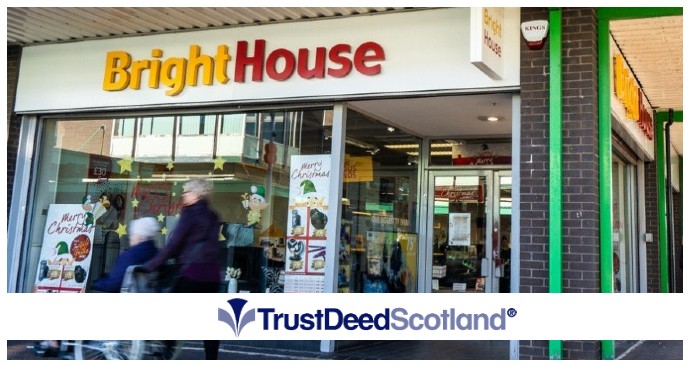
The rent to own retailer Brighthouse has collapsed into administration. Caversham Finance Limited, trading as Brighthouse, is owned by private equity firm Apollo Management. The company which has stores across Scotland is synonymous with high-interest borrowing that targets the most financially vulnerable with essential household goods from washing machines, beds, sofas and televisions – in what’s known as a rent-to-own credit lending arrangement. Brighthouse had previously been branded an irresponsible lender, and their interest rates were as high as 99.9% APR on some purchases – it’s no surprise that the stores were positioned in shopping centres and high streets across Scotland, and the rest of the UK where poverty is highest and access to affordable lending at its lowest. However many debt charities and Scottish debt help companies accept that while the sight of disappearing Brighthouses from our Scottish high streets is not widely regarded as any great loss, the unfortunate reality is that they were providing a vital service for people who have no access to adequate lending facilities. Trust Deed Scotland® advised that “The business model of rent-to-own retailers and in particular Brighthouse, is damaging to Scotland’s most vulnerable people who ultimately end up paying way more than they needed to, for basic household goods.” “Using credit-risk modelling, these people are deemed to be riskier and therefore more likely to pay more than a person of reasonable creditworthiness.” “With such a vulnerable market with few options, these people simply have no choice as it was only feasible way of buying household items.” As well as concerns over Brighthouse customers, the organisation also employed many individuals in Scotland with high stores in towns and cities like Motherwell, Glenrothes, and Inverness. With many retail and hospitality organisations already struggling and fewer job vacancies opening. There are many hundreds of Brighthouse employees with a precarious financial outlook also.

Brighthouse Repossessions

The administrators have said that while there will be no new lending, all existing outstanding rent-to-own and cash loans remain subject to the original agreed terms. Brighthouse customers will continue to be chased for payment and debt in the same way. Enforcement action including the repossession of Brighthouse goods. Previously, before going into administration – If you had purchased goods from Brighthouse and fell behind on payments – Brighthouse upheld their rights to repossess their goods. No exceptions were made, be that a television or a children’s bed, the Watford-based organisation were known to be ruthless in their repossession execution strategy.  

Brighthouse Affordability Claims

While being forced to close their high street doors due to the Coronavirus restrictions, the group had been struggling for a long time, with growing refunds owed to customers who were mis-sold goods they could not afford. In theie Q2 2019/20 unaudited results, BrightHouse warned investors that the company was growing liabilities due to a high volume of customer complaints regarding excessive interest charges on cash loans and repayment interest rates. Brighthouse stated at the time: ‘We have increased the affordability provision by £5.6m as a result of an increase in the number of complaints received and we have disclosed a contingent liability in respect of our affordability provision’ Similar tougher sanctions on the likes of Brighthouse, have affected other high-interest organisations in recent years. Wonga, the payday lender being one famous example and as recent as March 2020, Peachy Loans another payday loan provider also went into administration. Amigo Loans, a guarantor loan company being another that has felt the wrath of growing criticism from regulatory bodies and consumer awareness championing. The sub-prime group once labelled as legal loan sharks by MSPs, put itself up for sale in January 2020 amidst profit warnings and turmoil created by rising customer complaints and compensation claims. Customers mis-sold Brighthouse goods from 2010-2016 were awarded £15m compensation in 2017. Brighthouse issued a refund of the interest paid, with an extra 8% interest per year added on top of that refund, and any late payments, defaults deleted. However, the Financial Ombudsman said in 2019 that it would allow complaints at any time before 2010 to also be upheld. Unfortunately, any ongoing affordability claims are usually put on hold for a longer time than usual. If you feel you were mis-sold Brighthouse goods on the grounds of affordability, we recommend that you have a look at Resolver for information on any possible mis-sold Brighthouse claims.

Brighthouse Insurance & Warranty Claims

Brighthouse’s administrator says that insurance, servicing, warranties claims will continue to be provided until further notice for essential items and smaller courier deliveries. This is subject to continuous review. If you’re considering making a claim on your Brighthouse insurance, or warranty – You should do this immediately as it too could be pulled.

Brighthouse Alternative Rent to Own Lending

If you need household goods and there is no other way, you can investigate Fairforyou. Fair for you is a community interest company that claims to challenge high cost lending and says it does this by charging its manufacturers a commission – they will charge 3.5% a month of interest representative 51.1% APR on the products that you buy from them. Again, be careful of high-interest loan rates – a loan of £1,000, taken over 52 weeks will give you £940, with a £60 fee and £586.96 of interest; meaning you pay back £1,586.96 in total. perfecthome.co.uk and payasyougofurniture.com offer services similar to Brighthouse with similar financial terms. You can consider Charity Shops such as Shelter Scotland, who offer high standard second-hand furniture goods nationwide.

I’m worried about my Brighthouse debt, what should I do?

If you’re worried about your Brighthouse agreement or any other unaffordable debts, you should seek expert debt advice. Our team of experienced debt advisers at Trust Deed Scotland® have helped over [volume] people in Scotland with their debt problems. Our tailored, non-judgemental debt advice is personalised to you and your circumstances. To get started, give us a call on 0141 221 0999 or find what Scottish debt management solutions are open to you. Try our Trust Deed Wizard® tool

Is A Trust Deed A Good Idea?

Is A Trust Deed A Good Idea?

Trust Deeds help thousands of people in Scotland manage their unaffordable debts and reduce their monthly debt repayments to an amount that they can afford to repay on a regular basis. However, Trust Deeds aren’t a solution suitable for everyone and there are alternative debt management solutions in Scotland that can be just as effective or better. You can read more about how a Trust Deed works and the criteria within that link, or you can apply for a Trust Deed online, right now. The decision to proceed with a Trust Deed is based on you, your affordability and what is best for your long-term financial stability, rather than whether a Trust Deed is a good idea or not. Get in touch with Trust Deed Scotland® today and you’ll receive a personalised illustration.

Affordable Monthly Repayments?

The solution(s) open to you will largely depend on how much debt you have and how much you can afford to repay on a regular basis. If you have already defaulted on debts such as credit cards and loans, you may be familiar with income and expenditure guidelines, or budget sheets sent to you from your creditors. The same guidelines are largely available from debt charities and Money Helper websites. These budget sheets will ask you to write down a list of your income and expenditure details and what you usually spend on priority bills such as mortgage/rent and council tax.  These will also include what you spend on travel expenses per month, clothing and many other expenses Whatever monies are leftover is known as your disposable income. These are the funds that you have leftover to repay your debts. A debt charity service or a company such as Trust Deed Scotland® have the experience of advising on the acceptability criteria for these guidelines for these and can work with you to find out any hidden expenses that you may not take into account, and establish what your true disposable income is. This is important because if you are to enter a Trust Deed, or any other form of debt management solution, you will be making a commitment to repay a regular amount over a number of years. Where you fail to keep up the repayment of your Trust Deed, you could end up with a failed Trust Deed, ultimately leading to you being potentially sequestrated. More importantly for you, you would be no better off than when you first sought advice. This is where the experience and trustworthiness of your debt expert is important. Trust Deed Scotland® have advised over [volume] people since 2009 and have gathered thousands of five-star Trust Deed reviews on TrustPilot. We pride ourselves on our commitment to compliance and training. We genuinely want the best outcome for our clients and always have their best interests at heart.

Alternatives to a Trust Deed?

The Debt Arrangement Scheme is a popular alternative debt solution available to residents of Scotland. It’s a statutory debt repayment plan which also uses legislation to allow you to freeze interest and charges and bring your debts under control. There are advantages to the Debt Arrangement Scheme:
  • Personalised debt repayment plan based on your situation
  • Monthly payments will be based on what you can afford
  • Interest on your debt will be frozen
  • Protection against creditor action.
  • Assets protected meaning you will not be asked to sell your house, or your car.
  • Your Money advisor deals with creditors on your behalf.
There are also disadvantages of the Debt Arrangement Scheme:
  • May last longer than the typical 48 months offered by a Trust Deed.
  • Subject to certain conditions. Includes making all payments towards your Debt Payment Plan and paying your monthly expenditure and bills when they fall due. If you fail to make payments, your plan could be revoked.
  • Unable to obtain credit or use an overdraft while you are in a Debt Payment Plan.
  • Credit rating will be affected.
Depending on the severity of your situation, Sequestration may be the best way for you to resolve your debts. On the other hand, a debt consolidation loan or negotiating debt repayment plans directly with your creditors may also be better for you. Refer to our article regarding is a DAS worth it for further information on this solution.

Advantages of Trust Deeds?

There are many advantages of Trust Deeds, a few of which are:
  • Pay back what you can afford.
  • Your Trustee will deal with creditors on your behalf.
  • You will be protected against creditor action.
  • On the successful conclusion of a Trust Deed, your remaining debt will be written off.
  • If you own assets such as a property, you agree with your Trustee in advance whether the Trust Deed affects them.
  • You may be able to remain as the director of a Limited Company.

Disadvantages of Trust Deeds?

  • Your credit file will be updated to reflect that you have signed a Trust Deed. This information will remain on your credit file for six years.
  • As a result of this, you may find it difficult to get credit for a period after your Trust Deed is finalised.
  • For a Trust Deed to become protected, you must convey all your assets to your Trustee. That includes any property that you own. In certain circumstances, it may be possible to exclude your property, but you need to get clear advice on this when you speak to a debt advisor.
  • As mentioned earlier, failure to keep up with repayment of your Trust Deed could result in you being sequestrated. Therefore, it is important that you re fully aware of the Pros and Cons of a Trust Deed and that the amount you repay is realistic for all parties.

Can You Have 2 Trust Deeds?

If you have already been through the process and came out the other end then yes, you can get a Trust Deed twice. If you’re currently in a Trust Deed with a different company then you may also be able to get a second Trust Deed but there are some conditions attached. You can find out more about the process involved in our article on how to get a Trust Deed twice.

How to Get Trust Deed Advice?

If you really want to know if a Trust Deed is a good idea, seek tailored debt advice today. We’re open from 9am to 8pm during the week, and selectively during the weekends. If you do something about your debt today, you don’t need to worry about it tomorrow. Reputable debt advice companies and debt charities are regulated by governing bodies, this should help ensure that you are not ‘sold’ into a Trust Deed and that you are fully aware of the pros, cons and alternatives. Remember, a Trust Deed may not be for you, but that doesn’t mean that you are beyond help. The sooner that you seek help, the sooner you can begin to understand what options are open to you. You can also learn more a similar question of Is DAS Worth It? which investigates the Debt Arrangement Scheme in a similar fashion to the article above of the merits of whether a Trust Deed is a good idea.

What Happens When A Trust Deed Finishes?

When your Trust Deed comes to an end, your Trustee will issue what’s known as a ‘letter of discharge’. A copy of the letter of discharge will be sent to Accountant in Bankruptcy (AiB), the regulatory body of Trust Deeds in Scotland and the Register of Insolvencies will record your Trust Deed discharge. If you enter a Trust Deed, typically you’ll finish your repayment in 48 months, as long as you made all payments in your plan. Depending on your circumstances, you may have entered into a Trust Deed for an extended period of 5-6 years. Over the term of your Trust Deed, you’ll have made a number of affordable monthly payments – and this will count as ‘full and final settlement’ of the unaffordable debts included in your Trust Deed. At the end of your Trust Deed term, any unsecured debt that you weren’t able to repay during your Trust Deed will be written off. When you are discharged from a Protected Trust Deed, you will be discharged from any outstanding debts from the people you owe money to (your creditors) that you had included at the date you registered your Trust Deed. This means that your lenders are no longer allowed to pursue money that was owed to them when you signed the Trust Deed. However, some debts won’t be written off such as a student loan, or any court fine.

What Happens With Secured Debts After A Trust Deed?

If you owe money that is secured against an asset such as property or a vehicle, it won’t be included in your Trust Deed. Your secured lenders won’t be consulted on whether they agree to your Trust Deed, and they won’t write off monies that you owe them, whether you complete your Trust Deed term or not. However, the fact that you’re in a Trust Deed should make the secured payments easier to make, as your Trust Deed payments would be calculated not to take up any monies that you need for your typical essentials – not just your rent or mortgage, but utility bills, travel expenses and so on. If you’re a homeowner, you might be required to release some equity from your property, so you can repay your unsecured lenders more of what you owe them before they write off the rest. However, you may find that the impact of your Trust Deed on your credit rating makes it harder to release equity. Mortgage providers can see that you’ve entered a Trust Deed, so you might find that it’s harder to get a new mortgage deal, or that you’re charged a higher rate of interest if you do. If you can’t release any equity then your Trust Deed could be extended by 12 months.

Trust Deed Credit Score And History Impact

Information about Protected Trust Deeds and defaults will remain on someone’s credit reports for up to six years after they occur, so they are likely to remain on someone’s credit history even after they have been discharged from their Protected Trust Deed, which normally lasts for 4 years. If you’ve already defaulted on your credit agreements even before considering a Trust Deed, this too will be logged on your credit score.

How Will A Debt Arrangement Scheme Affect My Credit Rating?

When your Debt Payment Programme (DPP) is approved, you’re placed on the DAS register. This is coordinated and managed by the DAS administrator and is available to credit rating agencies. This register, along with other insolvency registers, is added to other information to your credit report, which calculates your credit score. Just like a Trust Deed, or even a simple default notice, the Debt Arrangement Scheme will affect your credit rating for at least six years. However, this may be extended further depending on how long it takes you to pay off your Debt Arrangement Scheme in total. E.g. if you are on a DPP for under 6 years there is no difference, or if you are going to repay a DPP for longer than 6 years; your debts will not be marked as satisfied until the debt has been repaid at the end of the DPP.

What is a Default Notice?

A default notice is usually sent when you’ve missed or paid less than the full amount for three to six months. The default notice will give you at least two weeks to catch up with any missed payments. If you can do this your account will carry on as normal. If you can’t pay the missed payments in this time your account will default. Default notices only apply to debts which are regulated by the Consumer Credit Act, such as credit cards, payday loans, personal loans and store cards. You’ll know a default notice has been served on you when you receive a letter informing you of a ‘Default notice served under section 87(1) Consumer Credit Act 1974’. The most recent revision of this act was in 1983, long before the evolution of the current Trust Deed legislation and the Debt Arrangement Scheme. As the wording of the default notices is quite old, you may, therefore, be directed towards Trading Standards and/or a solicitor – remember this is somewhat outdated legislation and you are advised to instead contact a qualified debt advisor, or debt charity instead. Unless you can get a default notice removed within 2 weeks, this will be recorded on your credit profile for six years. Depending on your lenders criteria, this may have the same affect as a Trust Deed or a Debt Arrangement Scheme registered against your name.

Can You Rebuild Your Credit After a Trust Deed?

Yes, it is possible to begin to rebuild your credit rating after your Trust Deed has finished. Eventually getting a mortgage after a Protected Trust Deed is achievable. It may not always happen immediately and will require a bit of work – it is certainly possible for most people to successfully be approved for a mortgage after a Trust Deed. Also, it will not be possible to obtain a re-mortgage on a home that is still in the Trust Deed, without the Trustee’s permission, until they have discharged their interest. A Trustee’s interest in a property can continue even after the debtor is discharged. It may be that the lending terms are not as favourable as before, however by showing a commitment by making regular payments to utility bills, and by using credit sensibly, purely for the purpose of rebuilding your credit score, you will in time secure a more favourable lending rate. Paying utility bills by direct debit can help rebuild credit after a Trust Deed and even just joining the electoral roll helps prospective lenders build trust in you.

A Brighter Financial Future

Many people in Scotland have approached Trust Deed Scotland® after they’ve put off seeking help over their unaffordable debts for a number of years. So severe are some people’s financial difficulties, that if minimum payments were made only; it may take them longer than two decades to clear their outstanding debts. If you’re struggling with debts and making minimum payments to debts such as credit cards, you may regard protecting your credit score as being more important to you than dealing with the debts you have. This isn’t uncommon. However, anyone pondering the pros and cons of the impact of entering a formal debt management solution may have on their credit score after a Trust Deed finishes should look towards the long term outlook and whether it’s better to essentially press the restart button, or continue on alone waiting for a solution to present itself in another form.

Want Trust Deed Advice?

If you feel you’re struggling with debt, seek tailored debt advice today. If you do something about your debt today, you don’t need to worry about it tomorrow. As well as Trust Deeds and Debt Arrangement Scheme, there are other alternative Scottish debt solutions. Trust Deed Scotland® are able to offer no-obligation, confidential advice on all debt management methods available in Scotland. Call us on 0141 221 0999 or try our Trust Deed Wizard® tool to get started today.

Buy Now, Debt Later – Interest-Free Credit Warning

Thanks to a rise in the advertising of Buy Now, Pay Later Loans and cross-platform social media promotion by ‘Social Media Influencers’, the steady rise of interest-free, buy now, pay later lending is set to continue, creating problems for residents of Scotland with Buy Now, Pay Later Loans Debt. It’s a worrying recent trend that can result in several thousand pounds of debt and all within the reach of a few clicks. Those most at risk are the so-called Millennial generation. Under 35s. Many of these consumers are students, or work part time with relatively low incomes. Many of the brands that are heavily invested in the promotion of buy now, pay later models of payment include the likes of Boohoo, ASOS, Superdry and JD Sports. Brands which traditionally target younger shoppers. Popular TV programmes including the likes of Love Island are awash with wannabe celebrities using their newly found fame to endorse Buy Now, Pay Later lenders and the brands that they represent. In what is known as a debt spiral, people can make themselves overdrawn, or borrow additional funds on an existing credit card. Many will even use payday loans to pay off their initial buy now, pay later debts and then the robbing Peter, to pay Paul chain can escalate very quickly.

Buy Now, Debt Later Loans Warning

Trust Deed Scotland said “The key point for anyone considering buy now, pay later loans is that if you think that you can’t afford the purchase today. What’s going to change in 60, 90, 365 days’ time?” “Inexperienced twentysomes are most at risk as traditionally they are a group who are the least capable of being able to budget effectively. What’s more, the casual nature of the wording and minimal information lulls younger people into a false sense of security and preys upon their experiences as a result. Many store card lenders had been slow to adopt their own responsible lending procedures over the years and now we have a situation where a shop can switch its preference from store card lending to the buy now, pay later model with all the benefits of increased sales and yet fewer of the negative connotations attached to a traditional store card.” Students are one group of individuals likely to underestimate the impact that BNPL lending may have on their Student Finances.

Who Are The Buy Now, Pay Later Vendors?

Perhaps the most well-known is Klarna, with an ominous 6 million UK customers. The Sweden-based company have become the cool and trendy face of two click purchases on retailer websites offering anything from high street clothing brands to designer furniture brands.  Nearly 60% of Klarna’s customers are under the age of 35. Klarna is funded by venture capitalists and has celebrity backers including Snoop Dog. Laybuy, is a New Zealand company launched in 2018 who refer customers to credit agencies after 30 days and then ClearPay, an Australian company with 500,000 customers. The BBC reported that the owner of the New Zealand-created firm intends to move to the UK in order to capitalise on a buoyant model here in the UK.

New Legislation on Buy Now, Pay Later Set by UK Regulatory Body

A UK regulatory body recently introduced new rules to help regulate the BNPL industry and save money for consumers. The new rules introduced in November 2019 mean that: Firms cannot charge backdated interest on amounts of money that have been repaid by the consumer during the Buy Now, Pay Later offer period. Firms must provide better information to consumers about Buy Now, Pay Later offers. The information should be more balanced and appropriately reflect the risks as well as the benefits of the product. Firms must give prompts to consumers, to remind them when the offer period is about to end, so that consumers are more likely to repay the credit before they incur interest.

Buy Now, Debt Later – What Next?

  At Trust Deed Scotland, we often say to our customers that if they do something about their debts today, they don’t need to worry about them tomorrow. Unlike buy now, pay later schemes – The sentiments are completely different. Having helped over [volume] people with financial difficulties in Scotland, we’ve spoken to individuals from all areas of the country, with differing reasons for why they found themselves with unmanageable debts. Buy now, pay later may be a way of potentially building up unaffordable debt in Scotland, but it is not an unfamiliar story and over the years we have successfully navigated thousands of people towards a brighter future. If you feel that you’ve built up unmanageable debts due to any type of lending, from credit cards and bank loans, to buy now pay later schemes, the best advice we can offer you is to seek help immediately. Call us on 0141 221 0999 or try our Trust Deed Wizard to find out if you could qualify for the Debt Arrangement Scheme, a Trust Deed and any other alternative solutions.