Cost Of Living Scotland: Petrol Prices

In the latest of our cost of living crisis in Scotland series of articles, Trust Deed Scotland® focuses on petrol price increases in Scotland. Recently, as reported by the RAC, petrol prices have just topped £100 to fill up the average family car in the UK. With day-to-day costs like energy bills, the weekly food shop and rent are rising steeply. If you’re worried about being able to afford to live, you’re not alone. Many people are struggling to cope with the rising cost of living, so if you feel like you have reached a level where your debts have become unaffordable, it’s important that you seek tailored Scottish debt advice as quickly as you can. Andrea Coscelli, CEO of the Competition and Markets Authority (CMA) recently said record pump prices are ‘causing significant concern’ for millions of people in the UK and that the watchdog will carry out a ‘short and focused review’ of fuel prices. As many as 21% of the Scottish population live in rural areas, depending on petrol for necessitous journies however many of these areas are inhabited by a higher percentage of elderly residents who have been identified as a group who are more at risk with the rising cost of living in Scotland. However high road fuel prices are causing significant concern for the millions of consumers and businesses who rely on being able to afford to fill up their vehicles. PetrolPices.com reports that the average petrol prices in Scotland rose from 127.92 pence per litre (PPL) in Jun 2021 to 184.64 PPL in June 2022. A 44.34% increase in Scottish petrol prices. Similarly, diesel prices in Scotland rose from 130.09 PPL to 190.78. A 46.65% increase in Scottish diesel prices.

Why are petrol prices so expensive in Scotland?

Petrol prices have increased sharply in Scotland because the price for crude oil, which is used to make petrol and diesel, has gone up. Crude oil was cheaper at the beginning of the Covid pandemic because many businesses temporarily closed and demand for energy collapsed. However, this has been impacted further by the war in Ukraine with sanctions being placed on Russia. 11% of UK oil is imported from Russia. As life returned to normal for most people across Scotland, the demand for energy increased. Suppliers have struggled to keep up and prices have risen. Another problem causing an increase in Petrol Prices increasing in Scotland is that the oil used to make petrol is paid for in US dollars. The pound is weak against the dollar at the moment, which makes fuel even more expensive. Petrol stations say that they have been ‘unfairly scapegoated’  after the UK government raised concerns a 5p fuel duty cut was not being passed on quickly enough to drivers. So far neither the Scottish nor UK governments have ruled out specific measures to tackle increasing petrol prices but have put together a £37bn package to help families deal with the wider rises in the cost of living such as the recent announcement that Scottish households will get a £400 energy bill discount.

How to get cheaper petrol in Scotland?

The price comparison website confused.com offer a service that allows you to search for petrol and diesel in your area by entering your postcode. PetrolPrices.com also show the cheapest petrol stations per area, however, you will need to sign up for a free account to be presented with any useful information. MoneySavingExpert.com working alongside RAC offers some practical advice on making your car more fuel-efficient. That advice includes keeping your tyres inflated and decluttering your car to then also making some recommendations about driving your car more efficiently including how you brake, to changing gears and acceleration tips.

Help to repay unaffordable debt in Scotland

The cost of living crisis is affecting people from all walks of life across Scotland, whether they are in financial difficulties or not. However, if you feel like you’re really struggling with your unaffordable debts as a result of not having enough money to pay all your bills there is help available for you. Trust Deed Scotland® have helped thousands of people in Scotland since 2009. We have dealt with cases that included council tax arrears, credit card debts and payday loans. We’ve successfully prevented and lifted creditor enforcement actions such as Wage Arrestments. Whatever the cause of your money problems, Trust Deed Scotland®  can help you to understand your options, find a solution and let you focus on enjoying a brighter future. Contact us on 0141 221 0999, or start by simply using our debt calculator tool online to quickly check what your options may look like. Download our Scottish debt guide for more information on the types of solutions available for you.

Talk Money Week 2022

7-11 November 2022 marks a week known as Talk Money Week in the UK. It’s an annual event run by Money and Pensions Service and it usually falls on the second week of November of any year. It’s a time for debt charities and companies such as Trust Deed Scotland® to come together and encourage people to open up about their money and debt worries. Talk Money Week’s focus for 2022 is around credit, something that many people are currently resorting to use to pay household bills. A recent Ipsos survey carried on behalf of Sky News found that 25% of its respondents said they have already used credit cards for essentials or skipped meals in response to the cost of living. The same survey highlighted that 90% are worried about cost of living for the country as a whole while around 8 in 10 are concerned for themselves and people in the area they live. An additional 33% are finding it difficult to pay their energy bills and a similar proportion of mortgage holders and renters report rises in their housing payments. The Money and Pensions Service are funded by levies on both the financial services industry and pension schemes and their vision is “Everyone making the most of their money and pensions.” They are an ‘arm’s-length body’ sponsored by the Department for Work and Pensions, with a joint commitment to ensuring that people throughout the UK have guidance and access to the information they need to make effective financial decisions over their lifetime. They deliver those across five core functions. 1. Pension guidance. 2. Debt advice. 3. Money guidance. 4. Consumer protection. and 5. Strategy.  

Why does talking about money and debt matter?

One of the key focuses of Talk Money Week 2022 is to encourage conversations about unaffordable debt. By having a conversation, you can improve your physical, mental and financial wellbeing. Money and Pensions research shows that talking about money can help you to:
  • Make better and less risky financial decisions
  • Have stronger personal relationships
  • Help your children form good lifetime money habits
  • Feel less stressed or anxious and more in control.
Building money conversations into our everyday lives also helps us build financial confidence and resilience to face whatever the future throws at us and Talk Money Week’s intention is for you to kickstart a conversation in any walk of life, including:
  • In your workplace
  • At home with friends and family
  • In educational establishments, or with debt charities
  • With the people to who you owe money to
However, it isn’t easy talking about money and debt. Many people fear being judged, embarrassed or ashamed of their debt when the truth is problem debt can happen to anyone.

How long do people wait before getting help with their debt?

In a 2022 study of existing Trust Deed Scotland® & Harper McDermott customers.
  • 17% got help with their unaffordable debt straight away
  • 25% waited up to 1 year before asking for help
  • 30% waited between 1-2 years before asking for help
  • 14% waited between 3-4 years before asking for help
  • 14% waited over 4 years before asking for help with debt
57.4% waited over a year before finally asking for help with their unaffordable debt.

What type of debts worried our customers most?

Credit card debts are the most troublesome type of debt that our customers encounter.
  • 33.84% were worried about credit card debts in Scotland
  • 24.33% were concerned about a personal loan
  • 11.60% thought that their overdraft was a worrying debt
  • 7.20% were worried about council tax arrears debt
  • 6.68% are worried about payday loan debt
  • 4.04% are worried about a buy now pay later agreement
  • 3.31% were worried about their gas & electric bills*
  • 2.98% were worried about rent arrears debt
  • 2.95% were worried about HMRC debts
  • Lastly, 3.07% were worried about another type of unaffordable debt
*It’s important to stress that these answers were taken before the cost of living crisis really started to bite. If this same survey were to take place today, the results would be vastly different. For example, a survey from Smart Energy GB in October 2022 found that almost half of its respondents said they were worried about rising energy costs.

What impact did debt have on our customers’ mental health?

We asked our customers if their mental or physical health was impacted by their debt problem and overall 91.36% of our respondents’ mental health was impacted by their debt problem.
  • 57.61% – Yes – My mental health was affected
  • 1.33% – Yes – My physical health was affected
  • 33.75% – Yes – Both my mental and physical health were affected
  • 7.30% – No – My mental or physical health was not impacted by my debt problem
In the same survey, 84% of existing Trust Deed Scotland® & Harper McDermott customers said that their mental health had improved, with 30.39% of our customers also saying that their physical health improved also.

What do people who have previously started a conversation with Trust Deed Scotland® say about their experience?

At Trust Deed Scotland® we currently have over [reviews] reviews from our customers, with a rating of 5/5 rating on Trustpilot. In addition to this statistic, our survey shows that: 97.7% of our customers said they were satisfied or better with the Debt Arrangement Scheme as their chosen debt solution. 98.8% of our customers said they were satisfied or better with a Trust Deed as their chosen debt solution. Our survey asked all active customers for their feedback and also those who had recently been discharged from a debt solution. Our Trust Deed Scotland reviews are just as important to us, not only as a signal that our customers are happy with the service that they have received from us but also because they allow people with problem debt in Scotland to find other individuals who were once in the same position that they too find themselves in Some of those reviews are anonymised by our customers to protect their own identities. Many of the reviews go into great detail, and some contain just a few words. Either way, they are always written completely in our customers’ own words describing their experience in their reviews and we’re always grateful to receive them; both good and bad. We’re always keen to take action on any feedback that we receive to make improvements to our processes wherever we can and continuously improve our own learning and development as a leading Scottish debt solutions provider. Our experienced debt advisers received reviews in the run-up to Talk Money Week 2022 which perfectly described many of the feelings that individuals have when they’re looking for help with their unaffordable debt.
Reviewing one of our experienced debt advisers Sharon, Sheila wrote: “Thank you to Sharon this process was a lot less painful for me. She put me totally at ease with my situation, was helpful, explained things well, was kind, friendly, and had a bit of humour. I felt like I was talking to a friend rather than a debt advisor. The whole experience took only 24hrs after struggling for the last 6 months to find the courage to call.”
Shaun, speaking about his experience with our debt adviser Michael, said “Great experience from start to finish. I had been trying to avoid a trust deed for a long time. Micheal, who I initially spoke with, was brilliant and made me feel at ease right away. He was very understanding and reassuring. The fact you only speak with the same person throughout the whole process is great. I felt I could contact Micheal at any point for advice, always available or would respond ASAP. Obviously, a highly experienced company that are calming during what can be an uneasy time.”
Another customer wrote about the beginning of her debt journey with Valerie by saying: “After burying my head in the sand with stress and worry for over a year, due to being laid off through covid and a looming court case, I just gave up on all debt and direct debits! But after getting back to work and the court case not having as bad an effect as first feared it would. There was still the weight and pressure of thinking I had messed up my life, by not paying debts and thinking I’d never get back on my feet, Then I heard of Trust Dead Scotland, and there was a lovely lady called Val that took on my case and from start to finish she was an absolute star, making me feel at ease with a solution that best suited. To even finding out who I owed the money to, as I had no idea what each creditor was due and what for. I really just had given up before and so had no clue, but after getting in touch with Trust Dead Scotland and Val, I can finally look to the future and il be back on my feet in no time.”

Start a conversation about your unaffordable debt

Our experienced, friendly debt advisers offer tailored debt advice and explain the advantages and disadvantages of any formal debt solutions that you may be eligible for. You can contact Trust Deed Scotland® on 0141 221 0999 or use our online form to find out more about your options. Talk Money Week 2020 Talk Money Week 2021 Talk Money Week 2022 Talk Money Week 2023 Talk Money Week 2024

Divorce, Separation and Debt

Divorce and separation rates are increasing in Scotland and relationship experts warn that the divorce and separation break up curve caused by the recent Coronavirus pandemic may not have peaked yet, with the rising cost of living now also adding to post-lockdown relationship woes. With many households experiencing reduced disposable income to the rising cost of living crisis in Scotland, the likelihood of an unaffordable debt problem as a result of divorce increases as a result. Many of the people that Trust Deed Scotland help with statutory Scottish debt solutions that include the Scottish Trust Deed, or Debt Arrangement Scheme (DAS) have cited a change in their household income as a significant reason as to why they became overwhelmed by personal debt in Scotland. During the recent Coronavirus pandemic, Citizens Advice in England reported via the BBC that in September 2000, online searches for divorce were up 25% compared to the same date in the previous year. Co-Op Legal Services earlier in 2020 said that couples being forced to spend more time together during the coronavirus outbreak saw an increase in divorce applications to the organisation with a 42% rise in divorce rates after the first lockdown. While it can be hard not to let a break-up turn nasty, amicable divorce experts say separated parents must keep their contact civil for the sake of the children. Going through a separation or divorce can be stressful at any time, never mind during a worldwide pandemic and often it means that an individual’s financial situation is affected. Any joint debts that you hold between you and your partner will have ‘joint and several liability’. This means that, if your partner can’t make payment to the debt, you will need to repay the full amount. If you don’t have any joint debts you can get a ‘notice of disassociation’. This removes any financial link with your ex-partner on your credit file. To do this you need to contact one of the credit reference agencies who can remove this link.

Divorce help and advice in Scotland

As a life-changing decision, divorce isn’t easy. It can lead to loneliness, and potentially a drop in your confidence, amongst other things. Separation often means your household income will reduce dramatically, so you may be struggling to manage your household bills along with any debts you have. However, household debts are not the only monetary issues that couples must face when looking to separate. Where children are concerned this is obviously a key issue but there are other considerations as well such as the logistics of where both parties shall live, and what to do with joint rental tenancies or mortgages. And then, of course, any potential settlements. Legal aid might be available to pay towards the legal costs of divorce or dissolution. You will be assessed on the basis of how much income and savings, investments and valuables you have (not including your main home). You might also be able to get legal aid if you receive certain benefits. If you live in Scotland, you can check if you can get legal aid with the Scottish Legal Aid Board, or find out about help with court fees on the Scottish Courts and Tribunal website. Divorce Aid is an independent organisation of professionals who can provide divorce advice to anyone in the UK.

Financial abuse and divorce

Financial abuse is also known interchangeably as economic abuse and both are a form of coercive control. Financial abuse may be part of the reason why a couple divorce and like other forms of domestic abuse, it is feared that financial abuse may have increased during the extended period of lockdown. Financial abuse can be described as the control that one person holds over another economically. While financial abuse is most frequently committed by a partner – a family member or other party known to the victim can use coercive control in this way. Examples of financial abuse include:
  • Forcing the victim to take out credit in their name
  • Removing access to household/joint finances
  • Controlling employment earnings and benefit entitlement
Many victims of physical, sexual and emotional abuse are likely to also be suffering financial abuse. Coercive control extends beyond separation and financial abuse may begin, continue or escalate post-separation. This can then become a factor in returning to the abuser.

Help with unaffordable debt in Scotland

As the country continues to cope with the ongoing cost of living crisis, many will need to deal with debt. Whether you’re going through a divorce or separation, or not, Trust Deed Scotland can help you reduce the stress and anxiety caused by having unaffordable debts through these difficult times. If you need non-judgemental debt advice or information on dealing with your debts, you can view our Scottish debt solutions guide. Our experienced debt advice team can offer debt solutions that are tailored to your situation. You can also call us on 0141 221 0999 and speak to one of our debt advisers.

Fuel Poverty In Scotland Increasing

Families across Scotland are having to choose between heating and eating, Energy Action Scotland reveals in a new fuel poverty awareness campaign. Energy Action Scotland was established in 1983, EAS seeks to develop and promote effective solutions to the problem of cold, damp and expensive to heat homes. Frazer Scott of the Glasgow-based charity reported to STV News that local food banks were reporting food banks asking for ‘cold packs’. Cold packs are parcels that can be eaten without the need of heat, suggesting that those families can no longer afford to oven cook or microwave meals. Frazer said “Right now, 600,000 households in Scotland live in cold and damp homes and it isn’t fair that more than 25 per cent of all Scottish households have to make choices every single day between heating or eating. More has to be done for households with all-electric homes. They on average pay £600 more than a house in Scotland which has gas and electricity to live a similar life. We need to get a balance of benefits and support in place to help lift them out of fuel poverty. Fuel poverty kills six a day in winter – that’s a disgrace” The group have been actively delivering lower-energy pressure cookers to housing associations, an incentive that can save as much as 70% off typical cooking bills, and recently teamed up with celebrity Masterchef Gary Maclean to promote a campaign to distribute more pressure cookers to those most in need. UK households are deemed to be living in fuel poverty if the home has a fuel poverty energy efficiency rating of band D or below or if, when they spend the required amount to heat their home, they are left with a residual income below the official poverty line. The official poverty line is when households’ income is 60 per cent below the median household income after housing costs for that year.

Fuel Poverty in Scotland Statistics

Fuel poverty is not a recent symptom of the financial impact of the Coronavirus pandemic, although the numbers of people affected by fuel poverty have undoubtedly grown as families struggle to make ends eat while one or both parents are unemployed, or are furloughed. A 2019 Scottish Government commissioned survey found that 613,000 households were living in fuel poverty, 311,000 of those were classified as having extreme fuel poverty. In July 2020, the UK-wide End Fuel Poverty Coalition predicted that as the numbers in fuel poverty soared, a second wave striking during colder weather could be catastrophic for individuals and health services. Earlier in 2021, the Resolution Foundation reported that many homes across the UK had fallen behind on their rent and mortgage payments. As a result of people being made redundant during the pandemic, or furloughed as part of the Job Retention Scheme, many people are falling into a cycle of debt where they are using credit to fund general living expenses, including priority bills such as council tax but with limited funds available, this often means that something needs to give. Increasing the likeliness of fuel poverty, or food poverty. Food poverty rates in the UK are amongst the highest in Europe reported the Big Issue earlier this month. Research into food poverty by the University of West Scotland found that the Coronavirus pandemic has aggregated food insecurity. Their report entitled ‘food insecurity in times of Covid-19‘ found that Food insecurity across the UK had been on the rise before the Coronavirus pandemic and that is was clear that the pandemic itself led to a further rise. Food insecurity is a wider term used to describe food poverty and varies in levels from mild food insecurity; worrying about the ability to obtain food to severe food insecurity; experiencing hunger.

Help With Unaffordable Debts in Scotland

If you’re worried about your finances and would like to take control of your unaffordable debt, you can contact Trust Deed Scotland on 0141 221 0999, or complete our Trust Deed Wizard tool for more information. As a leading provider of formal Scottish debt solutions including Trust Deeds, and the Debt Arrangement Scheme, our experienced debt advice team are able to work with you and offer tailored debt advice that puts you at the heart of the decision-making process.

What is a Payday Loan Continuous Payment Authority?

What is a Continuous Payment Authority?

A payday loan continuous payment authority sometimes referred to as a CPA, is an agreement that you make with a payday loan company, granting them permission to take a recurring amount from your debit or credit card. Payday loans are not the only companies to use continuous payment authorities as a means of collecting a recurring transaction, as most commonly, these agreements are used by streaming service providers such as Netflix, or mail order subscription services such as Amazon Prime. Gym membership, mobile phone apps and magazine subscriptions also frequently use continuous payment authority requests as their preferred recurring payment collection method.

How does a Continuous Payment Authority work?

When a payday loan company sets up a continuous payment authority, they will use your long debit card number, as opposed to a direct debit or standing order payment which uses your sort code and account number. Hidden within the terms and conditions of your payday loan agreement is a clause that previously allowed unlimited attempts to take money from your account, however, this has since been revised in recent times to allow companies to make only two attempts to obtain funds from you, unless you’ve agreed to rollover the balance, and these can only be for the full amount due.

What are the dangers of having Continuous Payment Authority arrangements?

Firstly, many subscription services are offered on a trial basis, which then gets deducted from an account on a regular basis after the trial period ends. Regardless of whether you used the service or not in the time you’ve been billed for. A number of mobile apps exist that encourage trial period based subscriptions, that are not easy or straightforward to cancel. Indeed, these apps offer little in the way of a reminder that a trial period is due to end and sometimes default to annual subscriptions. Secondly,  a continuous payment authority will be taken without any prior consideration of your affordability. If you have taken out a payday loan as a short term solution to financial difficulties then you are more likely to already be within a problem debt cycle and therefore making payments to an unaffordable loan may increase your chances of then not being able to afford a priority debt such as your mortgage, rent or council tax. Martin Lewis, also known online as the Money Saving Expert regularly writes about the need to audit our debit card transactions to monitor payments that are being deducted and not being used. “Do I need it? Can I afford it?” or “Will I use it? Is it worth it?” is a slogan that Martin uses to encourage savvy shoppers to save money in his online articles and TV appearances.. Many people with problem debt tend to check their bank accounts less frequently and therefore are more prone to paying for goods and subscriptions they no longer own, or are subscribed to. This may include a wider range of products such as breakdown cover for white goods and mobile phones no longer owned by the individual, but still being paid for.

How can I cancel a Continuous Payment Authority request?

You can ask your bank to stop the transaction, usually by writing to your bank directly, phoning or email. There are templates online that you can download to cancel a continuous payment authority. It’s also worthwhile emailing your payday loan lender to let them know that you won’t be making the latest payment and making them aware that you are experiencing financial difficulties. The cancellation deadline is close of business on the working day before the payment is to be taken but it is also advisable that you get confirmation that your request has been received and actioned by your bank. Switching banks may be a solution that also stops a continuous payment authority from occurring. However, while switching banking providers means that many standing orders and direct debits can be automatically transferred, continuous payment authority requests are not. This is something you should consider if you pay for insurance premiums using a CPA as your insurance provider may not pay out a claim if you’re uninsured due to non-payment of insurance premiums. If you believe that you have had a continuous payment authority payment taken without your permission, you can firstly complain to the company directly, or escalate your complaint to the Financial Ombudsman Service.

Whatever happened to Payday Loan adverts?

Many of the payday loan providers that once famously dominated our TV screens, newspapers and radio such as Wonga.com, Sunny and Quick Quid have since gone into administration and stopped trading. Payday loan companies haven’t gone away, there are many payday loan providers still in existence, albeit with greater scrutiny on their affordable lending practices. Payday loans have for many years been a well-known source of problem debt for many people throughout the UK for a number of years and recently, Manchester City Council have thwarted attempts at payday loan providers opening stores in disused high street locations, or local convenience stores with a commitment to preventing firms or individuals from applying for planning permission to convert convenience stores or disused offices into loan shops. As many retail units become available on UK high streets due to a succession of lost high street retail brands, this may become an ongoing concern with Provident loans closing their doorstep lending operation also. Therefore face-to-face over-the-counter lending facilities may not always be welcomed additions to high streets if they lead to an increase in irresponsible lending.

Worried about Payday Loan debt in Scotland and need help?

If you are worried about payday loan debts, or any other debts that you have may; it is always best to seek help as soon as possible. It is feared that more people in Scotland are turning to payday loans, and more alarmingly, loan sharks, in order to fund short term cash flow problem. Trust Deed Scotland® offer tailored debt advice and formal debt solutions to residents of Scotland and our experienced debt advice team are well placed to help you understand what your options are, plus the pros and cons of solutions such as the Debt Arrangement Scheme (DAS) or Protected Trust Deeds, which help thousands of Scots every year to deal with their unaffordable debt and allow them to look forward to a brighter future. For confidential, non-judgemental debt advice today, contact Trust Deed Scotland® or call us on 0141 221 0999.

Scrap 5 Week Universal Credit Wait: Scottish Debt Charity

Citizens Advice Scotland (CAS) has repeated a call for the abolition of the 5 week wait for new Universal Credit claims and the introduction of a non-repayable assessment period grant for everyone claiming Universal Credit to help prevent individuals in Scotland from being dragged into a problem debt cycle. The Scottish debt charity ran a survey of their clients and found that the wait for a first payment was causing stress and anxiety for those respondents to the survey. The survey was based on over 600 people who had sought universal credit advice in Scotland between March 2020 and December 2020.
  • 70% said they found the application for Universal Credit to be stressful.
  • Nearly 50% said they had to borrow or take an advance to get through the 5-week wait.
  • Among those that borrowed to get them through the 5-week waiting period until they got their first payment, 65% said they will find it difficult to repay the loan. Single people, homeless people, and people without a final wage were more likely to require loans during the 5-week wait, saddling them with debt before their UC payments have even begun.
  • Single-parent families were also more likely to borrow during the five-week wait, meaning children in those families may face significant financial hardship before the first payment.
‘Universal Credit should be a safety net, not an obstacle course’  Speaking on their findings, the Scottish debt charity’s spokesperson Nina Ballantyne advised: “CAS has long campaigned to end the five-week wait for the first payment, and today’s research shows the considerable detriment it continued to cause people throughout the pandemic. The five-week wait punishes the most vulnerable; those without savings and without family or friends to borrow from and those who are paid weekly who don’t have a final monthly salary payment to rely on. Many are also reluctant to take on additional debt.”

Pandemic Aftermath

As the country continues to recover, the Scottish debt charity further predicted that another influx of Universal Credit claims are expected when access to the Job Retention Scheme (furlough) is removed after September, and with the UK government also cutting the £20 additional payment in October these are worrying times for those most affected by redundancy and furlough due to the financial impact of the Coronavirus pandemic. From August onwards, the government will reduce their contribution from 80% in June to 60% in August & September with the employer expected to pick up at least the minimal 20% contribution, further causing anxiety for employees and employers alike, particularly in those sectors most affected both pre and post ‘freedom day.’

Getting money and debt advice in Scotland

As well as CAS, you can get impartial help with your money from Money Helper. By using the free services offered by either CAS or Money Helper, you can get guidance on a range of issues from benefits, pension and retirement and housing advice. If you are worried about your finances and in need of help with debt, the best advice is to not ignore the situation and try to deal with the debt issue as soon as you possibly can. If you’re unable to contact the people you owe money to and make your own arrangements, then you should seek advice from an experienced debt advisor in order to understand the severity of your situation, and any possible options available to help you deal with your debt. As Scotland’s leading debt solution company on Trustpilot with over [reviews] reviews, we are in a position to advise you on the advantages and disadvantages of formal debt solutions such as Trust Deeds, the Debt Arrangement Scheme (DAS) and alternatives such as Sequestration and the Minimal Asset Process route into Sequestration. Our experienced debt advisors provide tailored debt advice and every year guide many Scots towards a brighter future. Find out more about Trust Deed Scotland® today and find out more about your options by completing our Trust Deed Wizard tool, or by calling us on 0141 221 0999  

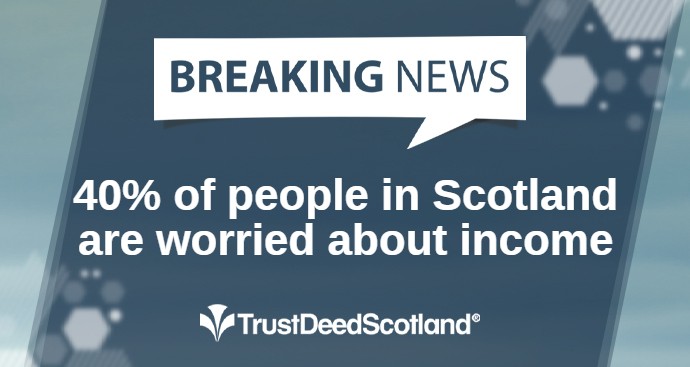
40% Of Scots Worried About Income Reports Citizens Advice Scotland

The research, carried out by the Diffley Partnership, found that 2 in 5 people of people in Scotland are concerned about their income during Coronavirus. As reported by Scottish Housing News, the research, commissioned by Citizens Advice Scotland, released to mark Talk Money Week 2020 in Scotland also found that:
  • 27% of people were concerned about utility bills
  • 24% were concerned about council tax payments
  • 25% were concerned about rent and 26% concerned about mortgage repayments
  • 23% were concerned about paying for food and essentials
  • 32% were concerned about debt repayments
The research concludes seven months of tracking attitudes by CAS and the Diffley Partnership and shows concerns around incomes have remained high and relatively static throughout the pandemic. It also reveals that while worries over expenditure dropped after the initial stages of lockdown, the latest figures show these worries are on the rise. CAS is warning that there must be no complacency from policymakers around supporting incomes and easing living costs and welcomed the move from the Chancellor to extend the furlough scheme.

Citizens Advice Scotland commented:

Myles Fitt, CAS financial health spokesperson, said: “It’s massively concerning that almost 2 in 5 people are worried about income a during the pandemic, it underlines yet again that this public health crisis is also an economic crisis that is hitting household budgets across the country. “Looking back at the seven months of tracking, we can take some heart that the initial levels of concern that were very high in each area have fallen, that suggest the fast action taken by policymakers, such as the furlough scheme, boosting Universal Credit, increasing the Scottish Welfare Fund and things like mortgage holidays have had an impact. However, the concern around income has remained high and we’re beginning to see concerns around bills increase. This is not the time for policy makers to be complacent, particularly with energy bills being the next problem as we head into winter, so we welcome the extension of the furlough scheme by the UK Government along with other payment support measures announced by a UK regulatory body. He added: “It is important for people to talk about any money worries they have, and the CAB network is here to listen and to help. In Talk Money Week, local Citizens Advice Bureau across Scotland stand ready to offer advice on managing money, paying bills and avoiding getting into debt.”

Diffley Partnership commented:

Mark Diffley, founder and director of Diffley Partnership, which carried out the research, commented: “Our polling with Citizens Advice Scotland has tracked the financial experiences of people since the COVID-19 pandemic struck in March. “While we have observed some decline since the beginning of the pandemic, it is clear that a significant number of people continue to face significant financial difficulties; this includes four in ten Scots (39 per cent) who are concerned about their income, while around a quarter are concerned specifically about being able to pay utility bills, rent and for food and essentials (27%, 25 % and 23% respectively). “We have observed throughout these waves of research, such financial concern is not spread equally the population. Of particular note, those in less affluent social class groups are clearly more likely to be experiencing financial difficulties, for example, 48% of those in social class groups C2,D and E are concerned about their income, a difference which is repeated across all issues in the survey. As the virus continues to cause a significant impact on the economy, so these findings are likely to continue, causing significant challenges for policymakers.”

Trust Deed Scotland commented:

Trust Deed Scotland, the No.1 rated company in Trustpilot‘s debt relief service category with over 3,000 reviews said: “We are not surprised that people across Scotland are worried about their income, we’re dealing with enquiries from all over the country and many of those have had their income reduced as a direct consequence of the pandemic. Our dedicated advice team have been advising on the risks and benefits of all the Scottish statutory debt solutions, including Minimal Asset Process as a route to bankruptcy, Trust Deeds and the Debt Arrangement Scheme over the duration of the Coronavirus pandemic and we expect to see a rise in enquiries as we move into the next year. We urge anyone who does have unaffordable debts to seek help and with it being Talk Money Week 2020 in Scotland and the rest of the UK, there are many organisations offering to help anyone who needs their support.” Our team can be reached on 0141 221 0999 or you can complete our Trust Deed Wizard.

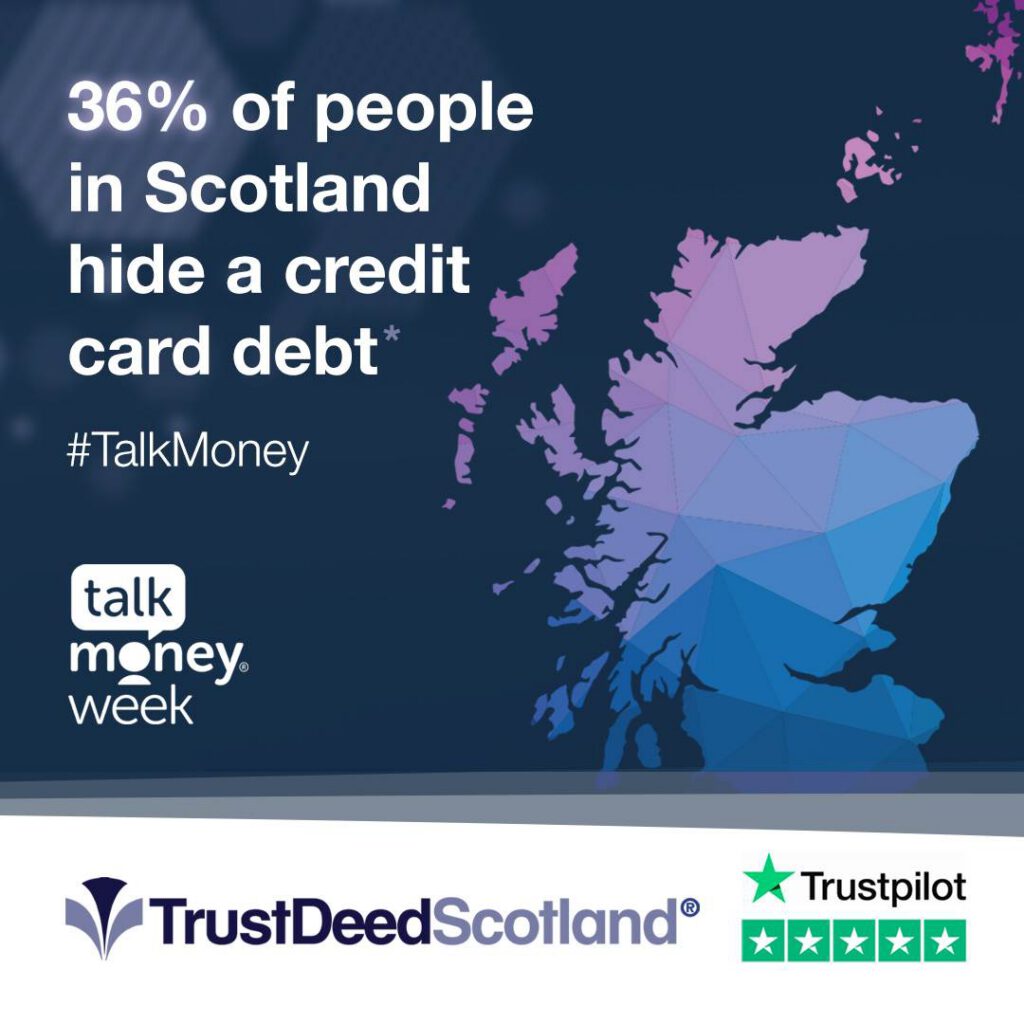
36% Of Scots With Hidden Credit Card Debts

A survey has shown that over 36% of the adult population has a hidden credit card debt. OVER 2 MILLION1 MONEY S£CR£TS KEPT FROM LOVED ONES IN SCOTLAND Research released by the Money and Pensions Service as part of Talk Money Week 2020 shows that 37% of people in Scotland have kept secrets from loved ones about credit cards, loans and savings • 37% of people in Scotland admit to keeping financial products secretPeople most likely to keep money secrets from their partner In the UK, millennials (25-34 year-olds) are the most secretive generation with three in five (59%) hiding money products Adults in Scotland have kept over 2 million2 financial products secret from their loved ones, according to a new study of people’s financial behaviours from the Money and Pensions Service (MaPS) to mark Talk Money Week. Of those who have kept financial products a secret in Scotland, the most common were hidden credit cards (36%). Despite Covid-19 having a widespread impact on people’s finances, the stigma surrounding talking about money in our culture remains – 36% of people in Scotland stay silent about money worries, with some of the reasons they give including embarrassment or fear of being judged. The research, which surveyed over 5,200 people across the UK, has been launched to mark the start of Talk Money Week (9-13 November), a public awareness campaign run by MaPS to improve financial wellbeing by encouraging people to open up about their finances, from pocket money through to pensions.

Hidden Credit Card Debts

Across the UK, 40% of people said they had secret financial products, with the most common products being:
  • Hidden credit cards (36%)
  • Undisclosed personal loans (23%)
  • Secret savings accounts (21%)
hidden credit card debts scotland UK millennials proved to be the most secretive generation, with 59% disclosing they have secret financial products, compared to just 25% of retirees. Of 25-34-year-olds who’d kept a product secret across the UK, credit cards, personal loans and overdrafts were most commonly hidden (by 40%, 31% and 23% respectively). The Talk Money Week study also revealed that across the UK people in relationships tend to underestimate the extent of money secrets their partner keeps from them. While 23% of people in relationships suspect their spouse has kept a money secret, hidden products were found to be even more common, with nearly half of those in relationships (45%) admitting to having an undisclosed money product. Some respondents told the researchers about secrets that became easier to manage once they opened up to their partners: one respondent claimed, “I was once close to bankruptcy due to credit cards and loans which I did not reveal to my partner until it couldn’t be hidden any longer. I admitted the issues eventually and we sorted it.” Another respondent said: “I didn’t tell my husband when I lost control of our credit card debt and ended up juggling cards and minimum payments. Eventually, I admitted it to him and actually acknowledged the amount of debt I now had – he supported me to get onto a Debt Payment Plan which I have been paying for just over a year now, and we are far more financially stable. We made a choice as a couple to no longer use credit. We also now have a joint account as our main account and only our agreed personal budget for minor expenses which is transferred out to our personal accounts.” Allison Barnes, Scotland Manager for the Money and Pensions Service said: “With over 2 million people in Scotland admitting they keep money secrets from loved ones, we are encouraging everyone across Scotland to open up and talk about any money worries you may have during Talk Money Week this week. “However, we understand there could be a number of reasons why people keep money secrets from those closest to them; a secret savings account could act as a buffer for those who want to escape a difficult relationship or an unpaid bill could be kept under wraps in order to protect anxious family members. For many who keep money secrets, it can be a feeling of shame or embarrassment that debts have spiralled out of control. 36% of people in Scotland claim to have money worries and initiating a conversation with someone – a friend, family member or expert – can be a first step to start to mitigate and address the problem. Opening up is a valuable start to making problems more manageable, for the benefit of our health, relationships and overall wellbeing. There’s no better time to start talking than today and the Talk Money Week website offers guidance to help start conversations and prepare yourself ahead of these. You are not alone and as our research shows in Scotland there are many others hiding secrets about money; there are resources available to help tackle some of these secrets including debt advice, as well as money and pensions guidance. Jasmine Birtles, TV money expert and Talk Money Week supporter, said: “Talking about money is still off-limits for a lot of people in the UK. Although we’re happy to talk about all sorts of subjects that used to be off-limits, if you ask someone about their income or investments they clam up. Talking about money really does seem to be the last taboo, despite it being something which is on everyone’s mind. In fact, it’s especially helpful to talk about it now, given the impact the pandemic has had on many people’s finances. It’s particularly important when times are uncertain to talk about money with those closest to us, so we can work together towards a common goal and support each other’s progress. If that’s not an option, you can turn to organisations like the Money and Pensions Service, who have trained specialists who give free, non-judgemental and impartial guidance.” MaPS has a wide range of resources to help people improve their financial wellbeing, starting with a conversation, during Talk Money Week and beyond. Guides to talking about money For guidance on kick-starting conversations about money, see the Money Advice Service’s guides: • Read their guide on Talking to your partner about money • Download their guide on how to talk about money. Take action to work through your money worries Money Navigator is a simple tool which helps people navigate their finances in the wake of Covid-19 to find a way forward, get money support now and help avoid future debt problems. Getting expert support To speak to an impartial expert for free guidance about your money and pensions, visit the following websites and helplines. Money Advice Service  0800 138 7777 Pensions Advisory Service   0800 011 3797 Pension Wise  0800 138 3944 Contact Trust Deed Scotland on 0141 221 0999 for tailored Scottish debt help. If your partner is controlling your money or running up debts in your name, you can find further resources and support on the Money Advice Service website. The research was conducted by Opinium for the Money and Pensions Service. A nationally representative survey of 5,225 UK adults aged 18+ was conducted from 9th – 19th October 2020, of which 440 were from Scotland. The data has been weighted to a nationally representative profile. 1. There are over 5,463,300 million people over 18 (the age you can apply for credit) in Scotland (ONS). The research found that 37% admit to keeping a financial product a secret from family and friends, equating to 2,021,421 people. 2. There are over 5,463,300 million people over 18 (the age you can apply for credit) in Scotland (ONS). The research found that 37% admit to keeping a financial product a secret from family and friends, equating to 2,021,421 products.

About Talk Money Week

Talk Money Week is an annual public awareness campaign, run by the Money and Pensions Service, to get the nation having conversations about money. Talking about finances has been shown to help people make better informed and less risky financial decisions, feel less stressed or anxious and more in control, have stronger personal relationships and help their children form good lifetime money habits. Talk Money Week will take place from 9-13 November 2020.

About Trust Deed Scotland®

Trust Deed Scotland® have helped over [volume] people in Scotland since 2009. Specialising in Trust Deeds and the Debt Arrangement Scheme as two formal debt solutions and advising on alternatives. Find out more about Trust Deed Scotland and get confidential, non-judgemental advice today by calling 0141 221 0999.

What is Financial Abuse?

Financial abuse is also known interchangeably as economic abuse and both are a form of coercive control. Like other forms of domestic abuse, it is feared that financial abuse may have increased during the recent Coronavirus pandemic restrictions and was a recent theme covered during Talk Money Week 2020.

What is financial abuse?

Financial abuse can be described as the control that one person holds over another economically. While financial abuse is most frequently committed by a partner – a family member or other party known to the victim can use coercive control in this way. Examples of financial abuse include:
  • Forcing the victim to take out credit in their name
  • Removing access to household/joint finances
  • Controlling employment earnings and benefit entitlement
Many victims of physical, sexual and emotional abuse are likely to also be suffering financial abuse. Coercive control extends beyond separation and financial abuse may begin, continue or escalate post-seperation. This can then become a factor in returning to the abuser.

What is economic abuse?

Similar to financial abuse, this can be committed by a partner or any other controlling party. Economic abuse is wider in its definition than financial abuse, as it can also include restricting access to essential resources such as food, clothing or transport, and denying the means to improve a person’s economic status e.g, through employment, education or training opportunities. The charity Surviving Economic Abuse describes it in the following way: “Economic abuse is designed to reinforce or create economic instability. In this way it limits women’s choices and ability to access safety. Lack of access to economic resources can result in women staying with abusive men for longer and experiencing more harm as a result.” Examples of economic abuse include:
  • Stopping the victim from going to work
  • Taking the victim’s car keys
  • Destroying the victims mobile phone and SIM card

How many people are affected by financial abuse?

Research from the domestic violence charity Women’s Aid shows that 20% of UK women experienced financial abuse and over 17% of UK men have experienced financial abuse in either a current or past relationship. According to Surviving Economic Abuse, a third of victim-survivors do not tell anyone about financial abuse: those that do are most likely to tell a friend or family member. The charity also reported that only 40% of those who experience financial abuse recognise this from the outset of the relationship. Women’s Aid also reported in 2019 that just under half of survivors of abuse who have children said they did not have enough money to pay for essentials for the children. This in itself increases the likeliness that a victim may then build up an unaffordable debt of their own post-relationship. Six in ten successful prosecutions of the offence of coercive or controlling behaviour involve at least one form of economic abuse Six in ten victim-survivors of coercive control have been coerced into taking out debt which can take many years to repay and impacts credit ratings. Also referred to as coerced debt.

What’s being done about this?

From 2017 onwards, members of the Building Societies Association have committed to improving outcomes for their customers in vulnerable circumstances, including providing further support to victims of financial abuse as per the Financial Services Vulnerability Taskforce recommendations. The Scottish parliament passed a new Domestic Abuse Act in February 2018 which recognised victims of financial abuse. This has latterly been updated from April 2019. Police Scotland and the Crown Office and Procurator Fiscal Service (COPFS) have a shared definition of domestic abuse which is: “Any form of physical, verbal, sexual, psychological or financial abuse which might amount to criminal conduct and which takes place within the context of a relationship. The relationship will be between partners (married, cohabiting, civil partnership or otherwise) or ex-partners. The abuse may be committed in the home or elsewhere including online”. You can either contact Police Scotland and report it or see below for other organisations that can help.

Where can I get help?

Everyone has the right to financial independence. If your partner or someone else you know is running up debts in your name, it’s financial abuse. There’s no need to struggle on alone. There are many support groups available to give you advice and guidance. Women can call the National Domestic Abuse Freephone helpline on 0808 2000 247 and for men, they can call the Men’s Advice Line on 0808 801 0327 Scottish Women’s Aid and LGBT domestic abuse in Scotland are excellent support group websites and Abused Men in Scotland also. The Scottish government have dedicated domestic violence support hubs for female victims and male victims. If you or your children are in immediate danger, call the police on 999. If you can’t talk, call 999 followed by 55 to indicate you need help, but can’t talk.

About Trust Deed Scotland®

Trust Deed Scotland® have helped over [volume] people in Scotland become debt free since 2009. Specialising in Trust Deeds and the Debt Arrangement Scheme as two formal debt solutions and advising on alternatives, over 97% of [reviews] people have rated us 5/5 on Trustpilot. Find out more about Trust Deed Scotland and get confidential, non-judgemental advice today by calling 0141 221 0999.

Black Friday Debt 2020

There’s no getting away from it. It’s Black Friday next week and that will be quickly followed up by Cyber Monday. Our email inboxes are already filling up with offers. Most retail websites we visit are offering generous voucher codes. We can’t browse social media, read a newspaper, watch TV, or listen to the radio without being offered even more discounts. It’s easy to get caught up in the shopping frenzy of Black Friday and end up spending more than we should. But…you should avoid spending money that you don’t have.

Avoiding Christmas debt

We already know that this is going to be a Christmas like no other. Many parts of the country are locked down from 6pm tonight for three weeks, heaping further pressure on people who have limited options of where they can buy their Christmas gifts. Regardless of how you feel about Christmas, don’t let money and debt cause you stress. Christmas debt can be really damaging…
  1. It adds stress in the back of your mind & stops you from enjoying time with your family.
  2. You start the new year on the wrong foot, New Year’s resolutions are trumped by Christmas debt.
  3. It cost you money. Buy now pay later, credit cards and store cards are expensive forms of borrowed debt.
To avoid developing Christmas debt, we recommend making a Christmas budget and sticking to it. Don’t feel pressured to spend more than you can afford. You don’t want to start 2021 with Christmas debt hanging over your head. We understand that with increased periods of isolation and upcoming Black Friday Deals, there will be a temptation to buy gifts for loved ones, many of whom we haven’t spent a lot of time with this year.

Black Friday debt guidance

In a typical year, to avoid developing Black Friday debt you may typically be advised to avoid social media. However, we understand that with increased isolation, this may be more difficult to achieve this year and contrary to existing advice around mental health and wellbeing. You can unfollow retail brands that you’re following on social media as a temporary measure. We advise you to delete all Black Friday email promotions as soon as you receive them. Try to avoid the types of website you know will offer you Black Friday deals. Black Friday may not be all it’s cracked up to be. In 2017, a survey carried out by Which? found that 87% of the items tracked during Black Friday and Cyber Monday were the same price at other times of the year – sometimes cheaper. The survey was carried out using data from 94 popular products. These products, which you’ll know if you’re a regular buyer, are some of the most discounted items put on sale during the Black Friday Week/Month duration. It is also likely that some retailers take advantage of the craze to sell items at a price that won’t really save you much money at all. This is important to remember when buying more expensive items, especially if it means eating into an overdraft or borrowing money from other sources to ‘grab a bargain’. One other small piece of advice we can give you – If you see a deal that you think you must take advantage of – add it to your shopping basket, leave it there and come back to it later. If you still feel that you want the item, and you have the money to afford the item, then you’ll have a better understanding of whether it was just an impulse purchase. However, most online retailers have what they call a shopping cart abandonment strategy. Essentially this means that they know 41% of shoppers will abandon an online shop and therefore will attempt to further entice the shopper by adding even more generous discounts!

Help with unaffordable debts

Trust Deed Scotland® have thousands of five-star debt reviews on Trustpilot. With our experience of having helped over [volume] people in Scotland, we offer advice on Trust Deeds, the Debt Arrangement Scheme and alternative Scottish debt solutions.
  • Reduce monthly payments
  • Write off unaffordable unsecured debt with a Trust Deed
  • Freeze interest and charges
  • Reduce creditor contact
To find out more about the risks and benefits of these solutions from our experienced debt team, Contact Trust Deed Scotland on 0141 221 0999, or complete our Trust Deed Wizard. May not be suitable for all. Can affect credit rating. Free advice also available from moneyhelper.org.uk.