Who Are Trust Deed Scotland?

When people are looking into getting help with their debts, they may or not know already know who Trust Deed Scotland®  are, what are Trust Deeds, the Debt Arrangement Scheme or alternative Scottish debt solutions in Scotland and whether the solutions offered may seem that they are ‘too good to be true’.

If you’ve been experiencing financial difficulties as a result of a recent change in your circumstances, or you’ve been in debt for a number of years; we’re offering solutions that means you’ll make lower monthly payments, protect your home and car, and write off debt you can’t afford to repay – in as little as 48 months…We appreciate how this may sometimes seem too good to be true.

You can find out more about Trust Deed Scotland and our story of how we became the No.1 rated debt relief company in Scotland.

The first thing you may or may not know about who are Trust Deed Scotland® is that we’ve helped over [volume] people in Scotland since 2009.

In-House Team – We don’t sell your details on. You will remain with Trust Deed Scotland® from the moment that you make your first enquiry until after you have been successfully discharged.

Some websites that you find on Google, social media and elsewhere are known as lead generators. This means that you may be passed from pillar to post and whilst the GDPR has resulted in better data protection all round, there are a number of companies who will use your details for their own end, and the companies that they work with ultimately concentrate on the solutions that result in more money for themselves.

Trust Deed Scotland® pride ourselves on providing balanced debt advice that explains the risks and benefits of Trust Deeds, the pros and cons of the Debt Arrangement Scheme and the advantages and disadvantages of any other alternative solution you may qualify for.

We’re aware of other organisations who use pushy sales tactics, we’re also aware of a number of copycat companies pertaining to be Trust Deed Scotland

Over [reviews] 5 Star Reviews – More than anyone else in our industry, we’ve collected on the independent reviews platform Trustpilot. The reviews that we’ve curated highlight in our client’s own words, the type of service that we’ve given them, and how the solutions have impacted their lives.

We understand that there still is a stigma attached to being in debt and that it can be difficult to take the first steps of asking for help.

Therefore whenever anyone leaves us a review, not only does this indicate that we’ve provided an ‘excellent’ service which we’re immensely proud of but it also helps to display a level of trust bestowed upon us by individuals who were in a similar position to anyone who is still considering if Trust Deeds are legit.

98.6% Trust Deed Acceptance Rate – If you apply for a Trust Deed you will be made aware of the likeness of the Trust Deed / DAS being approved. You will always be kept up to date and informed of your Trust Deed / DAS application, every step of the way and we will work with you to explain and overcome any issues, of all available solutions.

As the No.1 rate debt advice company, with the experience of helping over 25,000 in Scotland – this is where our years of experience help us to drive successful outcomes for our clients.

Scottish Heritage – Many of the organisations that offer debt advice in Scotland offer it as a bolt-on to solutions offered in England, Wales and Northern Ireland. We’re proud to be owned and operated in Scotland, with the correct experience and knowledge to offer these solutions in Scotland.

There are many differences between Trust Deeds and Individual Voluntary Arrangements as one example, that those companies based elsewhere simply don’t have the same level of expertise.

No Setup Fees – Unlike some other companies, we do not charge setup fees or any other upfront costs for our services. The purpose of asking for help with debts is to get your life back on track and work towards a brighter future. Adding fees and charging you for debt advice doesn’t help you and doesn’t sit right with us. We’ll always have your best interests at heart.

70% Debt Write Off Possible – Affordable monthly repayments are one of the biggest advantages to both Trust Deeds and the Debt Arrangement Scheme, and by using our Trust Deed Wizard tool and calculating fair expenses, we are able to reduce the amount that our clients repay every month.

For example – This means that if you were previously paying £909 every month to your debt payments, we can reduce this down to £273.

Regulated Debt Advice– We’re proud of our internal record of giving our staff the highest levels of training and support. However, we’re also officially authorised by regulatory bodies to give debt advice.

Trust Deed Awareness Campaigning – We’ve been actively making people aware of Trust Deeds and alternative solutions for a number of years, across TV campaigns, radio and many other places.

This may help you to understand how much your monthly Trust Deed payment will be, or how much you may be expected to pay under the Debt Arrangement Scheme and the agreed Debt Payment Programme. However, in addition, you will have a clear plan to get your finances back on track.

Ultimately, if you’re interested in learning more about who are Trust Deed Scotland®, then you can contact Trust Deed Scotland® today for debt advice. Our main debt advice helpline is 0141 221 0999, or you can try our Trust Deed Wizard® tool to start the process now.

Can Creditors Chase Payments In A Trust Deed?

When you’ve got unaffordable bills and you’re in a position where you owe money to a number of companies, the thought of creditors chasing repayment by making your phone ring with an unfamiliar telephone number or knocking on your front door can create a feeling of dread inside. A creditor – the people you owe money to – can be anything from your local council chasing you for overdue Council Tax arrears, to your credit card company. For many people in Scotland, even the postman delivering letters to an address can help cause further stress and anxiety to those fearing creditor contact over unpaid debts. Yes, a Trust Deed can reduce your monthly payments down to an unaffordable amount, stop interest and charges and write off some of the debt but one of the other advantages is that creditors can no longer continue to chase you for payment. The people that you owe monies to are not allowed to:
  • Chase you for debts covered by the Trust Deed.
  • Contact you directly about the Trust Deed or the debts included in it.
  • Add interest or charges to the debts included in Trust Deeds.
Trust Deed Scotland, having helped [volume] people in Scotland in a similar predicament have gathered thousands of reviews where many of our customers mention that they can sleep at night, safe in the knowledge that their creditors are no longer harassing them over payments. Entering into a Trust Deed means you’ll make payments on a regular basis and when a Trust Deed is protected, the creditors are legally bound by the terms of the arrangement. Creditors may contact you from time-to-time but you’ll find that this is informational. E.g. to inform you that your debt has been sold onto a new company. In this case, any new company that purchases the debt is still bound by its terms. Find out more about a notice of assignment. Annual statements, default notices are typical letters you’d also receive. The same is true for the Debt Arrangement Scheme, where you’ll continue to make payments under the terms of your Debt Payment Programme. Being contacted by your creditors while you’re paying them back through a Trust Deed can be frustrating and worrying, and it’s normal during the first few week. This is due to it taking some time for creditors to update their records after your Trust Deed, or DAS is approved. However, over the first 3-6 months of your Trust Deed, contact from your creditors should gradually start to reduce. If you do find yourself in a position where creditors chase their payments, threaten you with enforcement action or even just sent you an annual statement – you simply forward the information to your Trustee who will deal with this on your behalf. There are types of communication from creditors that are more important than overs, even if they all do sound threatening. Whether you’re with Trust Deed Scotland® or another firm; the key is to forward all correspondence to your Trustee. An advantage of using Trust Deed Scotland® over other companies that you find on Google, or social media is that the advisers are based in-house with direct contact with one another. This matters as some companies act as lead generators, introducers or intermediaries which may result in delays, as those companies essentially act as middlemen between yourself and the Trustee. This can be further evidenced by browsing our debt advice reviews, hosted on the independent reviews platform Trustpilot. Our review, written in our customers own words, often talk about how quick and easy the processes are. With good reason – it’s no fluke, it’s due to us being an end-to-end provider of debt advice in Scotland, and being able to implement those solutions completely in-house.

Getting help with creditors chasing payments

If you are being harassed by creditors or their debt collectors chasing their payments, you’re experiencing difficulties with Sheriff Officers in Scotland or you’re in debt due to a recent change in your circumstances, get in touch today for debt advice. Our debt advisory service commitment to you. Confidential – Your details are 100% safe and secure with us. Non-Judgemental – We’ve dealt with people from all walks of life, from all across Scotland. Balanced – Our advisors give the risks and benefits of all solutions that you’re suitable for, not just the bits we think you want to hear. Personalised – The advice we offer and the debt solutions that we then subsequently implement are tailored to your needs. Our main telephone number is 0141 221 0999, or you can get an indication on what your options are by completing our Trust Deed Wizard® tool.

Coronavirus And Maintaining A Positive Attitude

Maintaining a positive attitude is important when you’re going through a unique experience like those created by the current Coronavirus lockdown in Scotland. There’s only so much we can do without getting into a negative state of mind. A negative state of mind can result in you binge-watching TV, overeating or developing more severe behaviour that can affect your mental wellbeing during the Coronavirus crisis. Most successful people will talk about the power of positive thinking and how important it is at the best of times, however, it’s often easier said than done. From the safety of our lockdown to yours, Trust Deed Scotland® have provided our top ten tips on creating a positive mindset throughout the Covid-19 and beyond.

1. You Determine Your Reality

It’s important to realise that you determine your reality by the way you react to the outside world. When something happens, you get to choose whether it’s a positive or negative experience and react accordingly. If you’ve been furloughed or made redundant due to the Coronavirus – it might be the opportunity for bigger and brighter things.  You choose what it will mean to you. For example, have you always dreamed of changing your career but never had the time to commit to coursework. Now you do have surplus time, and there are fewer distractions.

2. Start Your Day Strong

Create a morning routine and get up out if your bed earlier. Othwerwise, if you oversleep and need to drag yourself out of bed, then this will create a negative mindset for the rest of the day. Whatever task you can think of, no matter how mundane it may seem like watering flowers, ironing or washing – creating a routine reinforces positive thinking.

3. Sit Or Stand As You Mean To Go On

Think about your posture while you’re self-isolating during the Coronavirus lockdown. If you’re slumped into a chair or lying down on a couch with a remote control, or mobile phone in your hand – this will affect your mindset from there on in. An idol mind is more likely to look for a quick fix solution to Cornavirus lockdown boredom such as online gambling during the Coronavirus outbreak. There’s nothing wrong with taking a break from your activities but subtle improvements to your posture while you’re standing up, or sitting down can make a big improvement. Or simply standing up more rather than sitting down can help too.

4. Exercise Is The Natural Feel-Good Drug

Exercise is a fantastic way to maintain a good attitude because of all the positive chemicals it releases into the blood stream. There are many ways we can exercise in the comfort of our own homes safely during the Coronavirus lockdown; often without spending a penny and without the need of equipment. For those of us without any health issues preventing us from exercising, there really are no excuses except for those that we create for ourselves to provide a narrative that justifies our excuse for not doing the exercise.

5. Garbage In, Garbage Out

This is a term that evolved from IT development originally. The Original concept is used to express the idea that incorrect, poor-quality input will produce a faulty output. Therefore in the context of positive-thinking, if you’re feeding your mind with negative thoughts all day long, then it’s unavoidable that you will be feeling negative as well. A lot of the media in Scotland, and the wider-UK including Newspapers and TV thrive on negativity and particularly across their social media and websites. Put yourself on a negativity diet, including people and notice how much easier it is to maintain your positive attitude without getting sucked into clickbait articles, or reading and reacting to tweets and comments from online trolls.

6. Language Shapes Thoughts

Even subtle changes in your language can change the way you think and how you act. Whenever someone greets you and asks how you’re doing, do you answer with ‘fine’ or ‘aye, not too bad?’ Spare a thought for what this language commutes to others and yourself. Answering with ‘brilliant’, ‘fantastic’, or ‘great’ without sounding sarcastic of course, not only does this remind you that life really can be brilliant but, it subtly lifts the state of the person you’re talking to as well.

7. Read. Listen. Watch.

Now more than ever, there are millions of streams, books, podcasts and videos for you to take in from people around the world, who are inspiring and making the most out of their own self-isolation during the Coronavirus. From the comfort of your own sofa, you can get the benefit of their positive emotions and their experience by learning how they think and what they do to create the lives they want. You can read, listen and watch inspirational content while exercising, while eating your breakfast, cooking, cleaning. There’s always time for positivity, even if you’re committing 10-15 minutes per day to doing so, and building up.

8. Talk To Positive People

Positive thinking and self-help gurus say that you will have a similar level of health, income and lifestyle as the 5 people you spend the most time with. So if you want to be fit, then start to talk to people already in this mindset. You can find out more about Tedtalks for example, which features influential videos from expert speakers and provides a forum for you to speak to likeminded individuals. Want to start a business? Then seek out like-minded business owners. And if you want to be positive, make sure you’re talking to positive people. Even after the Coronavirus, we can take this attitude back to our workplaces, avoiding any of the negative conversations that

9. Show Appreciation For Others

By appreciating others for a job well done, their outfit or their smile, you start to cause a positive chain reaction. Think about the positive impact that the recent Clap for our Carers campaign has had on helping our Coronavirus keyworkers in the most difficult of situations. Doesn’t it feel great when you receive a compliment from someone else? If you want to receive more compliments, then by giving out and watch what happens to the people around you.

10. Stop Negative Thoughts In Their Tracks

It’s really difficult to be constantly positive and no matter how well we try, negative thoughts are going to resurface from time to time. These may occur more frequently in the beginning but, will decrease as you put these tips into practice. When you start to notice negative thoughts, you can use a pattern interrupt to stop them in their tracks. There is a book, also available in Audible format that talks about ‘managing your inner chimp’ called The Chimp Paradox. The idea behind this concept is to interrupt your current thought pattern and change your state. There are many ways people can carry this out practically with experts in this field from not only here in Scotland, but throughout the world.

Negative Thoughts Resources

If you struggling with any conditions such as an anxiety disorder or Obsessive Compulsive Disorder – you might find it helpful to talk to your clinician, therapist, or other medical professionals. Many of which are still available online, or via telephone. There are an increasing number of online resources available for you and we recommend these services. Anxiety UK: Help for Health and other forms of anxiety during Coronavirus Beat Eating Disorders: Coronavirus and Eating Disorders BBC: Coronavirus: How to manage Anxiety and OCD during the pandemic OCD-UK: Tips for people managing OCD throughout the Coronavirus epidemic SAMH – Coronavirus and your mental wellbeing  

Negative Thoughts Caused by Debt Problems

  Dealing with unaffordable debt is never easy at the best of times, no matter how strong we feel mentally and the stress and anxiety caused by facing these issues alone can make it very difficult to see the light at the end of the tunnel. Understandably, the negative connotations and fear of the unknown can make it extremely difficult for an individual to have a positive outlook if they have financial difficulties. However, we often say at Trust Deed Scotland® that if you do something about your debts today, you can stop worrying about them tomorrow. And, by talking to an expert it’s easier to understand the Pros and Cons of any solutions that available to you. Should that solution be the likes of a Trust Deed, or the Debt Arrangement Scheme then you can establish a way forward that will allow you to turn a negative situation, into a positive and start to truly consider a brighter future.

Coronavirus Guarantor Loan Payment Breaks

EDIT: August 2021 – Payment breaks have been replaced by tailored support. If you have difficulty repaying a debt outstanding to a guarantor loan call 01412210999 for the latest advice
New Coronavirus credit card and overdraft payment break measures to now allow for home credit and guarantor loan payment breaks, meaning greater guarantor loan protection for both borrowers and those who act as the guarantor in the arrangement. Trust Deed Scotland® – the number one rated on Trustpilot for debt help in Scotland welcomes the latest guarantor loan payment break developments. Guarantor loans continue to be one of the most worrisome debt types in Scotland for individuals struggling to repay their debts due to the impact of defaults not only affecting the finances of the borrower but also on that of the guarantor. The regulatory body had already released proposals for lenders to offer a temporary payment freeze on loans and credit cards for up to three months, but these have been now been confirmed and extended to a wider range of creditors, including guarantor loans. The regulators have confirmed that it’s going ahead with a package of measures that ensure lenders offer temporary payment relief to customers affected by the Coronavirus outbreak. The following financial products are now covered:
  • Guarantor loans
  • Logbook loans
  • Home collected credit
  • Loans issued by Community Development Finance Institution
  • Credit Union Loans (only where these are regulated)

How to Request Guarantor Loan Payment Breaks

Even before the Coronavirus outbreak, if you’ve been sold a guarantor loan in the UK, you may be able to make an affordability complaint for guarantor loans compensation via Resolver. Resolver is a tool created by MoneySavingExpert that helps with guarantor loan protection for both the guarantor and the borrower and if your loan was unaffordable when it was sold, you’re due a guarantor loans refund of any interest you’ve paid (plus 8% statutory interest). Guarantor loans are notoriously offered at a higher cost interest rate offered as a last resort, where the guarantor will often pay the debt off on the borrowers’ behalf. You can argue that your guarantor loan was mis-sold to you when your lender didn’t make check your income and living expenses correctly. If you’ve found that you’ve been:
  • Struggling with living expenses
  • Borrowing to pay off a guarantor loan
  • Topping up your loan over and over again
In these circumstances, your loan may have been unaffordable meaning you have a valid dispute cause. The complaint itself won’t affect your guarantor. They shouldn’t be told that you’ve complained. You can ask for your guarantor to be removed if:
  • The loan was unaffordable for you, the borrower.
  • The guarantor couldn’t afford to repay the loan without difficulty when the loan was taken out.
  • You pressured them into becoming the guarantor
  • The lender didn’t explain the implications of being a guarantor to them
  • You had other financial links with the borrower (for example, if you share rent payments or car finance) that weren’t taken into account by the lender when affordability was assessed.
  • It wasn’t made clear to you that the loan was a top-up loan and that you would be responsible for the entire loan (not just the top-up).
If you successfully removed them as a guarantor, the loan will turn into a ‘normal’ loan. If you were unable to previously explore a Trust Deed, DAS or any other debt solution due to having a guarantor loan, this ‘normal’ loan can then be included as a creditor, without any impact to your guarantor or your guarantor’s credit rating. If you are looking to request a guarantor payment break, you should contact the company directly in the first instance. Amigo Loans Bamboo Loans George Banco Trusttwo

What is Home Collected Credit?

Also know as doorstep loans, and not to be confused with those offered illegally by loan sharks, home collected credit loans are often for small sums – between £50 and £500 – over short periods, with repayments collected weekly or fortnightly at your home. Doorstep loans tend to have a much higher interest rate than a bank loan or a credit card. All home credit lenders have to be authorised by the regulators; if not, they are acting illegally. If someone calls at your door and offers to lend you money during the Coronavirus, you should ask to see proof that they are authorised by a UK regulatory body. If they can’t provide this proof, it’s most likely that they are a loan shark or another Coronavirus scammer and you should end the conversation and report them to Trading Standards. The new Coronavirus credit payment break measures set out expectations for lenders to:
  • Offer a temporary payment freeze on loans and credit cards for up to three months, for consumers negatively impacted by Coronavirus
  • Allow customers negatively impacted, and who already have an arranged overdraft on their main personal current account, up to £500 charged at zero interest for three months
  • Ensure overdraft customers are no worse off on price, compared to what they were charged before the recent overdraft pricing changes started
  • Ensure consumers using any of these temporary payment freeze measures will not have their credit file affected.
Trust Deed Scotland® urges anyone in financial difficulties to check their lending firm websites or social media posts for more information, and where possible use their online services to request assistance. Many lenders are experiencing a high demand in calls throughout their call centres, so it may require a push from you in many directions.  

How to Request Credit Card Payment Breaks

You should only request a credit card payment break if you really require it, and you should continue to make normal payments until your lender confirms that you have been granted a payment break. you will not automatically have interest and charges frozen during the Coronavirus outbreak. Your credit card lender may email, or even write to you to suggest how to go about claiming a credit card payment break, but we again advise that you check your lending firm(s) websites or social media posts for more information, and where possible use their online services to request assistance.

Coronavirus Debt Advice in Scotland

At Trust Deed Scotland® we understand that debt can be overwhelming.

You may be finding it difficult to cope already and with the current Covid-19 conditions, this may be causing you to worry further about how you will afford to repay your unsecured debt, don’t worry every year we help thousands of Scottish residents reach a brighter future. For qualified, expert coronavirus debt advice in Scotland, give us a call on 0141 221 0999 or complete our Trust Deed Wizard®. 

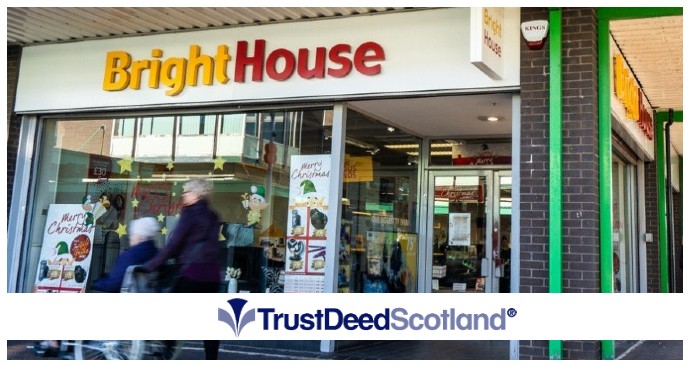
Brighthouse Administration

The rent to own retailer Brighthouse has collapsed into administration. Caversham Finance Limited, trading as Brighthouse, is owned by private equity firm Apollo Management. The company which has stores across Scotland is synonymous with high-interest borrowing that targets the most financially vulnerable with essential household goods from washing machines, beds, sofas and televisions – in what’s known as a rent-to-own credit lending arrangement. Brighthouse had previously been branded an irresponsible lender, and their interest rates were as high as 99.9% APR on some purchases – it’s no surprise that the stores were positioned in shopping centres and high streets across Scotland, and the rest of the UK where poverty is highest and access to affordable lending at its lowest. However many debt charities and Scottish debt help companies accept that while the sight of disappearing Brighthouses from our Scottish high streets is not widely regarded as any great loss, the unfortunate reality is that they were providing a vital service for people who have no access to adequate lending facilities. Trust Deed Scotland® advised that “The business model of rent-to-own retailers and in particular Brighthouse, is damaging to Scotland’s most vulnerable people who ultimately end up paying way more than they needed to, for basic household goods.” “Using credit-risk modelling, these people are deemed to be riskier and therefore more likely to pay more than a person of reasonable creditworthiness.” “With such a vulnerable market with few options, these people simply have no choice as it was only feasible way of buying household items.” As well as concerns over Brighthouse customers, the organisation also employed many individuals in Scotland with high stores in towns and cities like Motherwell, Glenrothes, and Inverness. With many retail and hospitality organisations already struggling and fewer job vacancies opening. There are many hundreds of Brighthouse employees with a precarious financial outlook also.

Brighthouse Repossessions

The administrators have said that while there will be no new lending, all existing outstanding rent-to-own and cash loans remain subject to the original agreed terms. Brighthouse customers will continue to be chased for payment and debt in the same way. Enforcement action including the repossession of Brighthouse goods. Previously, before going into administration – If you had purchased goods from Brighthouse and fell behind on payments – Brighthouse upheld their rights to repossess their goods. No exceptions were made, be that a television or a children’s bed, the Watford-based organisation were known to be ruthless in their repossession execution strategy.  

Brighthouse Affordability Claims

While being forced to close their high street doors due to the Coronavirus restrictions, the group had been struggling for a long time, with growing refunds owed to customers who were mis-sold goods they could not afford. In theie Q2 2019/20 unaudited results, BrightHouse warned investors that the company was growing liabilities due to a high volume of customer complaints regarding excessive interest charges on cash loans and repayment interest rates. Brighthouse stated at the time: ‘We have increased the affordability provision by £5.6m as a result of an increase in the number of complaints received and we have disclosed a contingent liability in respect of our affordability provision’ Similar tougher sanctions on the likes of Brighthouse, have affected other high-interest organisations in recent years. Wonga, the payday lender being one famous example and as recent as March 2020, Peachy Loans another payday loan provider also went into administration. Amigo Loans, a guarantor loan company being another that has felt the wrath of growing criticism from regulatory bodies and consumer awareness championing. The sub-prime group once labelled as legal loan sharks by MSPs, put itself up for sale in January 2020 amidst profit warnings and turmoil created by rising customer complaints and compensation claims. Customers mis-sold Brighthouse goods from 2010-2016 were awarded £15m compensation in 2017. Brighthouse issued a refund of the interest paid, with an extra 8% interest per year added on top of that refund, and any late payments, defaults deleted. However, the Financial Ombudsman said in 2019 that it would allow complaints at any time before 2010 to also be upheld. Unfortunately, any ongoing affordability claims are usually put on hold for a longer time than usual. If you feel you were mis-sold Brighthouse goods on the grounds of affordability, we recommend that you have a look at Resolver for information on any possible mis-sold Brighthouse claims.

Brighthouse Insurance & Warranty Claims

Brighthouse’s administrator says that insurance, servicing, warranties claims will continue to be provided until further notice for essential items and smaller courier deliveries. This is subject to continuous review. If you’re considering making a claim on your Brighthouse insurance, or warranty – You should do this immediately as it too could be pulled.

Brighthouse Alternative Rent to Own Lending

If you need household goods and there is no other way, you can investigate Fairforyou. Fair for you is a community interest company that claims to challenge high cost lending and says it does this by charging its manufacturers a commission – they will charge 3.5% a month of interest representative 51.1% APR on the products that you buy from them. Again, be careful of high-interest loan rates – a loan of £1,000, taken over 52 weeks will give you £940, with a £60 fee and £586.96 of interest; meaning you pay back £1,586.96 in total. perfecthome.co.uk and payasyougofurniture.com offer services similar to Brighthouse with similar financial terms. You can consider Charity Shops such as Shelter Scotland, who offer high standard second-hand furniture goods nationwide.

I’m worried about my Brighthouse debt, what should I do?

If you’re worried about your Brighthouse agreement or any other unaffordable debts, you should seek expert debt advice. Our team of experienced debt advisers at Trust Deed Scotland® have helped over [volume] people in Scotland with their debt problems. Our tailored, non-judgemental debt advice is personalised to you and your circumstances. To get started, give us a call on 0141 221 0999 or find what Scottish debt management solutions are open to you. Try our Trust Deed Wizard® tool

Coronavirus Private Renters Universal Credit Shortfall Fears

There are over 340,000 private renters in Scotland, while the Department for Work and Pensions has warned that new benefit claimants are likely to receive less money than they had anticipated, and not as quickly as they had hoped. Many campaign groups had been hoping for an accelerated universal credit application process to help alleviate the pressure families found themselves under after the coronavirus outbreak forced businesses to close and people to stay at home as part of the lockdown measures. Speaking at a press briefing, Universal Credit director general Neil Couling said: “If you play about with the architecture of Universal Credit you won’t be able to pay the vast millions we have to pay every month.” Exact projections are expected to be released at a later date but the worst is yet to come. Neil Couling added: “Next week, that’s the really peak week. We had about 270,000 claims in the first week of the pandemic, we had 540,000 roughly in the second week, then about 380,000, and last week was about 220,000. So that’s the kind of mountain we’ve got to go up.”

Universal Credit Housing Benefits Shortfall

For private renters in Scotland, affected by the Coronavirus pandemic The housing element of the benefit only covers the lowest third of market rents in an area, meaning those paying average rents will face a shortfall. In the Greater Glasgow area, the median monthly rate for a 2-bedroom flat is £750 but the Local Housing Allowance rate (LHA) is £648. In the Edinburgh area the equivalent average for Lothian is £900 per month, with an LHA rate of £822.73. Shelter Scotland is calling for the Government to increase housing benefit so that it can cover the average cost of local rents. Assistant director of Shelter Scotland, Gordon MacRae, speaking to STV News advised that: “Thousands of renters will be in dire straits further down the line without more support from the UK Government.” “As renters lose their jobs and see their incomes hit, many will have to rely on the welfare safety net for the first time.” As part of the Coronavirus (Scotland) Act 2020 passed recently, the Scottish Government has changed the law to offer greater protection against eviction due to having rent arrears. However, these measures only postpone payment of those arrears and is not the same as a mortgage payment break.

Post Coronavirus Recession Fears

While it’s true that there is greater protection against eviction for private renters and the legal changes will buy time for those individuals to find monies to pay their landlords, post-pandemic fears of a global recession loom. A stark warning from the IMF predicts that we’ll see the worst recession since the great depression ultimately resulting in job losses and Universal Credit payments lasting longer than originally forecast. Tourism, retail, hospitality and leisure will continue to be vulnerable throughout 2020 and 2021 meaning new claimants in these sectors could be hit hardest. Women and Under 25s Hardest Hit Recent research into the financial impact of the coronavirus outbreak has found that women, low-income earners and workers under the age of 25 may be the hardest hit by the Coronavirus crisis. The Institute for Fiscal Studies reported ‘Sector shutdowns during the coronavirus crisis: which workers are most exposed?’ and advised on the numbers behind those sectors that have faced mass closures in recent times, including Tourism, retail, hospitality, childcare and leisure.

I’m worried about my unaffordable debt, what should I do?

If you’re worried about your ability to pay off your private rent arrears, mortgage or any other priority debts due to having unaffordable, unsecured debts including credit card debts, you should seek expert debt advice. During these difficult times your priorities should always be – Shelter, Utilities and Food. Most credit cards, loans and other lending sources should now grant you a loan payment break without affecting your credit. Our team of debt specialists at Trust Deed Scotland® have helped over 20,000 people in Scotland with their debt problems. Our expert, non-judgemental advice is personalised to your situation. To get started, give us a call on 0141 221 0999 or find what Scottish debt management solutions are open to you. Try our Trust Deed Wizard®

Hiding Debt From Partners During Coronavirus

If you have been hiding your debt from a partner during the Coronavirus pandemic, you are not alone. Even before the Covid-19 outbreak, many people across Scotland had been hiding personal debts problems from their partners. In 2017, relationship charity Relate said that an estimated 14% of people are hiding a debt problem from their partner. The same report found that 25% of the respondents would typically argue with one another about debt and other financial issues at least once in a fortnight. In 2018, a report by the Money Advice Service found that 44% of a poll of 4,000 people were keeping their debt a secret and that the average debt being hidden was over £4,164. Credit card debts, personal loans and bank overdrafts are the most common types of debts that we hide from our partners with almost 48% hiding at least one credit card debt from their partner.

Are You Hiding Debts From Partners During Coronavirus?

It’s actually quite common for people to successfully complete a whole Trust Deed term of 48 months or finish their Debt Arrangement Scheme without ever telling their partner about their debt issues. Although Trust Deed Scotland would usually advise against hiding debt from your partner. Hiding a debt problem from our friends and family is more manageable when we are operating under normal circumstances  however, the effects of self-isolation during Coronavirus mean that most of us are spending more time together, finding less time for ourselves and finding it more difficult to ‘nip out to make a quick phone call’ Trust Deed Scotland, Scotland’s leading debt advice company has been continuing to provide assistance to individuals in Scotland struggling with debt during the crisis and found that many people are continuing to hide debts from their loved one, even under stricter lockdown conditions. Hiding your debts under a heightened stressful situation such as the Coronavirus may prevent you from seeking help – it may also prevent you from attaining a mortgage payment break, or credit card payment breaks due to the fear of your partner finding out about the total debt you have and the perceived fear of a backlash as a result. If this is the way you are feeling, we would recommend that you get in touch with an expert debt advisor as soon as possible, in order to find out what your options are. All advice is offered by qualified experts and it’s always confidential.

Why Do People Hide Debts?

There are many reasons why people in Scotland might choose to hide unaffordable debts from the people closest to them. Those reasons may include guilt, embarrassment or not wanting to burden their partner with stress. Sometimes the reasons for hiding debt could be more serious. E.g. as the result of gambling debts or other addictions. In these instances, hiding debts is only part of a bigger problem and means the causes of debt are less likely to be solved.

Domestic Violence Fears

On some occasions, people also hide debts from their partners for fear of domestic violence. If you have experienced domestic abuse during the Coronavirus pandemic, or at any other time – we recommend that you look at the Safer Scot website. It is a Scottish Government priority to ensure that anyone who is a victim of domestic violence gets access to the support services they need during these unprecedented times. Scottish Women’s Aid is operating a 24-hour helpline during the crisis, with support being offered by webchat and email as well. Scottish Women’s Aid and Police Scotland have said officers would treat domestic abuse cases with the same seriousness as they did before the pandemic, and that victims could still leave their homes to seek refuge. Another aspect of domestic abuse is known as financial abuse. This is a term used to describe cases where a partner or family member exerts excessive financial control, harm or exploitation of another. Victims find this difficult to talk to their friends and family about this, and financial institutions often fail to acknowledge financial abuse, according to the Citizens Advice Bureau. Domestic violence has reportedly increased 120% since the introduction of lockdown measures.

Why You Shouldn’t Hide Debts From Your Partner

Having debt is a burden on our minds that carries extra weight and the stigma of having debt often makes people attempt to struggle on alone. Opening up about our debts and talking to us closest to us can help take some of that stress away immediately. It’s even possible that a partner, or family member can help pay off the debt, or a chunk of it that will enable you to get back on your feet. Or more commonly, you can work together to resolve outgoings by spending less each month on the items that are non-essential. However, talking about our debts creates more trust in our relationships, provides fewer secrets and above all else, a sympathetic, friendly ear that can listen to your issues and give you extra security in sharing an issue. Where you still feel this isn’t an option – you can approach a charity such as Breathing Space. Trust Deed Scotland

Why You Shouldn’t Lie About Your Debts

Admitting your debt issues doesn’t make you a weak person. The opposite in fact – it means you’re willing to tackle the problem head-on rather than hide from it. Many of the independent debt advice reviews received about Trust Deed Scotland talk about these exact same issues that prevented our clients from seeking helped and we would often encourage opening up to your family and friends about your financial difficulties. Whether you simply created debts due to excessive charges from credit card debts and unaffordable personal loans – lying about debts to those closest to you is never recommended – the stress of having debts in itself can be unbearable but adding extra pressure on yourself by being deceitful in any relationship can add to that burden.

Opening Up About your debt to your loved ones

As a company that has helped over [volume] look forward to a brighter future, Trust Deed Scotland have spoken to many people from all walks of life. Of all the five star debt advice reviews that we receive, more and more people are saying that they’ve made an enquiry with us due to a recommendation from a friend, or family member. When people openly discuss their debt issues and signpost reputable sources of debt advice, it helps to dispel the taboo people have about debt itself and then encourages more people to seek help about their own situation.

Unaffordable debt issues happen to the best of us

Debt issues most often occur as a direct result of a change in circumstances. Long-term redundancy, sudden health issues. Relationship issues among the many reasons. Even just spending that spired out of control. It’s very rarely intentional but once debt gets to the stage where it becomes unaffordable, this is where people begin to feel embarrassed and ashamed at getting into the situation.

I’m worried about my unaffordable debt, what should I do?

If you’re worried about your ability to pay off your unaffordable, unsecured debts you should seek expert debt advice. Our team of Scottish debt specialists at Trust Deed Scotland® have helped over 20,000 people in Scotland with their debt problems. Our expert, non-judgemental advice is personalised to your situation. To get started, give us a call on 0141 221 0999 or find what Scottish debt management solutions are open to you. Try our Trust Deed Wizard®

Trust Deeds, Vehicles And Car Finance

One of the most worrying aspects for anyone considering entering into a debt solution is what will happen to their assets. The fear of what may happen to their homes and cars can be one of the reasons why people put off seeking help sooner than they do. Trust Deed Scotland® always suggests that it’s best to speak to a qualified, expert debt advisor for personalised advice, as usually there is a solution that resolves anyone’s financial situation. Where an individual is most concerned that they may have to give up their car as a result of entering a statutory debt solution, reassuringly this is typically an unlikely scenario.

Can I Keep My Car In A Trust Deed?

If you need a car, you can usually keep the car during your Trust Deed term. There are many reasonable needs for a vehicle during a Trust Deed – for commute purposes or for work. Even living remotely or taking children to school counts as a reasonable need to maintain a car during a Trust Deed. This includes vans and motorbikes too. If car finance is already secured upon your vehicle under an existing arrangement, you’ll keep maintaining the payments. This is because if you fail to make the payments, the car may be repossessed by the car finance lender otherwise. When entering a Trust Deed, an allowance gets added in your monthly budget to continue paying the secured car finance, as long as your monthly finance payment isn’t deemed excessive and that you have a fair need for the vehicle.

My Car Is An Asset?

If you own a car, it is regarded as an asset. Under a Trust Deed, your Trustee take account of any assets you own and where vehicles are concerned, a £3,000 valuation threshold applies. Where your car is valued less than £3,000, there are generally no issues at all. Where your vehicle is valued at £3,000 or more, a written plan will be put in place. You will become the owner of the vehicle when you have complete your car finance term but you would also consider how much the car would be valued after a period of 4 years, the typical length of a Trust Deed term. You may also consider downgrading the vehicle before you proceed with a Trust Deed.

Car Finance Shortfall Debts?

If you had a vehicle under a credit agreement and the car was repossessed due to handing the car back early, or due to not being able to afford the finance for whatever reason, there may be a car finance shortfall debt which will then be classified as an unsecured debt. Once the car finance shortfall debt becomes an unsecured debt, the lender is then added to your list of creditors in any Debt Arrangement Scheme or Protected Trust Deed. In any instance where a car finance shortfall debt exists, the unpaid debt will be added to your Trust Deed as a creditor.

Can I Get Car Finance With A Trust Deed?

It’s a question we’re asked at Trust Deed Scotland® quite often from people considering entering a Trust Deed and the answer is yes, you can get car finance. However, entering a Trust Deed will make accessing any kind of credit quite difficult. Any new lender will usually charge you a higher rate of interest, which can then eat into your agreed disposable income. Therefore, it’s more difficult to get car finance during a Trust Deed, but not impossible. During your Trust Deed term, you will need to seek permission from your Trustee to obtain any form of credit. Not informing your Trustee breaches the terms of your agreement and could lead to your Trust Deed failing. Your Trustee will decide on whether your request to take out car finance is reasonable. The Trustee will decide if taking out a vehicle on finance is suitable for you based on your income and expenditure. Your Trustee is likely to approve your request if the car finance is sustainable with your current budget and living costs. Special consideration will be given where you require the vehicle for work purposes.

Can I Get Car Finance After My Trust Deed Has Complete?

Yes, once you have finished your Trust Deed term, you are free to rebuild your credit rating and borrow funds as you go. Once you have been discharged from your Trust Deed you will be removed from the Insolvency Register. However, the Trust Deed shall remain on your credit file for 6 years from the date you took out your Trust Deed. Therefore, if your Trust Deed lasts the standard 48 months, it will remain on your credit file for a following 24 months. This impacts your credit score, which can make it more difficult to find a suitable lender than if you had no financial discrepancies. Waiting until you have rebuilt your credit score may be a more suitable option for you when considering taking a car out on finance as you will be able to access better market rates and deals – as long you are continuing to make responsible use of credit. If this is not an option, however, you can shop around and use comparison websites to find the best poor credit car finance lender. If you are struggling to find a company willing to approve your bad credit car finance application it may be just as beneficial to approach a credit union.

I’m Worried About My Unaffordable Debt, What Should I Do?

If you’re worried about your ability to pay off your unaffordable, unsecured debts you should seek expert debt advice. Our team of debt specialists at Trust Deed Scotland® have helped over 25,000 people in Scotland with their debt problems. Our expert, non-judgemental advice is personalised to your situation. To get started, give us a call on 0141 221 0999 or find what Scottish debt management solutions are open to you. Try our Trust Deed Wizard®

Is A Trust Deed A Good Idea?

Is A Trust Deed A Good Idea?

Trust Deeds help thousands of people in Scotland manage their unaffordable debts and reduce their monthly debt repayments to an amount that they can afford to repay on a regular basis. However, Trust Deeds aren’t a solution suitable for everyone and there are alternative debt management solutions in Scotland that can be just as effective or better. You can read more about how a Trust Deed works and the criteria within that link, or you can apply for a Trust Deed online, right now. The decision to proceed with a Trust Deed is based on you, your affordability and what is best for your long-term financial stability, rather than whether a Trust Deed is a good idea or not. Get in touch with Trust Deed Scotland® today and you’ll receive a personalised illustration.

Affordable Monthly Repayments?

The solution(s) open to you will largely depend on how much debt you have and how much you can afford to repay on a regular basis. If you have already defaulted on debts such as credit cards and loans, you may be familiar with income and expenditure guidelines, or budget sheets sent to you from your creditors. The same guidelines are largely available from debt charities and Money Helper websites. These budget sheets will ask you to write down a list of your income and expenditure details and what you usually spend on priority bills such as mortgage/rent and council tax.  These will also include what you spend on travel expenses per month, clothing and many other expenses Whatever monies are leftover is known as your disposable income. These are the funds that you have leftover to repay your debts. A debt charity service or a company such as Trust Deed Scotland® have the experience of advising on the acceptability criteria for these guidelines for these and can work with you to find out any hidden expenses that you may not take into account, and establish what your true disposable income is. This is important because if you are to enter a Trust Deed, or any other form of debt management solution, you will be making a commitment to repay a regular amount over a number of years. Where you fail to keep up the repayment of your Trust Deed, you could end up with a failed Trust Deed, ultimately leading to you being potentially sequestrated. More importantly for you, you would be no better off than when you first sought advice. This is where the experience and trustworthiness of your debt expert is important. Trust Deed Scotland® have advised over [volume] people since 2009 and have gathered thousands of five-star Trust Deed reviews on TrustPilot. We pride ourselves on our commitment to compliance and training. We genuinely want the best outcome for our clients and always have their best interests at heart.

Alternatives to a Trust Deed?

The Debt Arrangement Scheme is a popular alternative debt solution available to residents of Scotland. It’s a statutory debt repayment plan which also uses legislation to allow you to freeze interest and charges and bring your debts under control. There are advantages to the Debt Arrangement Scheme:
  • Personalised debt repayment plan based on your situation
  • Monthly payments will be based on what you can afford
  • Interest on your debt will be frozen
  • Protection against creditor action.
  • Assets protected meaning you will not be asked to sell your house, or your car.
  • Your Money advisor deals with creditors on your behalf.
There are also disadvantages of the Debt Arrangement Scheme:
  • May last longer than the typical 48 months offered by a Trust Deed.
  • Subject to certain conditions. Includes making all payments towards your Debt Payment Plan and paying your monthly expenditure and bills when they fall due. If you fail to make payments, your plan could be revoked.
  • Unable to obtain credit or use an overdraft while you are in a Debt Payment Plan.
  • Credit rating will be affected.
Depending on the severity of your situation, Sequestration may be the best way for you to resolve your debts. On the other hand, a debt consolidation loan or negotiating debt repayment plans directly with your creditors may also be better for you. Refer to our article regarding is a DAS worth it for further information on this solution.

Advantages of Trust Deeds?

There are many advantages of Trust Deeds, a few of which are:
  • Pay back what you can afford.
  • Your Trustee will deal with creditors on your behalf.
  • You will be protected against creditor action.
  • On the successful conclusion of a Trust Deed, your remaining debt will be written off.
  • If you own assets such as a property, you agree with your Trustee in advance whether the Trust Deed affects them.
  • You may be able to remain as the director of a Limited Company.

Disadvantages of Trust Deeds?

  • Your credit file will be updated to reflect that you have signed a Trust Deed. This information will remain on your credit file for six years.
  • As a result of this, you may find it difficult to get credit for a period after your Trust Deed is finalised.
  • For a Trust Deed to become protected, you must convey all your assets to your Trustee. That includes any property that you own. In certain circumstances, it may be possible to exclude your property, but you need to get clear advice on this when you speak to a debt advisor.
  • As mentioned earlier, failure to keep up with repayment of your Trust Deed could result in you being sequestrated. Therefore, it is important that you re fully aware of the Pros and Cons of a Trust Deed and that the amount you repay is realistic for all parties.

Can You Have 2 Trust Deeds?

If you have already been through the process and came out the other end then yes, you can get a Trust Deed twice. If you’re currently in a Trust Deed with a different company then you may also be able to get a second Trust Deed but there are some conditions attached. You can find out more about the process involved in our article on how to get a Trust Deed twice.

How to Get Trust Deed Advice?

If you really want to know if a Trust Deed is a good idea, seek tailored debt advice today. We’re open from 9am to 8pm during the week, and selectively during the weekends. If you do something about your debt today, you don’t need to worry about it tomorrow. Reputable debt advice companies and debt charities are regulated by governing bodies, this should help ensure that you are not ‘sold’ into a Trust Deed and that you are fully aware of the pros, cons and alternatives. Remember, a Trust Deed may not be for you, but that doesn’t mean that you are beyond help. The sooner that you seek help, the sooner you can begin to understand what options are open to you. You can also learn more a similar question of Is DAS Worth It? which investigates the Debt Arrangement Scheme in a similar fashion to the article above of the merits of whether a Trust Deed is a good idea.

What Happens When A Trust Deed Finishes?

When your Trust Deed comes to an end, your Trustee will issue what’s known as a ‘letter of discharge’. A copy of the letter of discharge will be sent to Accountant in Bankruptcy (AiB), the regulatory body of Trust Deeds in Scotland and the Register of Insolvencies will record your Trust Deed discharge. If you enter a Trust Deed, typically you’ll finish your repayment in 48 months, as long as you made all payments in your plan. Depending on your circumstances, you may have entered into a Trust Deed for an extended period of 5-6 years. Over the term of your Trust Deed, you’ll have made a number of affordable monthly payments – and this will count as ‘full and final settlement’ of the unaffordable debts included in your Trust Deed. At the end of your Trust Deed term, any unsecured debt that you weren’t able to repay during your Trust Deed will be written off. When you are discharged from a Protected Trust Deed, you will be discharged from any outstanding debts from the people you owe money to (your creditors) that you had included at the date you registered your Trust Deed. This means that your lenders are no longer allowed to pursue money that was owed to them when you signed the Trust Deed. However, some debts won’t be written off such as a student loan, or any court fine.

What Happens With Secured Debts After A Trust Deed?

If you owe money that is secured against an asset such as property or a vehicle, it won’t be included in your Trust Deed. Your secured lenders won’t be consulted on whether they agree to your Trust Deed, and they won’t write off monies that you owe them, whether you complete your Trust Deed term or not. However, the fact that you’re in a Trust Deed should make the secured payments easier to make, as your Trust Deed payments would be calculated not to take up any monies that you need for your typical essentials – not just your rent or mortgage, but utility bills, travel expenses and so on. If you’re a homeowner, you might be required to release some equity from your property, so you can repay your unsecured lenders more of what you owe them before they write off the rest. However, you may find that the impact of your Trust Deed on your credit rating makes it harder to release equity. Mortgage providers can see that you’ve entered a Trust Deed, so you might find that it’s harder to get a new mortgage deal, or that you’re charged a higher rate of interest if you do. If you can’t release any equity then your Trust Deed could be extended by 12 months.

Trust Deed Credit Score And History Impact

Information about Protected Trust Deeds and defaults will remain on someone’s credit reports for up to six years after they occur, so they are likely to remain on someone’s credit history even after they have been discharged from their Protected Trust Deed, which normally lasts for 4 years. If you’ve already defaulted on your credit agreements even before considering a Trust Deed, this too will be logged on your credit score.

How Will A Debt Arrangement Scheme Affect My Credit Rating?

When your Debt Payment Programme (DPP) is approved, you’re placed on the DAS register. This is coordinated and managed by the DAS administrator and is available to credit rating agencies. This register, along with other insolvency registers, is added to other information to your credit report, which calculates your credit score. Just like a Trust Deed, or even a simple default notice, the Debt Arrangement Scheme will affect your credit rating for at least six years. However, this may be extended further depending on how long it takes you to pay off your Debt Arrangement Scheme in total. E.g. if you are on a DPP for under 6 years there is no difference, or if you are going to repay a DPP for longer than 6 years; your debts will not be marked as satisfied until the debt has been repaid at the end of the DPP.

What is a Default Notice?

A default notice is usually sent when you’ve missed or paid less than the full amount for three to six months. The default notice will give you at least two weeks to catch up with any missed payments. If you can do this your account will carry on as normal. If you can’t pay the missed payments in this time your account will default. Default notices only apply to debts which are regulated by the Consumer Credit Act, such as credit cards, payday loans, personal loans and store cards. You’ll know a default notice has been served on you when you receive a letter informing you of a ‘Default notice served under section 87(1) Consumer Credit Act 1974’. The most recent revision of this act was in 1983, long before the evolution of the current Trust Deed legislation and the Debt Arrangement Scheme. As the wording of the default notices is quite old, you may, therefore, be directed towards Trading Standards and/or a solicitor – remember this is somewhat outdated legislation and you are advised to instead contact a qualified debt advisor, or debt charity instead. Unless you can get a default notice removed within 2 weeks, this will be recorded on your credit profile for six years. Depending on your lenders criteria, this may have the same affect as a Trust Deed or a Debt Arrangement Scheme registered against your name.

Can You Rebuild Your Credit After a Trust Deed?

Yes, it is possible to begin to rebuild your credit rating after your Trust Deed has finished. Eventually getting a mortgage after a Protected Trust Deed is achievable. It may not always happen immediately and will require a bit of work – it is certainly possible for most people to successfully be approved for a mortgage after a Trust Deed. Also, it will not be possible to obtain a re-mortgage on a home that is still in the Trust Deed, without the Trustee’s permission, until they have discharged their interest. A Trustee’s interest in a property can continue even after the debtor is discharged. It may be that the lending terms are not as favourable as before, however by showing a commitment by making regular payments to utility bills, and by using credit sensibly, purely for the purpose of rebuilding your credit score, you will in time secure a more favourable lending rate. Paying utility bills by direct debit can help rebuild credit after a Trust Deed and even just joining the electoral roll helps prospective lenders build trust in you.

A Brighter Financial Future

Many people in Scotland have approached Trust Deed Scotland® after they’ve put off seeking help over their unaffordable debts for a number of years. So severe are some people’s financial difficulties, that if minimum payments were made only; it may take them longer than two decades to clear their outstanding debts. If you’re struggling with debts and making minimum payments to debts such as credit cards, you may regard protecting your credit score as being more important to you than dealing with the debts you have. This isn’t uncommon. However, anyone pondering the pros and cons of the impact of entering a formal debt management solution may have on their credit score after a Trust Deed finishes should look towards the long term outlook and whether it’s better to essentially press the restart button, or continue on alone waiting for a solution to present itself in another form.

Want Trust Deed Advice?

If you feel you’re struggling with debt, seek tailored debt advice today. If you do something about your debt today, you don’t need to worry about it tomorrow. As well as Trust Deeds and Debt Arrangement Scheme, there are other alternative Scottish debt solutions. Trust Deed Scotland® are able to offer no-obligation, confidential advice on all debt management methods available in Scotland. Call us on 0141 221 0999 or try our Trust Deed Wizard® tool to get started today.