Category: Types of Debt

Payday Loan Debts

Payday Loans Debt have created a problem, not the quick-fix solution that so many seek.
Amidst the country’s growing consumer debt crisis, thousands of people in Scotland are turning to high-cost loans to make essential payments and ends meet. Despite constant bad press and recent regulatory crackdowns, the most common port of call is the Payday Loan because of its perceived convenience.
We want to show you the real cost of Payday Loans – all too often, reliance on high-cost, short-term credit serves as an entry point to a more serious debt problem: one that could last a lifetime, and not just until payday.
How Payday Loans work
As the name suggests, payday loans are short-term loans designed to tide you over, meet essential payments or living costs until your next payday. In 2018, 53% of borrowers withdrew a payday loan for living expenses or utility bills. A Payday Loan is paid into your account in one lump sum, and you repay in full, with interest and charges, typically at the end of the month. However, payday loans now commonly stretch over 3 months, with the option to ‘rollover,’ where for a fee the lender agrees to extend the repayment period even further. One condition lenders commonly attach is that you set up a recurring payment, essentially a direct debit allowing them to take a repayment instalment directly from your account on the agreed date. Despite their high-cost Payday Loans are a popular short-term solution, generally due to their ease of access and the simplicity of the whole process. Payday Loans allow you to get a ‘loan on your lunch hour,’ bypassing the timely process of borrowing from a mainstream lender. In 2017 the Competition and Markets Authority found that 85% of borrowers took out their payday loan at the click of a button and this figure has likely increased since then. Combine this with the fact that most lenders don’t conduct credit checks (and advertise this) and it’s easy to see where the perception of Payday Loans as ‘free money’ comes from.1,500% interest: the real cause of Payday Loan Debts
The number of payday lenders active in the UK has decreased significantly due to new regulatory requirements. Worth over £2 billion in 2013, the industry is now worth an estimated £220 million today. As a result, it has been argued that the industry is now less predatory, and consumer friendly. We wholly disagree. A payday loan is subtly expensive and can create a debt problem or make an existing one a lot worse in just a few short months. Although the average loan size is just £260, this can be deceiving. Servicing debt with debt is a risky business and should be practised with the greatest of care. You can consult our guide on safe debt consolidation for more information. Due to inflated interest payments, payday loans have no place in any effective debt consolidation strategy. Over a year, the average annual percentage interest rate of charge (APR) is typically between 1,200-1,300% and can be up to 1,500%. For comparison, a typical credit card has an APR of 22.8%. To give a practical example, we used lender’s own loan calculators to get a quote for a £500 loan. Quickquid offered a maximum repayment schedule of 3 months with an APR of 1294.1%. Therefore, the total interest on a £500 loan was £360, making the total repayment £860.Payday Loan Debts and the debt spiral effect
Payday Loans are one of the most common debts our clients have and with these interest charges, it’s no small wonder that they have dragged thousands into deeper waters. More and more research is emerging to back up our view that they are a major contributor to the debt spiral. In America, for example, the Centre for Responsible Lending found that 76% of Payday Loans are taken out to pay off older payday loans. They reported further, that although most are scheduled to be paid within two weeks, on average the borrower stays in debt for more than a year, demonstrating how a quick fix often leads to potentially long term debt. Borrowers regularly only notice the true cost of their loan at the time of repayment making the rollover option all too tempting. As the months go by, interest and charges snowball with their debt now standing at three to four times what it was. While it’s true that the situation is better here in Scotland than it is in the United States, there is a misinformed consensus here, that the UK’s financial regulator), have effectively addressed this cycle with recent reforms. In 2015 they introduced a price cap on the interest of payday loans, and limited charges to £24 per £100 borrowed. The result is that no customer would repay more than double the amount they had borrowed. This is a highly concentrated solution that regulates at the level of the individual loan. Consider the whole picture, and the trapping effect of payday lending is still clear. 75% of customers take out more than one payday loan per year – on average they actually take out 6. Consider also that 25% of borrowers take advantage of the rollover option at least once. Compound interest also comes into play if you borrow for more than one month, and it continues to accumulate each time you choose to roll over. In short, the new regulations only ensure you pay back a maximum of double your original loan if you take out a single loan and repay it the same month. It’s still very easy to multiply your debt rapidly with payday loans and create a much more serious debt problem.Alternatives and other considerations
Equipped with a more realistic understanding of payday loans, it’s important for you to consider alternatives. The one attraction payday loans will always have is that they are quick, easy and cover every cash flow emergency possible. The good news is they are not the only show in town anymore. Be it guarantor loans; peer-to-peer loans and other new ‘fintech’ initiatives; or credit unions, there are other options out there. If your last wage isn’t stretching far enough and you have an upcoming bill, essential payment to make or an unforeseen breakdown that needs to be repaired, try the Money Helper Payday Loan portal which is dedicated to payday loan alternatives as a starting point. As a final note, if you have very recently taken out a payday loan and feel you could struggle to repay, make sure to take advantage of the seldom advertised 14 days ‘cooling off period.’ This allows you to withdraw from the agreement if you change your mind within the first two weeks. You will only have to pay the interest on the credit you have used, and any other charges must be refunded to you.Need help now?
Perhaps this blog has reached you too late, and you already find yourself in an unmanageable debt spiral. If so, we can help. If you have multiple high-interest payday loans you are repaying individually you may qualify for a Trust Deed. A legal and binding agreement between you and your creditors, overseen and administered by an Insolvency Practitioner (IP.) A Trust Deed allows you to repay your debts in a single, reduced monthly payment distributed to creditors by your IP and write off the debts that you simply can’t afford. For more information on Trust Deeds read our guide on how they work. In time, the Protected Trust Deed will give you the financial fresh-start you need. We are here for you if you are in an unmanageable financial position and can talk you through your options, our service is no obligation and 100% confidential. Consider alternatives too, like the Debt Arrangement Scheme in Scotland. We have helped thousands of people like you out of debt so far. For a detailed, comprehensive consultation with one of our experienced debt advisers, get in touch today on 0141 221 0999 or find out if you qualify for a formal debt solution. Our team of friendly debt advisers are ready to help you.Sheriff Officers, their powers and what to do when faced with one

Dealing with bailiffs at your doorstep is one of the most anxiety-provoking, overwhelming aspects of a debt problem.
In Scotland, bailiffs are called sheriff officers. Typically, you will encounter a sheriff officer if you have unsecured debts like council tax arrears, tax payments or utility bill arrears which you are struggling to repay. What’s worse is, you may find yourself too busy trying to get by, to learn about their powers or what to do should you ever find yourself receiving that knock on the door.
Sheriff officers enforce court orders relating to debt recovery on behalf of government agencies, private companies or individual creditors.
With the right documentation, a Sheriff Officer can enter your home, using reasonable force if blocked from doing so and remove items that belong to you, both inside or outside of your home. These items are taken and resold with the proceeds going towards repaying your outstanding debt balance.
While they are officers of the court they are not the police, and therefore their powers are limited in that they can only enforce an existing court order.
Creditors are entitled to instruct sheriff officers to take action only when they have made formal attempts to collect your debt.
If you have received a ‘charge for payment’ (a formal demand for payment which is commonly sent after at least two or three previous letters warning of court action) this is your guide on sheriff officers: what they can and can’t do; your rights, and how to handle the situation without creating new problems.
Powers of a Sheriff Officer in Scotland
Forced Entry The ultimate concern of anyone with unsecured debts they can’t afford is that a sheriff officer will force their way into their home and seize their possessions indiscriminately. Though forced entry is allowed in certain cases, it is quite rare and depends on express authority from the courts.< So when can Sheriff Officers enter your home in Scotland? The Sheriff Officer requires an ‘Exceptional Attachment Order’ before they can force entry. Prior to gaining an Exceptional Attachment Order, a creditor must show that they have made reasonable attempts to repay the debt such as serving you with a Charge for Payment, allowing you 14 days to repay your debt. Additionally, for the order to be valid, you must have received a Debt Advice and Information Package from your creditor along with the charge for payment. As such, whoever your creditor may be, you should always be sure to note whether or not you have received an information pack with any documentation they have sent. A Sheriff Officer should also first try a less intrusive way of recovering your debt such as arresting your bank account, executing an Earning Arrestment or enforcing an Attachment Order. However, if a creditor can prove that they didn’t employ these methods because it wouldn’t have resulted in the debt being repaid they can be excused from not using them and apply for an Exceptional Assessment Order. Before granting an Exceptional Assessment Order a Sheriff Officer will consider the nature of your debt, your living, working and financial circumstances and whether you have applied for and been rejected from debt help in the past along with a number of other factors. When an Exceptional Assessment Order is granted however, they can force entry to, and remove items from your home. What if I refuse entry to the Sheriff Officers? If you or someone over the age of 16 with a full understanding of the situation does refuse entry to an authorised sheriff officer, they can force a door open or break a lock/window to gain entry. It’s quite ambiguous who would pay for these damages but the general rule is that the cost is covered as part of the officer’s fee. However, it is not uncommon for the cost to be forwarded onto you. Sheriff Officers cannot enter or seize possessions if, when they arrive:- You or someone over the age of 16 is not present.
- If you’re not present, but someone aged 16 or older is they can’t force entry if that person doesn’t speak or understand English; or is unable to understand the situation because of physical or mental disability.
What to Do When Facing a Sheriff Officer
Again, a sheriff officer can only come into your home with the correct authority from the court to do so – the Exceptional Attachment Order. Without exception, you should always immediately ask the sheriff officer to show you their identification and the document that states that they have the authority to come inside. They are obliged to show you both. Every Sheriff Officer has a red booklet with an identification photograph and the crest of the Scottish court service. It is countersigned by the sheriff clerk for the relevant area. In some cases, it may not be clear from the court document that permission to enter your home is included. As to the Attachment Order, the document usually has a phrase like “grants warrant for all lawful execution.” This is the group of words you are looking for, as they do provide appropriate authority. If you are in any doubt you should ask for the officer’s employer and call them. Though an upsetting ordeal, if the identification and documentation check out, you would be well-advised not to obstruct enforcement. You may face a ‘breach of the peace’ charge if you try to obstruct an officer of the court from carrying out a legitimate court order. It goes without saying that you should not resort to violence. Crucially, at any stage, you can arrange to pay the officer part or all of the debt. If this is affordable, it is probably preferable to having essential goods repossessed, and you should definitely offer to pay whatever you can.Has a Sheriff Officer Exceeded Authority?
If you think that a sheriff officer has behaved in an unreasonable way or taken action beyond their entitled powers, you should immediately call or contact their employer asking for an explanation. You should then make a formal complaint with the Sheriff Principal if you feel that their behaviour has been unreasonable. The Sheriff Principal can arrange for an investigation to be carried out.How to avoid this situation
Dealing with bailiffs and sheriff officers is one of the most distressing aspects of a debt problem, and we may be able to help you avoid to avoid this situation altogether. One of the key advantages of our specialist service, the Protected Trust Deed is that once it is signed and has become protected, as long as you stick to the agreed terms, your creditors can no longer legally contact you or further pursue your debt. Of course, there are other Scottish debt solutions that may help you, such as DAS. All correspondence must be directed to your Insolvency Practitioner instead – no Sheriff Officers, no contact, no stress. You can apply for a statutory moratorium also. Read up on our guide on how to stop sheriff officers in Scotland. For a clean break from your debt problem, get in touch today on 0141 221 0999 or find out if you qualify using our Wizard tool. Our team of friendly and experienced debt advisers, are waiting for your call.How to Stop Sheriff Officers in Scotland
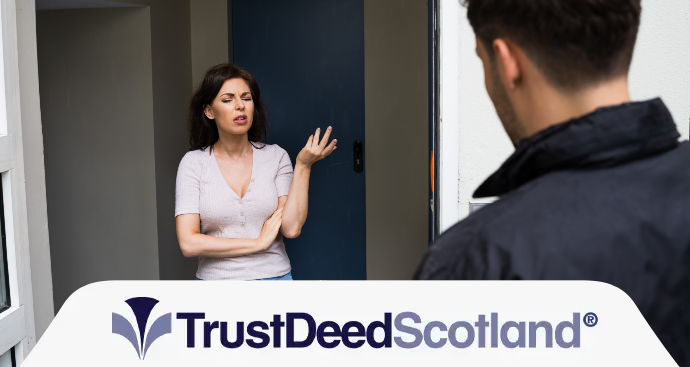
Stopping Sheriff Officers in Scotland – Sheriff Officers typically work on behalf of government bodies, most commonly they are used to collect council tax arrears debt and also on behalf of individual creditors. They are often confused with the rest of the UK equivalent, bailiffs.
Creditors (the people you owe money to) use threats of Sheriff Officers and bailiffs to frighten individuals into repaying debts, most often through further unaffordable borrowing. The terrifying idea of someone taking all your worldly goods is further intensified by well known TV adverts such as Channel 5’s ‘If you don’t pay, we’ll take it away‘.
Stirling Park and Walker Love are two of the most well-known Sheriff Officers and Messenger-at-Arms companies collecting debt in Scotland. If you’ve received a letter or visit from Sheriff Officers about council tax debt, or any other type of personal debt such as defaulted personal loans, don’t panic.
In this article, you’ll find basic help on how to deal with all Sheriff Officers, from Walker Love, Stirling Park sheriff officers or any other.
Trust Deed Scotland will help you find out what to do if they come to your house and how to stop them from taking your belongings.
If you’ve received a letter or visit from Sheriff Officers about council tax debt, or any other type of personal debt such as defaulted personal loans, don’t panic. Sheriff Officers and Messenger-at-Arms are strictly regulated and can only act to the extent that they are allowed to do so, within the Scottish legal system.
To try and force entry into an individual’s property in Scotland, they must have the authority to do so. They would have what is known as an Exceptional Attachment Order.
Only where they have an exceptional attachment order, will they issue it to you before trying to access your property.
Find out what to do if they come to your house and how to stop them from taking your belongings.
What should you do if Sheriff Officers come to your home?
Don’t let Sheriff Officers in when they come to your door. You’re under no obligation to allow a Sheriff Officer in Scotland to enter your home.What can Sheriff Officers in Scotland do?
Sheriff Officers usually only get involved after your local authority or creditor has taken you to court in Scotland. They have the legal power to remove and sell your belongings to pay your debts. If you let Sheriff Officers into your home, they can take:- Money
- Jewellery
- Luxury items such as televisions and game consoles
- Items that you own jointly with someone else
- Vehicles that are owed by you and not covered by hire purchase agreements, or any other outstanding finance.
What if a Sheriff Officer has already taken your goods?
To get your goods back you will have to:- Pay off your debt owed before your goods are sold on by Walker Love, Stirling Park etc
- Buy your goods back yourself
- Come to an agreement with your creditor and request that they ask the Sheriff Officer to return your goods back to yourself
Can Sheriff Officers really take my car?
Just like in the TV programme, ‘If you don’t pay, we’ll take it away’, bailiffs do often take vehicles, as this is the easiest thing for them to seize. The same rules apply in Scotland with Sheriff Officers as it also means that they don’t need access in to your property. They can take your car if it is owned jointly with someone else. If it’s owned independently through a third party, then they will not be able to take it. This will be true if the car is still under a hire purchase agreement. Walker Love Sheriff Officers will also not be able to take your car if you have a blue disabled badge. Nor will any other Sheriff Officer from Stirling Park or anywhere else.What other charges can Sheriff Officers add?
There is the possibility that you will be charged additional fees by Sheriff Officers such as:- The cost of storing your belongings when they’ve been taken
- Any court fees that they have had to pay
- The cost of locksmiths
Making a complaint about Sheriff Officers
If you do believe that a Sheriff Officer has behaved in a manner which brings themselves, their profession or the Court into disrepute, you can still make a complaint. When making a complaint about a Sheriff Officer or a Messenger-at-Arms, you have two options: The first option is to complain to their professional body, which is the Society of Messenger at Arms and Sheriff Officers. The second option, you can also make a complaint to the Court whose authority they were acting upon. In the case of a Sheriff Officer this means the sheriff principal of the local sheriff court. Secondly, in the case of a Messenger-at-Arms, their equivalent is the lord president’s office. In Scotland some creditors employ Sheriff Officers and Messenger-at-Arms as debt collectors. When acting in this lesser capacity of debt collectors, Sheriff Officers have no additional power over those held by other debt collection companies involved in collecting defaulted debts. They are not allowed to remove your property and cannot your arrest wages. They cannot enter your home without your permission. Trust Deed Scotland can give you advice and help on how to set up plans that will put an end to harassment from Sheriff Officers for the long term. Help is available for residents of Scotland and we’re here to get you a fresh start. Find out more about protection from Sheriff Officers and how a Statutory Moratorium (Scotland) may help you by calling us on 0141 221 0999.Trust Deed Specialist Forum

Looking for a Trust Deed Specialist Forum in an online world where advice is offered freely can be overwhelming and often contradictory.
Similar to whenever we feel under the weather, where it’s easy to consult with Google and self-diagnose ourselves with a critical illness, when in fact all we have is a common cold.
The same principle applies to those searching for a Trust Deed Specialist Forum, or any other Debt Advice Forum for that matter.
Unfortunately, it’s all too easy to find yourself in debt and you’re not alone. Often, it’s tempting to bury your head in the sand and hope your problems will go away – but debt isn’t a problem you can just ignore, with interest charges stacking up, the longer you do, the worse your financial situation will get.
For people struggling with debt in Scotland, several debt solutions could allow you to repay what you owe and potentially write off all, or part of your unaffordable debt.
But for true specialist Trust Deed advice, the first step Trust Deed Scotland recommends is to talk to an experienced debt adviser who can talk through all available Scottish debt solutions with you.
One of the options available to residents of Scotland is a legal agreement called a Trust Deed.
What is a Trust Deed?
Many people find themselves with unaffordable debt and do not necessarily know the types of solutions open to them. Therefore, the question of What is a Trust Deed? is fairly common among those in the research phase of their debt help journey. A Scottish Trust Deed is a voluntary legal agreement between you and the companies you owe money to. When you enter into a Trust Deed, your total debts are all grouped together and a Licensed Insolvency Practitioner takes on the role of a trustee. By grouping all of your debts together your trustee will help you to find an amount you can realistically, afford to pay towards your debts. This will become one monthly payment replacing all of your existing payments. Because this amount is based on what you can reasonably afford it is usually significantly lower than your previous combined payments. You’ll make this payment once a month, for 48-60 months depending on circumstances months. At the end of this time, any remaining, qualifying, unsecured debts will be written off. Legally, your creditors can no longer pursue you for the remaining amount. Almost all unsecured debts are eligible to be included in a Trust Deed, such as credit and store cards, unsecured loans including payday loans, overdrafts, old council tax arrears and old utility bills from a previous address, catalogues and old HMRC debts.Advantages of a Trust Deed
- Your debt becomes manageable – You will only make one monthly payment to your Trust Deed rather than several payments to several companies. This monthly amount will be based on what you can realistically afford and is therefore usually, significantly lower. You can agree on a regular date to repay the money you owe, for a time that suits you best – after payday for example.
- No further action – If the majority of your creditors don’t object to the Trust Deed terms it will become ‘protected’ meaning as long as you stick to the agreed terms they can’t legally take actions such as arresting your wages, or bank account to recover money. You can protect your house and car.
- No direct contact from your creditors – The licenced Insolvency Practitioner will take on the role of trustee, who is there to help you to repay your debts.As long as you make the reduced monthly payment, with Protected Trust Deeds your creditors can no longer call you up, email you or contact you directly in any way.
- Your future interest charges can be frozen – After signing a Trust Deed, you’ll be paying back the debt you already owe but not racking up any more debts as you go.
- Debt written off – At the end of your Trust Deed period, any remaining qualifying, unsecured debts will be written off. Legally, your creditors can no longer pursue you for the remaining amount.
Are there any disadvantages to Trust Deeds?
Before considering a Trust Deed, there are some things to be aware of:- You must be able to make the agreed monthly payments towards your debts unless your circumstances change. If they do you need to inform your trustee immediately.
- If you gain any new money or assets such as tax rebates or inheritance during your Trust Deed period your trustee can claim them towards your debts.
- A Trust Deed will negatively impact your credit rating for 6 years from the date you start one, making it more difficult to obtain credit such as a mortgage.
- Usually, you can’t be a director of a limited company. If you are self-employed you may have to appoint a new director or sell your business.
Are there Trust Deed alternatives?
Yes, you can pursue other forms of debt management in Scotland. The Debt Arrangement Scheme also allows to get your payments down to an affordable level and uses formal legislation, the same way a Trust Deed does. When you request Scottish debt help from a reputable firm, they would go through your details and advise you of the pros and cons of all solutions, but more important to you; how they would affect you based on your own circumstances. Always be careful that a company isn’t trying to force you into a solution. If in doubt, it doesn’t hurt to ask around and get advice from multiple firms who are regulated by UK regulatory bodies. It doesn’t harm you to look at the number of specialist Trust Deed forums online, or MoneyHelper – which an independent service set up to help people manage their money.Is a Trust Deed right for me?
If you are thinking of setting up a Trust Deed you should seek advice first, remember you should never pay for this advice, we offer confidential, experienced advice. You should also consider whether you have enough disposable income to afford the monthly repayments. If you’re not sure, it’s something we can help you with. A Trust Deed could be a good option if you:- Have unsecured debts of £5,000 or more
- Have enough income left after paying your bills each month to make a contribution towards your debts
- Have no disposable income to put towards your debts and no assets
- Have debts that don’t exceed £5,000
- Have enough disposable income to pay off your debts before 4 years
How can we help you?
From our feedback, we know people often feel too embarrassed to take that first step and talk about their debt. There’s no need to feel embarrassed and struggle alone. Watch our videos below and see how we can help you.Trust Deed Specialist Forum
At Trust Deed Scotland, we’re the leading Scottish debt advice company in the debt relief category of TrustPilot. We offer non-judgemental and 100% confidential advice to people living in Scotland and struggling with debt. For more than a decade, we’ve helped over [volume] people. Don’t just take our word for it check out our Trustpilot reviews where we currently have a rating of 5/5. Thousands of the people we have helped left us a positive Trust Deed review. If you think you may not qualify for a Trust Deed, we can talk you through the other options available to you. We will always give you advice suited to you, with your best interests at heart. It is our mission to help you get out of debt rather than sell you a solution. If you want to start the journey to a brighter future, or just want a friendly chat and some advice give our experienced team of debt advisers a call. Or, you can try our Trust Deed Wizard tool to find out if you’re eligible. Whilst not a Trust Deed Forum, our Trust Deed Scotland WhatsApp service can be used to quickly find an answer to your question.How a Trust Deed Could Help With Council Tax Arrears

Often, people who come to us looking to improve their financial situation have council tax debt. It is important to address council tax debt as soon as possible because the council can take you to court for payment, place an arrestment on your earnings and even force you to go bankrupt in some cases.
Many people feel overwhelmed and can be nervous dealing with the council or the debt collection companies they pass the debts to.
A Scottish Trust Deed could offer a solution for you if you find yourself in this position as your council tax debt could be included into your Trust Deed along with your other debts. You would then pay one manageable monthly payment, (agreed before the Trust Deed is finalised), which would be split between your creditors.
Once the agreed Trust Deed term has been finalised, all debts included in your plan will be written off.
To see how a Trust Deed could help you, try our Trust Deed Wizard tool.
Your monthly contribution would be determined by looking at your level of debt, your income and expenditure and who your creditors are. There are government guidelines to ensure you have adequate funds to cover your monthly necessities and make your Trust Deed payment each month.
These necessities include: mortgage/rent; council tax; food; gas and electricity; home and life insurance; phone/internet and TV, travel expenses and housekeeping.
Our qualified Scottish debt advisers are available to meet with you, discuss your personal circumstances and see if a Trust Deed would be right for you.
They will also go over all the other debts solution options available to you to allow you to make an informed decision. Setting up the Trust Deed can be done quickly if you provide all information relating to your income, expenditure, creditors and ID at the initial appointment.
If you have been putting off dealing with your council tax debt, then don’t delay any longer as if the council starts bankruptcy proceedings against you, it may be too late to stop the process. Contact Trust Deed Scotland today to give you peace of mind and get your finances back on track.
We understand you may be nervous entering into a debt solution to set your mind at rest, visit our Debt Reviews page for thousands of independently verified reviews written by our happy clients.
Should you use a Credit Card or Personal Loan?

If you’ve been trying to decide whether or not to use a credit card or personal loan for finance there are many things to consider.
Depending on your credit limit and the price of what you are purchasing, you may be surprised to learn a credit card may work out more cost-efficient than a personal loan. Many credit cards come with the perk of an interest-free period. These periods vary in length but the maximum on offer is longer than a 2 year period.
If you are able to clear the debt off within this time you will save money as you won’t be paying the interest on a personal loan and clearing the debt. If you haven’t cleared the debt off within the specified period, depending on you your credit score, you could potentially transfer the remaining balance to another interest-free credit card to finish paying the debt off interest-free.
If you don’t think you would be able to pay the debt back within the interest-free period, you could look for a card with a low-interest rate that would last for the duration of your payments. You could spend less on interest than you would with a personal loan. Check how much you would be spending monthly and see what is best for you.
If you’d like help with your finances, Trust Deed Scotland can provide you with experienced debt advice to help you make the best decision for you.
A Trust Deed is one of several options to get you back on track.
Try the Trust Deed Wizard tool now to find out more, or take five minutes to read our article Is a Trust Deed a good idea?
Depending on what you’re buying and where you’re buying it from, you may not be able to pay by credit card but only by debit or cash. If this is the case, you could get a card that allows money transfers.
This means you could transfer money to your bank account which you can then withdraw or spend by debit card.
Doing it this way will cost extra as there will be a fee but it means you can pay up the card as normal and get access to the funds to pay companies who don’t accept credit cards. Again, check the fees and interest rates and calculate if you would spend less money overall than you would with a personal loan.
See our Debt Advice Reviews for thousands of independently verified reviews showing how we’ve helped customers improve their quality of life.
If you need a substantial amount of money, you may be unable to get a credit card with a high enough limit. In that case, you would need to go down the route of a personal loan. Borrow the smallest amount possible in order to meet your needs and choose the shortest repayment term possible that is affordable for you.
Make sure you take into consideration what your current incomings and outgoings are and don’t overstretch yourself and put yourself in a difficult position.
It’s easy to be tempted into borrowing more and increasing the repayment term, however, you will cost yourself a lot more in interest in the long run.
For example, if you borrowed £8 000 at 9% over 4 years, you would pay £1 555.86 in interest but if you borrowed the same amount over 10 years, you would pay £4,160.87 in interest.
How much is your overdraft costing in fees and charges?
Overdrafts are often overlooked and you could potentially save money every month by considering switching the type of your account or your bank.
Another factor to keep in mind is it may cost you less to borrow slightly more. This doesn’t mean borrow thousands more than you’d planned.
Check the individual loans interest rates and thresholds and you may find borrowing £4500 costs you more overall than borrowing £5000, depending on the interest rates. Surprisingly, some companies charge up to 33% more interest on a lower loan than a higher one, so you would end up spending more overall once the interest had been accounted for.
Make sure to check for hidden costs when considering a personal loan.
You are entitled to pay loans off early but you may be subject to a fee which is usually around two months’ interest. You are also able to make overpayments to your loan without charge, (depending on when you took the loan out if it is pre-existing and how much the overpayments are).
Have you been given conflicting information about the impacts of bad credit?
We’ve dispelled some of the common bad credit myths to enable you to make an informed decision about what step to take next.
Many loans have lock-in fees meaning if you want to switch to a cheaper interest rate, you will be fined for moving. In this case, you will have to determine whether it is cheaper to stay on the higher rate of interest or transfer to a lower rate and pay a penalty.
It may actually be cheaper to stay where you are depending on how much the fee is. Always check what the early repayment fees are before taking out a loan or check the terms and conditions in your paperwork if you have an existing loan.
Finally, remember the interest rates advertised for credit cards and personal loans are representative.
This means, 51% of people who apply will receive these rates. The other 49% will pay extra. The only way to find out what rate you will be offered is to apply and this will affect your credit score so do your research before deciding where to apply.
Worried about unaffordable personal loan debt?
For more information see our Scottish Debt Help FAQs or Contact Trust Deed Scotland. Call us on 0141 221 0999 for tailored Scottish debt advice today.Council Tax Arrears Debts Scotland

Council Tax Arrears Debt – Help In Scotland
Trust Deed Scotland – Inbound Helpline – 01412210999. Council Tax Arrears debts are a priority in Scotland and should be dealt with as quickly as possible to stop the matter from escalating. Scottish councils are able to arrest your earnings and bank account, take you to court for payment and even force you to be sequestrated, (made bankrupt), if your debt level reaches a certain amount. Trust Deeds are one way to get on top of Council Tax Arrears, if you are struggling with multiple debts at the same time, however, the Debt Arrangement Scheme and other alternative solutions exist. All your unaffordable, unsecured debts, including council tax arrears debt, can be added to your Trust Deed and all you need to do is make one manageable monthly payment, (agreed before the Trust Deed is finalised), which will be split between your creditors. Once your agreed term is finished, any remaining balance will be written off. Try the Trust Deed Wizard to find out what you could expect to pay monthly. Your monthly contribution is determined by your debt level, income, expenditure and who you owe money to. There are government guidelines in place to ensure you can cover your necessary living expenses, (including mortgage/rent; council tax; food; gas/electricity; home/life insurance; phone; internet; TV; travel expenses and housekeeping). Only your expendable income goes towards your debts, meaning you don’t have to sacrifice your quality of life in orderto make payments to your creditors. Are you unsure how much overdraft interest fees have been costing you? You could save money by making a few simple changes. Often, council tax arrears are passed to a debt collection company and they will be less accommodating than the council when trying to recover the debt. In the more severe cases, your council tax arrears debt may be passed to a sheriff officer to collect the debt and undertake enforcement action against you. Understandably, you may feel nervous dealing with a debt recovery company or sheriff officer, but under no circumstances should you ignore contact from them as this may result in your situation getting worse. Once the council applies to the court to begin sequestration proceedings against you, it is very difficult, sometimes impossible to stop the process.Council Tax Debt – Trust Deed Scotland
Do you want to get your finances back on track? Here are some simple tips to help you keep more pounds in your pocket. Trust Deed Scotland is regulated by a UK regulatory body and has thousands of 5* ratings on Trust Pilot. View our Trust Deeds Reviews page to see thousands of independently verified reviews written by our happy clients. Many of whom also had debt problems with their Council Tax Arrears debt in Scotland.Council Tax Arrears Debt Scotland – Where to get help?
Our experienced debt advice team can arrange a callback, or meet with you to discuss your personal circumstances. Not only will they review your Council Tax Arrears debt, but they will also go over all the other debts you may have including, credit card debts and the debt solutions available to you to allow you to make an informed decision and choose the option best for you. You will be given a list of information to provide before your appointment e.g. proof of income, expenditure, creditors and. If you have these items ready for the advisor, your case can be moved along as quickly as possible. If you have any questions, see our Debt Advice Scotland FAQs or Contact Trust Deed Scotland today for peace of mind and the support to help you get your finances back on track.Council Tax Arrears Debt Calculator
If you have council tax arrears debt and have other unsecured debts like personal loans and credit cards, which have created an unaffordable debt spiral for you; you can use our handy Trust Deed Wizard® tool. This can be used to calculate how much you could save when you consolidate your council tax arrears debts alongside those other debts including personal loans and credit cards.How Much Are Overdraft Fees Costing You?
If you find yourself relying on your overdraft regularly, you are not alone but it’s important to remember that it is a form of debt and you are being charged overdraft fees for the privilege of using it. Average interest rates increased from £2 per month in 2008 to £12 by 2013 and last year it was reported that banks increased their rates further, some even tripling the previous rate.
If you need help with your finances, Trust Deed Scotland may be able to help. Try the Trust Deed Wizard now to find out more.
There are several steps you can take to see if you could save money on exorbitant overdraft charges:
Set up low balance alerts
Some banks give you the option to receive a free text alert when you are close to going into your overdraft. If you find yourself forgetting to check your balance which results in you going into your overdraft from time to time it may be a good idea to make use of this service to stop you accidentally becoming overdrawn.
See our testimonials for hundreds of independently verified reviews showing how we’ve helped customers get their finances back on track by entering Trust Deeds.
Check if your overdraft is charged monthly or daily
You may only get charged for the days you use your overdraft, so if you had a negative balance for a few days while waiting to be paid, you would only pay a fee for these days. You may, however, be charged monthly. This means that you would be billed at a flat rate for the month, whether you used the overdraft for just a few days or the entire month.
There are simple steps you can take to get your finances straightened out
Move direct debit dates
If you find yourself running short of cash around the same time each month and you have a direct debit due around that time, contact the company and see if you can change the date the direct debit date. This could be the difference between needing to dip into your overdraft or staying in credit.
There is a lot of conflicting information available about your finances. We have dispelled common myths about bad credit to help you make an informed decision.
Change your current account to one with lower interest fees
Look around at the options available to you. Your current bank may offer an account with more attractive overdraft rates or perhaps changing to another bank is your best option. Some accounts have a monthly usage charge but include no or low interest overdrafts in the cost. Depending on how much your overdraft is costing you at the moment and if you use it regularly, you may you save money by going for this type of account.

To find out more see our Scottish Debt Help page or Contact Trust Deed Scotland for more information.
The Dangers of Council Tax Debt
Austerity measures were inevitable after the results of the 2010 election, but voters will be disappointed these are still in place today after a slow economic recovery. Many people fear the Dangers of building up Council Tax Arrears Debt in Scotland.
Personal debt has been a damaging consequence from an unstable and uncertain economy around the globe. Poorer residents have felt that they have been taken advantage of by local authorities, with little leeway for those slipping into debt. This has been difficult to overcome following reduced local government spending.
Things such as Council Tax Reduction have been cut, leaving householders with higher property tax bills among other costly payments.
It’s no wonder personal debt has soared in Scotland and elsewhere. The cost of living never seems to drop in Britain, but funding protecting its citizens unfortunately has.
Thousands rely on the government’s financial support to get by and the economic climate has meant this has been cut quite dramatically. Although this is far from ideal, people can understand that cuts need to be made, but the approach of local authorities has been criticised by many.
UK local governments have been condemned for their aggressive debt collection tactics when attempting to recover people’s debts such as wage arrestments. There are a number of factors in the rise of household debt and increased council tax rates have been detrimental to numerous Scottish residents.
Perhaps most worrying of all is how local authorities are dealing with personal debt in their specific area.
Research from debt charity StepChange revealed that councils are more likely to use enforcement measures instead of offering help. Half of the participants from their survey said they were threatened with bailiffs despite speaking to the council and 62 per cent were threatened with court orders.
A spokesperson for the charity was unimpressed by how local council authorities were conducting themselves in regards to collection of Council Tax Arrears.
“The changing nature of debt problems, where more and more people are struggling to meet their essential living costs, combined with changes to council tax benefits, have conspired to create a debt problem that has grown second only to payday loans.
“Councils need to employ a more consistent, responsible, and proportionate approach to dealing with people in arrears, and not default to aggressive enforcement that often makes a bad situation worse.”
Arguably, the most concerning statistic of them all was that just 13 per cent were encouraged to get debt advice from companies such as us at Trust Deed Scotland.
By keeping your problems bottled up there will only be a negative effect to your finances and overall well-being.
While some councils may not adequately support people who need help the most, our doors are always open at Trust Deed Scotland. By using our Trust Deed Wizard you can quickly control your money troubles and talking to us will help formulate a decisive plan at reducing your debts. Our tailored debt advice service changes people’s lives for the better.
Even if you feel like you’ll be unable to sign up to a Trust Deed, it’s still well worth contacting us. We have several other effective alternatives such as a Debt Arrangement Scheme and Minimal Asset Process which stops harassment from creditors and puts you back in control of your financial situation.
We believe that people in debt should be in command of their finances, rather than fearing about enforcement agents and other intimidating figures.
If you require support then please do not hesitate in contacting a member of our experienced debt advice team today. We have an office in Glasgow so you can visit us in person if this is something that better suits your needs.
Alternatively, you can set up a debt solution using our WhatsApp debt advice service.