Can I get a Trust Deed if I live in England or Abroad?

The Protected Trust Deed and Debt Arrangement Scheme are two formal debt management solutions available to people who are residents of Scotland.

However, you can still enter into a Trust Deed if you live in any other country of the United Kingdom when you have lived in Scotland at any point in the last 12 months.

This isn’t limited to people currently living inside the UK’s borders. Scottish ex-pats living in the EU and anywhere else in the world can still apply for a Trust Deed as long as they’ve lived here in Scotland at any point in the previous 12 months.

This rule differs from the Debt Arrangement Scheme, which unfortunately is not possible unless you are a current resident of Scotland.

Every week, Trust Deed Scotland® deal with similar enquiries from former Scottish residents now living in countries such as Australia and Canada as well as mainland Europe and in most cases, we can help those individuals deal with their debts at home in Scotland.

I’m originally a Scottish resident living in England. Can I do an IVA rather than a Trust Deed?

If you are a former Scottish resident but now living in England then yes you can enter into an Individual Voluntary Arrangement.

We recently wrote about the differences between IVAs and Trust Deeds and should you be in the unique position where you have lived in Scotland in the last 12 months and eligible for both solutions then there are some key difference between the 2.

Arguably the biggest difference is that a Trust Deed has a typical duration of 48 months compared to the IVA which lasts a typical duration of 60 months. For anyone in this position, you may find this to be a significant point of difference to consider but in reality, apart from this significant point – there are more similarities than differences between a Trust Deed and an IVA.

Applying for a Trust Deed in the EU?

While the on-going saga that is Brexit continues to be negotiated, a Trust Deed is unaffected by any situation that may, or may not be created as a result of Brexit negotiations.

The Trust Deed is an answer to your finances back in Scotland and has absolutely no connection with European legislation.

One difference is the new debts that you may accrue in the new country – if you have credit cards, loans or any other type of unsecured debts then these would not be included in your Trust Deed. It may be possible that an equivalent solution exists in the new country. For example in Germany, you may investigate Schuldnerberatung options.

However, even in English speaking countries such as the United States, Trust Deeds have a completely different meaning for example in the US, a Deed of Trust which relates to Real Estate.

If you do have unaffordable debts in the new country, you should seek local, qualified advice.

Will my debts follow me abroad?

Although your credit history in the UK may not follow you when you move abroad, any debts you owe will remain active. It will be difficult for lenders to take legal action against you if you’re living in a new country outside the United Kingdom, but it is not impossible for them to make an attempt to recoup the debt.

Why do I need to pay my debts off in Scotland if I have emigrated?

While it may seem possible to abandon debt in Scotland when you move abroad, apart from a moral responsibility to deal with the debts then arguable the biggest reason to make sure your debts have been dealt with is in the event that you want to return to the country with a decent credit rating.

Furthermore, while mostly an unlikely outcome, your lender may still employ a tracing agency to locate you in your new country. Though as mentioned above, it would be difficult for them to pursue legal action against you in a country where they have no jurisdiction.

More commonly – you just may find that you are unhappy in the new country for whatever reason. Ill health, redundancy and many other changes in your circumstances may bring you back home quicker than you expected.

Some people who move abroad may use a relative’s address as their UK contact address, and while it’s a myth that an address is blacklisted, rather than an individual – without mail redirection, some may find that final demand letters, calls and doorstep visits are a nuisance to their relatives back home, where their address has been used as the last known address.

If you plan on moving back to Scotland, those debts will still apply and might also lead to a decree being issued awhile you were away or your Sequestration. If you have assets here in Scotland, a debt collector or sheriff officer may try to secure a debt against them on behalf of the lender. If you still work for the same company who are based in Scotland, then a wage arrestment can still be applied for.

Creditors may be able to bankrupt you in the new country. Bankruptcy is recognised across borders in most European countries and many other countries across the world are signed up to international agreements where their courts or insolvency services will cooperate.

At the very least, default notices will be served against you which will result in a significant impact on your future creditworthiness.

Applying for a Scottish Trust Deed

The good news is that you can start your application for a Scottish Trust Deed online abroad, anywhere in the world.

If you’re looking for debt advice regarding your debts at home while you’re living abroad, you can contact Trust Deed Scotland and make us aware of your current location and difference in timezone and we’ll arrange a call back to discuss your debts at home. Or, you can call us on +00441412210999 from abroad.

Debt Arrangement Scheme Reviews

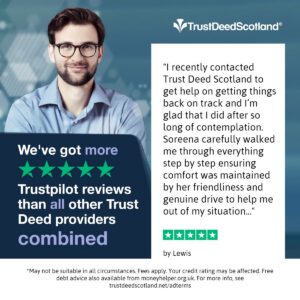
Alongside Trust Deeds, the Debt Arrangement Scheme is a formal debt management solution that takes advantage of Scottish government legislation to offer individuals and businesses a way out of debt in Scotland. Trust Deed Scotland recently reached a milestone of over 10,000 Trustpilot reviews and whilst many of those reviews were for the Protected Trust Deed solution, a growing number of those testimonials are also Debt Arrangement Scheme reviews. The Debt Arrangement Scheme is a formal solution that is superior to an informal Debt Management Plan in many ways, however, we always recommend discussing your circumstances with a qualified money advisor in order to understand your circumstances and provide you with balanced debt advice that is tailored to your personal requirements. You may then weigh up whether or not if a DAS is worth it, in the same way that you may ask yourself Is a Trust Deed right for me?

Debt Arrangement Scheme reviews on Trustpilot

Michael wrote of his DAS Scotland experience: “I watched an advertisement on the television for Trust Deed Scotland® and thought I would go to their website and see if they could help me with debt problems. By filling in a simple form first on the Trust Deed Scotland website I got the ok for contact to be made by phone to talk about all my debt options and how a debt agreement to my creditors can be achieved. The people I have talked to at Trust Deed Scotland® are very good at explaining what the best options in my situation were. Things are progressing ahead now step by step until an agreement is signed by all parties and hopefully take a big weight off my shoulders about my debts .” das reviews Mags, who also entered into the Debt Arrangement Scheme through Trust Deed Scotland® on wrote on Trustpilot: “This company has saved my life. I didn’t know where to turn to. So kind and understanding of my situation and so easy to deal with. Trish was the first person I spoke to and she was great. Reassuring and so friendly. I’m still paying my debts but interest is frozen and I’m paying what I can afford” das reviews John, another client who entered into a DAS Debt Payment Programme wrote: “I cannot thank Peter enough for the help and support he gave throughout this process. Absolute first class.”

How do I apply to join DAS?

If you think that a debt payment programme through DAS might be the best option to help you with your debts, you need to get help from an approved money adviser such as Trust Deed Scotland. You cannot apply for a DAS by yourself. As an approved money advisor, we have been authorised by the Accountant in Bankruptcy (AiB) to apply for debt payment programmes on our client’s behalf through DAS. The first thing that an approved money adviser will do is to look at all your circumstances and help you to decide on the best debt repayment option for you.

Can I take out further credit in a DAS?

You can get up to £2,000 credit whilst you are in a debt payment programme under the terms of the Debt Arrangement Scheme in Scotland, unless you already owe £1,000 on debts which are not included in the Debt Payment Programme. You need to be able to afford the ongoing payments to repay the new credit on top of your agreed DAS payments. If you cannot, your debt payment programme could be revoked. You are also permitted to get credit if one of the following special circumstances applies to you.
  • You need credit because you are responsible for reasonable funeral expenses.
  • You are also allowed to get credit if one of the following special circumstances applies to you.
  • Your DAS Administrator approves your credit and your debt payment programme is varied to help you to repay the extra credit.
  • You need credit for emergency repairs to your home.
  • Your credit was taken out before you joined DAS and was part of a cyclical loan agreement.
  • You incur a trade debt in the ordinary course of business.
You must tell the new creditor if you are in a debt payment programme currently and you get credit due to one of these circumstances. You will be expected to pay this at the agreed contracted rate. Your debt payment programme may be varied to take this into account.

Can I end my DAS early?

Your money adviser can ask creditors to accept less than the full amount of the money that you owed them when you started the debt payment programme. This is called offering a ‘composition’. If all your creditors accept this, it will end your debt payment plan and you will have no more to pay. This option is available to repay your debts early in a DAS to individuals and to sole traders, but it is not available in a business debt payment programme. An offer of composition can only take place after: You have paid 70% of the amount that you owed when the debt payment programme started; and You have made payments for a full 12 years (not including any payment breaks). Your DAS money advisor will record which creditors agree to the offer of composition. If a creditor does not respond to the offer within 21 days, they will be added to those creditors who agree to the composition. If all creditors (including those creditors who do not respond) accept the offer of composition, the money advisor will write to you to confirm that your debt payment plan has ended and they will tell your creditors. But, if all of your creditors do not agree to the offer, your DAS money advisor can still arrange a composition and alter your debt payment plan. They will take account of the agreements received and make a variation. Where a continuing money adviser is handling the administration of your case, they will write to confirm the result of the decision.

Apply to the Debt Arrangement Scheme

There are advantages and disadvantages to the Debt Arrangement Scheme, alongside the other main debt solutions in Scotland and you can get more advice on all solutions open you and apply for the Debt Arrangement Scheme by trying out our DAS Wizard tool. You can also call us on 0141 221 0999.

Can you get a Trust Deed twice?

The advice on whether you can get a Trust Deed twice varies depending on the reason for you asking the question of can you have 2 Trust Deeds. For example, you may have entered a Trust Deed several years ago, completed your Trust Deed term successfully, rebuilt your credit and then have the misfortune to end up with unaffordable debts for the second time in your life. This isn’t unheard of in Scotland, where we’ve had a series of recessions over the last couple of decades, and of course, people can suffer ill-health or changes to their circumstances more than once in their lives. Or, you have entered into a Trust Deed and for whatever reason, it hasn’t worked out for you and you’ve been discharged, then you may be looking at getting a Trust Deed twice for another reason.

Getting a Trust Deed twice when you’ve already successfully completed a previous one

Legally you are able to apply for a Trust Deed twice without any time limit. Your creditors would still vote on the Trust Deed in the same way as they did on the first arrangement. One advantage perhaps if you’ve been through the process already, is that you’ll have a better understanding of how it works, knowing what happens when a Trust Deed completes. There is still a stigma attached to having personal difficulties that may have stopped you seeking help quicker than you did the first time around, and should you reach the point where you need help again, this may be playing on your mind. We’re all now aware of the lifechanging ‘act of god’ that became the Coronavirus pandemic and as the country recovers, many will need to deal with the impact of debt, irrespective of however they may have been handling their finances previously.

Getting a Trust Deed when your last one failed

The other reason for asking if you can get a Trust Deed twice is when you’re in the situation of already being in an existing Trust Deed that has failed or is failing. In this case, you can enter into a second Trust Deed, but you must have been officially discharged from the first Trust Deed before you enter the second arrangement. Your chances of success on the second Trust Deed depend on factors individual to yourself, including the history of repayment during the first Trust Deed, how much debt was written off at the end, and your current level of debt. If a Trust Deed does break down for whatever reason, it’s important for you and your debt expert to understand all the reasons why your Trust Deed failed. If for example, you are unable to afford the contributions set out originally or felt pressurised to enter a Trust Deed rather than Sequestration or DAS, due to a lack of awareness of other options, or due to the perceived stigma attached to bankruptcy. Trust Deed Scotland® have been advising on Scottish residents on the risks and benefits of the Trust Deed and also the advantages and disadvantages of the Debt Arrangement Scheme and any other solution that you may be eligible for. We’re aware of some organisations who may push individuals into a Trust Deed, sometimes by proposing an unrealistic payment plan. This tactic may benefit the organisation but does nothing for the client’s long-term prospects of a brighter future. Formal debt management solutions, whether formal or not, should ultimately have the exact same objective; to help you manage your debts to the best of your ability and to help you move on with your life.

Can I switch from a Trust Deed to another solution?

You can, only if discharged from your Trust Deed, explore other solutions that you feel may benefit your circumstances better at that point such as Minimal Asset Process bankruptcy. Again, it comes down to what suits you best based on your own personal circumstances and the reasons you’re looking to be discharged from the Trust Deed. It may not be easy to get yourself discharged from a Trust Deed depending on your Trustee’s interpretation – ultimately you’ve made a commitment to resolve your debts using a formal solution, which is unlike a utility bill arrangement for example where you simply just cancel one provider and switch to another. It is in both your own and your Trustees interest to find an amicable solution and should you be worried about your ability to repay your debts then you should speak to your current Trustee as soon as possible, and find out what options they are willing to offer you. This is another reason why it’s best to get qualified debt advice from a leading debt company such as Trust Deed Scotland® where we will always work with you to provide you with balanced, expert advice that results in you understanding the solutions being offered to you and how they will impact your financial future.

Where can I get advice on getting a Trust Deed twice?

Trust Deed Scotland® have been advising Scottish residents on the disadvantages and advantages of Trust Deeds since 2009. In that time, we’ve given over [volume] people a route to a brighter future and gathered over [reviews] five star reviews on the independent reviews platform TrustPilot where we’ve become the number one company in the debt relief service category.

Can I include a Bank Overdraft Debt in a Trust Deed?

Yes, you can include a bank overdraft debt in a Trust Deed. In fact, not only can you include a bank overdraft debt in your Trust Deed, but the outstanding balance will automatically be included as one of your creditors. Sometimes clients that we speak to believe that a bank overdraft isn’t a real debt. Perhaps because they service the debt on a regular basis, as their wages and other income go into the account, it may take at least a couple of weeks before it either starts to become partially overdrawn, or more commonly, reaches the authorised overdraft limit. Bank overdraft debts are one of the more common debts types that will be included in a Trust Deed or DAS (Debt Arrangement Scheme), alongside credit card debts, unsecured loans and many others.

Bank overdrafts are an expensive way to borrow

You may consider that the bank overdraft facility is like a financial buffer for you, a very convenient form of borrowing but it’s feasible that the bank can request full payment of the bank overdraft debt at any time ‘upon demand’ And, most crucially for people who are already struggling with their finances, an overdraft can become a very expensive form of borrowing with penalties and high-interest rates. Research from Compare the Meerkat in August 2020 found that almost 33% of us are relying on an overdraft to get us through the Coronavirus pandemic. The average amount owed on their bank overdraft debt is in excess of £500. In June 2019, UK regulators introduced new rules on overdraft lending to help stimulate a fairer, simpler and more transparent overdraft market. In reality, the move to help people who have bank overdraft debts ultimately backfired as the likes of Lloyds, Barclays, Royal Bank of Scotland, HSBC, Halifax, Clydesdale Bank and others hiked-up their interest rates to almost 40% and up to 50% in some cases. However, since these new rules only started during lockdown when they also instructed banks to offer interest-free overdrafts, many customers of banks may not yet realise that the costs for using an arranged overdraft will be even more expensive than using credit cards.

Payment breaks coming to an end

Where people in Scotland are still furloughed, or have been made redundant and are already taking advantage of payment breaks, replaced by tailored support; expenditure may suddenly become overwhelming. If you are in a payment break that is due to end, our advice is to contact your lender(s) and ask what options you have for tailored support. If you have unaffordable debts in addition to your bank overdraft debt then we would also advise you to speak to a qualified money advisor such as Trust Deed Scotland®. In order to apply for a Trust Deed, all unsecured debts must be included and it is normal that if you bank with a provider who is also a lender, then you will need to open a new bank account with a lender whom you do not owe any money to. The good news is that it’s very easy to open a new basic account while in a Trust Deed, with a number of options open to you. Find out more about the best bank accounts for Trust Deeds. If you have a joint account, then you will need to remember that the other party becomes fully responsible for payment of that debt.

Can you get a new bank overdraft when a Trust Deed has ended?

Yes, once you have completed your Trust Deed, you will be free to start rebuilding your credit again and after a period of credit rating rehabilitation, you will be free to apply for a bank overdraft again. It’s true that bank overdrafts can make our day-to-day lives much easier. An unused bank overdraft may seem like the best option in the event of the ‘rainy day’ that may occur. But there is incontrovertible evidence that bank overdraft debts can once again develop due to poor affordability checks, which become self-regulated. No sooner, have you started to encroach your overdraft limit, than other debts such as credit cards, loans and the cost of living itself can sometimes put you in a precarious position.

What’s the difference between an emergency fund and a sinking fund?

For clients of Trust Deed Scotland® who have gone on to enjoy a brighter future, most often they will take the monthly contribution that they had paid into their Trust Deed and instead create a savings accounts that will be used as an emergency fund and a sinking fund. Essentially an emergency fund is what it sounds like. An allowance to cover a sudden emergency such as car repairs, anything that was unexpected. A sinking fund is more a way of budgeting for expenditure that we know will occur. These may be one-time purchases such as a new computer, or phone. A car, or a deposit for a home. Events such as weddings and graduations, or recurring expenses such as car insurance or Christmas. The added benefit of creating a savings account instead of an overdraft is that you will accumulate interest on the amount. Research online and find a savings account that suits your circumstances. While the easy answer may appear to be the account that offers the higher rate of interest, in real terms, these savings accounts are offered with penalties for early withdrawal etc, so always do your homework on them before committing.

Help with bank overdraft debt in Scotland

If you’re worried about bank overdraft debt in Scotland, or indeed any other type of debt – you can contact Trust Deed Scotland today for qualified advice. We offer expert debt help in Scotland and have helped over [volume] people in Scotland since 2009. Thousands of people have left debt advice reviews where our clients tell us in their own words that our advisors are friendly, non-judgemental and that our advisors were able to find a solution to their debt problems quickly and efficiently.

What is MAP Sequestration?

The MAP Sequestration is more formerly known as Minimal Asset Process and it is a form of sequestration in Scotland. Sequestration is the Scottish term for bankruptcy. The MAP solution was introduced in 2015 and was previously known as the Low Income, Low Asset bankruptcy which essentially describes it’s qualification criteria. The MAP is the nearest Scottish equivalent to a Debt Relief Order. The other type of Sequestration in Scotland is known as Full Administration Sequestration. Bankruptcy has always carried a greater stigma to it, not just here in Scotland but through the world. However, there really needn’t be as many more people struggle with their finances and require its use to get control of their finances again, working towards a brighter journey.

Benefits of the Minimal Asset Process

  • Most unsecured debts are included in MAP Sequestration
  • You can apply for MAP when you have a total debt level of £25,000.
  • Although MAP Sequestration is a formal legal process, you won’t need to appear in court
  • You’ll usually be discharged from your MAP Sequestration after six months, after which most debts will be legally written off
  • Once your MAP Sequestration is approved your creditors can’t chase you for payment or add more interest and charges to your debts, and they can’t take any court action

Risks of the Minimal Asset Process

  • Your credit rating will be affected for six years from the day your MAP Sequestration begins
  • Your bank is likely to close or freeze your accounts and you may only be able to get a basic bank account
  • Sequestration can impact some jobs or may lead to termination of employment
  • Some private landlords may evict tenants or not renew a tenancy agreement if you become Sequestrated*
  • Some debts, such as student loans, court fines ad child-maintenance are not included
  • If you are self-employed, Sequestration could make it harder to trade and obtain credit for goods and services

How has Coronavirus affected Minimal Asset Process Sequestration?

Following the coronavirus (COVID-19) pandemic, new legislation was brought in to change some of the MAP Sequestration eligibility criteria. The Coronavirus (Scotland) (No. 2) Act 2020 has made some changes which, while small in number, are significant. These are: The financial threshold of maximum debts owed has been increased from £17,000 to £25,000 The application fee to apply for Minimal Asset Process has been reduced to £50 and some fees has been waived for those on certain benefits * The Coronavirus (Scotland) Act 2020 protects tenants in Scotland from any eviction action for up to 6 months.

Where to get MAP Sequestration advice

Many companies that advertise on Google and social media concentrate purely on Trust Deeds as opposed to alternative Scottish debt help solutions including MAP sequestration and the Debt Arrangement Scheme for arguably self-motivated interests. This may seem like it’s more difficult to get qualified advice and assistance in applying for MAP Sequestration. At Trust Deed Scotland® we’ve always aimed to offered Debt Help in Scotland that is transparent, balanced and we’ve always put our clients at the forefront of the decision-making process. As such, we have our client’s best interest at heart. If you want to discuss your options, you can always find non-judgemental, confidential advice from us. Contact Trust Deed Scotland® today on 0141 221 0999. You can also get free MAP sequestration advice from organisations such as Money Advice Service, an independent service set up to help people manage their money.

Minimal Asset Process alternatives

When considering which option is best to help you manage your financial difficulties, you may also qualify for a Trust Deed, or you may be outwith the MAP Sequestration qualification criteria and therefore more likely need to apply for Full Administration Sequestration. There may also the option to apply for the Debt Arrangement Scheme as your best way forward. If you have reviewed your options for clearing debt in Scotland and found that the only solution that can help you is in fact MAP Sequestration, then don’t be put off this applying for this solution as they exist to help people with the severest of debt in Scotland. In the years 2018-2019 and 2019-2020, just over 3,800 Scottish individuals were declared bankrupt each year. Of this figure, just over 2,000 were awarded Minimal Asset Process bankruptcy. You are not alone. In 2018-19 there were 7,915 registered Protected Trust Deeds and this rose to 8,743 in 2019-20. Likewise, in 2018-19 there were 2,636 Debt Payment Programme applications received under the Debt Arrangement Scheme and 3,495 DAS Applications in 2019-20. When weighing up your options, it may be possible to be coerced into considering one solution over another. That coercion may come from an unqualified debt advisor, or within your own social circles – or hearsay within forums and groups. However, although mostly well-meaning, the truth is that you should always first seek expert money advice from a qualified money advisor, and that way you will receive tailored advice that suits your own circumstances. Call 0141 221 0999 today if you want to find out more about the advantages and disadvantages of MAP bankruptcy and alternatives.

What option for paying off debt is best for me?

The best option for paying off debt that is right for you will invariably always depend on your personal circumstances. We have a free Scottish debt help guide that can be used to work out the differences between each solution and how they may be advantageous for you, plus the disadvantages of each too. It’s always our recommendation to seek advice from an experienced debt adviser, as they will give you the most informed view of which options are best for paying off debt in Scotland. You may recognise any of these 10 traits in yourself when you have unaffordable debts in Scotland, but that alone doesn’t automatically mean you’re in need of a formal solution for your debts.
  1. Paying non-priority bills like credit cards instead of priority bills such as your mortgage or rent.
  2. Borrowing money from family and friends.
  3. Using payday loans to keep yourself rolling over.
  4. Dreading receiving new bills because you know you can’t pay them.
  5. Running out of money within days of being paid.
  6. Your credit and debit card are declined at the shop till.
  7. Using your bank overdraft to get by month to month.
  8. Making minimum payments every month to your credit cards.
  9. Avoiding phone calls and visitors to your doorstep for fear of it being a debt collector.
  10. Pretending everything is ok when it’s not.

Where you can get help today

You can and should seek help from a qualified money advisor as soon as you possibly can. Trust Deed Scotland® can be reached between 9 am and 8.00 pm by calling 0141 221 0999 or you can use an alternative method to contact Trust Deed Scotland. If you owe money to your creditors and you’re starting to receive demands for payment through the post, or by telephone – try and stay calm. The letters are deliberately worded to cause urgency, fear or alarm, so much so that the UK government ordered new debt letter rules to make the letters less intimidating and reduce distress. If you are considering an option for paying off debt that feels rushed, as a result of a creditor pushing you into it – make sure that this isn’t the only motivation for applying for the solution. A good debt advisor will always give you transparent, balanced advice and leave the decision in your hands, at your own pace. If you’re not quite ready to proceed, you can apply for a Statutory Moratorium to give yourself breathing space of up to 6 months from your creditors.

Trust Deeds

An option for paying off debt in Scotland is a Protected Trust Deed. Learn more about what are Trust Deeds and how Trust Deeds work. As a formal, legislated solution, the Trust Deed helps thousands of people make a fresh start every year in Scotland. A Trust Deed typically lasts for 4 years in Scotland and can be used to manage unsecured debts such as credit cards and loans. Once in place, interest and charges are frozen, creditor contact will be reduced from payment demands to mostly administrative notifications such as statements – all of which will be managed by your Trustee. When you evaluate whether or not you feel that a Trust Deed is a good idea or not you for – consider all pros and cons and how they affect you on a personal level. It’s important to seek advice from a qualified money advisor such as Trust Deed Scotland® where you will receive tailored debt advice based on your circumstances.

Debt Arrangement Scheme

Repaying debts under the terms of the Debt Arrangement Scheme is a solution that is growing in popularity. Figures based on official 2018-2019 to 2019-2020 data show an annual increase of 23% for people using DAS to clear their debts and that’s before taking into account figures that are likely to be inflated due to the Coronavirus pandemic and its financial impact on households. When you apply for a Debt Payment Programme in Scotland and it becomes approved, like a Trust Deed any interest and charges will be frozen. Depending on how much debt you have and how much you pay, the length of time to repay may be quicker, or longer than that of the Protected Trust Deed. Regardlessly, you will have a fixed end date in mind, which may then be shortened depending on your affordability and whether your personal circumstances were to change in a positive way. Learn more about what is a DAS and the advantages and disadvantages of the Debt Arrangement Scheme as a potential option for paying off debt for you.

Minimal Asset Process vs Full Administration Bankruptcy

The Sequestration (Scottish bankruptcy) method is another option for paying off debt in Scotland. It’s possible that a creditor can petition for your bankruptcy and remove the decision from your hands, if this is a concern for you – give us a call on 0141 221 0999. Sequestration or Bankruptcy in Scotland arguably carries the greatest stigma, yet while it may be considered as a last resort for many, the reality is that it can be the most effective way of clearing your unaffordable debts and moving forward in life. The sequestration process is effectively divided into two categories – Minimal Asset Process and Full Administration Bankruptcy. There are setup fees usually for these two products, however, recent legislation changes to MAP Sequestration mean it is now free to apply for. With Full Administration Sequestration, those fees have reduced these fees to a lesser amount of £150, depending on the individual’s income. If you are in receipt of certain benefits, the Sequestration too may be processed for free.

An alternative option for paying off debt in Scotland?

There are other alternatives that can be viable options for paying off debt in Scotland including an informal Debt Management Plan, or a Debt Consolidation Loan. You can find out more about the differences between a Debt Management Plan vs. Debt Arrangement Scheme but essentially the main difference between one and the other, is that the DMP is informal and the DAS is formal. Debt consolidation is perhaps the most commonly known overarching term for all debt solutions available in Scotland. This can help create a view that the only way to manage debt is to borrow more money in the shape of a larger amount of money and then consolidate those debts down to one, either by using a credit card or a loan. However, while there are benefits to doing so, the reality is that finding funds at a favourable rate is less likely. More often than not, with a poor credit rating and a history of defaults – the only loans that may be made available to you are a secured loan against your property or a guarantor loan using someone else to repay the debt on your behalf. We tend to advise against both of these solutions, but given the right circumstances, you may feel different, or they may work for you. Call us on 0141 221 0999 to find out more about how we can help you consolidate your debts. Find out more about the differences between an unsecured loan and a secured loan.

Will Trust Deed Scotland® be able to help me?

When you seek help with your debts it can be a worrying time. It is a big step, one which Trust Deed Scotland® fully understands and undoubtedly, people may be worried about doing so. You may worry about the reaction you will get from a stranger, and you may fear that the people you are speaking to will be shocked, will disapprove or judge you. On top of that, there is a stigma surrounding the debt advice process itself. What does it involve and what do all these abbreviations all mean? Debt advisors should never be judgemental and should always advise you on what’s in your best interests, not their own. If you feel they are pushing you into a solution without properly explaining it, seek qualified debt advice elsewhere. You should NEVER pay to receive debt advice, and no solution should have upfront setup fees; other than those required directly for Sequestration, should you not be exempt from paying the £150 application fee for this. Trust Deed Scotland® feels proud of our debt advice reviews as they indicate how our customer feel about our service in their own words. With over [reviews] reviews on Trustpilot, we’re rated excellent in their Debt Relief category, and with more five-star reviews than anyone else – we’re the No.1 rated in the category as well. Call us on 0141 221 0999, or try our Trust Deed Wizard® tool to get started.

Are Credit Cards included in Scottish Trust Deeds?

All types of unsecured debts are required to be included within a Scottish Trust Deed and credit cards are the most common type of debt that is included in Trust Deeds and alternatives such as the Debt Arrangement Scheme.

What are Credit Cards?

Credit cards and store cards are both used to purchase goods and services on credit in the same way that a catalogue accrues a debt, or a personal loan, bank overdraft and so on. A debit card is different to a credit card as it relies on finds being active in an account. Credit cards may be issued by your bank or building society, or other financial services provider. A credit facility may be provided by a high street store for example, more commonly referred to a store card.

Are Credit Cards a problem?

We’re a nation of credit card enthusiasts. The Money Charity reported in July 2020 that the average credit card debt per UK household was £2,238 in January 2020. Credit cards are convenient and handy. They’re useful for travelling and in some cases, they do offer greater protection for purchases and reclaiming where a transaction has resulted in a poor buying experience. Chargebacks themselves are really useful. A chargeback is a refund prompted by your card issuer. If you paid for a product or service with a credit card, you can dispute it through the card issuer and let them take the dispute to the merchant. If the issuer succeeds where you failed, the purchase price is refunded to the credit card you charged it on. However, as credit cards become more readily available, and the numbers of people relying on them continue to grow, defaults are becoming more common. Store cards carry with them a different level of threat. The store card may seem like its a loyalty card, being used to open with an immediate discount. However, with little room for competitive rates, the interest rates are often unfavourable, to begin with, and comes with the added temptation in the form of buying there and then, in the store.

How to manage Credit Card debt?

If you have a temporary payment problem, contact the card issuer to discuss this. They may offer some short-term flexibility and with payment breaks being replaced with ‘tailored’ solutions as a result of Coronavirus recommendations made by UK regulators. If you haven’t defaulted on your credit cards and have a great credit rating, you can shop around for other credit cards which allow interest-free balance transfers. Caution should be used when examining the small print. Credit card lending is done based on risk. The more of a risk you are, the worse the interest rate you are likely to achieve as a result. Will you be able to afford new lending terms over the longer term. However, if like many thousands of other households in Scotland, your money issues are more serious, it’s best to get expert debt advice. A qualified money adviser can take a look at your situation, advise you of the options and allow you to make a balanced decision. Solutions for credit card debts in Scotland may include the Scottish Trust Deed, Debt Arrangement Scheme or Sequestration.

What is a Scottish Trust Deed?

The Scottish Trust Deed is more formerly known as a Protected Trust Deed and is used to consolidate debts over a typical period of 48 months. It’s a government legislated debt solution that allows an individual to freeze interest and charges, pay back a more reasonable amount to their debts and protect assets such as a home or car. There are disadvantages too such as an impact on your credit rating. When you have unaffordable debts such as credit card debts, the Scottish Trust Deed solution may work for you.

Alternatives to a Scottish Trust Deed?

The Debt Arrangement Scheme is a solution that also allows you to legally freeze interest and charges, stop creditor harassment over non-payment and gives you a fixed time frame for when you will be able to repay the debt. When evaluating your options – we recommend speaking to a qualified money advisor and that will allow you to receive tailored advice depending on your circumstances. In addition to the Scottish Trust Deed or DAS, you may consider Bankruptcy as a way of managing your debts. Sequestration and Minimal Asset Process are the two forms of bankruptcy that are used in Scotland, and while they may carry the severest of impacts to a credit rating and come with a natural stigma attached to them – They are an effective way of clearing debt.

Help with Credit Card debts in Scotland

We’ve helped over [volume] people in Scotland, became the No.1 rated with more Trustpilot debt advice reviews than anyone else in Scotland. Every week, our experienced debt team give hundreds of people non-judgemental and confidential advice. Call us on 0141 221 0999 or learn more about Trust Deed Scotland today.

Debt and Mental Health

Debt and mental health are strongly linked. Over 25% of Scots experience a mental health issue in any given year. That’s not including the added impact caused by Coronavirus in recent times. Mental health issues cover a range of experiences, including anxiety and depression, schizophrenia, phobias, as well as many other conditions. Experiences of mental health conditions can also change over time, and sometimes even from day-to-day. Mental health issues, like physical illnesses, vary greatly from person to person. Mental health issues can be for short periods of time or last much longer. Experiencing a mental health issue does not automatically mean that you are unable to manage your money or deal with your debts, but it can make it more difficult. Research shows that half of adults in Scotland who are struggling with severe money issues, also have a mental health issue. Having unaffordable debt can be stressful and we can help you can help deal with your creditors. Both debt and mental health issues have increased recently during Coronavirus times and this is expected to increase over the winter months. In the early months of the outbreak, we wrote an article that spoke about maintaining a positive attitude during the outbreak. Many of the customers have we help often say that they feel like a weight has been lifted, that they can sleep at night again. Debt and mental health issues go hand in hand, however, these reviews received in October 2020 encapsulate the thoughts that our customers have on this subject. Whether you have a short term debt and mental issue causing you to stress, or you need longer-term help – many of the stories spoke about by our customers are used to reassure others that they are in safe hands with us. That we’ll always have their best interests at heart. But don’t just take our word for it…Find thousands of similar Trust Deed reviews. written by customers in their own words. Jemma wrote a review saying : “I think I speak for everybody when I say debt isn’t a nice feeling to have over you, especially when it’s not your fault. The worry and stress and pressure of most to pay it back at high demand from creditors. My situation just became too much that I needed a way out, and I had to stop being stubborn and ask for help. When I came about Trust Deed Scotland, I was cautious at first but that soon changed from a very kind and helpful gentleman called Joe. Right from the beginning this guy has been amazing and answered all the questions I needed and basically held my hand and took me through the steps. Always at the other end of the phone if I needed, and also I got invited to the main office to meet face to face so I could be more reassured that it was all legit and see it. Office is lovely by the way. The process isn’t long, at moments it did feel long as I still had the pressure of creditors calling and emailing but I just got told to hold off, and I think COVID slowed down the process from normal but I felt at ease through it all thanks to Joe. Now my paperwork is complete, I now know in 48 payments I’ll have paid a huge chunk off my debt paid which is fantastic and now I can pick myself back up and start going again, as life is really too short to feel this way!” Stewart also added a review: “Although being in debt is very stressful and embarrassing, Trust Deed Scotland has been great. Vicki in particular has been fantastic at helping me sort out my debts. Thank you. It’s the best thing I’ve done and the company have been a godsend as they’ve helped relieve the massive stress I was feeling. If you are struggling with debt then don’t hesitate to give them a call.” Maria added of her experience: “I cannot recommend Trust Deed Scotland highly enough. In particular, Trish, who supported me through every step of the process, with loads of patience and knowledge. This was a stress-free and extremely quick process, with Trish keeping me posted and up to date throughout it all. I feel as though a huge weight has been lifted off my shoulders. Trish provided me with a first-class service and was extremely professional, without making me feel anxious or embarrassed by my financial situation at any time. 10/10.”

Debt and Mental Health Help

If you’re struggling with debt and mental health issues combined, you’re not alone Our experienced team are on hand to listen and to help you to take the first step and deal with your unaffordable debt. Tailored advice: Helping you make an informed decision with non-judgemental, friendly and confidential advice. Trust Deed & Debt Arrangement Scheme Specialists: Professional, experienced and trusted advice on all Scottish debt solutions. Over [reviews] Trustpilot Trust Deed reviews. from customers who we’ve helped setup with a Trust Deed or DAS. All formal debt solutions offered: You can choose the best solution for you and your circumstances. Experienced debt advisers: Our team have helped thousands of people across Scotland write off their debt and reduce their payments down to a more manageable level.

Have Payment Breaks Ended?

Payment breaks offered by lenders have now ended under the existing measures and from November 2020 onwards are being replaced by ‘Tailored Support’ Note – if your income has been affected as a result of being furloughed or made redundant and you are in financial difficulties with several creditors, you can also explore a Statutory Moratorium as a way of gaining breathing space for yourself while you consider your longer term options.

Payment Breaks replaced by Tailored Support

You’ll be eligible for ‘Tailored Support’ measures in Scotland if you fall into one of these two categories:
  • Your first or second payment holiday expires after 31 October and you can’t resume your normal repayments. Once the existing payment holiday expires under the old scheme, you’ll move on to the Tailored Support schemes.
  • You experience payment difficulties after 31 October. This applies whether or not you’ve already previously used payment holidays in the past, or if you now find yourself in payment difficulties for the first time.

Does Tailored Support affect my credit rating?

Yes. Tailored Support from a lender, whether that’s reduced payments, a further payment break, or a repayment plan will be recorded as normal on your credit report (see how to check your credit reports for free) and could therefore affect your chances of getting credit in future. It had been agreed previously that payment breaks would not have a detrimental impact on an individuals credit rating.

Mortgage Tailored Support guidance in Scotland

If you’ve already taken 6 months of payment holidays on your mortgage, then you’ll be moved on to ‘tailored support’. However, what that means to you will depend on your unique financial circumstances. How settled your finances are will also have an impact. You will need to check with your lender directly, The following are some of the financial difficulties measures you may be offered, though lenders are free to offer other solutions if something else works better for your particular circumstances:
  • A change to your mortgage type. You could be switched to an interest-only mortgage or changed to a product with a higher interest rate.
  • An extension to your mortgage term. This is essentially like a remortgage and means you’ll pay less each month, however, you are then borrowing over a longer period, you’ll pay more long term as a result.
  • A period of reduced payments. If you can pay something towards your mortgage, but can’t make the full contractual repayment, your lender may agree to you making reduced payments. Again, this measure is likely to be for the short-term only.
  • A payment deferral. This is likely to be a short-term measure only and may be offered if your circumstances are still changing, and you’re not able to commit to a longer-term measure such as changing your mortgage type or length.

Credit Card Debts – Unsecured Tailored Support guidance in Scotland

There are an estimated 100,000 people across Britain with at least one credit card currently held on payment breaks under the previous system. Credit card debts and other unsecured debts are covered under the tailored support system. However, the outcome will depend on your own circumstances. You may be offered one or more of the following solutions.
  • Short term payment deferral
  • Short term reduced payments
  • Frozen/waived interest
  • Repayment plan
  • Consolidation loan from the same lender
Special rules apply for debts such as an overdraft debt where interest may be frozen, waived – or transferred to another product from the same lender such as a personal loan or credit card. If you have a car finance agreement, you can also apply for tailored support from your lender.

Help with debts in Scotland

Trust Deed Scotland® understands that for many people with unaffordable debts in Scotland, making contact with creditors is a difficult task. Especially when those debts have already been passed to a debt collection agency. Where possible, you should attempt to make contact with your creditors, however, if you feel that you cannot manage this and need help with your debts in Scotland then we recommend that you make contact with a qualified money advisor. Our friendly, non-judgemental Scottish debt help team have been helping people with unaffordable debts most recently throughout the Covid pandemic and longer-term since 2009. We’ve advised thousands of people from all over Scotland and many left a debt help review describing how they found their debt help journey with us. With over [reviews] Trustpilot reviews, we’re the No.1 rated in Scotland on TrustPilot. If you need help with debts in Scotland now, call us on 01412210999 or get started by using our Trust Deed Wizard® tool.

Talk Money Week 2020

Trust Deed Scotland® urges people to open up about personal finances in support of Talk Money Week • Talk Money Week 2020 (9-13 November) encourages people to have more open conversations about their money and pensions • Talking about money more important than ever amid ongoing financial impact of Covid-19 • To get more people talking money Trust Deed Scotland® will be running awareness activity across social media during Talk Money Week. Trust Deed Scotland® has announced it is taking part in Talk Money Week, an annual awareness campaign run by the Money and Pensions Service to encourage everyone to open up about their money and pensions. Also see Talk Money Week 2021.

When is Talk Money Week in Scotland?

Held from 9th to the 13th November, Talk Money Week aims to reduce the stigma around money by encouraging conversations among families, friends, neighbours, customers, colleagues and communities. Talking openly about money can have a huge impact on managing money worries, and is important for our overall health and relationships. The impact of Covid-19 has made it more important than ever to start conversations about money to look after our financial wellbeing. Talk Money Week is also an annual opportunity to celebrate the work organisations are doing to support the UK Strategy for Financial Wellbeing, launched by MaPS in January 2020, which has ambitious ten-year goals to help everyone make the most of their money and pensions. Throughout the week there will be activity in Scotland to get more people talking about personal finance issues, and engaging with topics such as saving regularly, planning for retirement, dealing with debt, and teaching children and young people about managing money. As part of the week, Trust Deed Scotland® will be running awareness activity across social media during Talk Money Week.

Trust Deed Scotland® commented:

“We encourage our clients to openly talk about their debts where possible. Even by sharing their experience with other clients on Trustpilot where other people with unaffordable debts can learn about their experiences in their own words. Debt is still a great taboo and the stigma attached to have debt problems means many people attempt to struggle on alone. We’d like to remind anyone who has a debt problem that they are not alone. We’re here for them. Our team of friendly, non-judgemental advisors can help individuals take steps to improve their lives for the better.” Stephanie wrote recently about her experience with Trust Deed Scotland® “Massive weight off our shoulders. We had built up alot of debt and maxed out our credit cards. We were paying an extortionate amount every month and couldn’t keep our heads above water. I was nervous about calling but I’m so glad I did. Spoke to a lovely lady called Danielle who made me feel so at ease. She managed to sort us out on a 48 month payment plan and got a lot of our debt written off so we’re now paying less than half than we were and even managed to protect our car payments and keep our car. It’s great to finally feel like we’re not fighting a losing battle and in a few short years, we will be debt free and have a fresh start. Wish we had done it sooner.” For more information on Talk Money Week visit www.maps.org.uk/talk-money-week/

Help from Trust Deed Scotland®

Let’s talk about debt today. Contact Trust Deed Scotland® on 0141 221 0999 or browse through our Scottish Debt Solutions. With our experience of having helped over [volume] people in Scotland and by becoming the No.1 rated debt company in Scotland with over [reviews] five star reviews, our team has helped people from all walks of life. Our advice team are:
  • Friendly
  • Non-Judgemental
  • Empathetic
  • Experienced

Talk Money Week 2020 Talk Money Week 2021 Talk Money Week 2022 Talk Money Week 2023 Talk Money Week 2024