New Year, New You Managing Your Debt

New Year’s Resolutions and Managing Your Debts – As recently as January 2020, many people had been showing their results of a ‘ten year challenge’ on social media platforms to mark the beginning of the new decade. The average household in Scotland owes over £15,000 on unsecured debts such as credit card debts, bank overdrafts and unsecured loans. Add in years of austerity, wage stagnation and the rising cost of borrowing, it’s little wonder that many people with financial difficulties over that same period have declined the opportunity to join in on this challenge.

Christmas Debt Hangover?

The average person in Scotland spends over £1,000 a year on Christmas and a sizeable amount of that has gone on gifts. Without assistance, it is easy to imagine that by the next time the 10-year challenge comes around, many people in financial difficulties may not be in a better position. This is also the time of year for new year’s resolutions to be made. Lose weight and join a gym, get a new job, book your dream holiday amongst others. And, many people may be contemplating managing their debt as their New Year’s resolution. While it’s true that quitting smoking, drinking and eating fewer takeaways will reduce your outgoings considerably, this alone may not be enough to impact your overall debt total.

New Year, Old Debts?

Many debt-help guides talk about being able to switch credit cards, consolidate debts with loans and advise ways of saving money through lifestyle changes. All great suggestions of course, which will help many families in Scotland but for those people at the severest end of the credit ratings spectrum, some of these solutions are unavailable or ineffective. Credit card providers including Royal Bank of Scotland, TSB and Barclays had been instructed in 2018 by a UK regulatory body to tackle what they describe as ‘persistent credit card debt’ in a period of 18 months and this means that those credit card lenders will be forced to close and suspend accounts that have been making minimum payments to their credit card balance over that same period. These changes are likely to most impact those with the most overall debts more than any other typical borrower.

What Is Blue Monday?

Look out for your loved ones in the run up to January 18 2021, described as Blue Monday. Blue Monday is a term used to describe the most depressing day of the year, the third Monday of January every year and is calculated using a formula using multiple factors. This includes our typical miserable Scottish weather conditions and our lack of daylight. The difference between debt accumulated and our ability to repay. The time since Christmas and the time since failing our new year’s resolutions. Low motivational levels and feeling of a need to take action. This is the time most people with financial difficulties are likely to feel their Christmas debt hangover the most. Learn more in our article Together we can beat Blue Monday.

New Year, New You!

If you have decided that next year is going to be the year that you get back in control of your finances, regardless of your debt amount, our experts can work with you to provide solutions that suit your circumstances. Perhaps, you want to ensure that by the next time a ten year challenge comes around, you’re able to join in and add a positive experience. Our experienced debt advisers provide Scottish debt help and their advice has helped give debt help in Scotland since 2009. All advice offered is completely non-judgemental and confidential. Why not give us a call today and find out how we can help? For a confidential debt consultation with a team member, get in touch today on 0141 221 0999 or try our Trust Deed Wizard to find out if you qualify for debt repayment solutions in just 60 seconds.

Trust Deed Scotland is now the Most Trusted Debt Advisor on Trustpilot

Trust Deed Scotland is now the Most Trusted Debt Advisor on Trustpilot

Nobody likes thinking about financial issues. If you haven’t sought out the right debt advice service you’ll probably have a knot in your stomach at the thought of your balance sheets. Fortunately, as thousands of our clients have found out, it doesn’t have to be this way.

With Trust Deed Scotland, the no.1 rated Scottish debt help team hitting a TrustScore of 5/5, we’re confident that we have the best possible service for people in Scotland struggling with their debt.

Trustpilot is a review driven community where consumers can collect reviews, letting other people know what they think of services they’ve used. It’s like the Yellow Pages where companies are ranked based on how trustworthy they have been found to be.

Consumers are asked to give a star-based rating from 1-5, and to “share your honest experience, and help others make better choices.” This score is averaged out and multiplied by two to give a company’s ‘TrustScore’.

With this in mind, we’re proud to announce that our Trustscore has hit a record high of 5/5.

The good news doesn’t end there though – we’re also incredibly honoured to be ranked 1st out of 30 companies in the Trustpilot’s Debt Relief category. We’re also 2rd in the Money category, where this category is incredibly broad, covering everything from accountants and banks to mortgage brokers and money transfer companies.

Unsurprisingly, the two companies which are beating us are in completely different financial sectors, separate from both from us and one another. This in turn makes us the most trusted debt advisory service on Trustpilot, based on client feedback.

We would like to thank the hundreds of people who took the time to rate us on Trustpilot, leaving overwhelmingly positive testimonials left on this site for other consumers to see. If you’ve used our services, your feedback would be greatly appreciated.

Here at Trust Deed Scotland, we help thousands of people get out of debt every year, and we honestly believe that getting out of debt should be a positive experience. As you can see from the reviews we’ve been left below, our customers have found just that. If you have any questions about our services, read the debt advice reviews and then make sure to call us today on 0141 221 0999.


4 Things Brexit Could Mean For Scotland

what the Brexit means to Scotland Most people in Scotland didn’t want it, but it’s happening: the UK has voted to leave the European Union. Take a look at 4 things this truly seismic result could mean for Scotland.

1. Another independence referendum

First minister Nicola Sturgeon has, in the past, come close to suggesting a second independence referendum should Britain vote for Brexit. This week, Sturgeon will meet European Commission president Jean-Claude Juncker in Brussels to discuss the outcome of the referendum. It’s thought Sturgeon will stress to Juncker that Scotland wants to remain inside the EU, potentially as an independent country. It’s been reported that Sturgeon is gearing up for a second vote, should Westminster approve it.

2. A complete block on leaving

It’s also been suggested that the Scottish parliament could completely block the legislation necessary for the UK to part from the EU. Sturgeon has said: “If the Scottish parliament is judging this on the basis of what’s right for Scotland, then the option of saying we’re not going to vote for something that’s against Scotland’s interests, that’s got to be on the table. You’re not going to vote for something that is not in Scotland’s interests.” With 62% of people in Scotland backing Remain and only 38% backing Leave, Sturgeon could argue that she has the will of the people on her side. However, it’s unclear whether the Scottish parliament really does have the necessary authority to veto Brexit.

3. Dual citizenship?

Some people are thinking of taking dual citizenship with Ireland, which has been an EU member since the 1970s. Theoretically, if there is a second independence referendum, dual citizenship could be an option in Scotland too. The Scottish government has said that:
  • British citizens born in Scotland would be automatic citizens of Scotland.
  • British citizens “habitually resident” in Scotland at the time of independence will also be automatically considered.

4. More support for business

Scotland is well-known for its emerging industries – gaming, new energy and life sciences, to name just a few. In the wake of Brexit, the government has moved to reassure businesses they have a bright future. Cabinet secretary Keith Brown has said: “I have been engaging extensively with the business community in Scotland over recent days to emphasise that, as of now we are still firmly in the EU. Trade and business should continue as normal and we are determined that Scotland will continue now and in the future to be an attractive and a stable place to do business.” What are your thoughts on the implications of Brexit for Scotland? Let us know. Thinking of taking out a Scottish Protected Trust Deed? Read our Scottish debt solutions FAQ guide and get top tips and financial insight on our info hub.

Aberdeenshire Property Affordability

Worried about Aberdeenshire Property Affordability?   After a brief hiccup in house prices after Brexit, confidence has returned to the housing market in Scotland, and with a shortage of properties on the market, demand for high-value houses remains high from overseas buyers. But how affordable is owning a dream property for Scottish homeowners? According to a recent report from MORE TH>N, almost half the average UK homeowner’s monthly income now goes towards essential home costs, such as utility bills, insurance and maintenance. Aberdeen comes out as the second most expensive area in Scotland to run a home, with an average home maintenance bill of £1,682 per month. So how much might it cost you to run your ideal country pile? We take a look at five of the most expensive (and gorgeous) properties recently for sale, and see how much we’d get stung. 1. Invery House, Banchory, Kincardineshire, AB31 Yours for: £2,500,000 What you get: 10 en-suite bedrooms Billiard room, gymnasium and wine cellar Kitchen with triple Aga and larder room A “staff wing” with 2 en-suite bedrooms Coach house and stables 30 acres of land EPC rating*: F

Likely cost to run: c. £121,000 (£10,000 a month)

The cost of maintaining this sprawling Georgian pile – and its outbuildings and grounds – could be crippling.  In 2014, Country Life estimated the cost of running a large country house at £115,950 a year or £9,662 a month, including staff costs, council tax and repairs. However, the oil-fired Aga stove could add an extra £5,000 a year onto the bill alone.  

2. 5 bedroom detached house for sale, Milltimber, Aberdeenshire, AB13

Yours for: £1,775,000 What you get: New-build luxury detached house 5 large bedrooms, 5 reception rooms Triple integral garage with electric doors 0.5 acres of garden EPC rating*: B

Likely cost to run: c. £31,000 a year (£2,583 a month)

Being a new-build, there are no crumbling, listed features here to be maintained, and it’s pretty energy-efficient. However, you’re still looking at a hefty price tag for the buildings insurance alone – perhaps £1,000 a year – plus security costs of around £500 a year. And a gardener adds another £15,000 or so on top.  

3. Balbithan House, Kintore, Inverurie, AB51

Yours for: over £950,000 What you get: Category A-listed baronial house 9 bedrooms, 4 reception rooms, library Garage, workshop, greenhouses, potting shed 9.75 acres of gardens and woodland Turrets and a spiral staircase EPC rating*: F

Likely cost to run: At least £46,000 a year (£3,830 a month), depending on repairs required.

This impressive house dating back to the 16th century has oodles of original features. That, plus the Category A listing, makes it a very expensive property to take on. Utility bills are likely to hit at least £4,500 and you’d need to budget around £500 a year to maintain the chimneys. And if something goes wrong with that roof, the sky’s the limit on repair costs.  

4. Fae-Me-Well House, Cothal, Aberdeen, Aberdeenshire.

Yours for: over £760,000 What you get: Period home with self-contained annex 7 bedrooms, 3 reception rooms 3 garages 3 acres of landscaped gardens EPC rating*: unknown

Likely cost to run: Around £29,700 a year (£2,475 a month)

This 19th-century converted farmhouse has great rental potential. But with seven bedrooms, plus one in the annex, utility bills could top £3,300 a year. Rental income on the annex would offset some costs, but you’ll have to pay separate council tax and water rates for it.  

5. Countesswells House (South Wing), Bieldside, Aberdeenshire

Yours for: over £915,000 What you get: B-listed country house 5-6 bedrooms Greenhouse, sheds, summer house 4 acres of landscaped grounds EPC rating*: unknown

Likely cost to run: Around £26,700 a year, or £2,225 a month.

  This 18th-century-period house has been converted into two residences, and the roof has recently been renovated, so maintenance costs should be relatively low.   Still want that dream house in the country? We’ve seen that a rural idyll could put the richest homeowners under pressure. But with rising inflation, all homeowners and renters in Scotland are now feeling the pinch as energy bills soar. With winter 2016/17 looking like a cold one, now’s the time to take stock of how much your home will cost to run over the next six months – and whether you’ve got enough savings to deal with something unexpected should the worst happen. Are you feeling the pinch, and worried about getting more into debt? Use our Trust Deed Scotland® debt calculator. *An EPC rating (Energy Performance Certificate) indicates how energy efficient a property is, ranging from A (most efficient) to G (least efficient).

Scottish Trust Deeds On The Rise

Article written in 2016. Some terminology may have changed since then. If in doubt, contact us for clarity and the most recent interpretation of the information provided. The latest government Protected Trust Deed data indicates that Scottish Trust Deeds are on the rise in Scotland. But what does that mean for Scottish people? Let’s look at the insolvency statistics for Scotland this year, and find out.

How Do the Insolvency Statistics Differ from Those in Previous Years?

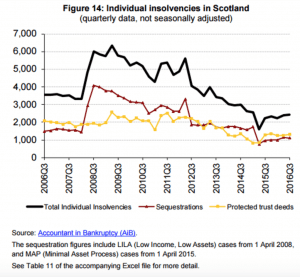
The government’s insolvency statistics for Scotland in the third quarter (July to September) of 2016 show that: ⚫ The number of individual insolvencies increased by 8.5% compared to the third quarter of 2015, with 2,424 recorded. ⚫ The number of individual sequestrations (bankruptcy) increased by 15.3% compared to the third quarter of 2015. Of the 1,113 in Q3 this year, 471 people went into sequestration through the Minimal Asset Process route. This replaced the LILA route (Low Income, Low Assets) in April 2015, which has led to a general decrease in sequestration filings. ⚫ The number of individuals applying for a trust deed increased by 3.3% compared to Q3 2015, with 1,311 filings. ⚫ The figures for all three quarters also display that for the first time in a long time, significantly more people have been filing for trust deeds than sequestrations. Looking at the figures for Q2 2016, the 1,261 trust deed filings saw a 48.5% rise compared to Q2 2015, while Q1 2016’s 1,235 was an increase of 48.1%. The rise in 2016, and how it compares to previous years, can be seen with ease on this graph of the Q3 data for individual insolvencies. While the numbers of individual trust deeds have occasionally matched or very minutely exceeded the number of sequestrations, the last time we saw this kind of change was back in 2007.

Why Have Scottish Trust Deeds Exceeded Sequestrations?

Insolvency legislation has recently changed with regard to the minimum period for contributing to your insolvency estate. While Sequestration‘s used to require a minimum period of three years, now both Sequestrations and Trust Deeds demand a minimum of four. This is most likely the reason for the rise in trust deeds – with no difference in the period of contribution, people are choosing the more positive option of a Trust Deed, than straightforward bankruptcy.

How Many People Have Applied For Trust Deeds?

Looking at the data from Q1, Q2 and Q3 together, you’ll see that 7,061 Scottish people have filed for bankruptcy so far this year, yet only about 4,000 have applied for a Trust Deed. This shows that we need to be reaching those other 3,061 people to try and show that Trust Deed Scotland is a strong alternative (as long as the debt is more than £5,000).  

What Is A Scottish Trust Deed?

If you’re asking the question of what is a Scottish Trust Deed at this stage, then the simplest explanation is that a trust deed is a voluntary arrangement whereby you effectively cover your debts through your own assets, rather than going into sequestration. Your contribution to your trust deed is based on how much disposable income you have once your living costs have been deducted from your income. To be eligible for a trust deed you have to be a Scottish resident with £5,000 or more unsecured debt.

Can You Get A Scottish Trust Deed Twice?

Yes. You can apply for a Scottish Trust Deed twice, and it is not uncommon for people to fall into financial difficulties again after originally clearing debts using this tool. Statistically, it is rare for individuals to need a second Trust Deed but such is life, some people may find themself in a similar position. You can have 2 Scottish Trust Deeds, but you must also be discharged from the first Trust Deed which means that the first Trust Deed has ended, either because it failed or you had complete the term. If you have failed a Scottish Trust Deed and you’re looking at being discharged – it’s important that all factors are considered and alternative solutions discussed. Trust Deed Scotland offer non-judgemental confidential advice and advise you to give us a call on 0141 221 0999.

What Does This Mean For Scottish People?

As we discussed earlier, the change in legislation for declaring yourself bankrupt has seen a rise in people filing for a trust deed. Many people who are in debt are happier once they have a trust deed, as it means that you are only making one payment a month to one body, rather than several to different creditors. Those who set up a Scottish Trust Deed with Trust Deed Scotland should also be confident that they are receiving support which puts them first – as evidenced by our no.1 rated status. With a less negative connotation than Sequestration, and support which puts people, not money, first, this rise in Scottish Trust Deeds should help to remove the stigma of being in debt, and show that bankruptcy is not the only option. For free, impartial Debt Advice In Scotland – call 0141 221 0999
5 Trust Deeds Questions

When it comes to trust deeds, there are certain questions people commonly have. Here at Trust Deed Scotland, we’ve compiled 5 Trust Deeds Questions, as well as the answers to each of them, to help you stay in the know.  

What is the difference between a trust deed and sequestration?

Trust Deeds differ from sequestration, or bankruptcy, in a number of ways:
  • A trust deed is less formal than sequestration and doesn’t involve the court – it’s a private contract between you, your trustees and your creditors
  • If you’re a homeowner, you can still keep your home if you enter a Trust Deed
  • Unlike sequestration, you can borrow money without disclosing your status, be a company director, and qualify for elected public office
Where they’re similar, though, is the minimum period for contributing to an insolvency estate. Recent legislation changes have increased this time for sequestrations from three years to four, on par with trusts deeds. This is thought to be the main reason why trust deeds today exceed sequestrations, according to government statistics – with no difference in the period of contribution, more and more people are shunning bankruptcy and going for the more ‘positive’ trust deed option.  Yes, a trust deed does affect your credit rating. This is because entering one means you’re breaching the original terms of your credit agreement. However, remember that if you’ve already missed credit payments or are paying your creditors decreased amounts, your credit rating may have been negatively affected, to begin with. After you’ve completed a Trust Deed, it will show on credit reference agency files for another two years. Your credit rating will stop mentioning it when six years have passed since you first entered a trust deed.

When does a Trust Deed become protected?

A trust deed becomes protected once the majority of your creditors (two-thirds by debt value, or more than half by number) agree to the proposal. They can then no longer contact you for any reason or start any legal proceedings against you to recover debt. However, you should know that even after your trust deed becomes protected, your trustees or creditors can still seek for your sequestration if they’re able to prove that it will give more back to your creditors than what a trust deed would. For more information on the Debt Arrangemennt Scheme, see our related article What is a DAS?

What is the minimum debt level required to take out a trust deed?

The minimum debt level needed to enter a trust deed with Trust Deed Scotland is £5,000 (as compared to £3,000 for sequestration). Keep in mind that there are some trust deed providers that may require higher levels of debt for them to take on your case. And of course, you also need to have been a resident in Scotland for a minimum of six months and have an income, or someone willing to act as a third party, for you to qualify for a trust deed.  

Trust Deeds Questions – Additional Queries Not Answered Here?

Setting up a trust deed with Trust Deed Scotland is easy. Enter your details on our website or call our office to arrange a free meeting with one of our debt advisors, who’ll then let you know all your options and help you find the best debt solution for you. Once we have all the information we need from you, we’ll start drafting your case. At this point, we’ll also help you set up your first trust deed payment, which means you can immediately stop any current payments to your creditors. Before you start setting up a trust deed, though, try our Trust Deed Wizard to see exactly how one could help you become free of debt. There are many more than just 5 Trust Deeds Questions. There are other alternatives in Scotland too. Get answers to more of your questions about financial options on our debt solutions.

What is the difference between a Trust Deed and a Deed of Trust?

The two are completely different, but we still see that it confuses people what the difference is when they’re searching on Google! As a result, below you will find the difference between a Trust Deed and a deed of trust to help you on your way to finding more about what you need.

What is a Trust Deed?

If you’re struggling financially and require debt advice in Scotland or support on how to move ahead, an advisor may make you aware of the opportunity of entering into a Trust Deed. Before you do so, you should ensure that you understand what a trust deed is, how it works and be aware of other debt arrangement schemes available. A Trust Deed is a voluntary agreement between you and your creditors (who you owe money to) to repay what you owe. It’s a formal debt solution that’s only available to Scottish residents who have a personal debt of £5,000 or more. A Trust Deed can be particularly helpful if you’re struggling to pay your debts within a reasonable timeframe – five years, for example. It’s generally a more straightforward and less restrictive alternative to declaring bankruptcy and can be used to pay off part of any “unsecured debt”, such as money borrowed using credit cards and loans. It’s important to note that social security benefits and things like Universal Credit can be taken into account to assess your situation when you apply for a Trust Deed, but the contribution you pay back will not be taken from these funds. Generally, only disposable income is used to pay creditors, but other assets such as furniture could also be liquidated to help make contributions, but this will have been agreed with your advisor before entering a trust deed. The financial advice on offer meanwhile when you enter into a Trust Deed can include remortgaging, but this is not mandatory and typically not advised unless a final option. There are two types of trust deed – protected and unprotected. An unprotected trust deed is not binding for a creditor (company or other) who doesn’t agree to the terms. A Protected Trust Deed meanwhile is binding for the creditor, although they have a 5 week period in which to appeal. It’s in the interest of the trustee to have the trust deed protected, but it’s not essential. It is also worth noting that a trust deed debt must be a minimum of £5,000 to become protected. You should be aware that all protected trust deeds that fall under the court of session and within the territorial jurisdiction of Scotland are advertised as a public record in the AIB register. It is also likely that setting up a trust deed will affect your credit record. Trust deeds can only be administered by a licensed insolvency practitioner.

 What is a Deed of Trust?

what is a deed of trust

Although similar in name, a deed of trust is something entirely different from a Trust Deed. A deed of trust is an important document (governed by The Trustee Act 2000) in which trustees are appointed to hold the property for beneficiaries. A Deed of Trust can be used to state how a property is owned. For example, the property may be owned by several parties, each with a different contribution towards the ownership, and this proportion of ownership may not be listed in the land registry. A deed of trust enables someone to be a protected owner of the property, even if they are not a registered owner with the land registry. A Deed of Trust can be necessary for various circumstances. For example, say that someone wishes to contribute towards buying a new house with their partner. However, they are already the owner of a property with a mortgage, so they cannot be part of the mortgage on the new house. A deed of trust can be used to register their contribution towards, and ownership of, the new property, while their partner is listed with the land registry as being the sole owner.

What is a trustee in a Deed of Trust?

A trustee is somebody who manages the property that is held in a deed of trust. Trustees are entrusted to act in an appropriate manner, and always in the interests of the beneficiaries.

What is the difference between a Trust Deed and a Deed of Trust?

So how does a Trust Deed in Scotland differ from a Deed of Trust? A Trust Deed is an alternative to bankruptcy in Scotland and involves a professional overseeing your repayment of debt over a certain amount of time to your creditors. A Deed of Trust meanwhile is a legal document most commonly related to the ownership of property and involves a trustee managing how it is really owned, enabling your percentage of ownership to be protected, even when you are not listed in the land registry as the owner. To find out more about Trust Deed Scotland and if you qualify for a Trust Deed, try our Trust Deed Debt Calculator. Debt Help Scotland  ✓ 30,000 people helped ✓ No.1 Rated ✓ Tailored Advice ✓ No Setup Fees.

How a Trust Deed Could Help With Council Tax Arrears

Often, people who come to us looking to improve their financial situation have council tax debt. It is important to address council tax debt as soon as possible because the council can take you to court for payment, place an arrestment on your earnings and even force you to go bankrupt in some cases. Many people feel overwhelmed and can be nervous dealing with the council or the debt collection companies they pass the debts to. A Scottish Trust Deed could offer a solution for you if you find yourself in this position as your council tax debt could be included into your Trust Deed along with your other debts. You would then pay one manageable monthly payment, (agreed before the Trust Deed is finalised), which would be split between your creditors. Once the agreed Trust Deed term has been finalised, all debts included in your plan will be written off. To see how a Trust Deed could help you, try our Trust Deed Wizard tool.
Your monthly contribution would be determined by looking at your level of debt, your income and expenditure and who your creditors are. There are government guidelines to ensure you have adequate funds to cover your monthly necessities and make your Trust Deed payment each month. These necessities include: mortgage/rent; council tax; food; gas and electricity; home and life insurance; phone/internet and TV, travel expenses and housekeeping. Our qualified Scottish debt advisers are available to meet with you, discuss your personal circumstances and see if a Trust Deed would be right for you. They will also go over all the other debts solution options available to you to allow you to make an informed decision. Setting up the Trust Deed can be done quickly if you provide all information relating to your income, expenditure, creditors and ID at the initial appointment. If you have been putting off dealing with your council tax debt, then don’t delay any longer as if the council starts bankruptcy proceedings against you, it may be too late to stop the process. Contact Trust Deed Scotland today to give you peace of mind and get your finances back on track. We understand you may be nervous entering into a debt solution to set your mind at rest, visit our Debt Reviews page for thousands of independently verified reviews written by our happy clients.

Trust Deed Scotland Copycat Warning

A senior figure at Trust Deed Scotland® said, ‘We have evidence other companies have been impersonating us in order to attract business. All attempts to impersonate us that have been brought to our attention are under thorough investigation.’ Trust Deed Scotland is the No.1 debt advice company in Scotland, having given over [volume] people in Scotland Trust Deed advice and does not work with any other debt advice companies. Our source said, “This issue came to our attention some time ago and incidences of Trust Deed Scotland copycat companies have been on the increase ever since.” Trust Deed Scotland® has earned its reputation by providing tailored debt advice. Its highly experienced debt advisers cover the whole of Scotland and provide a non-judgemental service with full discretion at all times. Trust Deed Scotland® have a 5/5 rating on TrustPilot, which shows how high the Glasgow-based insolvency values customer satisfaction. The Reviews section of the Trust Deed Scotland site shows thousands of independently verified reviews written by happy customers. When receiving a call from an unknown number, its only natural that people have questions such as should I answer, or who called me – if you search online – you can usually find this information quite quickly. You can also get further information on current scams by searching #ScamAware on Twitter. If you use Twitter, make sure you follow the official Trust Deed Scotland Twitter account. We’re also on Instagram, TikTok and Facebook. You can find our offices on Google Maps.

0141 221 0999 – Official Trust Deed Scotland®

01412210999 – if in any doubt, this is the official Trust Deed Scotland telephone number, where you can check out our credentials including our number under a UK regulatory body, which is 820851. Further, we would remind you to:
  • Always double-check the name of any company you are speaking to.
  • Read paperwork and emails carefully.
  • Ask where the company you are speaking to is based and to confirm their phone number.
  • Trust Deed Scotland® is based in Glasgow and their number is 0141 221 0999. (Also shown as +441412210999)
  • Remember, you should always thoroughly research the company you are engaging with. We advise you to read independently verified reviews wherever possible.
See the more recent Google crackdown on misleading debt service ads article for further information. Please contact Trust Deed Scotland if you receive any unsolicited communication from another debt advisory company claiming to be ourselves. You can also read our handy guide: Making sure it’s Trust Deed Scotland.