Is Equity Release Right for You?

When it comes to debt, there are many aspects to consider before deciding on the right debt solution for you. For those with a mortgage, a term that is often used with regards to your debts is “equity release”. Equity is the difference between the value of the home and the total of the mortgage, and any loans secured on it. Equity release refers to cashing in on the equity from the home without having to leave it. The money is released either in a lump sum or a steady stream of income using the value of your home. Those releasing equity from their homes usually need to be homeowners over the age of 55. The value of the property will also affect a person’s eligibility and the amount the lender is willing to offer. Equity release can be helpful for those looking to increase their income, pay off existing unsecured debts, or pay for care needs later in life. If you think that you may be eligible for an equity release and that releasing equity from your property may be the best way to deal with your debts, it’s highly recommended that your next step is to seek advice. Our experienced debt advisers can discuss all of the options available to you so that you can make an informed decision on your next steps.  

Types of Equity Release

There are two main types of equity release schemes. Each one works differently and deciding on the suitable option will depend on your circumstances and goals.   Lifetime Mortgages A lifetime mortgage gives a person funds in either a lump sum or in smaller amounts over time. The maximum amount of money that can be borrowed will be agreed with the scheme provider. Those who take out a lifetime mortgage will remain the owners of the property. Lifetime Mortgages do carry interest which can either be paid or allowed to build up over time. The loan along with any interest will be paid back wither when that person passes away or moves into long-term care.   Home Reversion Home reversion is the less common form of equity release. Under this scheme, a person will sell all or part of their property to a home revision company who will then provide a lump sum of money or regular monthly payments. A person can continue to live in the property until they pass away or sell their remaining share. Once the property is sold, the home reversion provider will be paid the agreed share of the final sale price.  

Risks of Equity Release

Equity release is not suitable as short-term loan. It’s a long-term commitment which needs to be carefully considered before proceeding. Equity release plans are generally designed to be paid back only when you die or move permanently into care – if your partner isn’t on the equity release and they outlive you, they could be forced to move house. There are a few risk factors to consider before deciding on releasing equity from your property. Releasing equity will reduce the overall value of the property and may affect your entitlement to state benefits. If you opt for a home reversion plan with your equity release, the company providing the plan will acquire the deeds to the property. If your home increases in value from here, you will only benefit from the increase in the proportion of the property you still hold. Similarly, any decreases in value will be shared by both you and the loan equity provider. Once you’ve taken out the equity release, if you decide to downsize to a smaller property, you may be required to repay the equity, either in part or in full. The final consideration is what happens when you pass away. The property you released equity from will be sold by the equity provider, and the equity (plus any interest) will be paid off. Any extra money from the sale will go to inheritance as normal. For those looking to leave the property as a place of residence for loved ones, equity release may not be the best option. For advice on equity release as well as all formal Scottish debt solutions, contact Trust Deed Scotland®. Our experienced debt advisers will be able to provide tailored advice based on your individual circumstances and allow you to make an informed decision on the right decision for you.

The Impact of Rising Food Prices

The price of food has increased at its fastest rate in 45 years and is one of the main contributors to the cost of living crisis in Scotland. The annual inflation rate for this category alone was 19.2%. Despite this, inflation has actually reduced in the last few months. As a result, more than over one million adults in Scotland have taken action to reduce their outgoings, admitting to spending less on essentials such as food.  

Food Poverty

Food poverty refers to not having access to sufficient food, or food of an adequate quality to meet a person’s basic needs. The UK’s rate of food poverty is among the worst in Europe. The Trussell Trust saw record numbers of people seeking help between April 2022 and March 2023, with more than 760,000 people forced to turn to the charity’s food banks for the first time in their lives. Key workers are far more likely to experience food poverty. Around one in five teachers, and one in four NHS workers are currently experiencing food poverty.  

Poverty’s Impact on Health

The cost of living crisis and the rising costs that have accompanied it can have a negative impact on a person’s health, both mentally and physically.   There are several ways in which rising costs can affect health, such as: – being unable to afford food or have a nutritious diet – living in a cold or damp home – an increase in unaffordable debt – financial worries may lead to a decline in mental health   What can be done to minimise health impact: – checking eligibility to benefits that may boost income – debt relief through a variety of debt solutions – flexible work to reduce childcare or transportation costs – reduce spending in non-essential areas that are unlikely to impact a person’s mental or physical health    

School Meal Debt

A health and wellbeing census published by the Scottish government in March found that nearly 60% of pupils at least sometimes went to bed or school hungry. For children living in food poverty, a free school meal may be the only guaranteed hot food that they have that day. A growing and forgotten debt is school meal debt. This is where parents or guardians have fallen behind with paying for their children’s school meals. Aberlour, a Scottish children’s charity, has revealed that over one million pounds of school meal debt is owed in Scotland, and one in four children continue to live in poverty. As a result, Glasgow City Council has decided to scrap school meal debt above a certain amount, with further councils expected to follow. Their aim is for this to help families who are struggling with the cost of living. To add to this, school lunches are currently free for children P1-P5, but the Scottish Government are planning to extend this to all primary children.    

Scottish Debt Solutions

There are a number of formal Scottish debt solutions designed to lift the burden of debt. A Trust Deed: A Trust Deed is a voluntary but legally binding agreement between you and your creditors where you agree to pay back an affordable portion of what you owe. After your Trust Deed has ended, which is typically after four years, the remainder of the debt is legally written off. The Debt Arrangement Scheme (DAS): The DAS is designed to help you pay back your debt at a regular, manageable rate – without the threat of legal action hanging over you. The Debt Arrangement Scheme freezes interest, fees, and charges from the date of approval. As long as you fully complete the plan, then these interest and charges cannot be added back by your creditors. Sequestration: Sequestration is the Scottish version of bankruptcy. Sequestration is a way for individuals in Scotland to get rid of their debts, however, if you have any assets, they could be sold to raise money for your creditors. Minimal Asset Process (MAP): Minimal Asset Process (MAP), is a route into Sequestration. The Minimal Asset Process allows you to write off your unsecured debts in a short period of time if you are on a low income with no disposable income left after covering your essential living costs or your income is only from income-dependent benefits. Statutory Moratorium: Whilst not a long-term ‘solution’ as such this effectively stops creditor action against you for 6 months, offering you valuable time to seek advice and think about your longer-term options. As the Statutory Moratorium is not a debt solution in the sense that it does not write off debt, or stop interest and charges from building up, it does give you time to think and will stop imminent creditor action, such as an earnings arrestment or a bankruptcy petition. Any debt recovery actions already in existence, e.g. an earnings arrestment, will remain in place. To get in contact for tailored debt advice, follow our Trust Deed Scotland® wizard tool or call us on 0141 221 0999.

Mortgage Fears after Interest Rate Hike

The Bank of England has raised the base interest rate to 5%, the highest the UK has seen since the 2008 financial crash. It was announced on Thursday 22nd June that the interest rate would rise from 4.5% to 5% at the start of July in an attempt to combat inflation. Inflation is currently sitting at just below 9%, however, the Bank of England’s target is 2%. This means that people with mortgages are likely to see an increase in their monthly payments.  

Mortgages

There are currently approximately 13 million mortgage accounts active in the UK. Those in fixed rate mortgage payments are likely to see a rise from an average of £700 per month to £1,000 per month. Approximately 800,000 households still need to refinance this year, and a further 1.6 million homeowners next year, meaning that they will face much higher repayments. Variable-rate mortgage repayments are also set to rise from an average of £450 to over £700 a month, this applies to 1.5 million UK households. Research by the National Institute of Economic and Social Research has estimated that the latest interest rate hike would see 1.2 million UK households run out of savings by the end of the year due to having to pay more for their mortgage.  

Risk to Private Rent Sector

Around two thirds of existing landlords are reliant on a mortgage. If a landlord’s mortgage is to substantially rise along with interest rates, then their tenants may be the ones expected to foot the bill. Landlords may choose to raise prices in-between tenants, meaning that new tenants may face much higher rent payments. A consequence of this is that many current tenants feel trapped in their current properties with unaffordable rent prices. Affordable properties become more scarce since the market value for similar properties rises at the same time.  

Risk of Falling into Debt

Around a third of adults currently paying rent or mortgage payments are finding it very or somewhat difficult to afford them. The steep rise in monthly mortgage payments may result in an increase in households struggling with unaffordable debt. It’s expected that many people who will struggle to keep up with the higher payments may turn to credit to fund everyday essentials. Unfortunately, this cycle of debt can very quickly become unaffordable.  

Accessing debt help in Scotland

For those struggling with debt, there are a number of solutions and ways to access financial help in Scotland. A Trust Deed is a legally binding agreement between you and your creditors where you agree to pay back an affordable portion of what you owe, whilst protecting assets such as your house and car. There is usually a fixed time rate of four years and on completion of this term, all remaining debt will be written off. While in a Trust Deed, creditors can no longer contact you and cannot pursue you for the remaining balance that will be written off. To qualify, you must have a suitable level of income and affordability and the amount of debt must be more than £5,000.   The Debt Arrangement Scheme (DAS) allows you to repay your debt at a manageable level for you, freezing all interest and fees. To qualify you can have any amount of debt but must not be in any other form of debt repayment. A DAS is also legally binding and the people you owe money to are not able to contact you or take action against you. Payment breaks of up to six months due to unemployment or illness are also available while in the scheme. The DAS will last until the debt is cleared but it will protect assets such as your home and cars.   The debt advice team at Trust Deed Scotland® can also give you the advantages and disadvantages of both solutions plus alternative formal Scottish debt solutions available for Scottish residents. Call us on 0141 221 0999 for more information.

Wedding Day Debt

There’s no doubt that a person’s wedding day is likely to be the most expensive day of their lives. With the average wedding day in the UK now costing £18,400, it’s no surprise that many couples are struggling to foot the bill. For those who are attempting to stick to a strict budget to keep their big day as affordable as possible, it can be more difficult than initially anticipated with an estimated 48% of couples going over budget

Funding the big day

Finding the money to fund a wedding day can take years. With the current cost of living crisis, many couples will not be able to afford one at all. Seeing as four in ten UK adults are already struggling to afford rent or mortgage payments, it is fair to assume that many will not have any disposable income left to save for a potential wedding day. That is why an estimated two-thirds of UK couples get into debt to fund the wedding day of their dreams. A study by Lowell said that although 74% of Brits recover from their wedding in under a year, it takes 15% of couples up to two years and 5% up to five years to pay off the debt. The average salary in the UK is £31,447. With the average wedding being over half of the average yearly salary, there’s no surprise that couples are turning to credit to fund their big day. There are already set to be over 130,000 weddings in the UK this year, with plenty more still to be booked. For example, there is an average of 275,000 weddings in the UK every year. This could mean millions of pounds of debt could be racked up by excited couples looking to make the most of their big day.  

Pre-existing debt

This couple spell disaster for those already paying of debt. An estimated 29% of couples are already paying off debt while planning their wedding. If a person is already balancing multiple minimum payments, taking on a large amount of debt for a wedding day can make those payments unaffordable long term. This can create a cycle of debt that can be difficult to get out of alone.  

Changing Times

Times have changed over the last few decades. In 1990, over 375,000 couples tied the knot, but in 2019 just 219,850 couples got married. With the steep increase in population since the 70’s, it would be expected that the number of weddings would also increase. To add to this, more and more couples are opting to wait and get married older. In 1970 the average age of marriage was 27 for men and 25 for women. It is now 34 for men and 32 for women.  

How to Seek Help?

For those who have found themselves with unaffordable debt, there are solutions that can help. Here at Trust Deed Scotland, we provide advice on all formal debt solutions that are available in Scotland. Our experienced debt advisers will be able to discuss your situations and provide you with information on all of the solutions that would suit your individual circumstances, so that you can make an informed decision on what is right for you. A Trust Deed is an example of one of the solutions that we offer. A Trust Deed provides legal protection from the people that you owe money to, while freezing interest and charges. It allows you to consolidate all of your debt repayments into just one affordable payment for a period of four years. At the end of the 48-month term, the remainder of the debt is legally written off. Another example of a debt solution that we offer is the Debt Arrangement Scheme (DAS). The DAS, like a Trust Deed, allows you to consolidate your debt into one affordable monthly payment while freezing interest and charges. The difference is that you would pay that affordable payment until the full debt amount is paid. If you think that a debt solution may be the right option for you, you can try our Trust Deed Wizard tool or call us on 0141 221 0999.

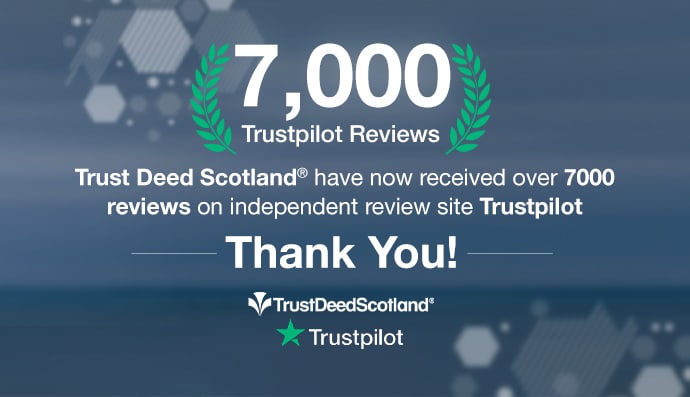
7,000 Trustpilot Reviews Milestone

Trust Deed Scotland® have more 5 Star TrustPilot reviews than all other Trust Deed providers combined. As a leading Scottish debt solutions provider, we’ve always been proud of our customer feedback, therefore this has been an important week for us as we’ve reached an important milestone of 7,000 Scottish Trust Deed TrustPilot reviews. Life can take our customers on many journeys and we would like to say thank you to our customers for letting us be part of theirs. Trust Deed Scotland® was founded in 2009 with the goal of becoming the best rated debt solutions company in Scotland, with a philosophy of putting our customers’ best interests at heart and helping them to truly realise their potential to achieve a brighter future. We’ve helped over [volume] people in Scotland by giving them tailored Scottish debt advice. Not only do we have an excellent Trustpilot rating, but our numbers stack up too. 98.5% of our proposed Trust Deeds gain approval status making us No.1 in Scotland¹ 99.9% of our proposed Debt Payment Programmes (DPPs) under the Debt Arrangement Scheme are approved by creditors²
Of our most recent debt advice reviews, Dean, reviewing the service received from our experienced debt adviser Danielle, said: “I was drowning in debt, couldn’t sleep because of it. In and out of overdrafts it was horrible. I made the call yesterday and spoke to Danielle who was unbelievable and put me straight at ease and has helped me so much. Feel like a weight has been lifted of my shoulders.
Writing a review of his Debt Arrangement Scheme experience and Jason in our debt advice team, our customer Aidan wrote: “The burden of accumulated stress and pressure over the years was instantly lifted after seeking their assistance. Honestly, five stars do not do justice to the exceptional service they provided. From the very beginning, they greeted me with warmth, professionalism, and a complete lack of judgment, which immediately put me at ease. Their knowledge and expertise were evident as they addressed all of my concerns and questions with utmost clarity. They took the time to explain every detail comprehensively, leaving no room for confusion. It’s safe to say that reaching out to these amazing individuals was one of the best decisions I’ve made. Their kindness and support have made an immense difference in my life. I wholeheartedly recommend their services to anyone facing financial difficulties.
Reviewing our debt adviser Jacqui, our new customer Danielle said: “I was so glad I found Trust Deed Scotland, Jacqui made me feel at ease from the very beginning. I couldn’t cope anymore. The DAS scheme was the right one for me and just by signing the paperwork I feel as though a weight has been lifted from me. Staff were always happy to answer my questions and worries and help put my mind at ease. There was no pressure whatsoever and Jacqui is such a lovely lady and so personal-able which made the process easier it was like talking to a friend of when you wanted help. I can’t thank you enough for making my terrible situation 1000% better I feel like I can have a life again. I wish I didn’t delay and wish I had taken steps sooner!

What did our 7,000th reviewer say of their Trust Deed Scotland® Experience?

Our 7,000th reviewer, Gayle wrote a short review about his Trust Deed Scotland® experience saying: “I was reluctant to contact Trust Deed Scotland as I was sceptical. I was very wrong. From my first phone call I was put in touch with Peter, he was absolutely fantastic and put me at ease. He reassured me every step of the way and made it all very easy and within a short time I now have peace of mind. I can’t recommend this service enough.  

Why does getting good debt advice matter?

At Trust Deed Scotland® we invest much time and effort into our own training and compliance in order to constantly evolve and enhance our customers’ experience. TrustPilot feedback and customer feedback surveys help us to drive improvements too. It’s another reason why our reviews matter to us. Our tailored debt advice is: Non-Judgemental – We’re here to listen and advise. Not to judge you. We can promise you that you’re not alone in developing problem debt. There are many changes in personal circumstances that create the situation. Redundancy, divorce, illness and simply overcommitment. Problem debt can happen to anyone, but if it does happen to you, we can help you move on. Confidential – We’ll always respect your privacy and will not divulge your situation to anyone. Safe & Secure – Our advice team are based exclusively in-house and regardless of whether you choose to proceed with us or not, we’ll never share your details with any other company. We will never attempt to push you into a solution, you’ll always be the one that makes the decision in your own time, on your own terms. Balanced – We’re here to give you the risks and benefits of all formal Scottish debt solutions. This helps you to understand what your options are and how they will impact your day-to-day life. You will be the one that makes the decision. Experienced – Not only are we authorised to give debt advice, but our team are vastly experienced, with knowledge of the inner workings of formal Scottish debt solutions legislation.

Get help with your debt today

You can contact Trust Deed Scotland® today for tailored, confidential debt advice on 0141 221 0999. Alternatively, start the process online and find out what options you might be eligible for by trying our Trust Deed Wizard tool.
In 2021-2022, we achieved a protection rate of 98.5%, this made us the best performing volume provider of Protected Trust Deeds in Scotland. Trust Deeds advertised between 01/01/21 and 31/12/22. ²In this sample of 1,144 Debt Payment Programmes (DPPs) under the Debt Arrangement Scheme (DAS), approved between July 2019 and October 2021, only 1 proposed DPP was rejected and unable to proceed.

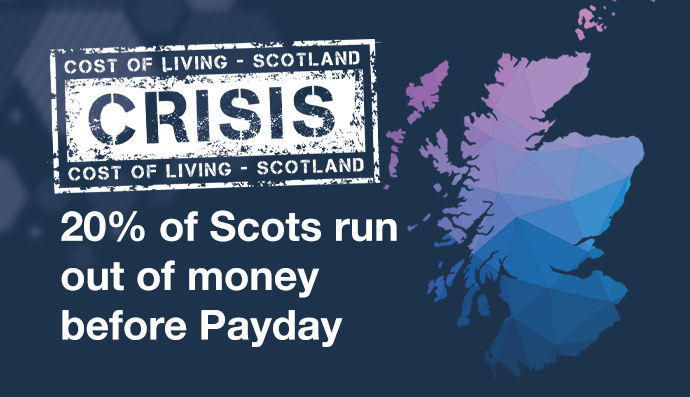
Cost of Living Crisis Scotland: 20% of Scots Running Out Of Money Monthly

20% of people in Scotland are running out of money before payday, a poll from Citizens Advice Scotland (CAS) has found. Broken down further the survey found that 11% run out of money most of the time. 9% of people said that they always run out of money before they are paid wages, pension payments or benefits. As previously reported by Trust Deed Scotland® the cost of living energy bill increases and weekly food shopping price increases have caused many people across the country to use short term credit facilities including their credit cards and bank overdrafts to pay their essential household bills, borrowing their way out of short term crises. With inflation and tax hikes, thousands of people across Scotland are struggling to cover the cost of day to day life. With over [reviews] reviews, Trust Deed Scotland® have helped over [volume] in Scotland and will continue to do so while the cost of living crisis continues to cause havoc to the everyday lives of many Scottish families. Quite simply, people are facing an impossible choice in their spending with some people having to choose between heating and eating. Myles Fitt a representative of CAS, a Scottish debt charity said “One in five people running out of money before payday is extremely concerning, given that these figures have seen an increase since 2021. A real issue here is that incomes simply aren’t keeping up with costs. Social security payments like Universal Credit effectively fell in real terms this year, and that was after the decision last autumn to remove the £20 per week uplift to the benefit.”

Cost of Living Crisis Scotland: Get help with unaffordable debt

When you have unaffordable debt, it’s important to seek help as soon as you can. In a recent survey of Trust Deed Scotland® customers, 57.40% of our customers waited more than one year before asking for help with their debt. 13.82% said that they waited 4 years or more before asking for help. There are many reasons why individuals may put off seeking help with their debts including the fear of being judged, or shame and embarrassment about having a problem with debt. If you do feel like this then it’s important to understand that even before the recent Coronavirus pandemic many people have found themselves with unaffordable debt through no fault of their own and thankfully, there are solutions that can help almost everyone. You do not need to deal with your debts alone. Speak to Trust Deed Scotland® today in confidence and see if we can help put you on the path to a brighter future.
  • Debt solutions that help individuals cope with rising living costs
  • Peace of mind that unaffordable debt is under control
  • Continued support until your journey is complete
Use our Wizard tool to quickly check your options, or call us on 0141 221 0999 for advice.

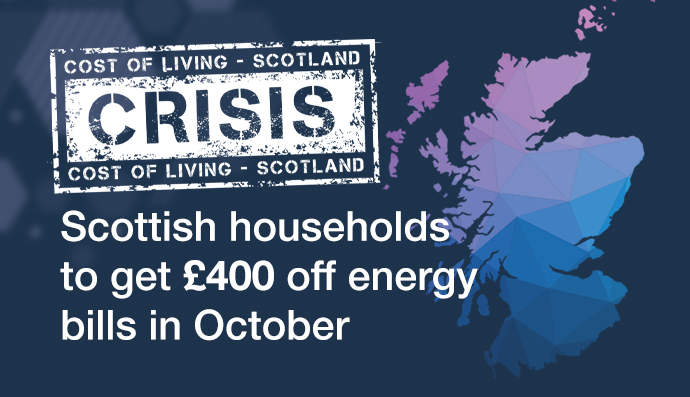
Scottish Households Will Get a £400 Energy Bill Discount

All households in Scotland will get an energy bill discount in the shape of a grant that will reduce the impact of increased energy bills in Scotland by £400 from October the chancellor, Rishi Sunak has announced. Further measures announced contain a mix of broad help and specific payments to those on lower incomes, in Scotland and throughout the rest of the UK. Direct debit and credit customers will have the money credited to their account, while customers with pre-payment meters will have the money applied to their meter or paid via a voucher. Whilst this does come as a source of relief for some households in Scotland; there is a long way to go yet as previously reported in the Trust Deed Scotland® cost of living crisis info hub. If you’ve been following this story closely in the news, you may have heard about the original idea to ‘loan’ £200 to households. Thankfully, the scheme has been scrapped and now replaced by the £400 energy bill discount for all.

The elderly and people on benefits in Scotland get additional help

Households that receive the Winter Fuel Payment, which is nearly all homes with at least one person of pension age in Scotland; will receive an extra £300 in November or December. Those on lower incomes, who claim pension credit, will also receive the £650 mentioned earlier. A small group of pensioners with disabilities will receive a total of £1,500 when all the new payments and discounts they are eligible for are added up. A £650 payment will be made to more than 8,000,000 low income households across the UK who receive Universal Credit, tax credits, pension credit and other means-tested benefits. This will be an automatic payment into bank accounts. It comes in two instalments – the first in July and the second sometime this autumn. Payments for those on tax credits only will follow shortly afterwards. Those on disability benefits will receive £150 in September, which may be on top of the £650 payment.

The cost of living crisis in Scotland will not go away

A typical domestic energy bill is estimated to rise to £2,800 in October, Jonathan Brearley CEO of Ofgem recently told MPs. That is an £800 a year increase, on top of a £700 a year rise which took effect in April 2022. Official forecasters are saying that the rate is set to accelerate. Prices will not fall next year and beyond, but the rate of increase is expected to slow. The biggest factor is what will happen to energy bills in the next few years. This will depend to a large extent on the war in Ukraine, and its wider impact on energy supplies from Russia and how that changes the wholesale prices paid by energy suppliers. The Russian and Ukrainian conflict may affect the cost of our weekly food shop as wheat prices soared on world commodity markets, and the cost of everything from bread and cakes to noodles and pasta has gone up.  

Help to repay unaffordable debt in Scotland

It is important to understand that some bills are more important than others. Known as priority bills, a typical energy bill in Scotland from a current supplier is most definitely a priority bill and you should pay these types of bills first whilst other debts such as credit cards and payday loan debts for example are not as urgent. However, even though these types of debts may not be as important, simply ignoring them is not an option either. If you feel like you’re really struggling with unaffordable debts you should seek advice from an experienced debt adviser or debt charity as soon as you can. You’re not alone in asking for help but the sooner you do something about your debt, the sooner you can move on with your life. Unfortunately, as many as 25% of Scots wait 3 years before seeking help with their unaffordable debt so we would urge you to ask for help sooner so that you don’t fall into the same trap. Trust Deed Scotland® have helped thousands of people in Scotland since 2009. We have dealt with cases that included council tax arrears, credit card debts and payday loans. We’ve successfully prevented and lifted creditor enforcement actions such as Wage Arrestments. Whatever the cause of your money problems, Trust Deed Scotland® can help you to understand your options, find a Scottish debt solution and let you focus on enjoying a brighter future. Contact us on 0141 221 0999, or start by simply using our debt calculator tool online to quickly check what your options may look like.    

Talk Money Week 2022

7-11 November 2022 marks a week known as Talk Money Week in the UK. It’s an annual event run by Money and Pensions Service and it usually falls on the second week of November of any year. It’s a time for debt charities and companies such as Trust Deed Scotland® to come together and encourage people to open up about their money and debt worries. Talk Money Week’s focus for 2022 is around credit, something that many people are currently resorting to use to pay household bills. A recent Ipsos survey carried on behalf of Sky News found that 25% of its respondents said they have already used credit cards for essentials or skipped meals in response to the cost of living. The same survey highlighted that 90% are worried about cost of living for the country as a whole while around 8 in 10 are concerned for themselves and people in the area they live. An additional 33% are finding it difficult to pay their energy bills and a similar proportion of mortgage holders and renters report rises in their housing payments. The Money and Pensions Service are funded by levies on both the financial services industry and pension schemes and their vision is “Everyone making the most of their money and pensions.” They are an ‘arm’s-length body’ sponsored by the Department for Work and Pensions, with a joint commitment to ensuring that people throughout the UK have guidance and access to the information they need to make effective financial decisions over their lifetime. They deliver those across five core functions. 1. Pension guidance. 2. Debt advice. 3. Money guidance. 4. Consumer protection. and 5. Strategy.  

Why does talking about money and debt matter?

One of the key focuses of Talk Money Week 2022 is to encourage conversations about unaffordable debt. By having a conversation, you can improve your physical, mental and financial wellbeing. Money and Pensions research shows that talking about money can help you to:
  • Make better and less risky financial decisions
  • Have stronger personal relationships
  • Help your children form good lifetime money habits
  • Feel less stressed or anxious and more in control.
Building money conversations into our everyday lives also helps us build financial confidence and resilience to face whatever the future throws at us and Talk Money Week’s intention is for you to kickstart a conversation in any walk of life, including:
  • In your workplace
  • At home with friends and family
  • In educational establishments, or with debt charities
  • With the people to who you owe money to
However, it isn’t easy talking about money and debt. Many people fear being judged, embarrassed or ashamed of their debt when the truth is problem debt can happen to anyone.

How long do people wait before getting help with their debt?

In a 2022 study of existing Trust Deed Scotland® & Harper McDermott customers.
  • 17% got help with their unaffordable debt straight away
  • 25% waited up to 1 year before asking for help
  • 30% waited between 1-2 years before asking for help
  • 14% waited between 3-4 years before asking for help
  • 14% waited over 4 years before asking for help with debt
57.4% waited over a year before finally asking for help with their unaffordable debt.

What type of debts worried our customers most?

Credit card debts are the most troublesome type of debt that our customers encounter.
  • 33.84% were worried about credit card debts in Scotland
  • 24.33% were concerned about a personal loan
  • 11.60% thought that their overdraft was a worrying debt
  • 7.20% were worried about council tax arrears debt
  • 6.68% are worried about payday loan debt
  • 4.04% are worried about a buy now pay later agreement
  • 3.31% were worried about their gas & electric bills*
  • 2.98% were worried about rent arrears debt
  • 2.95% were worried about HMRC debts
  • Lastly, 3.07% were worried about another type of unaffordable debt
*It’s important to stress that these answers were taken before the cost of living crisis really started to bite. If this same survey were to take place today, the results would be vastly different. For example, a survey from Smart Energy GB in October 2022 found that almost half of its respondents said they were worried about rising energy costs.

What impact did debt have on our customers’ mental health?

We asked our customers if their mental or physical health was impacted by their debt problem and overall 91.36% of our respondents’ mental health was impacted by their debt problem.
  • 57.61% – Yes – My mental health was affected
  • 1.33% – Yes – My physical health was affected
  • 33.75% – Yes – Both my mental and physical health were affected
  • 7.30% – No – My mental or physical health was not impacted by my debt problem
In the same survey, 84% of existing Trust Deed Scotland® & Harper McDermott customers said that their mental health had improved, with 30.39% of our customers also saying that their physical health improved also.

What do people who have previously started a conversation with Trust Deed Scotland® say about their experience?

At Trust Deed Scotland® we currently have over [reviews] reviews from our customers, with a rating of 5/5 rating on Trustpilot. In addition to this statistic, our survey shows that: 97.7% of our customers said they were satisfied or better with the Debt Arrangement Scheme as their chosen debt solution. 98.8% of our customers said they were satisfied or better with a Trust Deed as their chosen debt solution. Our survey asked all active customers for their feedback and also those who had recently been discharged from a debt solution. Our Trust Deed Scotland reviews are just as important to us, not only as a signal that our customers are happy with the service that they have received from us but also because they allow people with problem debt in Scotland to find other individuals who were once in the same position that they too find themselves in Some of those reviews are anonymised by our customers to protect their own identities. Many of the reviews go into great detail, and some contain just a few words. Either way, they are always written completely in our customers’ own words describing their experience in their reviews and we’re always grateful to receive them; both good and bad. We’re always keen to take action on any feedback that we receive to make improvements to our processes wherever we can and continuously improve our own learning and development as a leading Scottish debt solutions provider. Our experienced debt advisers received reviews in the run-up to Talk Money Week 2022 which perfectly described many of the feelings that individuals have when they’re looking for help with their unaffordable debt.
Reviewing one of our experienced debt advisers Sharon, Sheila wrote: “Thank you to Sharon this process was a lot less painful for me. She put me totally at ease with my situation, was helpful, explained things well, was kind, friendly, and had a bit of humour. I felt like I was talking to a friend rather than a debt advisor. The whole experience took only 24hrs after struggling for the last 6 months to find the courage to call.”
Shaun, speaking about his experience with our debt adviser Michael, said “Great experience from start to finish. I had been trying to avoid a trust deed for a long time. Micheal, who I initially spoke with, was brilliant and made me feel at ease right away. He was very understanding and reassuring. The fact you only speak with the same person throughout the whole process is great. I felt I could contact Micheal at any point for advice, always available or would respond ASAP. Obviously, a highly experienced company that are calming during what can be an uneasy time.”
Another customer wrote about the beginning of her debt journey with Valerie by saying: “After burying my head in the sand with stress and worry for over a year, due to being laid off through covid and a looming court case, I just gave up on all debt and direct debits! But after getting back to work and the court case not having as bad an effect as first feared it would. There was still the weight and pressure of thinking I had messed up my life, by not paying debts and thinking I’d never get back on my feet, Then I heard of Trust Dead Scotland, and there was a lovely lady called Val that took on my case and from start to finish she was an absolute star, making me feel at ease with a solution that best suited. To even finding out who I owed the money to, as I had no idea what each creditor was due and what for. I really just had given up before and so had no clue, but after getting in touch with Trust Dead Scotland and Val, I can finally look to the future and il be back on my feet in no time.”

Start a conversation about your unaffordable debt

Our experienced, friendly debt advisers offer tailored debt advice and explain the advantages and disadvantages of any formal debt solutions that you may be eligible for. You can contact Trust Deed Scotland® on 0141 221 0999 or use our online form to find out more about your options. Talk Money Week 2020 Talk Money Week 2021 Talk Money Week 2022 Talk Money Week 2023 Talk Money Week 2024

Cost Of Living Crisis: Christmas

More evidence has emerged of the extent Scots are worried about how they’ll be able to cope during Christmas. As a leading debt help company in Scotland, we’ve already helped many people across Scotland in December enter into a Trust Deed, or the Debt Arrangement Scheme and advised on other alternative formal debt solutions including the Minimal Asset Process route to Sequestration. However, the UK debt charity Stepchange commissioned a survey and it found that 30% of people in Scotland are expected to struggle to afford Christmas. A further 31% of people said that they expect to cut back this year. 3% said that they wouldn’t celebrate Christmas at all this year.

Problem Debt Can Happen to Anyone

The cost of living crisis is continuing to take up a large proportion of income with the survey showing that as many as 12% of the respondents said they feel that they had no choice but to rely on credit this Christmas. With inflation showing no sign of easing, and with energy bills set to worsen in 2023, more people may end up with problem debt than ever before. Statistics released by Trust Deed Scotland® earlier in the year showed that over 57.4% of our customers waited over a year before they did something about their unaffordable debt, however, the survey was conducted prior to the pressures of the cost of living crisis really squeezed most households.

Tips to Help Avoid a Christmas Debt Hangover in 2023

There are many guides available to help you have a more affordable Christmas for you and your family from Money Saving Gurus such as Martin Lewis to Mrs Mummy Penny. Here are our top tips to enjoy a more frugal Christmas this year: Calculate your budget – Calculate your budget and think about what you can realistically afford to spend. Christmas is one day and you don’t want to ruin the whole of the next year for it. Don’t buy unnecessary presents – We’re all struggling right now so consider making a ‘No Unnecessary Present Pact’ (NUPP) with friends, family or colleagues or at least agree to a Secret Santa with a £5 to £10 cap on gifts. Sometimes all it takes is one person to make the first move and everyone else is grateful for the gesture. Visit charity shops – Don’t only would you be giving to good causes but you could find unwanted, or next-to-new items and save some money in the process. Buy a cheaper Christmas day meal – You don’t need to get a fresh turkey bought in. Save money buying a frozen turkey or simply choose a more cost-effective alternative such as a Steak Pie. OK, it may be more of a traditional Scottish meal for New Year’s day but you’ll save money in cooking time alone. Look out for deals – From wine to early sales, keep an eye out for supermarket and online deals. Claim any cashback that’s going from TopCashback and Quidco. Start saving for next year, now – Putting a small amount aside each month, from this month onwards may help you make Christmas 2023 more affordable, and stress-free. Many of these tips may help with short term money management, however, if you are really struggling to manage your finances, with excessive interest and charges, or if you are not meeting your minimum payments on debts like credit cards, you may need to consider what your long term options may look like.

Help With Unaffordable Debt In Scotland

You should seek help as soon as possible if you feel that you are struggling with debt. Unaffordable debt can cause stress and anxiety, especially at this time of year with many people also reporting that it gives them sleepless nights, Tailored Scottish debt advice is available from our experienced debt advisers. They’re there to help you, not judge you, so don’t worry. You don’t even need to leave it until 2023 – check your options today and see if a formal debt solution is right for you or not. You will be able to make an informed decision and should you choose to enter into a formal debt solution, there are no upfront setup fees to pay. Try our Wizard tool to get started, or call us on 0141 221 0999.  

2.3m Scots Households Missed January Payments

A new survey commissioner by the consumer watchdog Which? has found a record number of people missed a payment or defaulted on an unaffordable debt in Scotland in January 2023. Worryingly, the report showed that the number of households defaulting on debt repayment rose by 21% across the UK from £1.9m to £2.3m within one month. As the cost of living crisis continues to push households across Scotland to the limit and with interest rates, more people are struggling to repay debts. Speaking about the findings of their report, Rocio Cocha of the consumer group said “As the cost of living crisis continues to bite into household finances, we are calling on businesses in essential sectors – like food, energy and broadband providers – to do more to help customers get a good deal and avoid unnecessary or unfair costs and charges.” Which? research shows an alarming number of people are struggling with the financial and emotional impact of rising prices. For many people that means missing their mortgage payments, not paying rent or leaving their unsecured debt unpaid entirely. Trust Deed Scotland have already been busy in 2023 and have given confidential, tailored debt advice to hundreds of people who have since entered into a formal debt solution such as a Protected Trust Deed or the Debt Arrangement Scheme in order to take back control of their debt.

Would a formal debt solution help me to repay my unaffordable debt?

People with unaffordable debt in Scotland can get help from Trust Deed Scotland. Our experienced debt advisers have helped over [volume] people to regain control of their finances in Scotland and in a 2022 survey, 84% of our customers told us that their mental health improved as a result of entering into a formal debt solution with us,